
County-paid lobbyists sought Democratic support for Columbia County’s property-tax plan while raising concerns about provisions in a separate, broader package backed by House Speaker Jon Burns.
By Karin Parham
EVANS, Ga. – Columbia County Commission Chairman Doug Duncan blamed Georgia House Democrats for blocking a constitutional amendment that county officials say they need to provide greater property-tax relief to homeowners. State Rep. Rob Clifton made a similar argument.
Most House Democrats did vote against the constitutional amendment that reached the House floor. County records, however, show Columbia County was pursuing a different property-tax proposal at the same time and paid lobbyists who sought Democratic support for the county’s plan while raising concerns about provisions of the broader package backed by House Speaker Jon Burns.
The county’s plan
Columbia County paid two firms to represent its interests at the Georgia Capitol: Oglethorpe Public Affairs, headed by Scott MacGregor, and Civic Forward Strategies, headed by Tom Gehl.
County records show Oglethorpe was paid $30,000 for fiscal year 2026, up from a $20,000 purchase order the year before. In July, Oglethorpe billed the county $50,000 for fiscal year 2027, and the county issued a purchase order for that amount. Civic Forward received two payments of $12,500 in January and March 2026.
County Manager Scott Johnson worked directly with both lobbyists. In response to an open-records request seeking Commission minutes showing discussion or approval of the contracts, the county said it had no responsive documents.
By December 2025, Gehl and MacGregor were working with county officials and legislative counsel on a proposal allowing local governments to return excess property-tax revenue to homeowners.
The Georgia Constitution limits an existing homeowner incentive adjustment to the equivalent of $18,000 in assessed value. Columbia County wanted the General Assembly to authorize a broader grant program and voters to amend the Constitution to remove that limit.
The proposal became HB 1156 and HR 1178, sponsored by Rep. Gary Richardson.
Seeking Democratic support
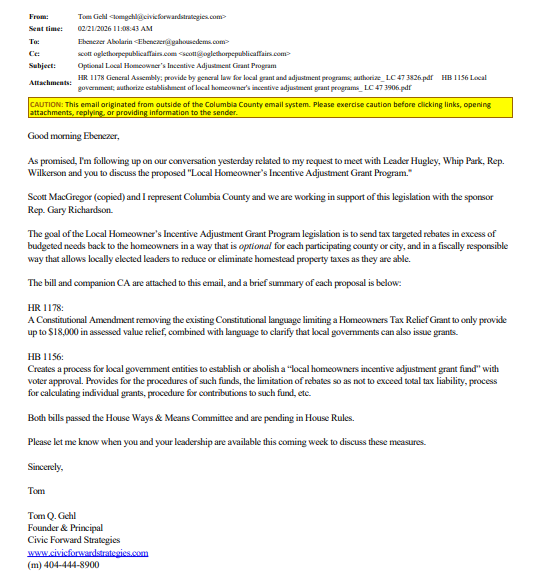
On Feb. 21, Gehl emailed Ebenezer Abolarin with the House Democratic Caucus seeking a meeting with House Minority Leader Carolyn Hugley, Minority Whip Sam Park and Rep. David Wilkerson.
“Scott MacGregor (copied) and I represent Columbia County and we are working in support of this legislation with the sponsor Rep. Gary Richardson,” Gehl wrote.
Gehl said the proposal could allow local governments to return revenue collected above their budget needs and “reduce or eliminate homestead property taxes as they are able.” He attached HB 1156 and HR 1178.
At the same time, Burns and other House Republican leaders were advancing a broader property-tax package through HR 1114 and HB 1116. The version of HR 1114 that reached the House floor proposed gradually reducing the assessed value of homesteaded property from 40% to 10% over 10 years. It also would have removed the same $18,000 constitutional limit Columbia County was seeking to eliminate, but as part of a much broader property-tax package.
The Burns package also proposed limiting year-to-year increases in property-tax collections from non-homestead property. The Georgia Municipal Association raised concerns about the proposal. On Feb. 12, Gehl forwarded GMA’s concerns about HR 1114 and HB 1116 to Johnson and MacGregor.
The records reviewed for this story do not show Columbia County instructing legislators to vote against HR 1114. They do show the county’s paid lobbyists advocating for a separate proposal while raising concerns about provisions of the Burns package..
One amendment reaches the floor
Columbia County’s HR 1178 advanced through the House Ways and Means Committee but never received a vote by the full House. The county’s preferred, narrower constitutional amendment therefore never came before the full House.
On March 2, Gehl told Johnson and MacGregor that the House Ways and Means Committee had passed new versions of HR 1114 and HB 1116.
“The Democrats voted ‘no’ on the legislation,” Gehl wrote.
The next day, HR 1114 received 99 votes in favor and 73 against on the House floor, short of the two-thirds majority required to send a constitutional amendment to voters. The House voted 97-68 on March 4 to reconsider the measure, but HR 1114 never returned for another floor vote.
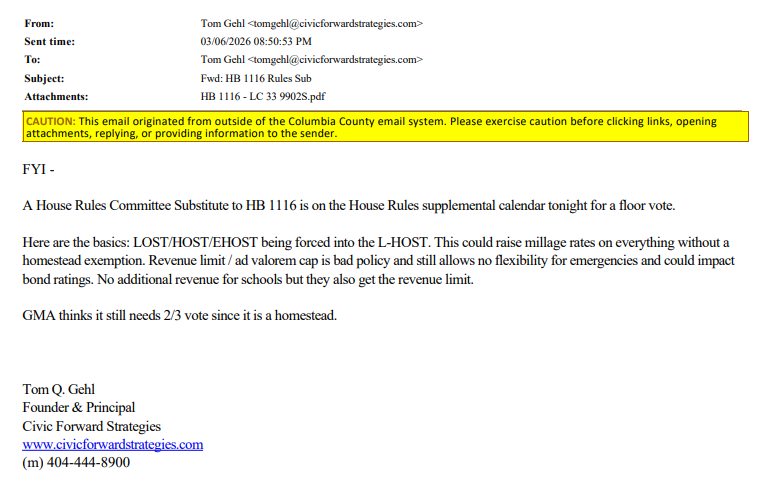
On March 6, Gehl criticized the revenue limit in HB 1116, HR 1114’s statutory companion.
“Revenue limit / ad valorem cap is bad policy and still allows no flexibility for emergencies and could impact bond ratings,” Gehl wrote.
He also warned that the proposal could result in higher millage rates on non-homestead property.
Columbia County’s original bills did not complete the legislative process. The homeowner grant language from HB 1156 was incorporated into HB 439 later in the session.
HB 439 passed both chambers and was signed into law. On the final House vote agreeing to the Senate substitute, 97 Republicans and two Democrats voted yes, while 64 Democrats voted no. The Senate approved the substitute 49-1, with all 32 Republicans and 17 Democrats voting in favor.
The law gave local governments a mechanism to create homeowner grants with voter approval, but it did not remove the constitutional $18,000 limit. Doing that still requires a constitutional amendment.
Democrats blamed
On June 24, Clifton pointed to Democratic votes when discussing the Legislature’s failure to send property-tax amendments to voters.
“Each time, Democrats voted against” the proposals, Clifton wrote in a Facebook post.
By August, Columbia County officials were discussing how to use HB 439 locally. Johnson said the county wanted to use its grant fund to eliminate the county portion of homeowners’ property-tax bills, but the $18,000 limit stood in the way.
“We’re relying on the folks in Atlanta to carry that water,” Johnson said Aug. 4.
Two weeks later, Duncan placed responsibility for the failed constitutional amendment on House Democrats.
“The Democrats in the state House blocked the constitutional amendment,” Duncan said Aug. 18. “Everything was set up and they wouldn’t let it go through because it took 60 votes so they had to participate.”
A proposed amendment to the Georgia Constitution requires approval by two-thirds of each legislative chamber. In the 180-member House, that requires 120 votes.
“We’d be done with all that if they wanted tax relief, property tax relief,” Duncan continued. “But they didn’t. That’s just the reality.”
The constitutional amendment Democrats voted against was part of Burns’ broader property-tax package and would have removed the $18,000 limit Columbia County wanted eliminated. Its companion bill, HB 1116, contained provisions that drew objections from Columbia County’s paid lobbyists. Columbia County’s narrower constitutional proposal never received a vote on the House floor.