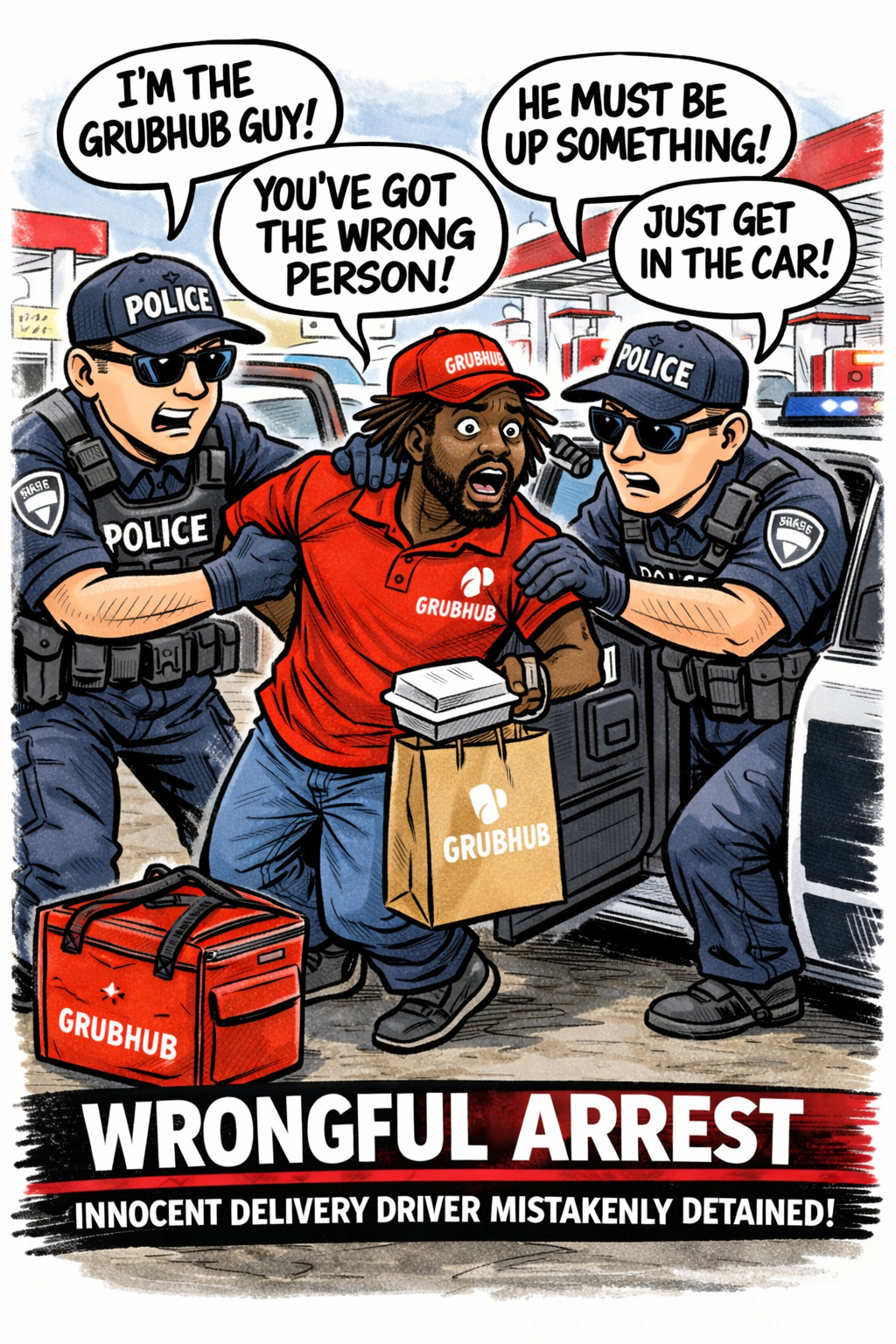
GROVETOWN, GA — A body camera video from a 2022 traffic stop is raising pointed questions about whether the Grovetown Police Department crossed the line from investigation into overreach — and whether an arrest followed not from criminal conduct, but from a citizen’s failure to submit quietly.
The footage, now circulating widely online, shows officers detaining a Grubhub delivery driver at a Walmart gas station on December 29, 2022. Police were investigating a reported hit-and-run involving a white vehicle with front-end damage. The driver’s car matched the general description.
Within minutes, officers had approached with guns drawn.
Suspicion Collapses — But the Arrest Doesn’t
The stated basis for the stop was twofold: the hit-and-run investigation and an alleged tag light violation. But in the video, an officer later acknowledges the critical point: the vehicle was not the hit-and-run suspect car.
That determination should have narrowed the scope of the encounter. Instead, the situation intensified.
Despite confirming the driver was not involved in the hit-and-run, officers proceeded with an arrest that included resisting charges. The man was later found not guilty, according to court outcomes cited in coverage of the case.
The central investigative question becomes unavoidable:
Once the suspected crime was ruled out, what justified putting him in jail?
From Criminal Suspicion to “Non-Compliance”
In the footage, officers describe the driver as “non-compliant.” He questioned commands. He appeared confused when approached at gunpoint. He disputed officers’ claims that he reached for his firearm. He protested what he described as an inappropriate pat-down.
At one point, an officer states that if he had “just let him check,” he would have been free to go.
That statement has become the focal point of the controversy. It reframes the outcome not around whether the man committed a crime, but around whether he behaved in a sufficiently compliant manner during a high-stress encounter.
Legal experts note that resisting arrest or obstruction charges can stem from conduct during a stop, even if the original suspicion proves unfounded. But critics argue that such statutes can become elastic — expanding to cover hesitation, confusion, or verbal objection.
The footage shows no contraband found. The firearm was reportedly legal. A background check indicated no felony record. Yet the arrest proceeded.
Escalation Under the Banner of Safety
Officers justified their actions as part of an investigative stop and officer safety protocol. The driver’s vehicle generally matched the description of the suspect car. Officers said he reached under his seat. In modern policing, such movements are treated as potentially life-threatening.
But critics question the proportionality of the response.
Was drawing firearms necessary before confirming identity?
Was a custodial arrest warranted after the hit-and-run link was eliminated?
Did the search continue beyond the scope of the original suspicion?
These are not rhetorical questions. They go to the heart of Fourth Amendment standards governing reasonable suspicion, probable cause, and the limits of police authority once suspicion dissipates.
Chief Responds to Backlash
As the video spread, Grovetown Police Chief Jamey Kitchens publicly responded to what local outlet The Augusta Press described as a surge of vulgar messages and legal threats directed at officers.
The chief defended the department and condemned harassment of law enforcement personnel. Supporters argue the officers acted within policy and emphasize that viral clips often lack full context.
But critics counter that the body camera footage itself is the context.
They also note that only one officer’s body camera footage has circulated publicly, raising transparency concerns about whether additional angles would clarify or complicate the department’s position.
A Larger Pattern?
The case touches on a broader issue increasingly debated nationwide: when investigative stops shift from inquiry to enforcement — and whether “attitude” can become a de facto trigger for arrest.
The video suggests a sequence in which:
- A vehicle generally matches a suspect description.
- Officers approach with force.
- The suspect vehicle is ruled out.
- The interaction escalates based on behavior during the stop.
- Arrest follows.
If accurate, that progression raises a deeper institutional question:
Should compliance determine liberty when criminal suspicion has already evaporated?
The Grovetown Police Department maintains its officers acted lawfully. The courts ultimately cleared the driver of the charges. But legality and necessity are not always the same standard.
As the footage continues to circulate, the case has become more than a local controversy. It is now part of a national conversation about discretion, escalation, and whether investigative authority sometimes stretches further than the facts allow.