By Garden City Gossip Investigative Desk
Original Reporting | Augusta, Georgia
Augusta, GA – By now, Augusta residents have heard that the Charter Review Committee has made “significant progress.” That’s the phrase used in the January 26 memo summarizing months of votes and revisions. On paper, it looks like reform. In practice, it may be something closer to recalibration.
The memo lays out what has been decided so far — and what kind of government Augusta is poised to adopt as a mayoral election approaches. The central takeaway is clear: the committee has rejected a strong-mayor system and reaffirmed a council-manager structure.
he city manager will be “the chief executive and administrative officer of the city.” The manager will appoint and remove department heads, direct departments, prepare the budget, and “see that all laws… are faithfully executed.” That is not ambiguous language. It is the backbone of a professional-manager model.
But here’s the question voters should be asking: is this a meaningful structural reform, or simply a clarification of what already exists?
For years, Augusta’s governance problems have been attributed not only to personalities but to blurred authority lines. The memo claims to fix that. Yet much of what it adopts codifies powers that already functionally reside in the manager.
Even the much-discussed change regarding hiring the manager is less dramatic than advertised. Under the new language, “The Mayor shall present up to three candidates for the Manager… with appointment of six or more Commission votes.” In other words, the mayor proposes, but the Commission disposes.
That may give the mayor influence. It does not give the mayor control.
The manager still serves at will and “may be summarily removed… by six or more Commission votes.” The mayor alone cannot remove the manager. The Commission remains the ultimate center of gravity.
If this is a power shift, it is a modest one.
Supporters of the rewrite argue that this structure promotes professionalism and stability. They point to the new internal audit framework — which establishes an independent Audit Oversight Committee and an Internal Auditor with authority to investigate fraud and report irregularities — as evidence of real reform. The ethics section is extensive, detailing conflict-of-interest rules, whistleblower protections, gift bans, and even an 11-member Board of Ethics.
Those provisions are serious on paper. The Internal Auditor will have “unrestricted access to employees, information and records.” Ethics violations can lead to forfeiture of office. A charter review will be required every seven years to prevent stagnation.
That all sounds impressive.
But Augusta has never lacked for written rules. The problem has often been enforcement and political will.
The memo itself hints at division. Several key structural votes passed 9–2 or 6–5. That is not consensus reform; that is negotiated compromise. And compromise language tends to preserve existing power balances rather than disrupt them.
The mayor will remain “the official spokesperson… and chief advocate of policy.” The Commission will continue to be “vested with all the powers of government of this city.” No abstentions will be allowed unless conflicts are disclosed — a change aimed at preventing political maneuvering through silence.
Yet none of this fundamentally changes the dynamic that has defined Augusta for two decades: power flowing through coalition-building on the Commission floor.
In practical terms, governance will still depend on whether six commissioners agree.
The other side of this argument deserves acknowledgment. Advocates say the rewrite modernizes Augusta’s charter, professionalizes administration, strengthens audit independence, codifies ethics enforcement, and prevents another 20-year period of drift. They argue that clear lines of authority and institutional guardrails matter — even if personalities change.
That is a fair case. Institutional design does matter.
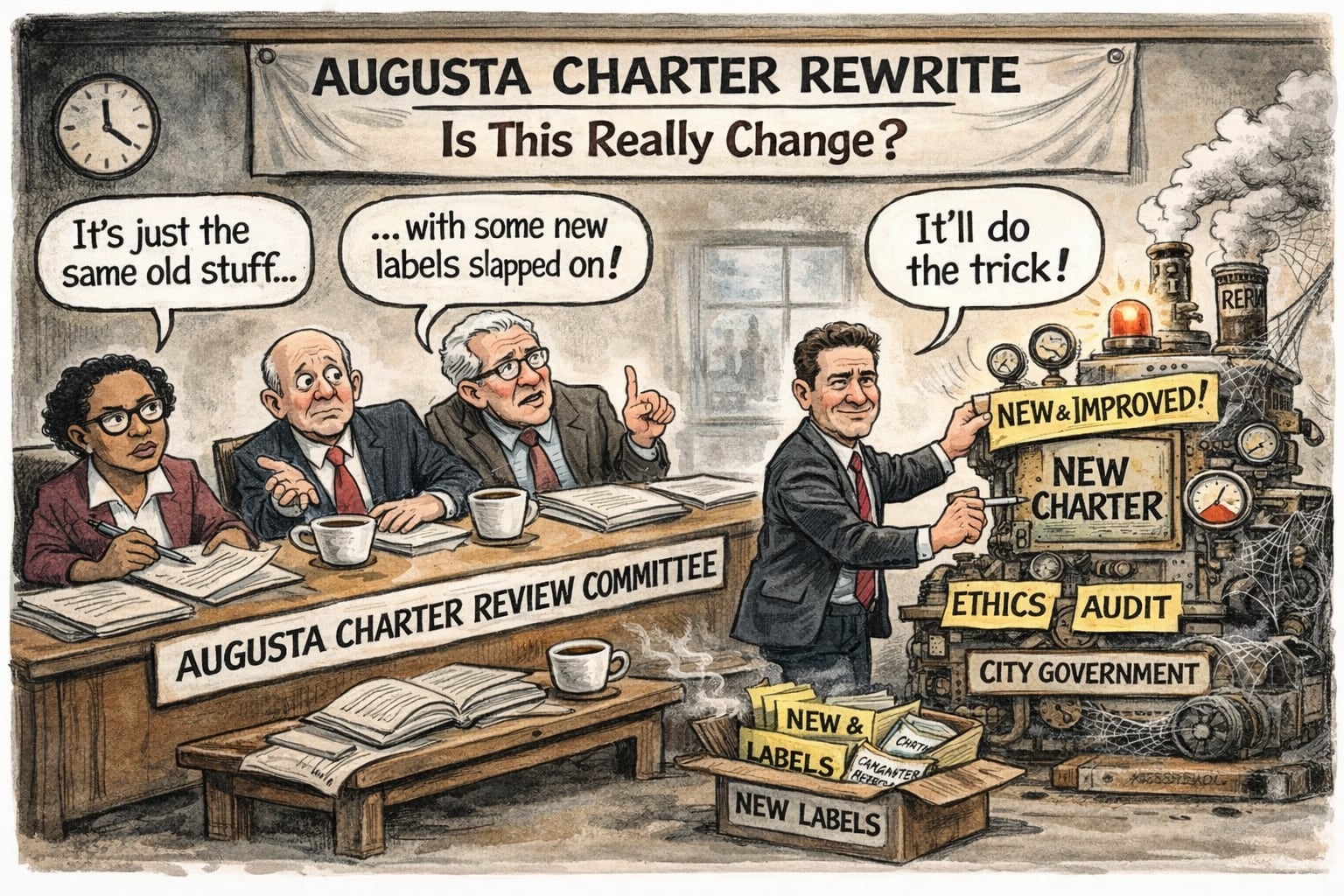
But institutional design also reflects political reality. What this memo reveals is not a revolution in Augusta’s governance — it is a refinement. The manager model survives. The Commission remains dominant. The mayor gains influence in selection but not executive command.
As a mayoral election approaches, candidates may campaign as if sweeping change is at hand. The charter, however, suggests something more incremental.
Augusta may be updating its operating manual. It is not redesigning the machine.
The real test will not be whether this language passes. It will be whether, under this framework, future leaders choose to govern differently than their predecessors.
Charters can clarify authority. They cannot manufacture courage, discipline, or cooperation.
And that has always been Augusta’s deeper challenge.
This is a follow up story, see our first story on the subject here: The Quiet Rewrite of Power: Inside Augusta’s Charter Review as a Mayoral Election Approaches
The Memo in Question: