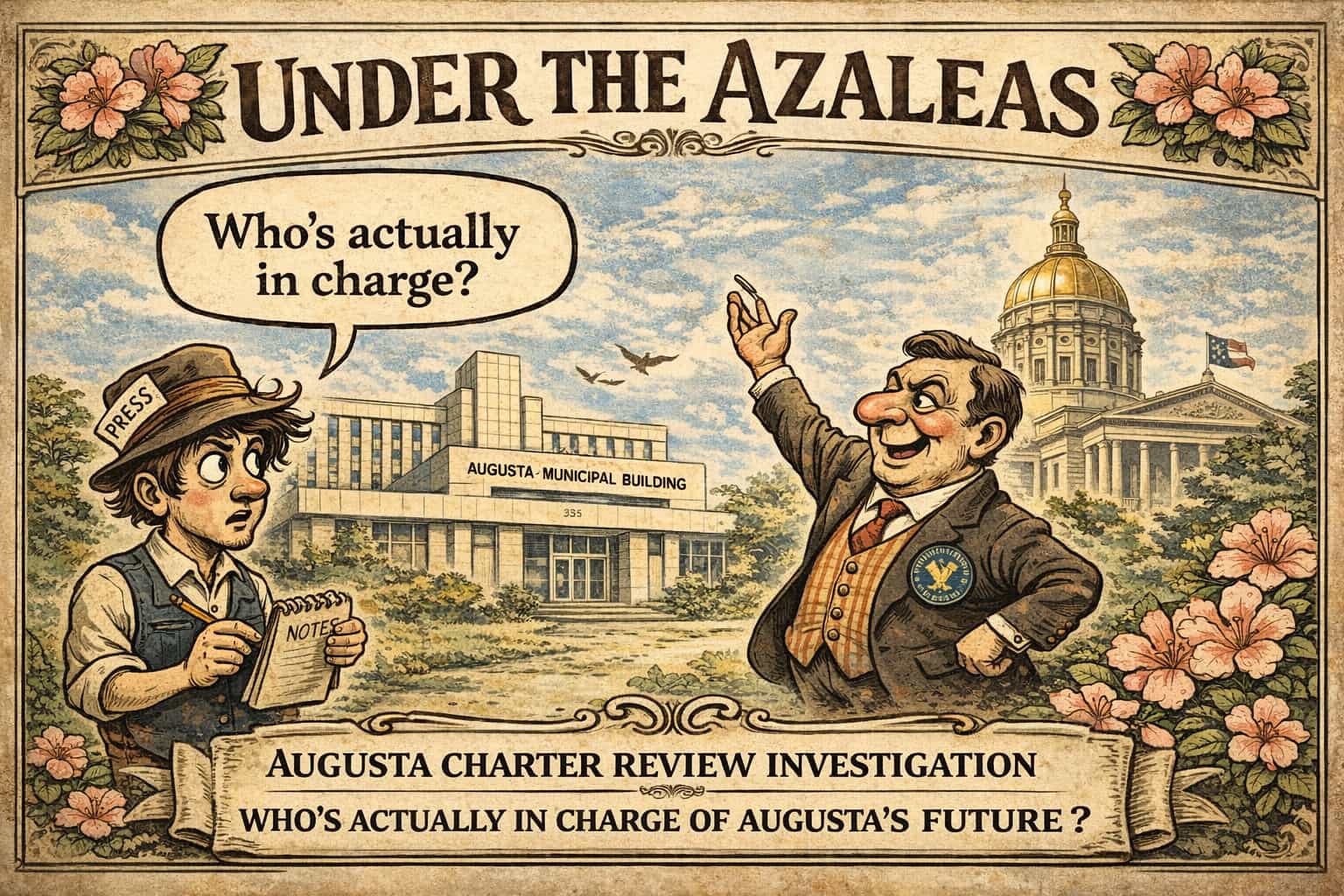
Notes from Inside Augusta’s Political Garden
Wait, wait, wait, I thought we were keeping politics out of this…
By Simone Raines
Augusta, GA – If the investigative piece establishes what happened, this is about understanding what it means—and why it should concern anyone paying close attention to how power actually operates in Augusta.
The Charter Review Committee was not created casually. It was, in many respects, a tacit admission by city leadership that the Augusta Commission lacked the credibility to rewrite its own governing framework without an intervening layer of independence. The committee’s purpose was not merely technical; it was institutional. It was meant to create distance between those who hold power and the process that defines it.
That distinction is essential, because once that distance collapses, the legitimacy of the process collapses with it.
And that is precisely what occurred.
Before the committee resolved the central structural questions—questions that go to the core of how authority is exercised—the process moved forward anyway. Legislative action began. The timeline hardened. And the independent body tasked with producing a coherent framework was effectively repositioned as a participant rather than the author of the outcome.
That is not a sequencing issue. It is a transfer of control.
If you have not yet read the full investigation documenting how that shift occurred, it is worth doing so before proceeding:
Augusta’s Charter Rewrite Was Supposed to Be Independent. It Wasn’t.
Because once the procedural shift is understood, the substantive implications become unavoidable.
The most persistent defense of the commission’s actions has been grounded in timing. The argument is straightforward: the legislative calendar imposed a constraint, and if Augusta wished to place a charter amendment before voters in 2026, it had to act within that window. That claim is not without merit. Legislative processes do operate on fixed schedules.
But timing explains only why action occurred when it did. It does not justify acting before the underlying work was complete.
By every credible account—including statements made during the March 10 meeting—the Charter Review Committee had reached agreement only on the broad concept of a manager form of government. It had not resolved the mechanisms that determine how that system functions in practice. The nomination process remained unsettled. Removal authority was unclear. The role of legal counsel was still under active debate.
Those are not ancillary issues. They are the structure itself.
Advancing legislation in the absence of those determinations does not accelerate reform; it displaces decision-making into a different arena, one that is less transparent and less directly accountable to the local process that was intended to produce the outcome.
This is where the rhetoric of “manager government” begins to obscure more than it reveals. The term suggests a defined model, a recognizable structure with established characteristics. In reality, it encompasses a spectrum of possible arrangements, ranging from genuinely independent administrative systems to hybrid forms in which political actors retain decisive influence through nomination, removal, and oversight mechanisms.
The distinction between those forms is not semantic. It is determinative.
During the committee process, this distinction surfaced most clearly in the debate over nomination authority. Allowing the mayor to control the pool of candidates for the manager position introduces a gatekeeping function that fundamentally alters the character of the system. A manager selected from a mayor-controlled shortlist is not independent in the way reform advocates typically describe. The position becomes, at least in part, an extension of executive influence, regardless of how it is formally structured.
This is not a theoretical concern. It is a structural reality.
And it leads directly to the central question that remains unresolved: where does power actually reside within the proposed system?
If the commission retains hiring and removal authority, then the system remains legislative in character. If the mayor influences nominations, executive power persists in a meaningful way. If the manager is insulated from removal, administrative authority may become dominant. Each configuration produces a different government.
At present, the proposed structure does not clearly resolve which of these outcomes is intended.
That ambiguity is not incidental. It is the consequence of moving forward before the work was complete.
Compounding this uncertainty is a factor that has received insufficient attention: the role of the Georgia General Assembly. Augusta does not possess unilateral authority to redefine its own charter. Any change must be enacted through state legislation, which means the final structure will be shaped not only by local actors but by the legislative delegation in Atlanta.
Once the process moved to that level before the committee had finalized its recommendations, the center of gravity shifted decisively. The charter ceased to be purely a local product. It became a hybrid of local input and state-level decision-making.
This raises an unavoidable question: whose design is ultimately being presented to voters?
The answer is no longer straightforward.
There is also a quieter but equally consequential shift embedded in the proposed changes—one that has been overshadowed by the focus on the manager system. The modification of language governing independent legal counsel, from mandatory to discretionary, represents a structural reallocation of authority. In legal drafting, such changes are rarely incidental. They determine whether oversight functions operate as constraints or as options.
Discretion, in this context, is not neutral. It is a form of control.
When combined with an unsettled administrative structure, the implications extend beyond the legal department. They affect how the entire system is interpreted and applied in practice.
Taken together, these elements point to a broader pattern—one that will be familiar to observers of Augusta politics. Processes that begin with an emphasis on independence and transparency gradually re-enter the sphere of political influence before reaching completion. The mechanisms may be more sophisticated in this instance, and the language more carefully calibrated, but the underlying dynamic is recognizable.
The difference is that this process concerns the foundational document of local governance.
By the time this proposal reaches the ballot, it will likely be framed in simplified terms. Voters will be asked whether they support a manager form of government. That framing, while not inaccurate, is incomplete. What they will actually be deciding is whether to endorse a structure whose most consequential features were not fully resolved within the process designed to produce them, and which may have been further shaped through state-level intervention.
That is a far more complex proposition.
The Charter Review Committee was intended to provide more than recommendations. It was intended to provide legitimacy—to ensure that whatever emerged from the process reflected thorough deliberation, clear structure, and independence from immediate political pressures.
Once that process was overtaken, the question is no longer simply what system Augusta will adopt.
It is whether the system, whatever its final form, will carry the institutional credibility that the process was meant to guarantee.
That is not a minor concern.
In governance, legitimacy is not an accessory to structure. It is a condition of its effectiveness.
And when the process that produces a governing framework is altered before it is complete, that legitimacy becomes harder to establish—and harder to sustain.
Prior GCG UTA Coverage:
🌺 UNDER THE AZALEAS 🌺 – The Curious Urgency of Augusta’s 2026 Charter Vote
🌺 UNDER THE AZALEAS 🌺 – New Columnist! – Alvin Mason Running Again?