

Richmond County gave Democratic congressional candidate Ceretta Smith a margin of more than 30,000 votes Tuesday. Across the full 12th District, Republican Rick Allen still prevailed. In neighboring Columbia County, voters backed Republican Alison Couch for commission chair while one commission district gave Democrat Samantha Rockwood a narrow lead.
Those outcomes belong to the same election. They resist the idea that a national wave tells us everything important about who will govern Augusta and its neighbors.
The Democratic victories in Washington and statewide races are part of the local story. So are the county lines, district boundaries and individual contests that interrupt it. Richmond and Columbia produced different answers even before voters reached the nonpartisan school-board races, where incumbents survived, a challenger held a 61-vote advantage and one district faced another trip to the polls.
The useful question now is what those separate decisions will change. A congressional seat, a county chairmanship and a place on a school board carry different powers. Combining them into a single verdict obscures the officials residents will need to hold accountable.
This analysis uses the Georgia secretary of state’s Richmond County and Columbia County returns checked on the morning of Nov. 6. Both were marked unofficial, with election-night precinct reporting complete. Richmond’s election board had scheduled certification proceedings for 3 p.m. Friday. A complete election-night display is not the same thing as a certified result.
Two counties, different margins
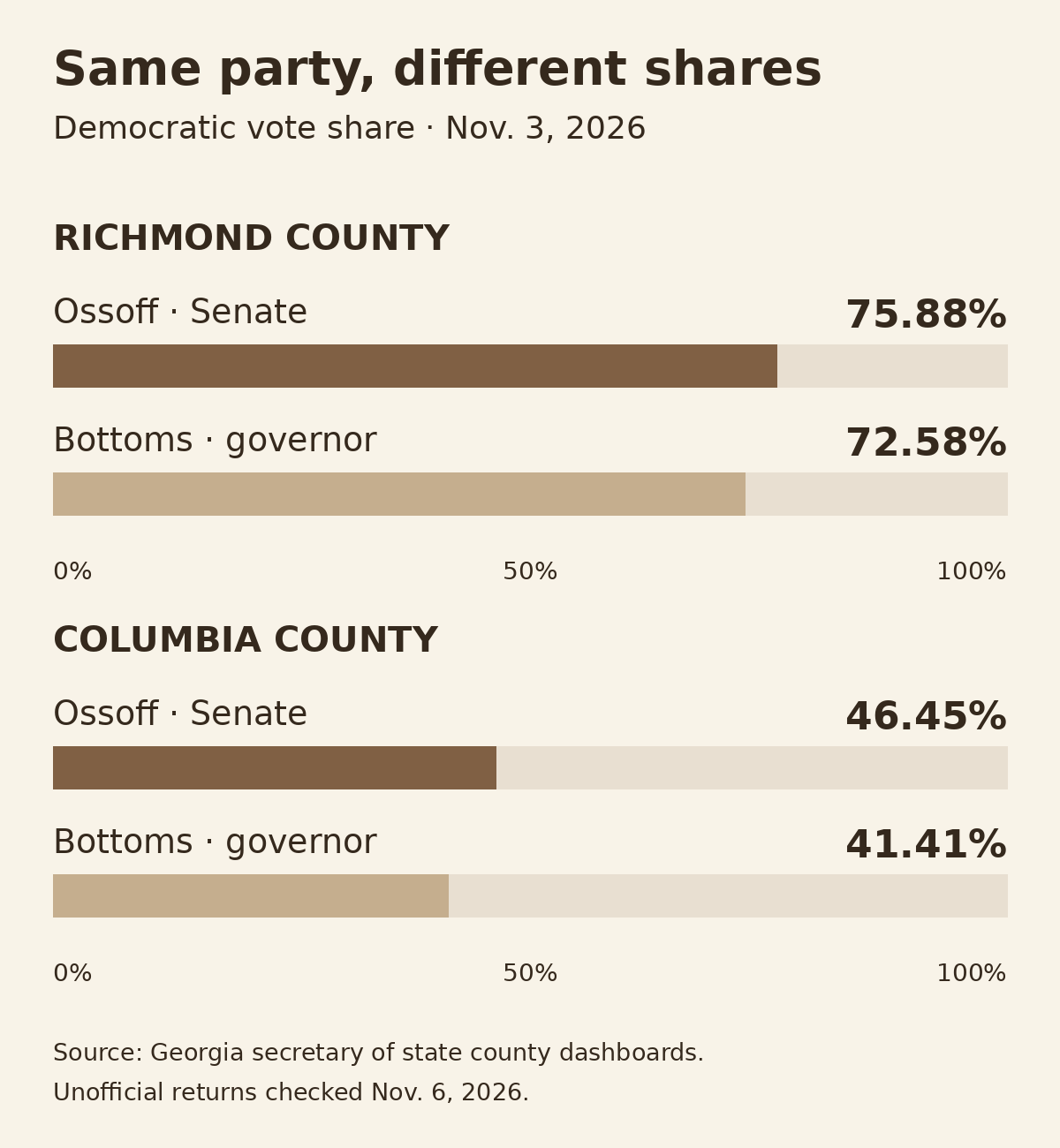
The contrast begins at the top of the ballot. Democratic Sen. Jon Ossoff received 75.88 percent in Richmond County and 46.45 percent in Columbia County. Democratic gubernatorial nominee Keisha Lance Bottoms received 72.58 percent in Richmond and 41.41 percent in Columbia.
Republicans therefore retained the advantage in those two Columbia County contests even as Democrats dominated Richmond. But the comparison within each county matters, too. Ossoff ran 3.30 percentage points ahead of Bottoms in Richmond and 5.04 points ahead in Columbia.
That does not tell us precisely which voters crossed party lines or why. The contests had different candidates and different totals of votes cast. County-level results cannot reveal an individual ballot. What they do show is that a party label did not produce one uniform percentage, even among voters choosing candidates on the same day.
The distinction is particularly useful in Columbia County. A Republican majority in a statewide contest does not mean every Republican candidate had the same cushion. Nor does a competitive Democratic performance in one race establish that the county as a whole changed parties.
GCG’s turnout analysis examined who participated across the two counties. The returns here answer a narrower question: how the votes recorded in particular contests were distributed. Turnout, candidate support and the number of seats a party wins are related measures, but they are not interchangeable.
For candidates planning the next election, these gaps are evidence worth examining. For readers assessing this one, they are a reason to keep the race name attached to the percentage.
Augusta’s vote is not the whole congressional district
The congressional race makes the geography especially clear. Smith received 48,428 votes in Richmond County to Allen’s 18,044, a Democratic margin of 30,384. In Columbia County, Allen led 38,813 to 28,643, a Republican margin of 10,170.
Together, those two counties gave Smith a substantial advantage. The congressional district includes considerably more territory.
Decision Desk HQ’s districtwide count, updated Thursday afternoon, put Allen at 140,843 votes, or 52.10 percent, and Smith at 129,500, or 47.90 percent. The service called the race for Allen on election night. Its displayed margin was 11,343 votes, with more than 95 percent of the estimated vote counted. That is a race call and a reported count, not a claim of final certification.
The difference between Richmond’s result and the district’s result is not a contradiction. Voters outside the two counties supplied the rest of the districtwide electorate. A candidate can carry Augusta decisively and lose the seat that includes it.
The political consequence is also more complicated than a red or blue map suggests. Allen will represent a district with a large Augusta constituency that voted against him. At the same time, the Republican congressman is set to serve in a House whose majority will be Democratic, according to the Associated Press’s national calls. Local representation and control of the chamber will point in different partisan directions.
That makes the substance of congressional work worth following closely: the legislation Allen supports, the administration decisions he defends or questions, and the constituent needs his office takes up. Neither Richmond’s Democratic margin nor Allen’s districtwide victory settles those choices in advance.
The same boundary problem appears farther down the ballot. In the Columbia County portion of state Senate District 23, Democrat Shayna Boston led Republican Max Burns, 12,073 to 10,932. In Richmond’s portion, Burns led 2,597 to 2,525. Neither county subtotal determines the whole district. WJCL reported Burns won District 23.
A county results page can be perfectly accurate and still be the wrong place to read a districtwide winner. Before interpreting a legislative result as a local political shift, readers need to know whether the displayed numbers cover the entire seat.
Columbia County divided its local choices
The Columbia County commission results put a more immediate set of governing responsibilities into view.
Couch led the countywide chair race with 36,643 votes, or 54.72 percent, against Democrat Cambrey Wood’s 30,322, or 45.28 percent. In District 1, Republican Alex Griffin led Democrat Michael A. Jordan, 11,414 to 6,624.
District 4 supplied the different result. Rockwood led Republican Al Reeves, 7,731 to 7,387, a margin of 344 votes. Her share was 51.14 percent. Columbia’s unofficial dashboard still marked provisional ballots as not reported when checked Friday morning, so the narrow lead should be described with that qualification.
It would be easy to call this a divided mandate and then skip the important detail: these were different electorates. Every eligible county voter could participate in the chair race; only District 4 voters could choose that district’s commissioner. The results show a countywide Republican advantage alongside a competitive district-level Democratic performance. They do not establish how the same individual voters split their tickets.
The chairmanship is also a different job from a district seat. Columbia County’s description of the office says the countywide chair conducts commission meetings, prepares and presents the agenda and appoints commissioners to standing committees. Those responsibilities help shape how public business reaches the board, although the chair does not acquire unilateral control over every county decision.
Couch is already the county’s District 4 commissioner and vice chair. Her move toward the chairmanship therefore represents continuity in governing experience alongside a change in position. The current county roster identifies Doug Duncan as chair for the term ending in 2026. Election-night returns should not be mistaken for an immediate transfer of the office.
For residents concerned about development, infrastructure or county spending, the practical follow-through will be in agendas, committee assignments and recorded votes. A campaign victory supplies the authority to participate in those decisions. The decisions themselves will show what the result means.
The county’s regular commission schedule provides a place to follow them: first and third Tuesdays at 6 p.m., with standing committees generally meeting on second and fourth Tuesdays at 8:30 a.m. Residents should check the county’s current meeting notices for changes and specific agendas.
A tax-relief vote with limits
The local homeowner incentive referendum passed by an overwhelming margin. The unofficial count showed 56,679 votes in favor and 8,314 opposed, or 87.21 percent support.
The official sample ballot asked about a local homeowner incentive adjustment program under House Bill 439 to reduce the property-tax burden on qualifying homesteads. Support extended well beyond the share received by either party’s countywide candidates.
That makes the referendum a strong instruction to pursue the program voters were asked to authorize. It does not answer every question about the eventual benefit. The ballot did not promise every household an identical dollar reduction, and the vote total alone cannot supply a future credit amount.
It is also a narrow question about a stated tax-relief mechanism. It should not be converted into blanket approval of every development proposal or every way county officials might seek additional revenue. Those choices require their own public record.
For homeowners, the next useful information will be administrative and financial: who qualifies, what steps are required, how the adjustment is calculated and when it appears. A large electoral margin cannot substitute for those details.
Richmond’s school-board results tell a different story
Richmond County’s partisan margins were large. Its nonpartisan school-board contests were far less uniform.
Incumbent Charlie Hannah led District 2 with 3,233 votes, or 57.48 percent. Incumbent Venus Cain led the four-candidate District 9 race with 16,172 votes, or 57.87 percent. Those results do not support a simple account of voters rejecting everyone already on the board.
District 6 was much closer. Charles Williams held 3,595 votes to incumbent Edward “Ed” Lowery’s 3,534. The difference was 61 votes, about 0.86 percentage points of the votes cast in that contest. WRDW reported Williams as the winner on Wednesday. The official dashboard used for this analysis still identified its figures as unofficial Friday morning.
That distinction does not erase the reported outcome. It preserves the status of the count, particularly in a race where a small number of votes separates the candidates. Lisa Martin, meanwhile, appeared as the sole listed candidate in District 7 and received 6,982 votes.
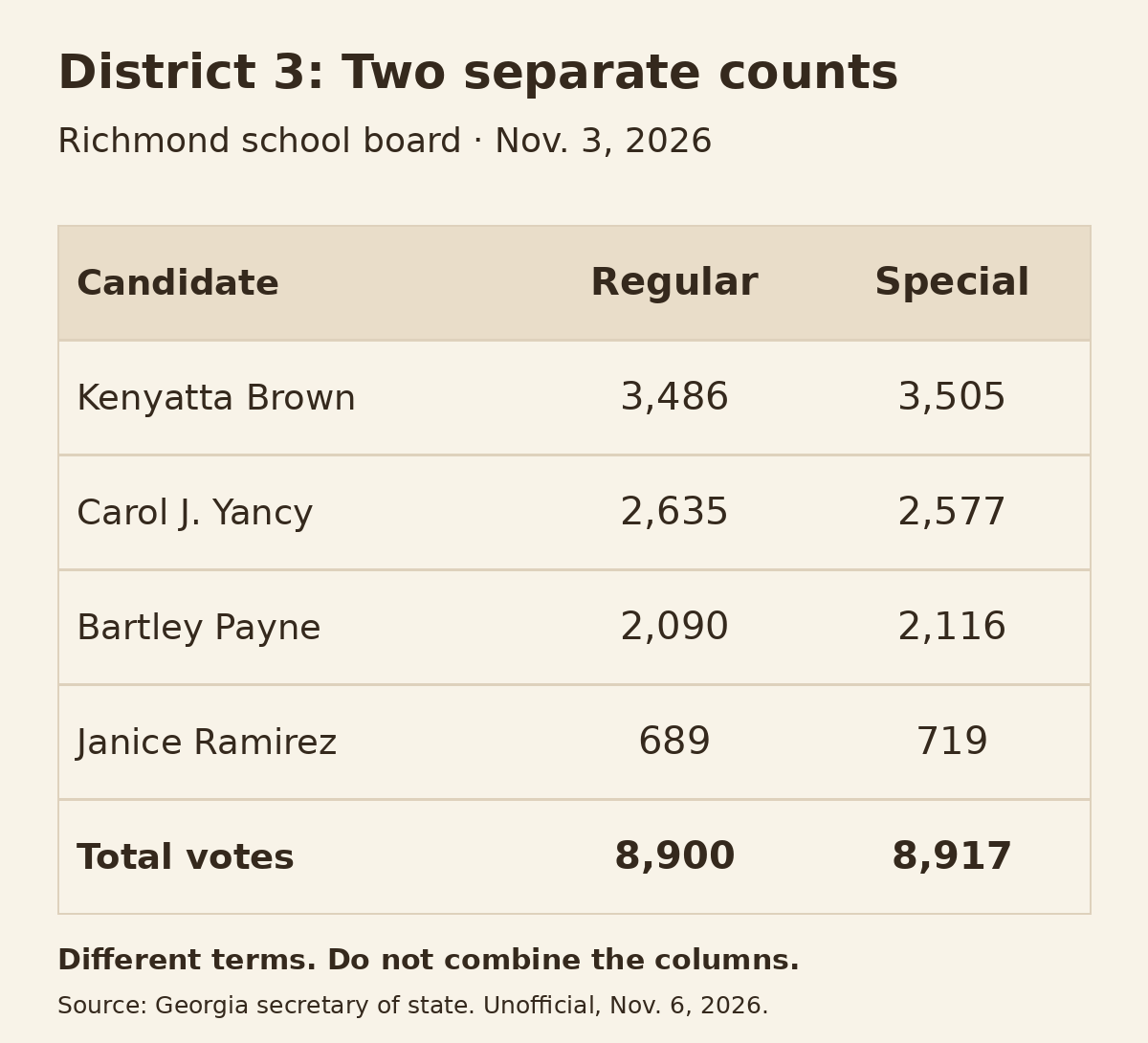
District 3 requires special care because voters encountered two contests: the regular election and a special election for an unexpired term. The official Richmond sample ballot lists them separately. Their totals should remain separate in any account of the result.
In the regular election, Kenyatta Brown had 3,486 votes and Carol Yancy 2,635. In the special election, Brown had 3,505 and Yancy 2,577. Both contests also included Bartley Payne and Janice Ramirez. Brown led each, but remained below 40 percent in each. Adding the two contests together would count separate choices for different terms as though they were one election.
WRDW reported that Brown and Yancy will face a Dec. 1 runoff, with advance voting planned for Nov. 23–25. Its Wednesday report said the advance-voting location would be finalized Friday. Voters should use the Board of Elections’ subsequent notice for the confirmed location and hours, and My Voter Page to check their own voting information.
The governing test extends beyond the runoff. Richmond’s board norms put day-to-day operations with the superintendent and say individual board members should not direct staff or act as administrators. The same document commits the board to reviewing the district’s strategic plan twice a year.
Those rules give residents a concrete way to assess promises of change. Members can be judged on the questions they raise, the decisions the board makes and the progress it measures. A new member cannot personally run every school, and a returning member’s reelection does not establish that every existing practice is working.
The next dates matter, too
The immediate unfinished business is certification and the runoff. Augusta’s Oct. 30 meeting notice schedules the regular, precertification and certification meetings beginning at 3 p.m. Nov. 6 at the Board of Elections warehouse, 2029 Lumpkin Road. That is the announced meeting site; it should not be assumed to be the runoff voting location.
After the counts are certified, the governing questions will continue. Columbia County will need to turn its homeowner referendum into an understandable program. Its incoming commission members will have to make choices about the county’s business. Richmond’s school board will have to turn competing campaign claims into collective decisions. The region’s congressional representation will operate within a changed national majority.
Tuesday produced a powerful national result and several distinct local ones. Following all of them means keeping the right electorate, institution and deadline in view. The next meaningful verdict will come from what the winners do with the offices they sought.