
Garden City Gossip requested the Cherry Bekaert audit in January. The city refused. Weeks later, multiple outlets reported the document’s findings before the report was finally released.
When public records are withheld from formal requests but circulate elsewhere, transparency starts to look optional.
by Publisher
Augusta, GA – Garden City Gossip asked Augusta for a public record. The city said no.
Weeks later, after a lawsuit was filed to force the document’s release, other news outlets began publishing the report’s findings — while the publication that had requested it under Georgia’s Open Records Act still did not have it.
By the time the document finally arrived, the story was already gone.
Whether by design or by coincidence, the sequence accomplished something powerful: it neutralized the one outlet that had pushed the hardest to obtain the report in the first place.
That outcome — denying a records request, delaying access while litigation moves forward, and then allowing the document to surface elsewhere — raises an uncomfortable question about how Augusta’s government handles journalists who insist on using the state’s transparency laws.
Georgia’s Open Records Act is supposed to guarantee equal access to public information.
But if the reward for filing a lawful request and pursuing it in court is to receive the document only after everyone else has already published it, the law begins to look less like a right and more like a warning.
When Garden City Gossip filed a Georgia Open Records Act request for Augusta’s Housing and Community Development audit in January, the goal was simple: obtain a public document about the management of millions of dollars in federal housing funds.
Instead, the request triggered a sequence of events that raises troubling questions about how the city treats journalists who press too hard for public records.
The audit was denied.
A lawsuit was filed to compel its release.
Service of the lawsuit stalled for weeks in a bureaucratic limbo.
And by the time the document was finally released to the publication that requested it, multiple other news outlets had already published its findings.
Whether intentional or not, the effect was unmistakable: the organization that pursued the document through the legal process lost the story.
A Timeline That Raises Questions
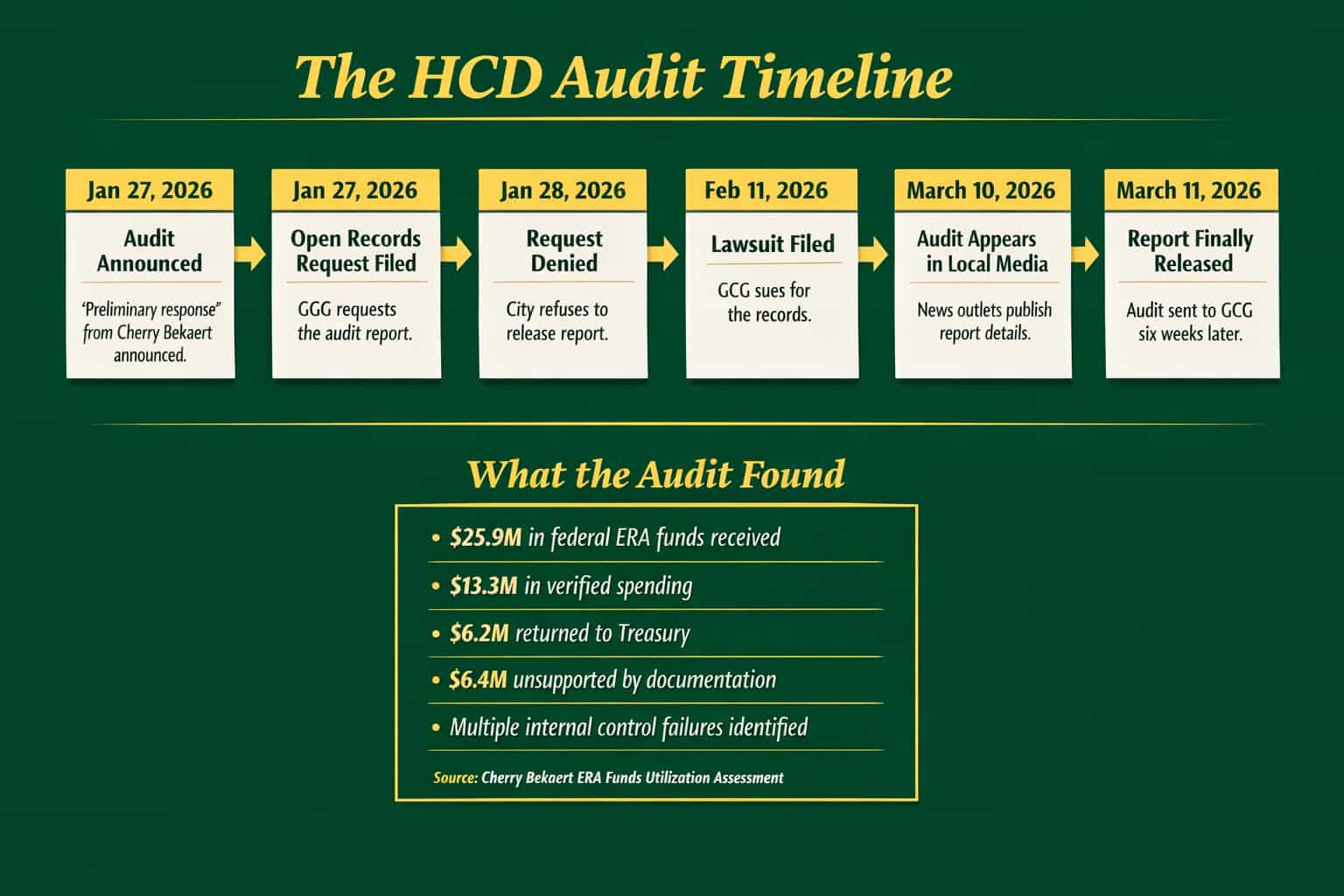
City retaliates in face of Open Records act
Jan. 27, 2026 — Audit Announced
Augusta officials announced they had received what they described as a “preliminary response” from Cherry Bekaert regarding the Housing and Community Development department’s handling of federal Emergency Rental Assistance funds.
Officials said the city needed additional clarification before moving forward.
Source:
https://www.augustaga.gov/CivicAlerts.aspx?AID=3936
That same day, Garden City Gossip submitted a Georgia Open Records Act request seeking the Cherry Bekaert document and related communications.
Jan. 28, 2026 — Request Denied
The city denied the request the following day, citing statutory exemptions.
No timeline for release was provided.
Feb. 11, 2026 — Lawsuit Filed
After the city refused to produce the records, Garden City Gossip filed a lawsuit in Richmond County Superior Court seeking the document under Georgia’s Open Records Act.
February–March — The Case Stalls
Before the case could move forward, the city had to be formally served with the lawsuit.
That process took weeks.
During that time, Garden City Gossip was told by the clerk’s office that the Richmond County Sheriff’s Office was responsible for the delay. The sheriff’s office, in turn, indicated the issue originated with the clerk’s office.
The mayor’s office — where service ultimately occurred — is located only a short distance from the sheriff’s headquarters.
After weeks passed without service being completed, a private process server was hired to ensure delivery.
March 4 — City Finally Served
The lawsuit was finally served at the mayor’s office.
March 10 — The Story Appears Elsewhere
Before Garden City Gossip ever received the document it had requested under the Open Records Act, other outlets began publishing stories based on the report’s findings.
WRDW reported that auditors found widespread financial control failures inside the Housing and Community Development department and that roughly $6.4 million in spending could not be supported through available documentation.
WJBF also reported on the audit and calls by commissioners for additional investigation.
Another local publication published a detailed story the following day describing the same document and its findings. T
o be clear, GCG does not fault any of these organizations for running with a news story they had. If they are wise, they will be more disturbed by this than I am, as they stand to lose significant investments if they’re investigative stories are going to get agressively handled like this.
Augusta seems to have viewed the release of the Epstein files as a model they should follow: do everything possible to obfuscate the truth and if you ever do have to give it out, do it in such a petulant manner that it damages the news organanization legitimately seeking it.
This sort of bad faith towards the press may not be against the law, but it certainly won’t do anything to allay Augustan’s concerns that their local government is lying to them constantly.
March 11 — The Document Finally Arrives
Nearly six weeks after the original request — and after multiple outlets had already reported its contents — the document itself was finally sent to Garden City Gossip.
The report was titled “ERA Funds Utilization Assessment.”
What the Cherry Bekaert HCD Audit Found
The 17-page assessment examines the city’s management of approximately $25.9 million in Emergency Rental Assistance funds distributed between 2021 and 2025.
The auditors concluded:
-
$13.3 million in spending could be supported with documentation
-
$6.2 million was returned to the federal government
-
about $6.4 million in spending could not be supported through available records
The report also identifies numerous systemic weaknesses, including:
-
pooled federal and local funds
-
inconsistent financial coding
-
unsupported journal entries
-
delayed reconciliations
-
missing documentation
-
weak internal financial controls
Auditors concluded the department’s financial systems lacked the structure necessary to demonstrate compliance at the transaction level.
“Preliminary”?
The city’s justification for withholding the document in January was that it was only a “preliminary response.”
Yet the report that was ultimately released contains:
-
a full executive summary
-
detailed testing procedures
-
financial reconciliation work
-
specific findings
-
and nine separate recommendations for structural reforms
Those recommendations include implementing unified financial reporting, strengthening internal controls, and separating federal funds from other program accounts.
Whatever officials called it at the time, the document itself reads like a completed professional assessment.
A Message to Anyone Who Pushes Too Hard
The motto of the Washington Post became “Democracy Dies in Darkness,” soon after Trump was elected the first time, but by the time he was elected a second time, apparently Jeff Bezos decided that journalism’s ability to probe the government for truth wasn’t so important anymore, so now we get “Riveting Storytelling for All of America.” It would be funny if it were not so sad.
Whether the sequence of events was intentional or not, the outcome sends a clear signal to anyone seeking public records from Augusta’s government.
The dispute over the audit report may be finished.
What it revealed about Augusta’s approach to public records is not.
The city denied the document, delayed its release while litigation moved forward, and allowed the report’s findings to circulate elsewhere before the requester ever saw it.
If that becomes the playbook, the Open Records Act stops functioning as a transparency law.
It becomes a waiting game.
And the people who insist on using it are the ones who lose the story.
Prior Reporting by GCG:
Garden City Gossip Files Open Records Lawsuit Seeking HCD Audit Records From Augusta