

The human-trafficking story in Augusta does not begin with a stranger in a parking lot or a rumor about a crowded week in town. One place to begin is the public record: a state investigation that reached Richmond and McDuffie counties, and a specialized prosecution team now based in Augusta.
In August, Georgia’s attorney general announced three indictments charging eight people in Richmond, McDuffie and Bibb counties in an alleged scheme involving the commercial sexual exploitation of a minor. Those are accusations, not convictions. But the investigation provides a concrete local starting point for a subject too often discussed through frightening generalities. Georgia attorney general’s August 20 announcement.
The larger picture includes more than sex trafficking. Federal cases elsewhere in Georgia have documented coercive agricultural work, unlawful recruitment fees and control of workers’ identification documents. Across the Savannah River, South Carolina has assembled a statewide healthcare guide that asks a different question: when someone experiencing exploitation reaches a clinic, what happens next?
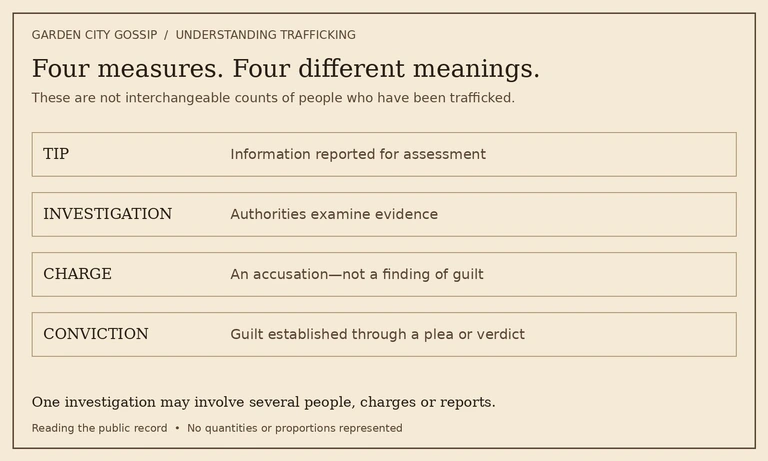
These are connected stories about control, money, institutions and the practical ability to get help. They are also stories in which the distinctions matter. A tip is not a verified victim count. A charge is not a finding of guilt. A legal victory that allows a lawsuit to proceed is not a damages judgment.
Garden City Gossip is introducing Trafficking Watch and TVPRA Review, public-information projects created by GCG and published under Saturn Strategy LLC, to give these issues sustained attention. One focuses on news, awareness, prevention and routes to support. The other examines civil litigation and the reach—and limits—of legal accountability. Neither is a law firm, a client-intake service or an emergency response organization.
A local case, not a local head count
The August announcement describes an investigation led by the GBI’s Thomson regional office and the attorney general’s human-trafficking and gang units. Prosecutors allege an enterprise that advertised and transported a minor for commercial sex and benefited from it.
That establishes what the state alleged and when it announced the charges. It does not establish that every allegation has been proved, how many other people in the region are being exploited, or whether trafficking is increasing locally. GCG is not identifying the minor or repeating details unnecessary to understanding the case. The defendants retain the presumption of innocence. Read the state’s account and charging distinctions.
There is a separate, verifiable institutional development. In April 2025, the attorney general announced an Augusta expansion consisting of a prosecutor and two investigators, with regional work beginning May 1. The expansion gives the region a dedicated prosecution and investigative presence; the public record must still establish what individual cases prove. Augusta expansion.
More investigative capacity can improve the response to exploitation. It also changes how much activity authorities can detect. That is one reason a rise in reported cases cannot, by itself, explain whether the underlying crime has increased, reporting has improved, or both.
The central issue is control—not transportation
The word “trafficking” can suggest people being moved across a border. The legal concept is different. The Department of Homeland Security’s public guidance explains that trafficking centers on exploitation and does not require transportation. Someone can be trafficked without ever leaving their hometown. Movement may be part of a case, but it is not the defining feature. DHS human-trafficking response guide.
For adult commercial sex, force, fraud or coercion separates trafficking from consensual commercial sex. Commercial sexual exploitation of a person under 18 does not require proof of those means under federal trafficking law. This distinction does not make all other commercial sex legal; it explains why prostitution and trafficking are not interchangeable descriptions. Human smuggling, meanwhile, concerns unlawful border movement and can occur without trafficking, although a person who is smuggled can later be exploited. FBI explanation of the distinctions.
Labor trafficking belongs in the same conversation. Georgia’s official overview describes work or services obtained through coercion or deception, including situations involving debt bondage or involuntary servitude. The absence of a sexual component does not make compelled labor a lesser category of concern. Nor does a worker’s age remove the need to establish coercive means in a labor-trafficking case. Georgia’s trafficking overview.
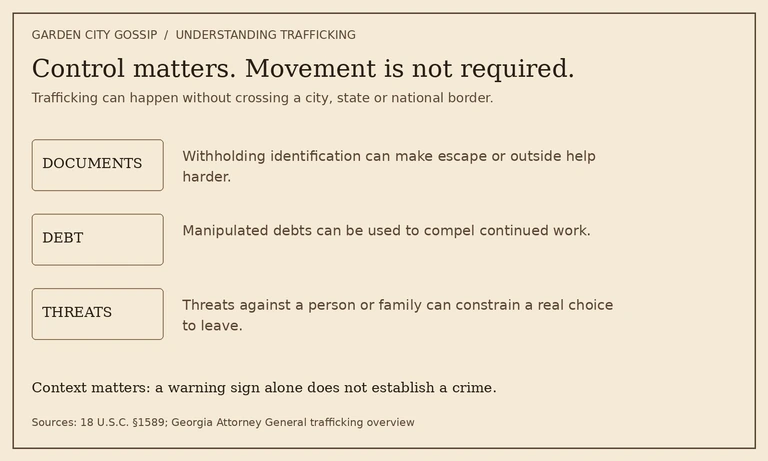
Federal forced-labor law makes that point explicit. Section 1589 addresses force, serious harm, abuse of legal process and schemes that make a person believe that refusing to work will bring serious harm. Its definition includes psychological, financial and reputational harm, judged in the circumstances of a person with the victim’s background. A threat can therefore matter without a locked door or visible injury. That does not turn every bad job or wage dispute into trafficking; the statutory requirements still must be established. 18 U.S.C. § 1589.
For a community trying to understand the problem, the useful question is not simply whether someone appears able to walk away. It is what consequences have been threatened, who controls the money or documents, and whether an apparent choice is being maintained through coercion.
Georgia’s farm-labor cases widen the lens
Operation Blooming Onion offers a regional example, not an Augusta prevalence estimate. In June 2026, federal prosecutors in the Southern District of Georgia announced sentences for three defendants who had pleaded guilty to conspiracy to commit money laundering in the larger investigation of exploitation on South Georgia farms.
The distinction in the convictions matters. The announcement placed those financial crimes within an operation involving fraudulent use of the H-2A agricultural visa program, unlawful fees, withheld documents and threats against workers. It reported prison terms of 51, 40 and 10 months, and said the proceedings against the original 24 defendants had concluded. Those facts do not mean that every defendant was convicted of the same trafficking offense. DOJ’s June 12 sentencing announcement.
The case also shows why immigration status and the existence of a visa do not answer the exploitation question. A formally organized labor arrangement can still be used coercively. Following the money, recruitment practices and restrictions imposed on workers can reveal a different story from the one suggested by the paperwork alone.
That is a reason to include labor cases in local readers’ understanding of trafficking—not a basis for labeling Augusta employers, farms or industries without evidence. Regional context should widen the lens without erasing geography or making unsupported accusations.
What the numbers can—and cannot—tell us
South Carolina’s attorney general reported that the state Law Enforcement Division investigated 315 human-trafficking tips in 2025, involving more than 300 potential victims. The state’s January 2026 announcement said investigations reached 41 counties. It also explained that National Human Trafficking Hotline data were omitted that year because of an operator transition. These are descriptions of reporting and agency activity, not a census of everyone trafficked in South Carolina. South Carolina’s 2025 report announcement.
A person may be counted differently by a hotline, a police agency and a service provider. An investigation can involve several people; several contacts can concern the same situation. A low recorded total can reflect a lack of detection as well as a low level of crime. Without a common definition, time period and counting method, putting figures beside one another can produce a misleading comparison.
The South Carolina task force itself cautions that prevalence data remain scarce. Its reports are useful for understanding the response and identifying questions, but they do not justify a confident Augusta-area “hotspot” ranking. The records reviewed for this feature also do not establish a trafficking spike tied to the Masters or any other local event. Repeating such a claim without evidence would substitute a familiar story for reporting. South Carolina data and reports.
A more useful public record would explain what agencies count, which cases resulted in charges, what happened in court and what support was actually accessible. Those are questions that can be followed over time without pretending a single dramatic number answers them all.
Recognition is only the first step
The FBI warns that trafficking indicators are not a checklist or a formula: no single sign proves trafficking, and no particular number of signs settles the question. Its guidance includes restrictions on identification documents and earnings, monitoring, threatening debts and limits on movement or communication. Context matters. A person’s clothing, accent, job or neighborhood is not a diagnosis. FBI trafficking-indicator guidance.
That approach is especially important in healthcare. South Carolina’s June 15, 2026, best-practices guide, developed with HEAL Trafficking, emphasizes privacy, patient choice and connections to continuing care. It recommends private conversations where possible, clear explanations of confidentiality limits, and coordinated referrals rather than treating a clinical encounter as a criminal interrogation. It also calls for attention to local availability and after-hours services. Read the healthcare guide.
The practical difference is substantial. Recognizing a concern does not establish that there is an available shelter bed, an accessible appointment, a safe ride or a service the person wants to use. A referral is a beginning, not proof that help was received. For Augusta and Aiken institutions, the next reporting questions are concrete: who has adopted a response protocol, who is available after hours, and how are patients connected to the next provider?
GCG’s report on the South Carolina healthcare guide examines that gap between publishing guidance and putting it into practice. The guide is not evidence that every local hospital or clinic has implemented its recommendations.
On the South Carolina side, the state’s annual report also describes a Second Judicial Circuit regional task force involving Aiken and Barnwell. Its reported activities include quarterly meetings and work on public awareness and professional training. That is evidence of an organized response, not a guarantee of services in every individual situation. 2025 annual report, regional task-force section.
Accountability does not end with the criminal case
Criminal prosecution asks whether the government can prove an offense. Civil litigation can raise an additional question: whether a perpetrator or a qualifying beneficiary owes damages to someone harmed by trafficking.
The federal civil-remedy provision, Section 1595, permits victims to sue perpetrators and certain people or entities that knowingly benefit, or attempt or conspire to benefit, from participation in a venture they knew or should have known engaged in a trafficking violation. It provides for damages and reasonable attorney’s fees. It also includes limits, including a stay during related criminal proceedings. It is not a rule that every business receiving money somewhere in a chain is automatically responsible. 18 U.S.C. § 1595.
A March 30, 2026, Eleventh Circuit decision illustrates why the legal details deserve attention. In consolidated appeals involving Georgia hotel operators, the court concluded that the plaintiffs had presented enough evidence to take their claims to a jury and vacated summary judgments for the operators. The court examined participation in a venture and knowledge under the civil statute. Its ruling reopened the path to adjudication; it did not itself award damages or make a final jury finding of liability. Eleventh Circuit opinion.
For readers, the difference is not technical trivia. A dismissal, a remand, a stay and a verdict answer different questions. Careful coverage should tell readers what a court actually decided, which facts were assumed for a particular stage, and what remains unresolved. Civil accountability deserves scrutiny without either promising recovery or treating every unsuccessful claim as proof that exploitation never occurred.
Two projects, one commitment to public information
GCG’s concern about human trafficking is the reason for these two projects. Their purpose is to make credible information easier to find and harder to confuse with rumor, spectacle or salesmanship.
Trafficking Watch is the public-facing news and awareness project. Its reading list links to original reporting and official announcements, distinguishes allegations from findings, and includes forced labor alongside sexual exploitation. Its Augusta-area support navigation points readers toward established providers rather than presenting the publication as a provider itself.
TVPRA Review addresses the legal and institutional side. It publishes source-linked case notes and explainers about civil trafficking accountability: who can be sued, what courts require, why some cases proceed and why others do not. The name refers to the Trafficking Victims Protection Reauthorization Act. Its focus is the public record and the law, not recruiting clients or offering an individual legal assessment.
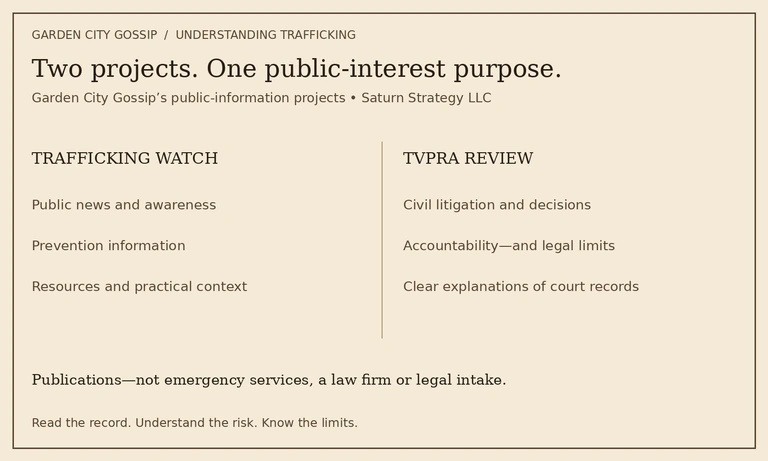
Both are public-information projects created by Garden City Gossip under Saturn Strategy LLC. They are separate from legal-services intake. They do not dispatch help, investigate reports from readers or arrange emergency accommodation.
The editorial obligation is the same across the projects: link to sources; distinguish accusation from proof; protect vulnerable people’s identities; correct mistakes; and avoid turning a person’s exploitation into an illustration of horror. An arrest announcement should not disappear from public attention merely because the next stage is slower and less dramatic. Nor should prevention coverage stop at telling readers to be afraid.
The next questions are about outcomes. What happened to the charges? What did the court decide? What was learned about a business practice or a failure of oversight? Did a new training or referral process become a usable service? Those are the questions a sustained public-information project should keep asking.
Where to start if help is needed
Immediate danger: call 911 when it is safe to do so. Do not confront a suspected trafficker or attempt a private rescue. DHS guidance specifically cautions against confrontation. DHS public guidance.
Trafficking-related help or information: the National Human Trafficking Hotline is 1-888-373-7888, with text access at 233733. South Carolina’s attorney general lists the service as available 24 hours a day, seven days a week. A hotline contact is not a substitute for an emergency response. Official South Carolina resource listing.
Georgia: the attorney general lists the statewide, 24-hour human-trafficking hotline at 1-866-363-4842. Use the state’s resource page for reporting and support information.
Local practical support: United Way of the CSRA’s 211, also reachable at 706-826-1495, provides information and referrals Monday through Friday, 8:30 a.m.–5 p.m. Its online directory is available around the clock. Coverage includes Augusta-area Georgia counties and communities in Aiken and Edgefield; availability and eligibility depend on the provider. It is a general referral service, not a dedicated trafficking emergency line. United Way CSRA’s 211 service and coverage.
If a device or account may be monitored, consider whether it is safe to use it to seek information. Closing a webpage does not erase browsing history. Avoid posting a person’s name, location or identifying photographs online in an attempt to obtain help.
The most useful public response begins with accurate information and a safer next step. Augusta does not need an exaggerated story to take human trafficking seriously. The documented cases, unanswered questions and practical work ahead are reason enough.