Staff Reports
Augusta, GA – Augusta’s 2026 mayoral race is taking shape months before the official qualifying period opens, with incumbent Mayor Garnett L. Johnson and challengers Eric Gaines and Steven Kendrick each launching campaigns centered on distinct themes.
While the election remains months away, the early framing suggests a contest focused on governance style, administrative structure, and leadership direction rather than overt partisan divisions.
Johnson: Continuity and Completion
Mayor Johnson formally launched his re-election campaign during a February event in South Augusta, asking voters for the opportunity to “earn your vote again.”¹
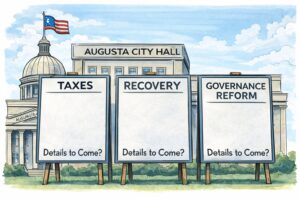
In his announcement remarks, Johnson emphasized what he described as a stance of “no new taxes,” progress on hurricane recovery, and ongoing charter review discussions aimed at improving government efficiency.¹
His early messaging frames the race as an opportunity to “finish what we started,” signaling a continuation argument tied to his first-term priorities.
Gaines: Administrative Transparency and Systems Reform
Challenger Eric Gaines has centered his campaign on internal government processes and structural transparency.
In campaign materials and public messaging, Gaines has proposed reviewing the city’s 311 system, establishing regular public office hours, and creating a public dashboard outlining mayoral priorities and stalled initiatives.
He has also criticized what he described as “closed-door” development practices, though without naming specific projects or officials.
Gaines’ early positioning emphasizes measurable administrative reform over broad policy shifts.
Kendrick: Experience and Return to the Ballot
Steven Kendrick, who previously faced Johnson in the 2022 mayoral race, has also entered the 2026 contest after launching his campaign in late 2025.
Kendrick, formerly Chief Deputy Tax Commissioner for Richmond County, has positioned himself as an experienced public administrator seeking another opportunity to lead the consolidated government.
His campaign materials highlight fiscal management and leadership experience, though a detailed 2026 policy platform has not yet been released publicly.
The Road to 2026
Candidate qualifying for the 2026 election cycle runs March 2–6, 2026, according to the Georgia Secretary of State.² The general election is scheduled for November 3, 2026.²
With several months remaining before ballots are cast, the early phase of the campaign appears focused on positioning and leadership framing.
Sidebar: What Voters May Be Watching For
As the race develops, several measurable questions are likely to shape debate:
1. Tax Policy
Will Johnson provide documentation supporting his “no new taxes” claim, and will challengers propose changes to millage rates or fees?
2. Administrative Performance
What data will support or challenge claims about 311 responsiveness, departmental coordination, and internal transparency?
3. Charter Reform
What specific structural changes are proposed or completed, and what remains pending?
4. Disaster Recovery Metrics
What benchmarks define recovery progress following Hurricane Helene?
5. Budget and Capital Planning
How would each candidate approach infrastructure spending, debt management, and long-term capital projects?
At this early stage, campaign messaging has emphasized direction rather than detailed execution plans. Whether the race evolves into a document-driven policy debate may determine its tone heading into qualifying season.
Other GCG Campaign Coverage:
Attorney Alexia Davis Payne Challenges Incumbent Judge in Local Judicial Race