

Twenty-five furnished homes on Merry Street represent a substantial promise to young adults leaving foster care: a place to begin adult life with support close by.
Bridge Builder Communities celebrated its ribbon-cutting on Oct. 14 at 1140 Merry Street. In a WJBF profile updated this week, co-founders Jackson Drumgoole and ShDonna Drumgoole described the project reaching the point of handing over keys. The station reported that all 25 homes were furnished and supplied with essentials, including bedding, towels and dishes.
The next chapter will be less visible than the opening ceremony. It involves the routines that allow a young adult to keep a job, continue school, manage money and make decisions about a home of their own.
The operator’s opening notice marks an important milestone. The next measure will be residents’ longer-term housing stability, a result that takes time to establish.
A home, with a program around it
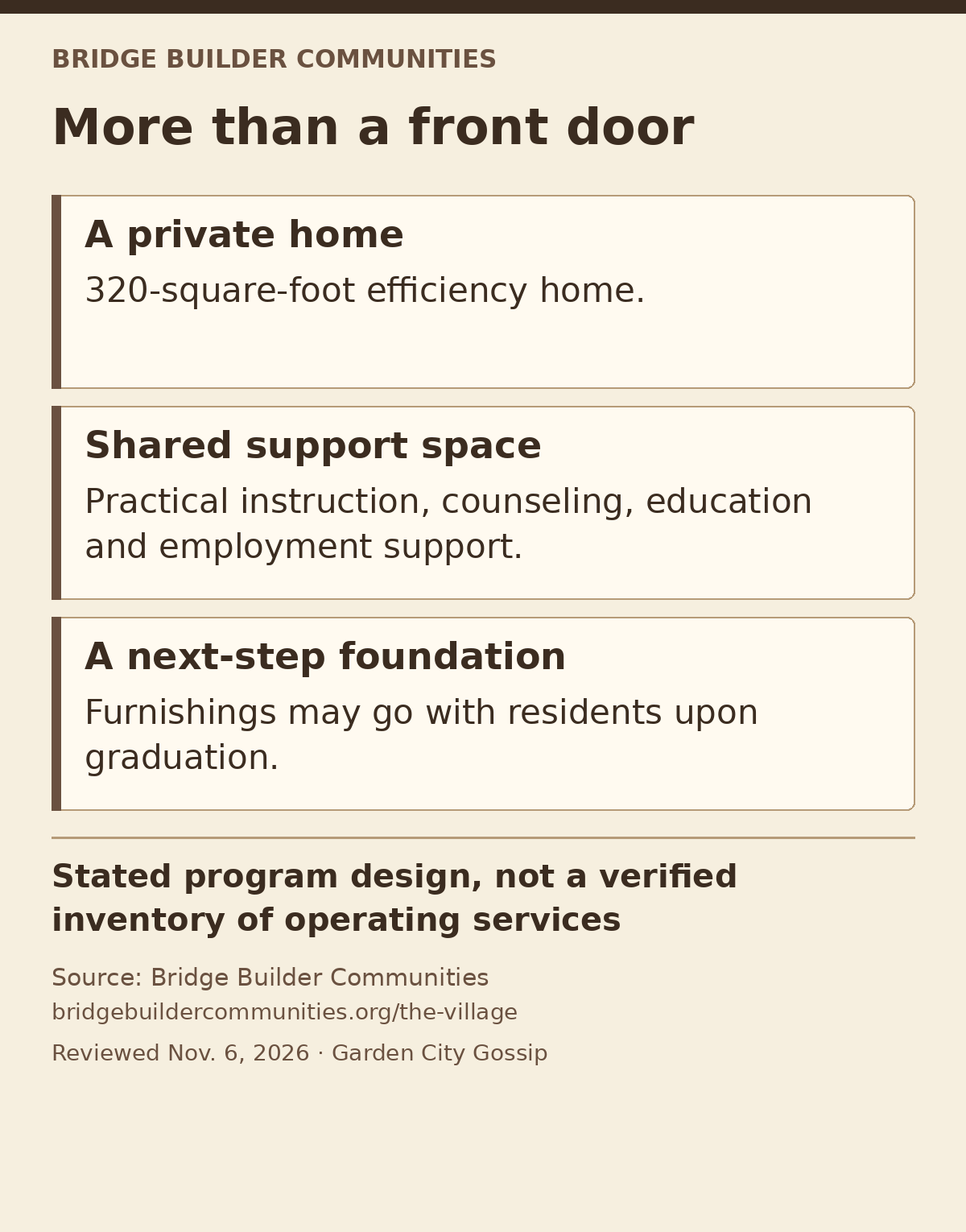
The physical design begins with a manageable space. Bridge Builder’s description of the village sets out 320-square-foot efficiency homes, each with a living and sleeping area, bathroom, storage and a compact kitchen. It also describes a community building for practical instruction, counseling and education and employment support.
That page still uses construction-era language, so its descriptions should be read as the program’s stated design, rather than confirmation that every listed service is now operating. But the intention is clear: give residents privacy without leaving them to handle every problem alone.
One detail reaches beyond the stay itself. The operator says residents will be able to take the furnishings originally supplied in their homes when they graduate from the community. A bed, table and kitchen supplies would then become part of the next household, instead of another set of purchases required at the moment of moving.
There was already more expressed interest than space at the opening. WRDW reported Oct. 14 that Drumgoole put the waiting list at 60 and expected the first cohort to arrive in about two weeks. That was a forecast, not confirmation of subsequent move-ins. Nor does a waiting-list count establish that every person on it has completed screening or qualifies for admission.
For prospective residents, the immediate question is how the program works for them.
Who can apply, and what remains to be clarified
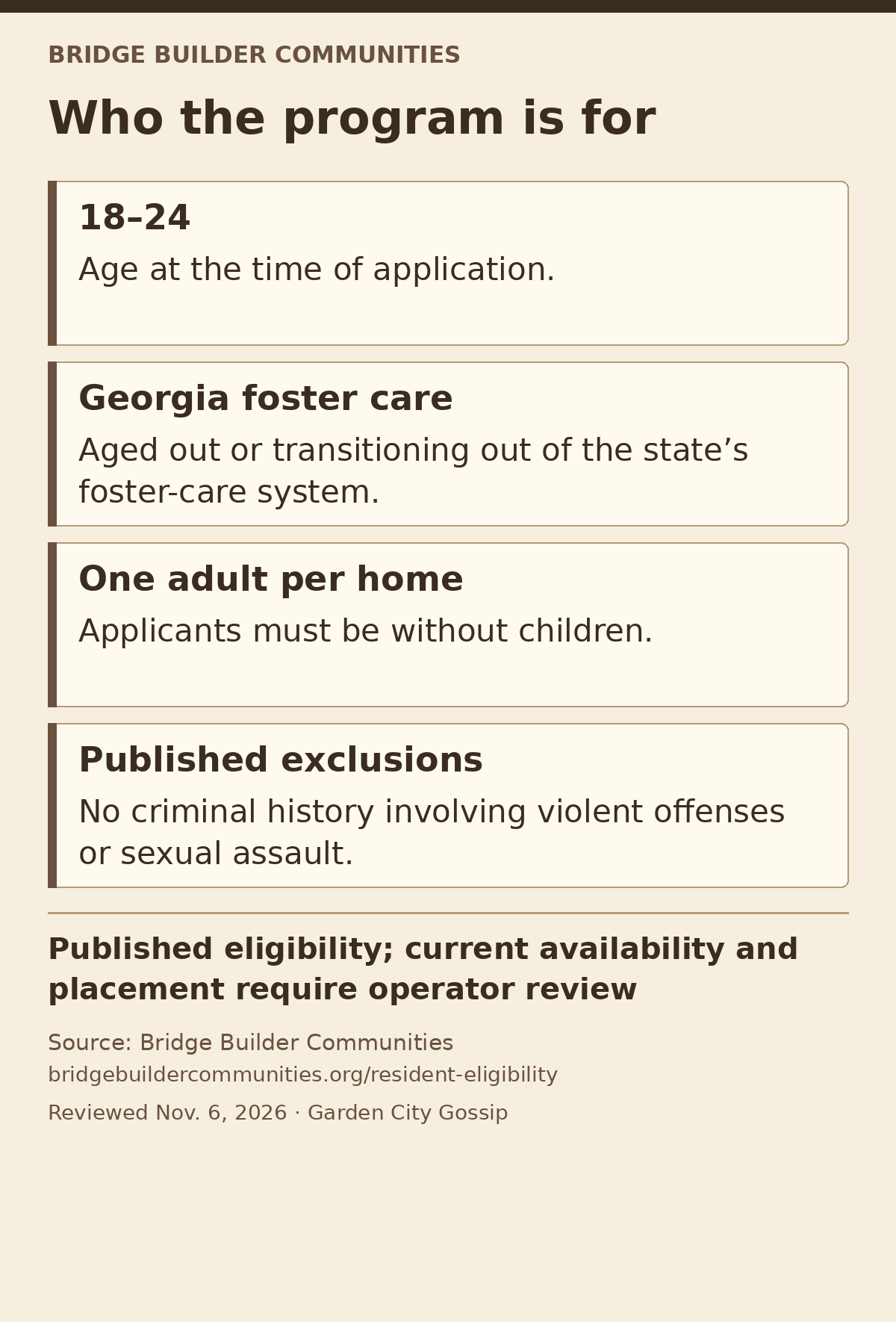
The current resident-eligibility page specifies applicants ages 18 through 24 who have aged out of, or are transitioning out of, foster care in Georgia. It excludes applicants with a criminal history involving violent offenses or sexual assault. Applicants must also be without children; the operator says each home is equipped for one adult.
Those limits make this a particular residential program rather than housing available to every young adult seeking help. Young parents, for example, fall outside its stated criteria.
The first step is an interest screener linked from the eligibility page. Completing it does not guarantee acceptance or placement. The organization says its team reviews the information and contacts people eligible to continue through intake. Anyone considering applying should use that current page rather than assume a furnished home is immediately available.
Costs also deserve careful reading. A May profile by USC Rossier described a plan for residents eventually to pay rent and utilities on a sliding scale as they settle in, work or attend school. It also described a goal of residents leaving with savings sufficient for six months of living expenses.
Those are reported plans and aspirations, not a current fee schedule or a promise of savings. Prospective residents should confirm current rent and utility charges, lease terms, length of stay and what happens if their income changes before accepting a placement.
The people behind the buildings
The public staffing descriptions offer another view of the work ahead. Bridge Builder’s careers page describes a full-time, on-site caseworker who would assess residents’ needs, develop individual plans, coordinate services and help with job readiness and life skills. The role works with a program director, resident advisor and outside partners.
The page says applications for the listed jobs are closed. Its role descriptions explain the intended support model; they are not a current staff directory.
That distinction is practical. A resident may need help with an employer’s paperwork, a class schedule or a problem that arises after the office closes. The usefulness of a support program depends partly on whether someone can respond at the time the help is needed.
Transportation belongs in that picture, too. Getting to a job, training program or appointment requires more than having an address. Applicants should ask how they can reach work and school alongside the support available on site.
Community backing has helped build the setting for that work. WRDW reported in August that a $100,000 Lowe’s grant would support shared outdoor spaces, with employees also volunteering. Spaces to cook, gather and spend time with neighbors fit the project’s emphasis on relationships. Keeping those relationships and services available will require sustained support beyond the opening.
What the next chapter can show
A useful account of the first months would follow residents’ experience without turning their personal histories into a public exhibit. How many people enter and remain housed? Can they reach school and work? What help is available when a plan changes? Where do residents go when their time at the village ends?
Those questions can be answered with aggregate information and, when residents freely choose to participate, their own accounts. A full village would show demand and occupancy. Sustained housing after departure would tell readers something different about the program’s lasting effect.
For now, Augusta has a concrete investment in a transition too often discussed only in the abstract. The homes are built and furnished, according to the recent reporting. The work ahead is helping the people who live in them carry stability, useful relationships and practical choices into whatever comes next.