

The county line between Richmond and Columbia does more than divide governments. It helps determine where the benefits of Augusta’s economy become private wealth, where that wealth supports public institutions, and where the costs of the region’s development remain.
We are accustomed to discussing Columbia County’s prosperity and Richmond County’s problems as if they were separate stories. Columbia’s growth becomes a story of success; Richmond’s poverty becomes a story of failure. One has the schools people want to buy into. The other is expected to explain its shortcomings. This is an extraordinarily convenient way to describe a region whose people, employers, hospitals, roads, and institutions are interconnected every day. It permits us to celebrate the results on one side of a boundary without seriously examining the arrangements that helped produce them.
The evidence supports a harder account. Richmond remains a much larger center of employment, while Columbia is home to substantially higher household incomes. The counties’ public schools educate sharply different racial populations. Columbia has a larger taxable school property base at a lower school millage rate. Richmond’s recorded exempt-property base is larger, and its inventory of hazardous sites is longer. These are different measures, from different records, and none should be confused with a complete balance sheet. Taken together, however, they make the idea of two self-contained county economies impossible to defend.
The question is how a common regional economy came to contain such different concentrations of household wealth, school resources, and industrial legacy, and whether its public obligations are distributed fairly.
The prosperity that crosses the line
Start with the distinction between where people work and where they live. In March 2026, the Bureau of Labor Statistics counted 104,109 covered workplace jobs in Richmond County and 44,430 in Columbia. Average weekly wages for the first quarter were $1,226 in Richmond and $960 in Columbia. These are workplace measures, not the incomes of county residents.¹
The household picture runs in the opposite direction. Census estimates for 2020–2024 put median household income at $95,592 in Columbia and $55,637 in Richmond, in 2024 dollars. Household income includes more than wages and depends partly on how many earners live together. It is not interchangeable with an individual paycheck. Even with that distinction, the contrast is revealing: the county with the larger employment base and higher average workplace wage is the county with the lower median household income.²
Commuting records show one important connection. In the Census Bureau’s 2023 primary-job origin-and-destination data, 21,502 jobs linked Columbia County residences to Richmond County workplaces. The reverse flow was 8,294. These are administrative employment records, not a count of cars crossing the line each morning, and they exclude military and certain security-related employment. In a region shaped by Fort Gordon, that omission is consequential. The figures establish a substantial, unequal, two-way connection without pretending to capture every worker.³
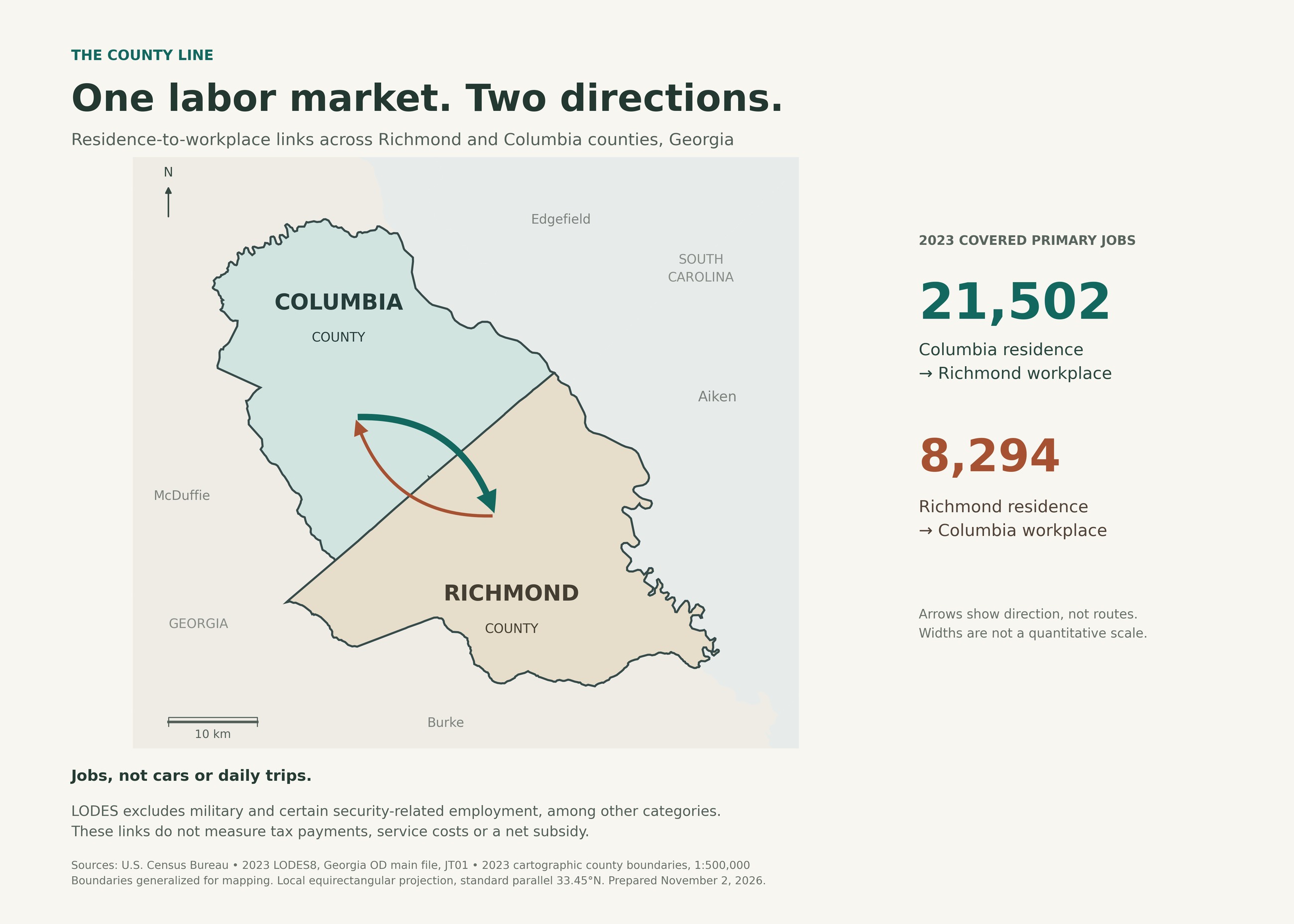
Columbia is not simply a bedroom county. It has manufacturing, distribution, retail, public employment, and a growing medical presence of its own. The new Wellstar Columbia County Medical Center began treating patients in August 2026, after the periods covered by those commuting and workplace figures. Richmond residents also benefit from jobs and services across the line.⁴
Acknowledging those facts does not dissolve the relationship. It makes the argument more exact. Columbia’s prosperity cannot be understood as an accomplishment independent of Augusta’s employment center, any more than Richmond’s economy can be understood without the people who live elsewhere and work within it. A county boundary organizes political responsibility. It does not create economic independence.
A regional economy built with public power
Augusta’s economic history did not begin with suburban subdivisions or cyber investment. After the Civil War, the canal, mills, rail connections, and cotton economy helped organize industrial growth. The physical arrangement mattered: workplaces, workers’ housing, transportation, and land ownership became part of the same urban landscape. Black Augusta also built commercial and civic institutions under segregation, including the businesses and professional life remembered in the Golden Blocks. That history cannot be reduced to a city of employers and an undifferentiated population of workers. Opportunities to own, borrow, learn, and accumulate wealth were unequal.⁵
The postwar economy added institutions whose reach extended well beyond the older city. Signal training came to Camp Gordon in 1948, and the installation became permanent in 1956. Across the river, construction of the Savannah River Plant began in 1951, bringing an enormous federal undertaking into the regional labor market. Medical and educational institutions expanded in Augusta. Public investment supplied much of the foundation on which subsequent private development rested.⁶
That growth did not suspend racial hierarchy. A contemporary federal study found that Black workers made up about one-fifth of DuPont’s Savannah River construction workforce in early November 1951, but 91 percent of those Black workers were employed as common laborers. An expanding economy could offer employment while preserving a sharply unequal distribution of skilled work and earnings.⁷
Nor did institutional expansion come without displacement. A federal housing-market analysis prepared in the 1960s recorded relocation associated with Augusta’s medical and urban-renewal projects. It recorded 150 families relocated by the Medical College project. About 400 families had lived in the University Hospital project area in 1965; by the report, displacement and demolition there were virtually complete. The 400 is a resident count, not an exact relocation tally. These counts do not identify the families’ race. They do establish that the growth of institutions now treated as regional assets involved the removal of existing households.⁸
This is the history that disappears when prosperity is narrated entirely through new construction and recruitment announcements. An institution can be indispensable and still impose costs on its neighbors. A development can create opportunity while reducing someone else’s security. The regional economy was built through decisions about whose land could be cleared, whose labor would be valued, and which communities would receive investment on terms they could control.
Suburban growth changed where some of the resulting income and investment settled. Augusta’s downtown development authority was created in 1974 in response to the movement of commerce toward the suburbs. Consolidation, effective in 1996, joined Augusta and Richmond County government, but it did not create a metropolitan government encompassing Columbia County. A larger consolidated Augusta still sat inside a region whose economy crossed its governing boundary.⁹
Consolidation could reorganize responsibilities within Richmond. It could not, by itself, make the regional distribution of those responsibilities equitable.
Schools made the boundary consequential
Schools belong at the center of this history because education is both a public institution and a powerful organizer of the housing market. Families seek educational opportunity. Home prices reflect access to it. Those prices help determine who can enter a district and what taxable wealth the district can draw upon. School reputation and residential advantage can reinforce one another, even when no individual family thinks of itself as participating in a regional system of exclusion.
But the history is not merely an impersonal story about consumer preference. The struggle reaches back well before suburban expansion. In the 1899 Cumming case, Black Richmond County taxpayers challenged the continued support of white high-school education after the board suspended the Black high school. The Supreme Court declined the injunction they sought. The allocation of tax-supported opportunity was already contested ground. Richmond County’s later desegregation litigation began in 1964. The federal record described a system in which, during the 1967–1968 school year, only 5.5 percent of Black students attended formerly white schools. Legal access and actual integration were very different things.¹⁰
The Digital Library of Georgia’s catalog of a 1972 WSB newsfilm describes white parents protesting school pairing in Augusta and taking children to newly established private schools in churches. This is evidence of actual resistance to integration, not a motive inferred from a modern demographic map. It does not prove why every family moved, or establish that every subsequent move to Columbia County was racially motivated. It does prevent us from writing race out of the educational history.¹¹
Present-day enrollment shows how pronounced the division remains. Georgia’s 2024–2025 public-school subgroup data report Richmond’s student population as approximately 76 percent Black and 11 percent white, compared with approximately 22 percent Black and 52 percent white in Columbia. These rounded shares leave other racial and ethnic groups in both systems. They describe public-school enrollment, not the full county population, private-school enrollment, or a judgment about any child’s ability.¹²
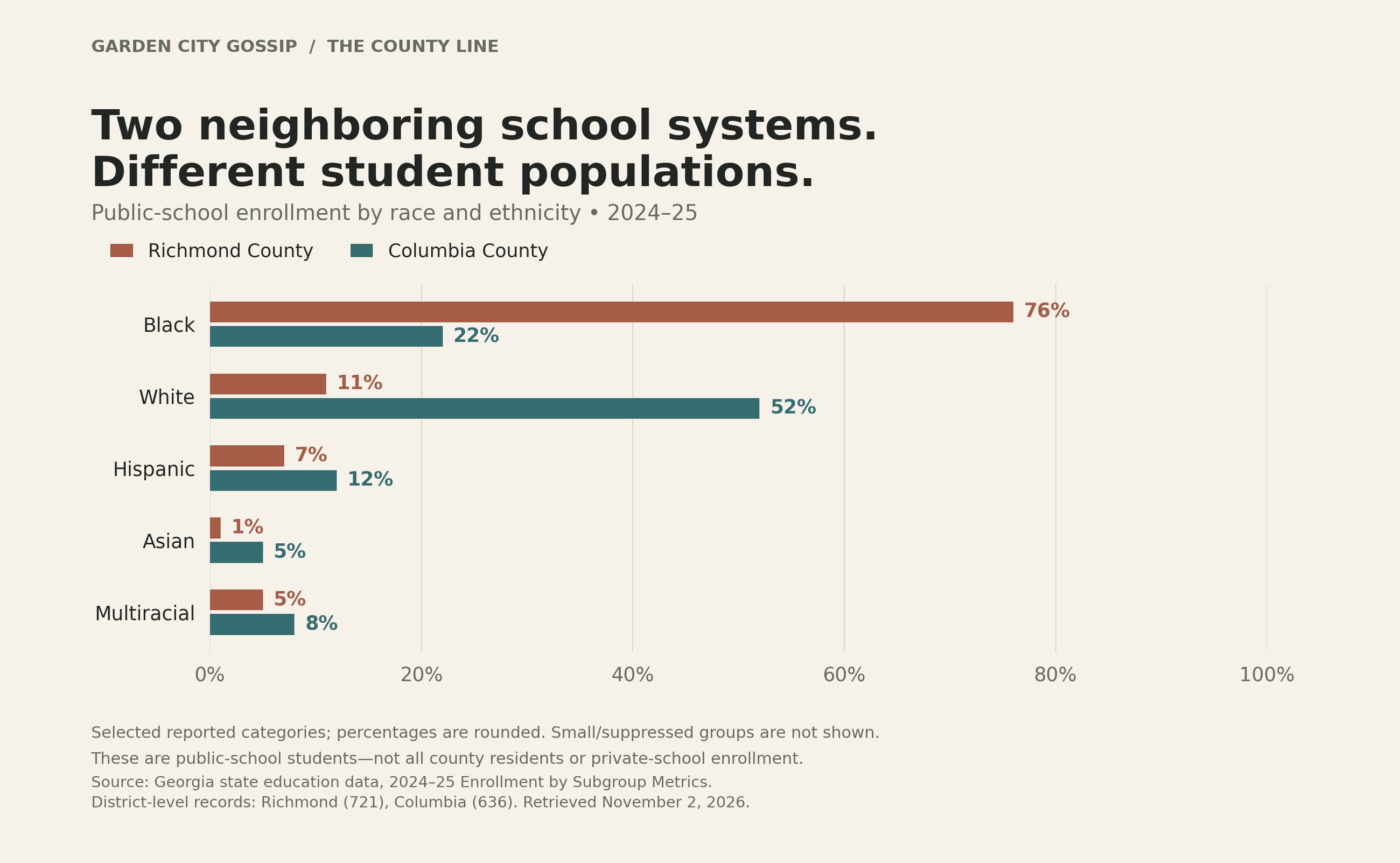
Columbia has also become more diverse: its white public-school share was 67 percent in 2010–2011, compared with 52 percent in 2024–2025. A 1974 federal order also documents that Columbia, too, was subject to desegregation requirements. Neither fact erases the present division; both keep its history from becoming a caricature.¹⁰ ¹²
The fiscal comparison gives those demographic differences material context. The state’s 2024 digest snapshot lists Columbia’s taxable school maintenance-and-operations base at approximately $7.90 billion, compared with Richmond’s $7.29 billion. Columbia’s school millage in that snapshot was 17.10; Richmond’s was 18.33. Columbia could therefore draw on a larger assessed base at a lower rate. State aid, enrollment, and student needs affect resources per pupil; these totals alone cannot establish them. Local tax capacity and tax effort are different things.¹³
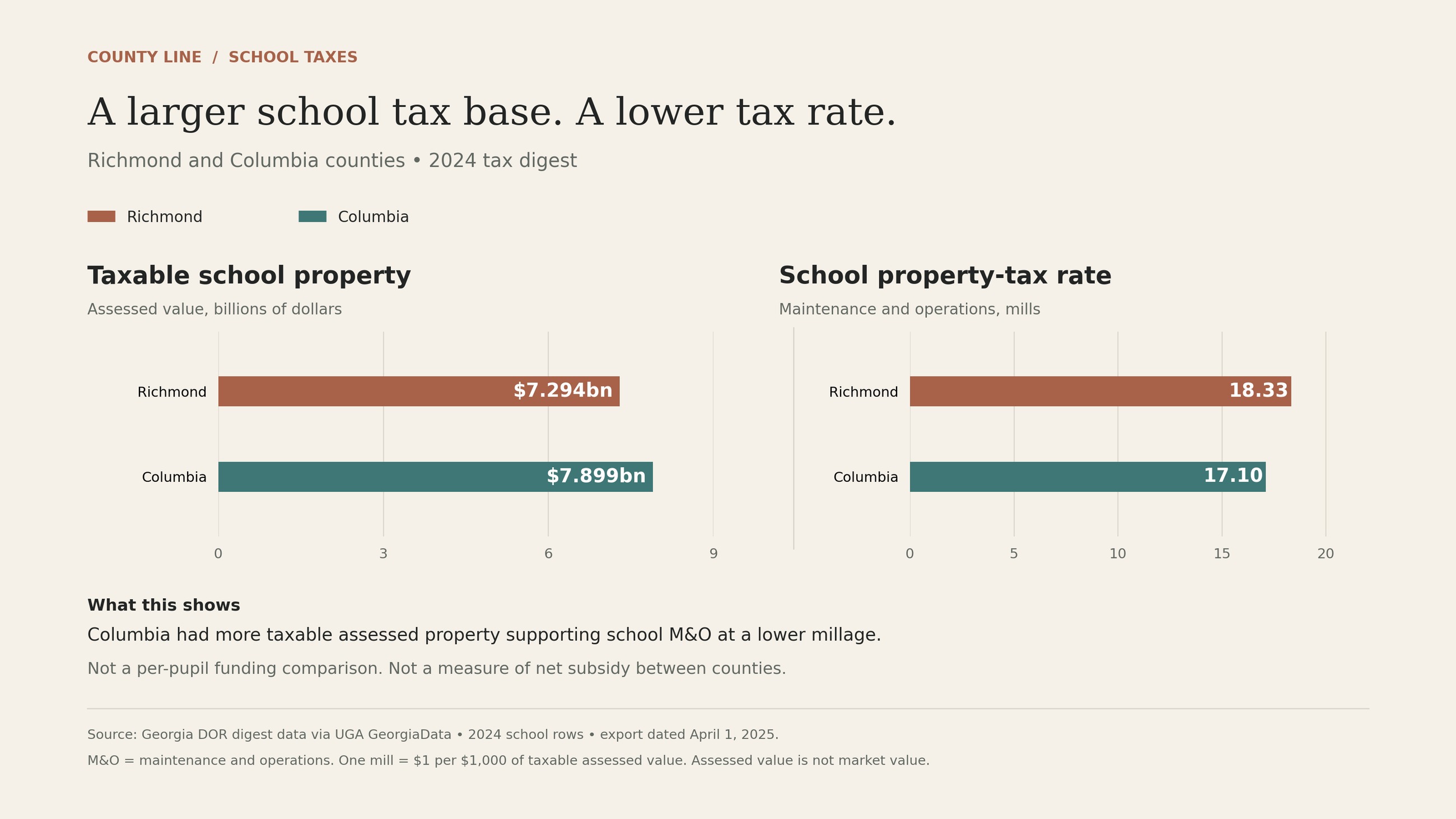
This distinction matters whenever school outcomes become a referendum on the character of a community. A district’s students arrive with different resources, and its government confronts a different property base. A reputation for success can attract households already positioned to purchase access to it, adding wealth that helps sustain the reputation. A reputation for failure can discourage investment and intensify the burden on the children who remain. The feedback is economic as well as educational.
The state’s fiscal-year 2025 direct-certification data add a measure of economic need: 68.8 percent of Richmond’s K–12 pupils were directly certified through specified assistance or eligibility categories, compared with 26.2 percent in Columbia. This is not a Census poverty rate. It is a same-year indication of very different concentrations of need.¹²
None of this excuses poor administration or makes accountability unnecessary. It changes what honest accountability requires. We should examine classroom quality and institutional decisions. We should also examine the conditions under which those decisions are made, rather than treating inherited advantage as proof that one community cares more about education.
Race is essential to that examination. So is the refusal to turn race into a shortcut. Black families in Columbia, white families in Richmond, and lower-income families in both counties belong in the story. The county line does not separate two homogeneous populations. It separates public systems that operate within a region shaped by a documented history of unequal access.
What the tax base actually means
The phrase “taking the tax base” expresses a real concern, but it can conceal the mechanism. A salary earned in Richmond is not automatically a county tax payment that Columbia has confiscated. Workers are paid for their labor. Where they live affects where their homes are taxed, where they use residential services, and where some of their consumption occurs. A family moving out does not physically remove its old house from Richmond’s digest; the consequences work through demand, values, replacement occupants, and where new development occurs. Employers and commercial property may remain taxable in Richmond. Commuters can spend money there. Different taxes follow different rules.
The state’s 2023 county comparison reported about $165.8 million in local sales-tax distributions for Richmond and $105.2 million for Columbia. Those are aggregated distributions, not a clean measure of general-fund revenue or a record of which county’s residents paid the tax. They are nonetheless important counterevidence to the idea that every benefit leaves Richmond at the end of the workday.¹⁴
The property-tax mix is different. The state’s 2024 levy report recorded approximately $163.0 million in residential levies in Columbia, compared with $96.5 million in Richmond. Commercial levies ran the other way: approximately $84.6 million in Richmond and $32.7 million in Columbia. These are taxes levied across the report’s jurisdictions and categories, not necessarily taxes collected, and rates and exemptions affect the totals. The contrast is consistent with a residentially wealthy suburb alongside a more commercially weighted employment center.¹⁵
Richmond also has a larger recorded exempt-property base. In the 2024 digest snapshot, the listed exempt-property categories totaled about $1.46 billion in assessed value in Richmond and $765 million in Columbia. The charity-hospital category alone was approximately $234 million and $10 million, respectively. These records should not be mistaken for a comprehensive market valuation of federal installations or every public asset. Nor can exempt value simply be multiplied by a tax rate and labeled a net loss: institutions generate benefits, spending, and surrounding taxable activity.¹³
Still, the distinction is fundamental. A regional hospital, university, or federal installation can help support household wealth throughout the metropolitan area without supplying the host government with the same property-tax stream as an equivalent amount of taxable real estate. That is a structural question about how public benefits and public obligations are financed. It is not evidence that the institution should disappear.
Columbia, meanwhile, pays for its own roads, schools, public safety, and other services. Growth produces bills as well as revenue. Regional transportation funding already provides one example of shared financing through the Transportation Investment Act. Any serious accounting must include those costs and transfers, along with the taxes nonresidents pay in Richmond.¹⁶
The evidence reviewed here does not establish whether, or by how much, either county subsidizes the other on a net fiscal basis. Calculating that balance would require identifying outside users of services, associated costs, fees, taxes, reimbursements, and reciprocal benefits. Commuting counts are not a substitute. The absence of that calculation is a reason to demand an honest regional accounting, not a reason to pretend the distribution of wealth and responsibility is neutral.
Industry leaves more than payroll
Industrial pollution belongs in the same account. A plant may generate jobs for people living across the region while its physical footprint, contaminated land, and cleanup obligations remain in a particular neighborhood. When the employer closes, its workers can seek employment elsewhere. The land cannot relocate with them.
Georgia’s July 2026 Hazardous Site Inventory lists 15 entries in Richmond County and three in Columbia. This is not a ranking of health risk or a count of operating factories: the inventory includes different kinds of property and contamination, including dry-cleaning sites, landfills, and sites under different cleanup classifications. Several Richmond entries are associated with the same broader groundwater problem. The count establishes a larger inventory of listed sites, not five times the exposure or five times the illness.¹⁷
Hyde Park shows why both moral clarity and factual care are necessary. The community’s history cannot be responsibly compressed into a slogan about contamination. In a 2008 consultation evaluating specific soil, sediment, and groundwater information, Georgia public-health officials working with the federal Agency for Toxic Substances and Disease Registry classified the evaluated soil and sediment conditions as “No Apparent Public Health Hazard.” They also recommended remediation of elevated lead in particular soil samples. Municipal water service mattered to the groundwater finding because the assessment did not identify drinking-water exposure through those monitoring wells.¹⁸
That assessment was not a declaration that no contamination existed, a reconstruction of every resident’s lifetime exposure, or proof that industrial pollution caused a cancer cluster. It cannot responsibly be used as any of those things. Residents’ experiences deserve serious investigation, not a choice between dismissing their concerns and making medical claims the evidence does not establish.
The public consequences are visible without inventing a health conclusion. Augusta’s fiscal-year 2023 budget-priorities document described the drainage project that followed Hyde Park residents’ relocation and identified an additional $4 million to $5 million needed for completion without an identified funding source. That was a stated budget need, not proof of an expenditure, and the drainage project should not be relabeled entirely as pollution cleanup. It nevertheless places the consequences of a vanished residential community inside a real public budget.¹⁹
There is also a necessary qualification about who pays for contamination. At the Alternate Energy Resources Superfund site in Augusta, a historic federal settlement involved private companies and federal and state parties in funding cleanup. Environmental costs are not automatically borne solely by city taxpayers. Polluter responsibility, federal programs, state oversight, and local infrastructure can overlap.²⁰
The larger point survives that complexity. Jobs, ownership returns, property values, and environmental burdens do not have identical geographies. We should know which communities receive the wages, which governments receive the taxable value, and which neighbors remain beside contaminated property. Race and housing access belong in that inquiry because they help explain who had meaningful choices about where to live. Establishing the connection at a particular site requires records and testimony, not simply drawing a circle around a facility on a map.
A region cannot account for itself this way
There is an easy version of this argument in which Columbia County is the villain and Richmond County is relieved of responsibility for its own decisions. It would be satisfying, and it would be inadequate. Richmond’s officials must answer for administration, spending, schools, and land use. Columbia’s residents are not individually responsible for every historical arrangement from which they may benefit. Neither proposition makes the arrangement itself fair.
The harder argument is that our familiar boundaries have become a way of narrowing the questions. Employment is regional when we advertise the workforce. Health care is regional when we describe a hospital’s reach. Development is regional when a new project is announced. Then the discussion turns to schools, taxable wealth, aging infrastructure, or contaminated land, and responsibility becomes intensely local.
We should test that contradiction with public records. A regional fiscal analysis should identify service use and payment across county lines rather than assume either exploitation or balance. School comparisons should put local property capacity beside state aid, student needs, access to housing, and the history of desegregation. Environmental planning should connect cleanup and monitoring to neighborhood investment, rather than leaving a community’s future suspended between agencies with separate mandates.
These are practical demands. They do not require pretending that every public service should be consolidated or that the two counties are interchangeable. They require treating the metropolitan economy as the connected system it already is, then asking whether our public arrangements distribute its obligations defensibly.
The most important question is not whether Columbia County has earned the right to prosper. Its residents have worked, built businesses, raised families, and paid taxes. The question is why regional prosperity is so readily treated as a private achievement, while a discussion of the public conditions that sustain it so often stops at the county line.
The history examined here reveals unequal access to the benefits of development and an uneven geography of its lasting costs. Schools, race, and industrial pollution are central to that history because each reveals a different way those separations become durable.
A county line can assign a bill. It cannot tell us whether the assignment is just.
Notes
-
Bureau of Labor Statistics, “County Employment and Wages in Georgia First Quarter 2026,” September 2, 2026, https://www.bls.gov/regions/southeast/news-release/countyemploymentandwages_georgia.htm. ↩︎
-
U.S. Census Bureau, “QuickFacts Columbia County Georgia,” https://www.census.gov/quickfacts/columbiacountygeorgia; “QuickFacts Richmond County Georgia,” https://www.census.gov/quickfacts/richmondcountygeorgia. ↩︎
-
U.S. Census Bureau, “LODES8 Georgia Primary Job Origin Destination Data 2023,” https://lehd.ces.census.gov/data/lodes/LODES8/ga/od/ga_od_main_JT01_2023.csv.gz; “LODES Technical Documentation,” https://lehd.ces.census.gov/data/lodes/LODES8/LODESTechDoc8.3.pdf; Census research paper on administrative employment coverage, https://www2.census.gov/library/working-papers/2025/adrm/ces/CES-WP-25-52.pdf. ↩︎
-
Wellstar, “First Patients Receive Care at Wellstar Columbia County Medical Center,” https://cm.wellstar.org/articles/first-patients-receive-care-at-wellstar-columbia-county-medical-center; Columbia County Development Authority, “Major Employers,” https://developcolumbiacounty.com/thrivelocally/major-employers/. ↩︎
-
National Park Service, “Laney Walker North Historic District,” https://npgallery.nps.gov/GetAsset/0869fbb1-dad2-4542-8cd3-a209d095cd4a/; Lucy Craft Laney Museum, “Golden Blocks,” https://lucycraftlaneymuseum.com/golden-blocks/; Augusta Canal National Heritage Area, https://augustacanal.com/overview/. ↩︎
-
U.S. Army, Fort Gordon history, https://home.army.mil/gordon/about/history; U.S. Department of Energy, Savannah River Site history, https://www.energy.gov/srs/savannah-river-site-history-1950-1989; Medical College of Georgia, historical highlights, https://www.augusta.edu/mcg/documents/mcghistory.pdf. ↩︎
-
Bureau of Labor Statistics, “Labor and the Savannah River AEC Project,” Bulletin 1100, https://fraser.stlouisfed.org/title/labor-savannah-river-aec-project-4439/fulltext. ↩︎
-
U.S. Department of Housing and Urban Development, “Analysis of the Augusta Georgia South Carolina Housing Market as of November 1 1966,” printed page 28, https://www.huduser.gov/portal/publications/pdf/scanned/scan-chma-AugustaGeorgia-SouthCarolina-1966.pdf. ↩︎
-
Downtown Development Authority, “History,” https://augustadda.com/about/history/; Augusta Richmond County, “2018 Comprehensive Annual Financial Report,” https://ted.cviog.uga.edu/FINANCIAL-DOCUMENTS/sites/default/files/budgetdoc/financial-report/county-richmond-augusta-richmond-fy2018-financial-report.pdf. ↩︎
-
Cumming v Richmond County Board of Education, 175 U.S. 528 (1899), https://tile.loc.gov/storage-services/service/ll/usrep/usrep175/usrep175528/usrep175528.pdf; Acree v County Board of Education of Richmond County, 294 F. Supp. 1034 (S.D. Ga. 1968), https://www.casemine.com/judgement/us/5914c7eaadd7b049347e62d9; historical February 14, 1974 order reproduced in a DOJ-hosted court exhibit, Exhibit A printed page 6 and PDF page 27, https://www.justice.gov/sites/default/files/crt/legacy/2013/10/25/mcduffiecsd.pdf. ↩︎
-
Digital Library of Georgia, WSB newsfilm of Augusta school pairing protests and private church schools, 1972, https://dlg.usg.edu/record/ugabma_wsbn_wsbn65879. ↩︎
-
Georgia state education data, “Enrollment by Subgroup 2024 2025,” https://download.gosa.ga.gov/2025/Enrollment_by_Subgroup_Metrics_2024-25_2026-02-19_00_31_56.csv; “Enrollment by Subgroups 2010 2011,” https://download.gosa.ga.gov/2011/Enrollment_by_Subgroups_Programs_2011_OCT_22_2020.csv; “FY2025 Directly Certified District Data,” https://download.gosa.ga.gov/2025/2025_directly_certified_district.xls; catalog and definitions, https://goews.georgia.gov/dashboards-data-report-card/downloadable-data. ↩︎
-
Georgia Department of Revenue digest data, 2024 tax year snapshot dated April 1, 2025, via UGA Carl Vinson Institute, https://georgiadata.org/depofrevdata; workbook https://georgiadata.org/download/file/fid/453; exemption code definitions https://georgiadata.org/download/file/fid/132. ↩︎
-
Georgia Department of Revenue, “2024 Annual and Statistical Report,” 2023 county comparison, https://dor.georgia.gov/document/document/2024-annual-and-statistical-report/download. ↩︎
-
Georgia Department of Revenue, “2024 Summary of Ad Valorem Taxes Levied,” March 31, 2026, https://dor.georgia.gov/document/document/2024-summary-ad-valorem-taxes-levied-reportpdf/download. ↩︎
-
Columbia County, “2024 Annual Comprehensive Financial Report,” https://www.columbiacountyga.gov/Archive.aspx?ADID=138; Georgia State Financing and Investment Commission, “Transportation Investment Act,” https://gsfic.georgia.gov/financing-and-investment-division/transportation-investment-act; Georgia Department of Revenue, “Distributions FAQs,” https://dor.georgia.gov/local-government-services/distributions-section/distributions-faqs. ↩︎
-
Georgia Environmental Protection Division, “Hazardous Site Inventory List by County 2026,” https://epd.georgia.gov/document/pdf/hsi-list-county-2026/download. ↩︎
-
Georgia Division of Public Health and Agency for Toxic Substances and Disease Registry, “Hyde Park Community Health Consultation,” April 7, 2008, https://www.atsdr.cdc.gov/hac/pha/HydePark/HydePark%20HC%204-7-2008.pdf. ↩︎
-
Augusta Georgia, “Fiscal Year 2023 Budget Priorities,” October 18, 2022, https://www.augustaga.gov/DocumentCenter/View/16339. ↩︎
-
U.S. Environmental Protection Agency, “Consent Decree AER Superfund Site Settlement Agreement,” https://www.epa.gov/enforcement/consent-decree-aer-superfund-site-settlement-agreement. ↩︎