
Aiman Tariq – Regional News Editor
Atlanta, GA –
The special election to replace former U.S. Rep. Marjorie Taylor Greene has drawn a crowded Republican field and turned a reliably conservative northwest Georgia district into a referendum on former President Donald Trump’s influence over his own political movement.
More than a dozen Republicans are competing for the March 10 special election in Georgia’s 14th Congressional District, despite Trump endorsing one candidate earlier this month.
The race follows the resignation of Marjorie Taylor Greene in January after a public split with Trump, ending a five-year tenure that made her one of the most nationally recognized conservative lawmakers in Congress.
Now, voters in the district are choosing not only her successor — but potentially signaling where the Republican base stands.
Trump’s Endorsement Doesn’t Clear the Field
Trump endorsed Clay Fuller, a former district attorney in northwest Georgia, on February 4. Fuller has emphasized that backing in campaign appearances and materials.
But the endorsement did not deter other Republicans from staying in the race.
At least a dozen GOP candidates remain on the ballot, along with three Democrats and one independent. If no candidate receives more than 50% of the vote on March 10, the top two finishers will advance to a runoff scheduled for April 7.
Political scientists say that dynamic alone makes the election notable. In a district long viewed as a stronghold of the MAGA movement, Trump’s backing would typically be expected to consolidate support.
Instead, multiple candidates are positioning themselves as the authentic heirs to Greene’s brand of politics.
The crowded field has intensified scrutiny of Trump on Marjorie Taylor Greene’s future and whether his endorsement power remains decisive in Republican primaries.
Marjorie Taylor Greene’s Departure Shifts the Spotlight
For years, Marjorie Taylor Greene defined the district’s political identity.
Elected in 2020, she quickly became one of the most outspoken members of Congress aligned with Trump’s populist agenda. Her district — stretching from Atlanta’s outer suburbs to the Tennessee border — has consistently delivered large Republican margins.
Greene’s resignation, following a highly publicized break with Trump, created a vacancy that drew immediate national attention.
Recent Marjorie Taylor Greene news coverage has focused on whether her split from Trump reflects a broader shift within the Republican Party — or simply a personal falling out.
Despite the tension with Trump, Greene remains well known among voters in the district. Her exit leaves open the question of whether voters prefer a continuation of her confrontational style or a different approach.
Competing Claims to the MAGA Label
Nearly every Republican candidate in the race has pledged loyalty to Trump’s policy priorities.
Former state Sen. Colton Moore, who has clashed with Georgia’s Republican leadership in the past, is running under the slogan “GOD. GUNS. TRUMP.” He has described himself as a defender of the former president and continues to campaign on hardline conservative messaging.
Other candidates, including Fuller, have emphasized economic development, military service, and local issues, arguing that the district needs steady representation rather than national controversy.
The differences among leading Republicans appear to center more on tone and strategy than core policy positions.
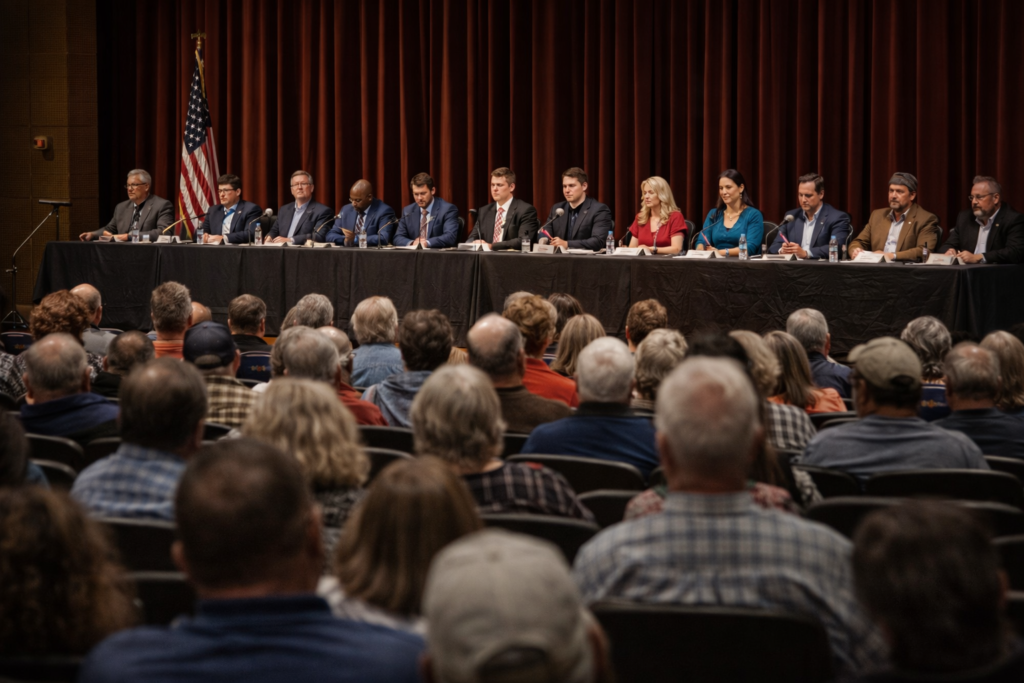
In public forums, some candidates have embraced the combative approach associated with Trump-era politics. Others have called for a focus on infrastructure, agriculture, and job growth across the rural portions of the district.
The debate underscores how the MAGA movement has expanded beyond a single personality, even as loyalty to Trump remains a key factor in Republican campaigns.
Democrats Face Long Odds but Watch Closely
Three Democrats are also competing, including Shawn Harris, a retired brigadier general and farmer who challenged Greene in 2024.
Harris lost that race by a wide margin. Analysts describe the district as one of the most Republican in Georgia, making a Democratic upset unlikely.
Still, a fractured Republican vote could allow a Democrat to advance to a runoff if no GOP candidate secures a majority.
Harris has focused his campaign on lowering costs for working families and expanding access to healthcare. He has also pointed to environmental and economic concerns in parts of the district.
Political observers note that Democrats have recently outperformed expectations in some special elections nationwide, though the partisan makeup of Georgia’s 14th District presents a steep challenge.
Voters Weigh Local Concerns

Interviews reported from candidate forums indicate that many Republican voters are still undecided.
Some voters have said they respect Trump’s endorsement but want to evaluate candidates based on local ties and priorities.
Georgia’s 14th District includes manufacturing hubs such as Dalton, often referred to as the “carpet capital of the world,” as well as rural communities facing economic challenges.
Affordability, infrastructure, immigration policy, and agriculture are frequent topics at campaign events.
Political science professor Nathan Price told reporters the race reflects a party “in transition,” with some voters beginning to look beyond a single leader and toward the future of the party.
Whether that transition translates into electoral change remains unclear.
House Majority at Stake
The winner of the special election will serve the remainder of Greene’s term through January 2027.
Republicans currently hold a narrow majority in the U.S. House. While Georgia’s 14th District is considered safe for the GOP, any open seat draws attention given the tight margin.
A runoff, if required, would extend the contest into April and likely intensify campaigning and outside interest.
For now, the focus remains on turnout and whether Trump’s endorsement consolidates support behind Fuller or whether another Republican can break through in the crowded field.
The Bottom Line
The race to replace Marjorie Taylor Greene has become an early test of Trump’s influence over his base in one of Georgia’s most conservative districts.
Despite Trump’s endorsement of Clay Fuller, more than a dozen Republicans remain in the contest, each claiming to represent the district’s conservative values.
Democrats face long odds but are watching for any opening created by a divided GOP field.
Election Day is March 10. If no candidate wins a majority, a runoff will be held April 7.
The outcome will signal not only who represents Georgia’s 14th District — but how unified the Republican base remains heading into a broader election year.
Follow us for updates on this developing story and more Georgia political coverage.