Aiman Tariq – Regional News Editor
Atlanta, GA –
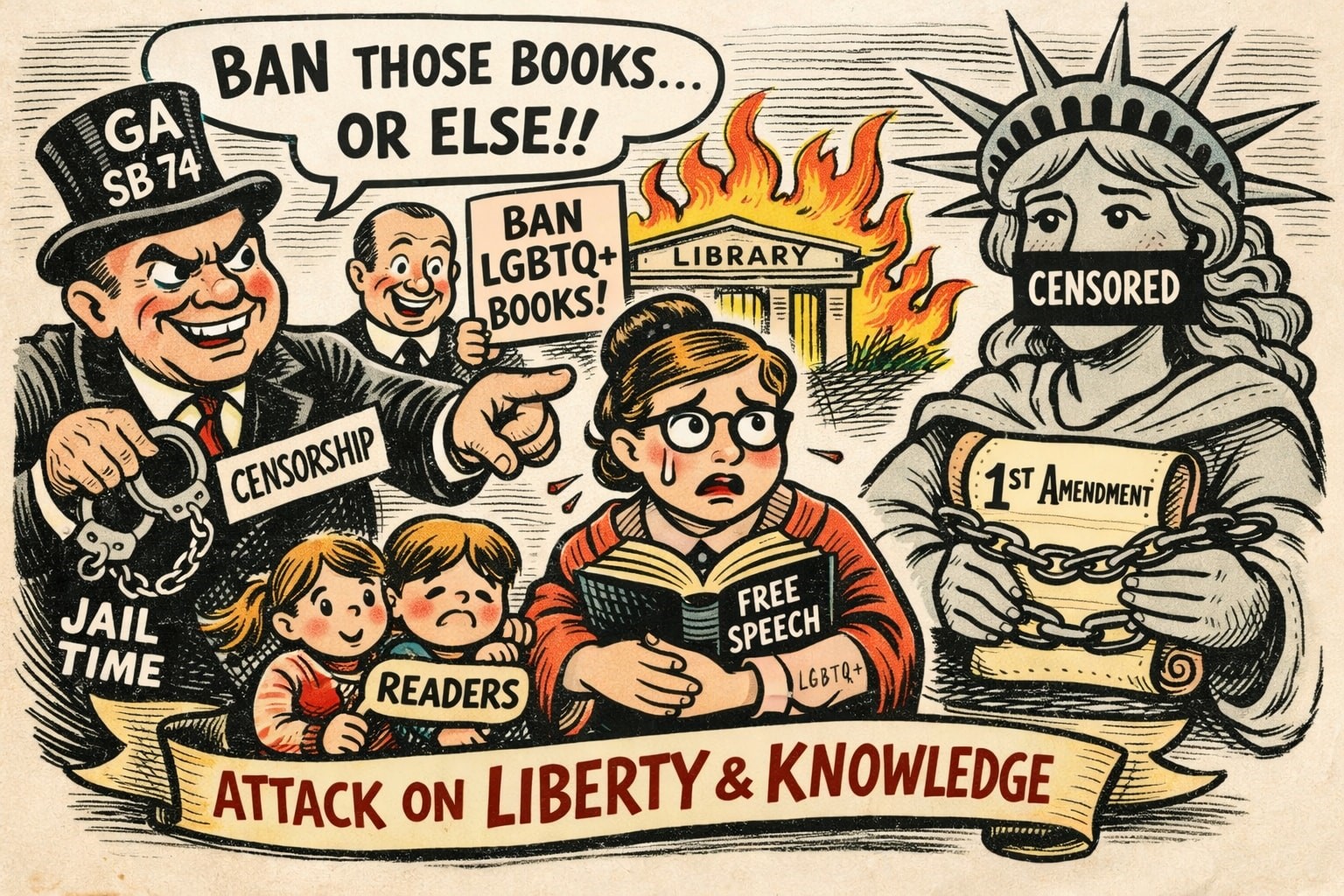
Georgia lawmakers describe Senate Bill 74 as a child-protection measure. In reality, the bill removes long-standing legal protections for librarians and replaces them with the threat of criminal prosecution. It is difficult to read the legislation any other way: SB 74 is designed to pressure public libraries into adopting restrictive content policies by placing librarians themselves at legal risk.
Under current Georgia law, public libraries and school, college, and university libraries are exempt from prosecution under the state statute governing the distribution of materials deemed “harmful to minors.” SB 74 would repeal that exemption. Reporting by CBS Atlanta indicates that violations under the underlying statute can carry penalties of up to 12 months in jail and fines up to $5,000.
Supporters say the bill is not about banning books but about ensuring compliance with existing law, protecting children, and moving disputed titles into different library sections rather than removing them outright. But removing a statutory shield and exposing individual librarians to criminal penalties does not simply “clarify compliance.” It fundamentally alters the legal environment in which libraries operate.
Criminal liability is not a minor administrative adjustment. It is a coercive tool.
A Law Built to Intimidate

The central effect of SB 74 is unmistakable: it places librarians under the threat of investigation and prosecution for decisions about materials that may later be challenged.
When criminal penalties enter a workplace, behavior changes. That is not speculation; it is basic institutional reality. Faced with possible prosecution, rational actors reduce risk. In a library setting, reducing risk means restricting access, relocating books, declining to purchase controversial titles, or removing materials preemptively.
This is what constitutional scholars call a “chilling effect.” The government does not need to ban a book outright if it can make the consequences of shelving it severe enough that institutions avoid the risk altogether.
SB 74 functions precisely this way.
Free Speech and the First Amendment
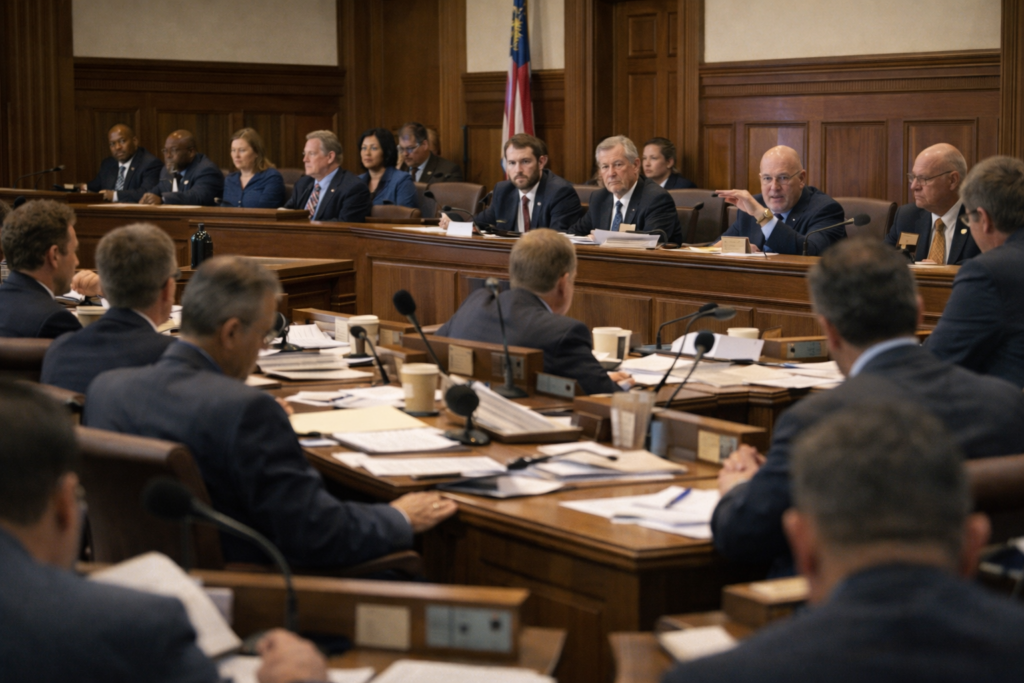
The First Amendment does not protect obscenity, and states have authority to regulate material deemed harmful to minors. But public libraries are not commercial distributors. They are public institutions created to provide access to information, viewpoints, and literature across a wide spectrum.
By removing the exemption that has long recognized that role, SB 74 pushes library decision-making into the shadow of criminal law.
Courts have consistently held that government action can burden speech indirectly, not only through explicit bans but through policies that deter lawful expression. When a librarian must consider the possibility of jail time in deciding whether to stock or retain a book, the state has effectively inserted itself into the content-selection process, even when the disputed material may be no more graphic than a beat up face in an illustrated scene or a passing image in a larger story.
That is not a neutral administrative adjustment. It is government pressure operating through fear of prosecution.
The LGBTQ+ Impact
Although SB 74 does not name LGBTQ+ content explicitly, the broader context makes the likely targets difficult to ignore.
Across the country, books challenged in recent years have disproportionately involved LGBTQ+ characters, same-sex relationships, or discussions of gender identity. According to the American Library Association, hundreds of titles have faced challenges annually, with LGBTQ+-related books frequently among those contested.
Georgia’s harmful-materials statute defines “sexual conduct” in a manner that does not distinguish between heterosexual and homosexual acts. While that language is not new, critics warn that in the current political climate it creates an opening for disputes over LGBTQ+-inclusive books to escalate into legal threats.
The concern is not that every book featuring an LGBTQ+ character would suddenly become contraband, but that even a holding hands picture or another simple, non-explicit moment could be pulled into a legal or political dispute. The concern is that when criminal exposure exists, books dealing with sexual orientation or gender identity—even in age-appropriate, non-explicit contexts—may be treated as legally risky.
The predictable result is self-censorship.
LGBTQ+ students and families who rely on public libraries for representation and access to information may find those materials harder to obtain—not because a court has declared them unlawful, but because librarians are no longer insulated from prosecution.
In that sense, the bill does not merely affect librarians. It affects the communities whose stories and identities are already most frequently challenged.
Librarians as the Pressure Point

SB 74 does not impose penalties on activists who file complaints. It does not criminalize political rhetoric and does not sanction policymakers.
It targets librarians.
Public librarians are trained professionals who operate under board-approved collection policies and formal review procedures, often relying on a material review board or similar local process when books are formally challenged. Disputes over materials already move through established administrative channels. What SB 74 adds is the threat that a disagreement over interpretation could become a criminal matter.
That shift places the burden of a culture-war conflict squarely on public employees at the circulation desk.
When lawmakers claim the bill is simply about protecting children, they sidestep the fact that the mechanism they have chosen is criminal enforcement against library workers. If the state’s goal were merely improved policy compliance, civil or administrative remedies would suffice. Criminal liability is a far more aggressive tool.
It signals intent to compel.
Democracy and Access to Information
Public libraries are not incidental institutions. They are foundational to civic life, and the values behind the library bill of rights help explain why librarians see broad public access to ideas as a core part of their mission. They provide access to literature, history, science, and political thought. They allow citizens—young and adult alike—to encounter ideas that help them become informed participants in a democratic society.
When the state creates incentives for libraries to narrow collections out of fear, the impact extends beyond a single controversial title. It affects the breadth of information available to the public.
Democracy depends on access to ideas. That access cannot be contingent on whether front-line public employees feel legally safe enough to stock a book.
The Bottom Line
Georgia can protect children without threatening librarians with prosecution. It can address concerns about age-appropriate placement without dismantling the exemption that has recognized the unique role of libraries.
SB 74 crosses that line.
By removing legal protections and introducing criminal exposure, the bill operates less as a child-protection measure and more as a deterrent. Its practical effect is to frighten librarians into adopting the most restrictive possible reading of what is “safe,” with LGBTQ+-related materials likely among the first casualties.
In doing so, it risks undermining not only the professional integrity of librarians but the constitutional principle that access to ideas should not depend on fear of prosecution.
If enacted, SB 74 would not simply change shelving policies. It would alter the balance between government authority and intellectual freedom in Georgia’s public institutions—and that is a consequence far larger than its sponsors are willing to acknowledge.