

Augusta can say yes to a data center when the case for it holds up. The Nixon proposal hasn’t met that test. Before changing the zoning, the city should have numbers its own finance staff can check and written terms it can enforce against whoever ends up running the campus. Augusta has its most leverage now, while the developer still needs a vote. Once the roads have moved and the buildings are halfway up, every request for an exception comes with an argument nobody has to entertain today: look how much has already been spent.
That is why I support District 1 Commissioner Jordan Johnson and why I think the Augusta Commission should deny this rezoning on December 1. Johnson raised questions about water, noise, buffers and community benefits before the fight over this particular site reached its final zoning agenda. After the Planning Commission voted 6–4 to recommend denial, he told WJBF, “I will always side with the people in my district.” He is right to take their concerns seriously. The documents give the rest of Augusta good reason to do the same. Johnson’s October remarks · WJBF interview · Planning vote · December 1 agenda
Find out what has to be built and who pays
3 G Investments wants to rezone roughly 383 acres near Augusta Regional Airport for a seven-building campus. The property is beside Castle Pines Mobile Home Park, and the plan would realign Four H Club Road. The developer identifies an existing high-voltage transmission easement and has set aside space for a substation. City utilities staff flagged possible relocation of existing lines and called for an agreement. The developer told planners it would absorb the cost of required electrical upgrades. Augusta should ask what that promise covers: the substation, the connection to the grid, and any transmission or generation work needed beyond the property line. An existing power line tells you where the line is. It doesn’t tell you whether it can serve the campus or who pays to make it possible. Application and staff report, pp. 48–59 · Applicant’s utilities presentation
The state filing puts Nixon’s peak demand at 600 megawatts. The applicant told planners that Georgia Power had accepted an intake form and that there was no committed end user. Accepting an intake form does not reserve 600 megawatts. Before treating that capacity as available, ask Georgia Power to show what its engineering study says the project needs: the on-site substation, the connection to the transmission grid, and any upgrades farther upstream. Existing lines beside the property are no substitute for knowing where there is spare capacity, what has to be built, or who pays for it. The consultant’s draft, as reported by WRDW, assumes the campus would generate power on site starting in 2029 and take permanent Georgia Power service in the second quarter of 2031. The developer’s team separately said its backup generators would run on natural gas. I have not seen a public filing that establishes the fuel, capacity, location or permits for the interim generation, or that confirms a separate gas plant. But a generator meant to run during an outage and a plant meant to power buildings for two years raise very different questions about noise, emissions, fuel supply and who lives next to them. State filing · Applicant’s power presentation · WRDW on the draft’s power assumptions
A private power plant is not a far-fetched possibility. Elon Musk’s xAI says it used temporary natural-gas turbines to power its Memphis facility; Mississippi issued a construction air permit for a project in Southaven, across the state line, with 41 permanent gas turbines designed to supply roughly 1.2 gigawatts for on-site use. That does not tell us what Nixon will do. It shows why Augusta should distinguish emergency backup, temporary generation that supplies electricity day to day, and a permanent plant before voting. If Nixon later decides a private plant is cheaper, Augusta should require a separately disclosed proposal and public review of the land use, noise, air permits, fuel supply and operating hours. The posted data-center rules contemplate utility coordination and review against an approved site plan. I found no ruling that a specific Nixon plant could go forward under this rezoning, or that it would necessarily require a separate rezoning. xAI on its temporary turbines · Mississippi permit and board record · Augusta’s posted ordinance text · Georgia air rules
There is a direct budget consequence. If Nixon makes and consumes its own power, that electricity produces no Georgia Power sales from which Augusta can collect the electric franchise fee. Covered standby or supplemental utility charges could still produce some revenue. But take out the projected $12.13 million fee and leave every other line unchanged, and the developer’s $38.96 million annual headline falls to about $26.8 million in gross local revenue. That is an illustration, not a revised forecast. Augusta should not have to weigh a future power-plant request after approving a data center on the assumption that it will buy power from the utility. Augusta Finance report · Developer’s fiscal slide
The revenue can disappear. The cost of capacity already built does not. A substation, transmission upgrade or new generating capacity still has to be paid for even if tenants arrive late, install fewer servers or never draw the power the developer projected. The question is who bears the unpaid cost: the project customer under a binding contract, Georgia Power and its shareholders under applicable protections, or other customers if regulators ultimately allow those costs into rates.
The Georgia Public Service Commission has adopted safeguards intended to keep those costs off household bills. It provides for minimum bills and longer terms for large-load contracts, froze Georgia Power’s base rates through 2028, and says the utility agreed to backstop costs of its approved statewide generation expansion through 2031. Those protections matter. They do not tell Augusta what Nixon’s customer would owe if it takes less power than planned or walks away. I found no Nixon-specific agreement establishing who pays for each upgrade, how much the customer owes even if it uses less, and what financial security backs that obligation if the customer can’t pay. Augusta should have those answers before approving the rezoning. Georgia PSC fact sheet
Set the water terms before the first slab
City staff cites the applicant’s estimate of 1,600 gallons a day. The developer told planners it intends to use closed-loop cooling and does not intend to seek an exception. That is worth putting on the record. It is not a metered limit binding a future operator. Closed-loop systems recirculate coolant and do not ordinarily need a routine full refill. But the public needs to see the design from the servers to the equipment that ultimately releases the heat, along with how much water is needed for the initial fill, flushing, maintenance and peak operation. The filing supplies no project-specific refill schedule. City staff report, pp. 51–52 · State filing · Cooling Q&A at the hearing · HPE cooling guidance
Rezoning would not itself grant a different cooling system or approve construction. The problem is what happens to the city’s bargaining position if it lets work proceed while leaving the water limits unsettled. Suppose a future operator says the approved design costs too much and asks for more water rather than leave a building unfinished. I’m not saying that is the developer’s plan. I’m saying Augusta can avoid putting itself in that position. Any future proposal should spell out enforceable limits on withdrawal and discharge, make the meter readings public, and require public review before a material change. The same principle applies to mitigation of wetlands, noise from cooling equipment and generators, and who pays to remove idle equipment if the project is abandoned. Staff’s proposed site-plan conditions
A promise has to survive a change of operators
The people who secure the zoning may never pour the concrete or run the servers. A developer can tie up the land with an option or a ground lease, secure approvals, then bring in a partner or sell the project. A project company can raise equity and borrow against the rent a long-term tenant agrees to pay. A contractor can build the campus, a different firm can operate it, and the company using the computing capacity may never own the land or employ the people who run the facility.
We don't have to speculate about whether deals can work that way. In Sandersville, Georgia, CleanSpark disclosed a 20-year data-center lease followed by debt raised through a subsidiary to help pay for construction. For the Helios expansion in Texas, Galaxy disclosed a separate general contractor, HITT, and a long-term customer, CoreWeave. Those are examples, not evidence of how Nixon is financed. For Nixon, the public record identifies 3 G Investments as the applicant for the Nixon Trusts. The applicant told planners it had no identified end user. I found no public agreement showing who is committed to finance, build or run this campus. CleanSpark’s SEC filing · Galaxy’s SEC filing · Augusta’s agenda · Applicant’s hearing presentation
A separate project company is a normal way to raise money and keep one development’s risks apart from another’s. It can also make it hard for the public to tell who controls the project, who has actually put money at risk and whose balance sheet backs a promise. A familiar name on a presentation doesn’t tell Augusta which company would pay if the road work goes over budget or the campus closes before the cleanup is done. If a project company signs, the city should know who stands behind it and require a credible guarantee or other financial security for the obligations that matter. That is a reason to ask for the documents, not a basis for claiming that Nixon has set up an undisclosed holding company. Example of subsidiary financing and collateral, CleanSpark SEC filing
A future operator could say, honestly, “We weren’t at that hearing. Here is the deal we signed, and here is what it takes to run the facility.” By then Augusta may be looking at a half-built campus and being asked to choose between a concession and a stranded project. That is exactly why the city should settle the terms while it still has a choice.
Augusta doesn’t need to know the name of the next operator to decide what the land may be used for. If the project uses a ground lease, put the limits in that lease and require every assignee, subtenant and operator to agree to them in writing before taking over, including after a lender steps in. If the land is sold instead, use properly drafted, recorded restrictions designed to bind later owners. Either way, put the public protections in enforceable approvals or an agreement Augusta can enforce directly, so the landowner and operator can’t waive them between themselves. Write down the cooling method, water and discharge limits, who pays for the power and road work, and who pays to clean up if the project stops. Then whoever takes over can read those terms before they sign.
Read the tax slide and the jobs slide together
The developer’s hearing slide projects $38.96 million in annual gross local revenue after full buildout and once the campus is operating at a steady level. About $18.72 million is tax on business equipment and $12.13 million is the electric franchise fee. Together they make up 79% of the total. Tax on land and buildings accounts for about $5.57 million. The regional report calls its roughly $38 million figure property tax, yet the developer’s slide shows only $24.29 million in combined real and business personal property taxes. The figures cannot all be used as shorthand for what Augusta can spend. The state filing gives a local total; the earlier consultant draft was reported as net new revenue. I found no public Augusta Finance worksheet that reconciles those descriptions or shows what the city keeps after its costs. Developer’s fiscal slide at 50:56 · Regional report, p. 82 · WRDW on the draft fiscal analysis
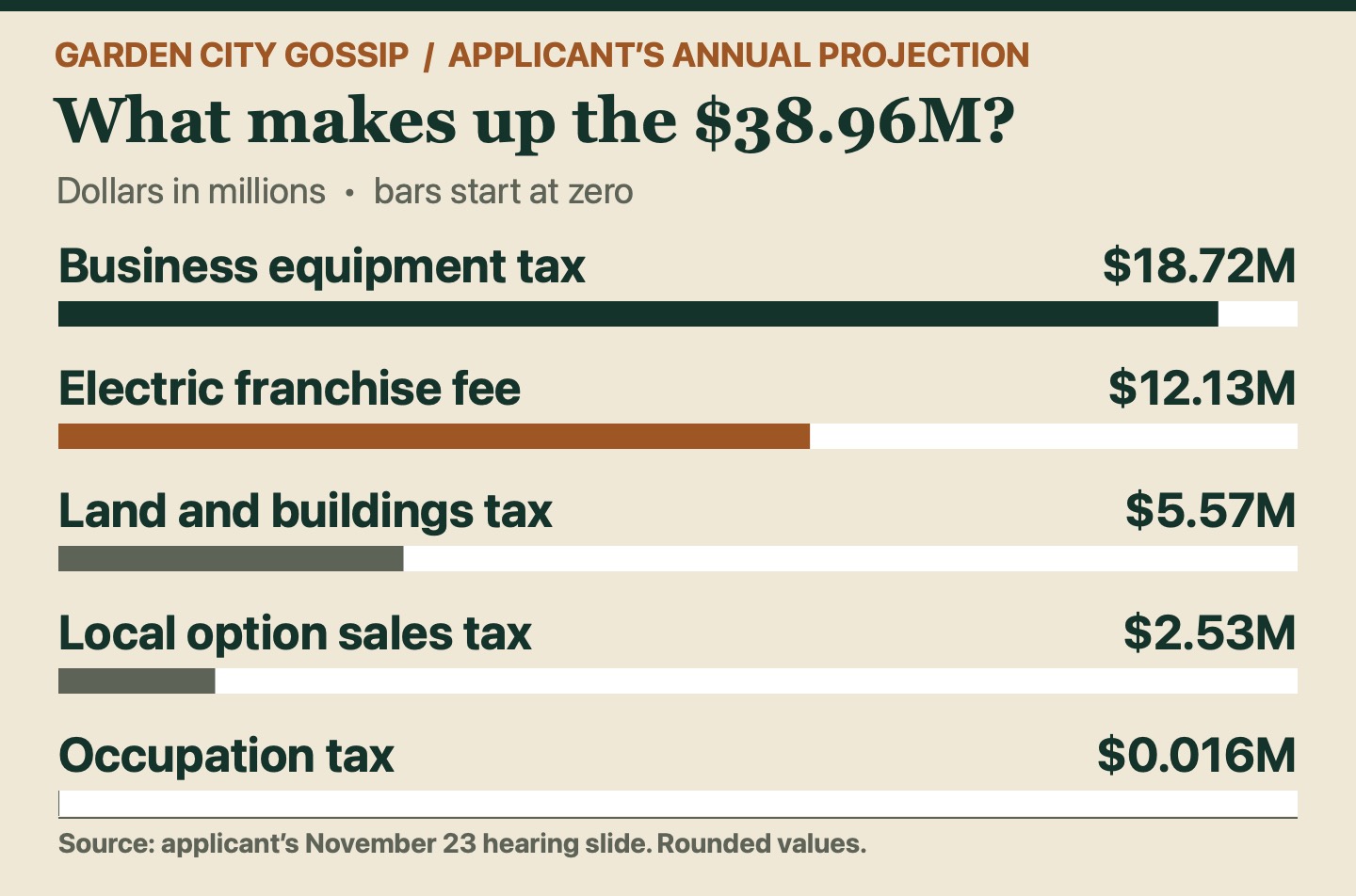
Augusta can get all seven buildings and still miss the revenue projection. If tenants install fewer servers, or install them later than projected, there is less taxable equipment on the books. At the same tax rate, a smaller equipment tax base means smaller property-tax collections. And if the campus draws less electricity than projected and the utility bills it less, Augusta gets a smaller franchise payment. The fee is a share of covered utility revenue, not a payment for reserving 600 megawatts. A contract could require minimum payments even if actual power use falls short, but I found no Nixon agreement showing a minimum or how it would count toward the fee. Georgia property valuation rules · Augusta Finance report · PSC on large-load contracts
Here's the scale of that risk. If the equipment-tax and franchise-fee lines each came in at half the developer’s estimate, and every other line held steady, the $38.96 million headline would drop to about $23.5 million in gross local revenue. That isn’t a forecast. It shows how much of the projected benefit depends on equipment actually arriving and power actually being sold. A smaller tax base does not shrink the bill for permanent infrastructure already put in place. Developer’s fiscal slide
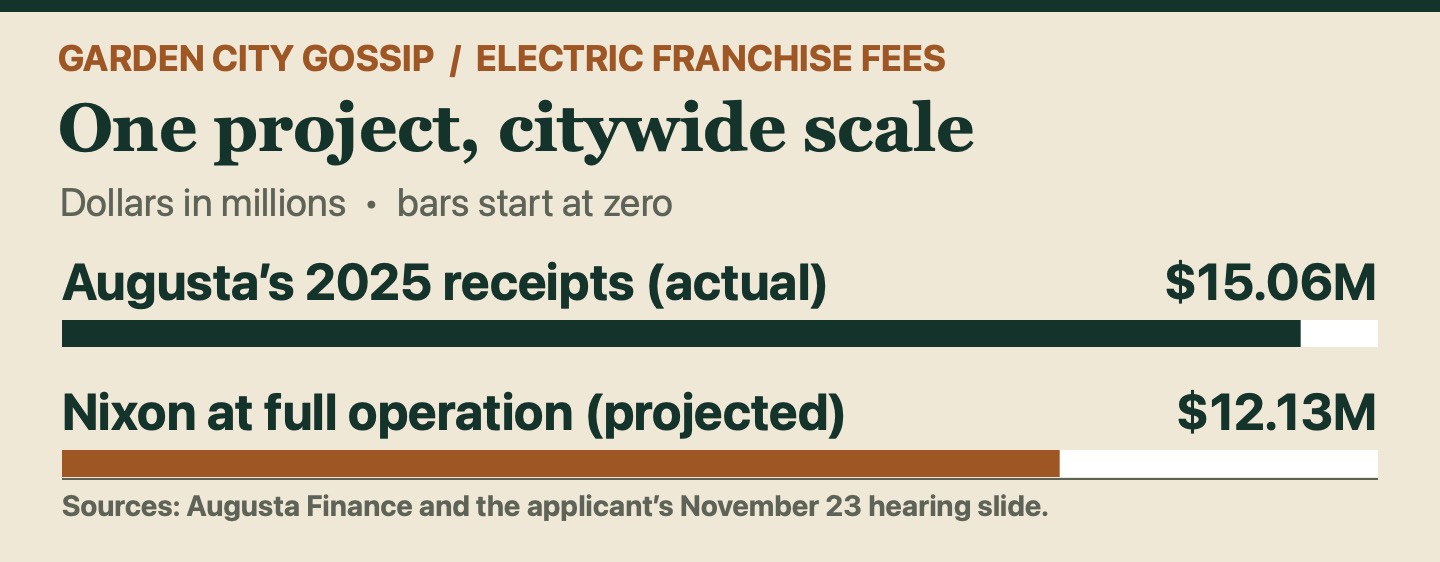
The franchise fee does go to Augusta’s General Fund. At the city’s published 4% remittance, the projected fee implies about $303 million a year in covered utility sales. For scale, Augusta’s budget records about $15.06 million in 2025 electric franchise receipts. Georgia Power and Jefferson Electric remitted that money in a first-quarter installment based on prior-year Richmond County sales. Nixon’s projected $12.13 million from one campus is roughly four-fifths of that entire collection. That compares dollars, not megawatts or kilowatt-hours: large industrial customers can pay different rates and charges. It is a useful yardstick for the scale of the power purchases, and a reason to insist on a full engineering and cost review. Augusta’s 2026 budget, account 3117110 Since Augusta is paid on the prior year’s revenue, even the draft’s timeline would make the first quarter of 2033 the earliest payment reflecting a full calendar year of permanent service. A full year of service is no guarantee of a fully occupied campus. And if the eventual operator qualifies for Georgia’s equipment sales-tax exemption, that would affect eligible purchases, not automatically erase the annual property tax. The applicant says it is not asking for a local tax break; that assurance is no substitute for seeing the model’s assumptions. Augusta Finance report · Applicant counsel’s statement · Georgia equipment exemption
The same slide shows 552 direct permanent full-time equivalents and 539 jobs attributed to suppliers and spending in the wider economy. That is how the presenter got to roughly 1,000. The slide does not say there will be 1,000 people working at Nixon, and the public record does not reconcile 552 with the 40 full-time employees in the state filing. QTS, on a separate Augusta project, projects 45 permanent jobs on its own payroll and 160 to 220 on site including tenants. Construction jobs are valuable while they last. Augusta does not collect a local wage tax from those workers, and construction activity should never be counted as a recurring return. Developer’s jobs slide · State filing · QTS Augusta figures · Georgia’s local income-tax prohibition
There is a respectable argument for expanding Augusta’s tax base. Make it with numbers the public can check. Show what Augusta actually keeps each year if only one phase opens, the servers arrive late, or the campus supplies its own power. Separate school revenue from money the city can spend, and subtract the costs the city would bear. A full-buildout slide is no substitute for that work.
Then put the obligations in writing before the vote: who funds the roads and electrical infrastructure, what the customer owes if it uses less power, what kind of generation and cooling are permitted, what the metered water limits are, and what security pays for cleanup if the project is abandoned. Put those protections in enforceable approvals and agreements that bind the next owner or operator, too. Augusta doesn’t have to settle every engineering detail before a zoning vote. It does have to settle who takes the risk.
Start with a developer-funded cleanup bond, payable to Augusta. Agree to that requirement before the zoning vote and require the bond to be in place before any land is disturbed. Set the amount from an independent estimate of what it would cost to secure and restore the site if construction stalls or the campus shuts down. Update it as each phase is built and keep it in force through a sale or transfer until the city verifies the work is done. A promise to clean up is worth little if the company that made it is out of money. The city’s posted draft text discusses plans for decommissioning and recovery of cleanup costs. Augusta should insist on financial security it can actually draw on for this project, rather than counting on recovering money after a failure. Augusta’s posted draft text, §§ 24-A12–13
The revenue promise needs its own backstop. If the developer asks Augusta to vote on the strength of projected revenue, require a written minimum for the amount Augusta itself would receive each year. Use a city-verified, year-by-year schedule, not the $38.96 million gross estimate that includes revenue the city may not keep. Each year, compare actual project receipts credited to Augusta with that minimum. If tenants install less equipment or the campus buys less utility power and the city comes up short, the project owner pays the difference. Secure that obligation with a payment bond or comparable financial security Augusta can draw on, and require any successor to assume the obligation and keep the security in force. This is a proposed protection, not an existing Nixon commitment. Augusta’s lawyers should confirm a lawful way to structure it before any approval. If nobody will stand behind the number, commissioners should not vote as though it were guaranteed.
The protection has to survive the sale of the project. A buyer can take control by buying the land, taking over the lease, or buying the company that holds it. In any of those cases, Augusta should insist, to the extent the law allows, that the new owner or operator assume the obligations in writing and that the original obligors stay on the hook unless Augusta approves an equally strong replacement. The cleanup and revenue commitments should be backed by an independent surety, a bank letter of credit or protected cash escrow that Augusta can draw on if the responsible company defaults. Require replacement or renewal before the security expires, and never release it just because the project changes hands.

Augusta already knows what industry can leave behind
The Merry Brickyard Ponds near Phinizy Swamp are old clay pits that became waterfowl habitat. That is a good use of a landscape industry changed, not a Superfund story. South Augusta has one of those, too: at the Peach Orchard Road groundwater plume, EPA says it could not secure payment from a viable responsible party and that taxpayers are funding the cleanup. And just across the river, Avondale Mills in Graniteville closed in 2006 after reopening following the previous year’s chlorine derailment. EPA later described a redevelopment effort covering 15 shuttered mills and a steam plant, supported in part by public grants. The brickyards, the plume and the mills are different stories. They make the same point about time: the land and the community are still there long after the business changes or leaves. Augusta’s comprehensive plan · EPA’s Peach Orchard Road site profile · U.S. DOT on the Graniteville closure · EPA Brownfields guide on Avondale
Across the river in South Carolina, the Department of Energy is still closing radioactive-waste tanks and cleaning up Cold War contamination at the Savannah River Site. The river has a separate industrial history, too. Federal researchers identified Olin’s mercury-cell chlor-alkali plant near Augusta as an upstream source of mercury discharged directly to the Savannah River, particularly in the late 1960s. The same research documents separate mercury releases from federal operations into on-site seepage basins. A data center is not a weapons complex or a chlor-alkali plant. The lesson is about how long the consequences of an industrial decision can last, and why the agreement ought to identify who pays for the work at the end. DOE’s Savannah River Site cleanup program · Federal historical mercury assessment
There is a local precedent for insisting on money behind the promise. EPA’s 2012 settlement with Southern Wood Piedmont and its parent, Rayonier, covered five facilities, including one in Augusta. EPA reported $41.7 million in financial assurance for closure and corrective work across those facilities, not for Augusta alone. And South Carolina’s legislature recorded in 2025 that utility customers were still paying costs tied to the two unfinished V.C. Summer reactors abandoned in 2017. An unfinished project can keep sending bills even when it delivers none of the benefit it was built for. EPA’s Southern Wood Piedmont settlement · South Carolina’s V.C. Summer resolution
In the national Kerr-McGee and Tronox case, a bankruptcy court found that asset transfers left the spun-off company insolvent and burdened with legacy liabilities. The litigation ended in a $5.15 billion settlement plus interest. In California, a bankruptcy court released Exide from its obligation to clean up its former lead-battery facility in Vernon. Neither case tells us what Nixon’s developers intend. They tell us why Augusta should secure the money now instead of assuming a future lawsuit will pay for the work. EPA on the Tronox litigation and settlement · California’s Exide bankruptcy record
That is not a case against every data center. It is a case against approving this one on the record we have. Johnson is right to side with the people who will live with the decision. His colleagues should join him and deny the Nixon rezoning. If the developer comes back, let it come back with numbers Augusta can verify and terms Augusta can enforce.