

The Savannah River Site is reporting no operational emergency Monday, five days after a fire at its national laboratory brought traffic restrictions and precautionary sheltering. What residents still cannot get from the site’s published emergency notices is a full explanation of what started the fire and why the response unfolded as it did.
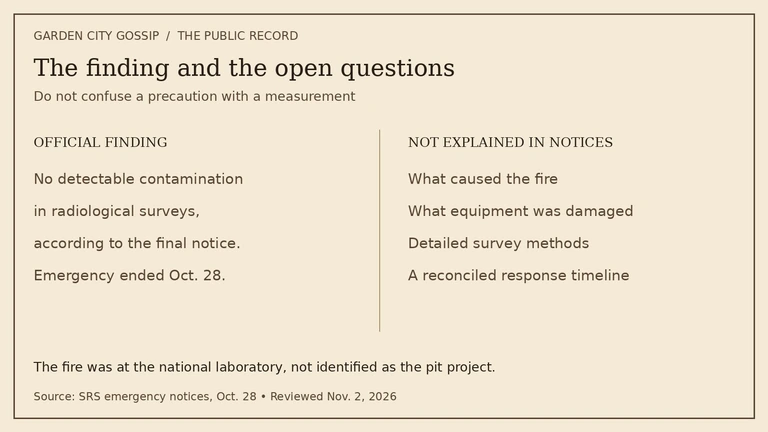
The most consequential finding in the final notice was reassuring: radiological surveys found no detectable contamination. Officials ended the emergency at 9:45 p.m. Wednesday, Oct. 28. The site’s status page, dated Nov. 2, now reports neither operational emergencies nor scheduled delays.
That is a different question from whether the incident has been fully explained. As of Monday’s review, the SRS latest-updates page still led with the Oct. 28 emergency notices. Those statements do not identify the cause, quantify damage or give a detailed account of the work underway where the fire occurred.
For Augusta and the surrounding communities, the next useful development is not another frightening image of a nuclear complex. It is an incident account that connects the initial alarm, protective decisions, measurements and eventual all-clear.
What happened Wednesday
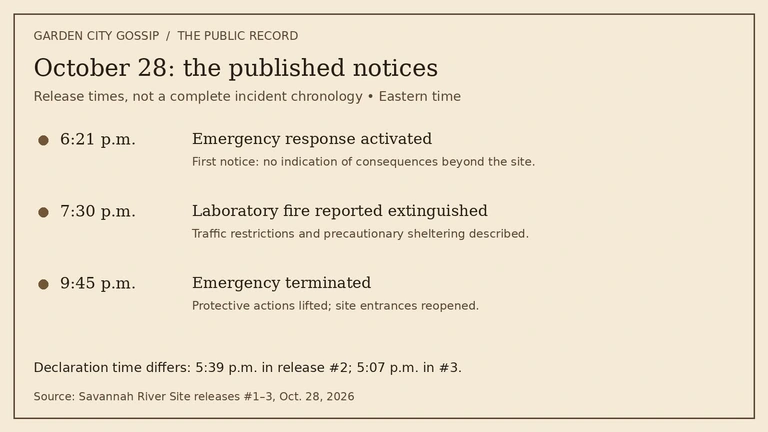
The first official release, marked 6:21 p.m., said an event had activated the emergency response organization. It did not identify a fire. It reported no indication of consequences beyond the site boundary.
The 7:30 p.m. update identified the Savannah River National Laboratory as the location and said the fire had been extinguished. Incoming vehicles were being held at site entrances; rail, river and air movements nearby were restricted. Some employees in affected areas were sheltering as a precaution while response and shutdown personnel continued their work.
The 9:45 p.m. release ended the emergency and lifted protective measures. Highway 125 was open, and employees were told to report for their scheduled shifts.
There was also an injury. A Department of Energy spokesperson told South Carolina Public Radio that one employee was taken to a hospital with minor injuries. That report should not be confused with evidence of radiation exposure.
DOE subsequently told The Associated Press that no radiological material was released and employees were not exposed to radiological contamination. AP also reported calls from nuclear watchdogs for a fuller explanation. Those requests for scrutiny are not findings that contamination occurred.
Two declaration times remain in the record
The notices contain a small but concrete inconsistency. Release No. 2 places the emergency declaration at 5:39 p.m.; release No. 3 gives 5:07 p.m. Neither explains the change.
That does not establish a delayed response, and the publication times on the releases are not necessarily the times every warning reached workers or neighboring governments. It does mean a reconstruction should not select one declaration time without explanation.
A reconciled chronology would show when the fire was discovered, when responders were notified, when the emergency classification was applied and when protective measures began. The two stated declaration times cannot, by themselves, answer any of those additional questions.
What the emergency label means
SRS’s community preparedness guide places a Site Area Emergency between an Alert and the more severe General Emergency. It describes a response in which government agencies are notified and may prepare precautionary protection for people nearby.
A classification tells readers which response framework has been activated. It is not a laboratory result. The guide’s examples of possible incidents do not establish what happened inside this particular building Wednesday.
The distinction matters because a warning and a later favorable survey result can both be accurate. Officials can take protective steps while determining the extent of an incident. Assessing whether those steps were timely and sufficient requires the underlying chronology and findings, rather than treating the existence of precautions as proof of an off-site release.
The laboratory is not the planned pit facility
The laboratory fire also arrived during a major change elsewhere at the sprawling federal site. On Oct. 16, the National Nuclear Security Administration announced approval for full construction activities on the main processing building for Savannah River’s plutonium-pit project. Pits are components of nuclear weapons.
The announcement describes a production complex with supporting facilities, covering 160 acres. It is context for the site’s future workload and public oversight—not evidence that the Oct. 28 fire occurred in that project. The emergency notices locate the incident at the national laboratory.
Keeping those facilities straight is essential to understanding both stories. Questions about future construction cannot substitute for identifying the equipment, activity and conditions involved in the laboratory incident.
What a fuller account would establish
The remaining questions are specific: What burned? What was being done nearby? Which protective systems operated, and were any found deficient? What locations were surveyed, when were measurements taken, and what methods supported the contamination findings?
None of those questions presumes an adverse answer. A useful follow-up report could establish that safeguards performed as intended, identify improvements, or do both. It would also explain whether any corrective work is required before the affected operation resumes, without confusing the broader site’s status with the condition of a particular work area.
Residents can use the SRS status page for operational notices and the preparedness guide for local warning channels and planning zones. The guide directs people to follow official instructions for their zone during an emergency. Wednesday’s restrictions should not be recirculated as if they were still in force Monday.
The emergency has ended. A clear explanation of how it began, and what the response established, is the next part of the public record to watch.
More from GCG: Government coverage.