Garden City Gossip Investigation
By Garden City Gossip Investigative Desk
Original Reporting | Augusta, Georgia
With Augusta’s mayoral election set for May, a committee most voters have never attended is rewriting the document that will define how much power the next mayor actually holds.
Over the past year, the Augusta Charter Review Committee has been revising the city’s governing charter — the legal blueprint that determines who hires department heads, who supervises staff, and who answers when something goes wrong.
The debates have sounded technical. The votes have looked procedural.
But a review of official transcripts from May 2025 through February 2026 reveals a consistent divide — and a set of members who repeatedly align when questions of accountability and authority surface.
This is original reporting by Garden City Gossip based on those records.
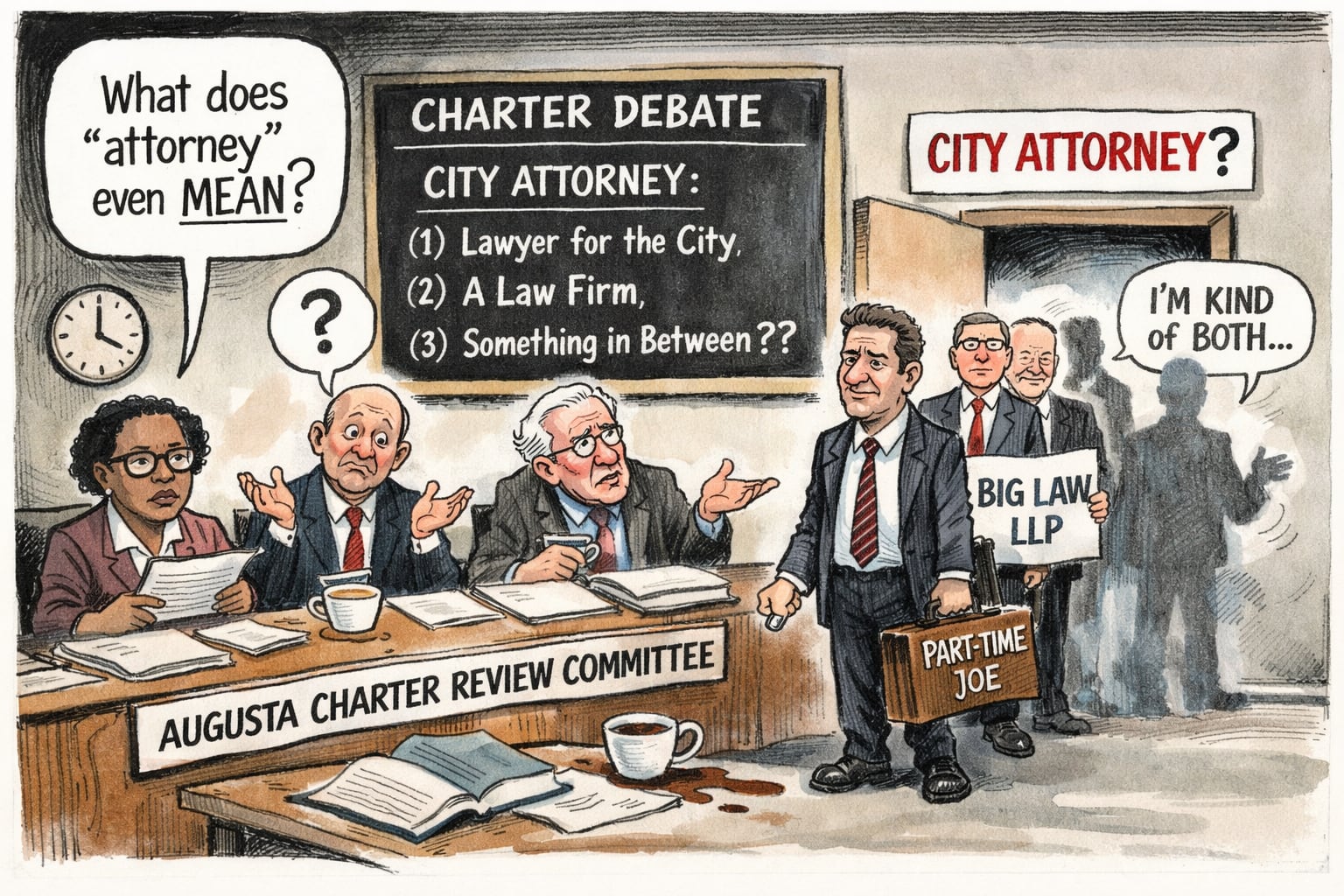
The Title Fight: “City Attorney” vs. “General Counsel”
Before the committee ever reaches the larger mayor-versus-administrator debate, it has spent an outsized amount of time on what appears to be a semantic dispute: whether the charter should refer to the government’s top lawyer as the “City Attorney,” “General Counsel,” or “Counsel for the City.”
On its face, the distinction seems minor.
But in practice, the person — whatever title is used — runs the city’s law department and serves as the chief legal advisor to the Augusta-Richmond County Commission. This individual drafts ordinances, interprets charter language, advises on contracts, defends litigation, and determines what actions are legally permissible.
In other words, title aside, it is the same job.
Yet the committee’s prolonged debate over terminology reflects something deeper: who that lawyer ultimately answers to, how independent the role is structured to be, and whether accountability rests with a clearly identified individual or a broader structure.
The dispute over wording has become a proxy for a larger question — how tightly authority should be defined in the charter itself.
A 7–3 Vote That Reveals a Pattern
On February 5, 2026, the committee considered language allowing a law firm — rather than a single named individual — to serve in that top legal role.
Supporters described the change as practical flexibility. Opponents argued it blurred accountability, warning that if different attorneys rotated through meetings, responsibility for legal advice could become diffuse.
The motion passed 7–3.
Voting no were:
- Miss Robinson
- Miss Bakus
- Mr. Eric Gaines
In the transcript, concerns centered on consistency and clarity. If advice shifts from one attorney to another, who bears responsibility when guidance proves flawed?
The majority advanced the language anyway.
Another Attempt to Loosen Structure
During that same meeting, a substitute motion sought to soften mandatory language regarding whether the attorney must be an employee of the government or could be an independent contractor. The proposal would have replaced “shall” with “may,” allowing more discretion.
That substitute motion failed.
The transcript records six “no” votes, though the roll call in that segment does not list every name. The debate echoed the earlier division: flexibility versus structural certainty.
The pattern is not isolated.
The Members Who Consistently Align
Across meetings, certain names reappear in consequential splits.
Robinson, Bakus, and Gaines
These three voted together against the 7–3 general counsel provision. Their recorded comments emphasize defined lines of responsibility and skepticism toward language that expands discretion without clarifying oversight.
Pearson
Mr. Pearson has frequently voted with the prevailing majority coalition on structural and procedural revisions. In a May 1, 2025 hearing, he supported a substitute motion that ultimately passed. In February 2026, he again voted with the majority on the legal counsel provision.
Powell
Mr. Powell has demonstrated a willingness to dissent independently. In May 2025, he cast the sole “no” vote on a procedural motion regarding public comment placement — signaling that close votes in the future may hinge on individual judgment rather than predictable blocs.
Why This Matters Before May
The Charter Review Committee does not set policy. It writes the rules under which policy is made.
The individual labeled “City Attorney,” “General Counsel,” or “Counsel for the City” — regardless of title — plays a central role in advising the Augusta-Richmond County Commission and interpreting the charter itself. How that position is structured can influence how freely a mayor acts and how insulated legal advice is from political shifts.
With a mayoral election in May, the stakes are immediate.
The next mayor will inherit whatever structure this committee finalizes. If authority is consolidated and flexibility expanded, executive discretion could widen. If guardrails remain firm and accountability tightly defined, operational independence may be preserved.
Based on recent voting patterns:
- Robinson, Bakus, and Gaines have shown caution toward expanding structural flexibility.
- Pearson has often aligned with modernization efforts advanced by the majority.
- Powell’s independent streak could become decisive in narrower votes.
If similar alignments hold when broader governance questions arise, margins may be slim.
After Twenty Years, Augusta Cannot Afford to Get This Wrong
Augusta’s current charter has been in place for roughly two decades — and during that time, city government has repeatedly struggled with ambiguity over authority, blurred lines of supervision, public disputes between elected officials and administrators, and recurring legal and procedural confusion.
Much of that dysfunction traces back not to personalities, but to structure.
When authority is unclear, conflict fills the vacuum. When oversight is undefined, accountability weakens. When legal roles are loosely drawn, power shifts through interpretation rather than design.
This charter review represents the first comprehensive opportunity in twenty years to correct those structural flaws.
Whether the committee tightens definitions or expands flexibility, whether it centralizes authority or reinforces guardrails, the decisions made now will shape Augusta’s governance for decades — long after this election cycle passes.
The mayor chosen in May will matter.
But the durability and clarity of the charter they inherit may matter even more.
Garden City Gossip will continue to follow every vote, every amendment, and every structural shift.
Because after twenty years of governance friction, getting the charter right is not a technical exercise.
It is a necessity.





2 Responses
Clarifying just a few things:
1. My last name is spelled Bakos
2. The charter is 30 years old, not 20
3. We didn’t have a prolonged debate over the title of the General Counsel. The two main points of discussion were whether the GC would be an employee or independent contractor; and if the GC is an individual and/or law firm.
4. The first motion made was by me (Bakos) to accept it as written but remove the sentence referring to law firms. 2nd by Gaines, it failed 3-7 with Bakos, Gaines, Palmer voting yes and Lewis absent.
The second motion made by Foushee, 2nd by Powell to accept as written. Robinson made a substitute motion to change ‘shall’ to ‘may’, 2nd by France and it failed 4-6 with Robinson, France, Powell and Palmer voting yes. Going back to Foushee’s motion to accept as written, it passed 7-3 with Robinson, Gaines and Bakos voting no.
Just a suggestion. Go to the YouTube videos for the CRC meetings. Click on the description and opt to view transcript. Copy/paste the transcript into a Word Doc. Then when you’re trying to figure out voting results, you can just ‘control F’ and search by keywords rather than scrolling back and forth through video for the exact moment. 😉