A Homicide Without a Mechanism
and a Constitutional Question That Could Eclipse It – And Cause a Mistrial
Augusta, GA –
For most of Thursday, the Tripp trial revolved around bones.
A veteran forensic pathologist from the Georgia Bureau of Investigation told jurors that the skeletal remains recovered in this case were the result of “homicidal violence.” The manner of death, she said, was homicide. The chief reason for that conclusion was not a bullet wound, not blunt force trauma, not strangulation marks — but the clandestine burial of the body itself.
The remains were skeletonized. There was little soft tissue left. No definitive injury could be identified. No medical mechanism of death could be determined.
Still, the pathologist ruled it a homicide.
In a murder case that has stretched more than eight years, that ruling matters. The State must prove not only that a person died, but that the death was caused by criminal agency — not accident, not suicide, not natural causes. Thursday’s testimony gives prosecutors a formal, medical classification of homicide. It supplies the legal footing to argue that this was not an unexplained death but a criminal one.
But it does not answer the harder question: how.
And it does not answer the hardest question: who.
The pathologist acknowledged she could not determine the specific cause of death. There was no anatomical finding that revealed how the victim was killed. The conclusion rested on the surrounding circumstances — investigative reports, photographs, and most significantly, the fact that the body had been hidden.
“Dead people don’t bury themselves,” she said.
It is a powerful line. It is also a legal bridge built on inference.
The prosecution’s case, at this stage, relies heavily on circumstantial strands. One of those strands was played for jurors in the form of Leon Tripp’s first custodial interrogation.
In that recorded interview, conducted shortly after his arrest in Atlanta, Leon insisted that the victim traveled with him there and was alive when he last saw her. He described a house off Oakland Drive. He said he gave her $400 to shop and take a bus home. He named people who might have seen her. He suggested she may have traveled elsewhere.
Investigators returned again and again to one theme: no one could independently verify that she was ever there.
No neighbor. No store employee. No bus ticket. No surveillance footage. No third-party witness who could place her alive in Atlanta.
The interrogation was not a confession. It was not even a clear contradiction. It was something subtler: a narrowing of the timeline. If no one can confirm she was alive after traveling with Leon, and she was later found buried, the State asks the jury to draw a conclusion from absence.
The forensic testimony and the interrogation work together. The medical examiner establishes that the death was a homicide. The interrogation invites jurors to question whether Leon’s account creates a verifiable endpoint.
Defense Moves for Mistrial due to Conflict of Interest
But just as the State appeared to solidify one element of its case — criminal agency — another issue surfaced that could destabilize the proceedings entirely.
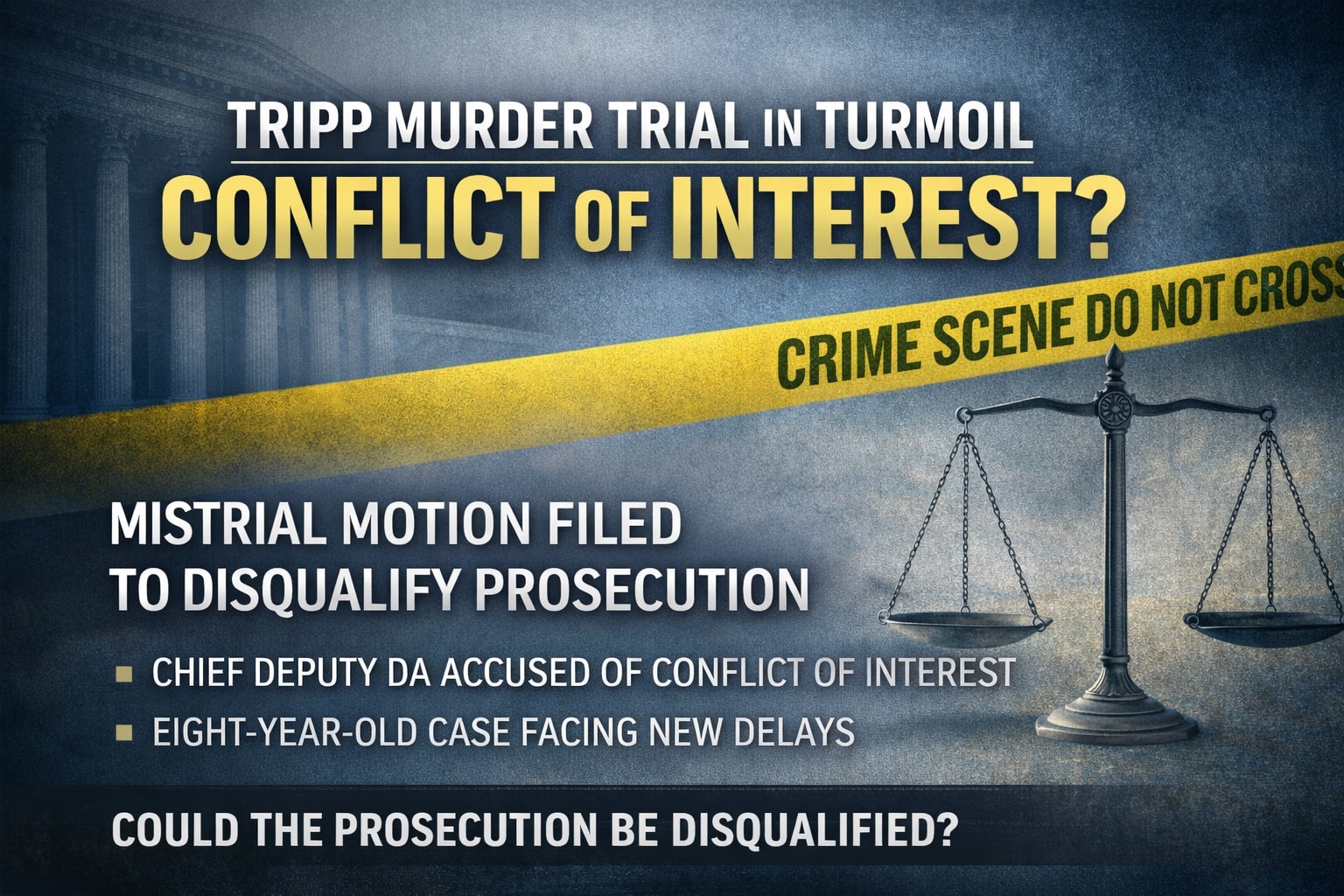
After the jury left the courtroom, Tanya Tripp’s attorney moved for a mistrial and asked the judge to disqualify the entire District Attorney’s Office from any future retrial.
The basis for that motion lies not in the evidence presented to the jury, but in the institutional history of one of the prosecutors.
Kevin Davis, now the Chief Deputy District Attorney and second-in-command in the office, previously worked at the local Public Defender’s Office during the period when Tanya Tripp was represented there in this very case. The State has acknowledged that Davis has been intimately involved in prosecuting the case. He has been present in court. He has participated on the State’s side.
The constitutional question is not whether Davis acted in bad faith. It is whether the adversarial line between defense and prosecution was ever crossed — even unknowingly.
A prosecutor cannot prosecute a case in which he previously represented the defendant or had access to confidential defense information in that same matter. The rule protects attorney-client privilege and the integrity of the criminal process. If a lawyer who once stood on the defense side gains access to privileged strategy and later stands on the prosecution side, the concern is structural. The fairness of the proceeding itself comes into question.
Defense counsel argued that the Public Defender’s Office commonly handled major cases collaboratively, with group meetings and shared discussion. This case, he suggested, was significant enough that it would have been difficult not to know about it inside the office. Whether Davis had any personal involvement, supervisory role, or access to confidential strategy remains unknown. The lawyers are briefing the issue for argument Monday.
If Davis had no exposure to the defense’s confidential information, the motion likely fails. If he did — even indirectly — the remedy could be severe: mistrial, disqualification of the office, appointment of a special prosecutor.
And hovering over all of it is time.
This case is already more than eight years old. If a mistrial is granted and the prosecution must begin again under a new office, the delay will grow longer. Under constitutional speedy trial principles, courts weigh not just the length of delay, but the reasons for it. Delay caused by structural prosecutorial conflict carries different weight than delay caused by ordinary scheduling.
None of that has been decided. The jury has not heard any of it. But the case now stands at an inflection point.
Thursday provided the State with what it needed to argue that a crime occurred. It did not provide medical certainty about how. Leon’s interrogation raised questions about verification and credibility, but not direct proof of killing.
And now the focus shifts from bones and timelines to institutional integrity.
In a case built largely on inference, the next question before the court is not what happened years ago — but whether the prosecution team itself has been irreperably tainted.
For Prior GCG Special Coverage:
Jury Selection Continues in Janell Carwell Murder Trial; Opening Statements Likely Thursday
Nearly Nine Years Later, Opening Statements Reveal the Battle Lines in the Tripp Trial