

A public decision now facing White Oak concerns water permits rather than tax incentives: whether a proposed data-center campus in Columbia County can proceed with permanent impacts to nearly 4.7 miles of streams and 4.36 acres of wetlands.
Those are the impacts described in an October 13 Army Corps of Engineers public notice for permit application SAS-2019-00750, not a record of completed damage or a final permit. Georgia's Environmental Protection Division has separately opened water-quality certification review, with a notice close date of Nov. 15.
Kinetic Infrastructure Solutions, LLC proposes 12 data-center buildings, two substations and associated roads, offices, utilities and stormwater facilities on about 3,152 acres west of the intersection of Interstate 20 and Appling Harlem Road. The waters are associated with Kiokee Creek. The Corps notice does not identify an eventual data-center customer.
The scale makes the permit documents a distinct accountability record from the incentives covered in GCG's earlier Columbia County tax-deal story. They show which waters the applicant proposes to affect, what alternatives it says it considered, and how it proposes to compensate for aquatic losses.
What would change on the site
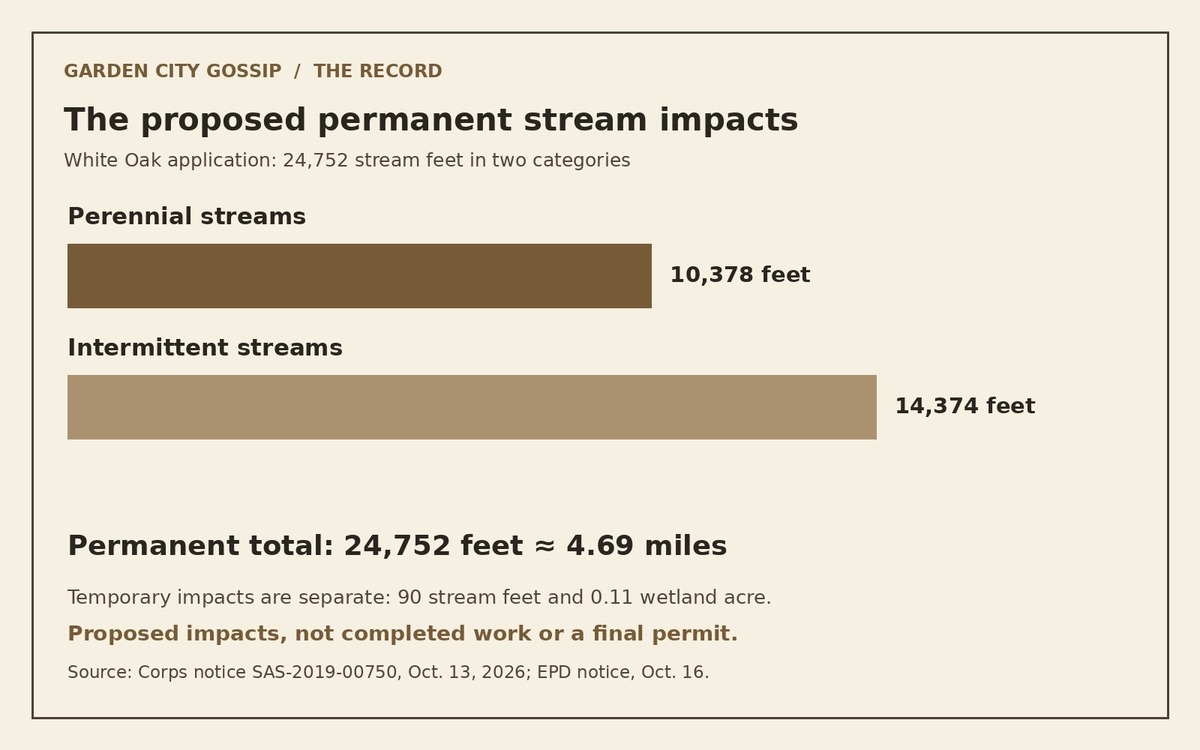
The permanent stream total combines 10,378 feet of perennial stream and 14,374 feet of intermittent stream. The application also proposes temporary impacts to 90 feet of perennial stream and 0.11 acre of wetland. The permanent and temporary figures should not be conflated.
The Corps notice describes six permanent roadway stream crossings: three embedded box culverts and three bridges designed to avoid impacts to waters. A power-line maintenance road would require four more box culverts. Other water impacts would result from grading.
The applicant's delineation identified 198 streams, 104 wetlands and three ponds across the property. Those are site inventories, not a claim that every identified feature would be filled. The notice says Corps personnel verified the geographic extent of aquatic resources that are, or are presumed to be, within federal jurisdiction. It separately warns that applicant-furnished information had not yet been evaluated for compliance with the regulatory program.
Alternatives and mitigation remain claims to examine
According to the applicant's account in the notice, four possible sites were screened and three considered practicable. Five layouts were examined for the preferred site. A layout avoiding all on-site waters was rejected because it would provide much less processing and storage capacity than the applicant says the project needs.
The applicant says its preferred configuration produces the least impact among the remaining layouts. That is its explanation for the design, not a final Corps finding that every impact is unavoidable.
The proposed compensation is the purchase of stream and wetland mitigation credits. The notice gives 20,885.75 stream credits under the 2018 method and 4.23 wetland credits under that method, with alternative totals under the older credit system. Those are accounting units for compensatory mitigation, not feet of stream or acres of wetland to be restored on this property.
The public review can therefore examine two different matters: how much harm the project could avoid through its layout, and whether the compensation proposed for remaining impacts is adequate. Purchasing credits does not itself answer the first question.
Two reviews, different comment instructions
The Corps says comments will inform its decision whether to issue, modify, condition or deny a permit. Its review includes water quality, wetlands, flood hazards, wildlife, historic properties and other public-interest factors. A request for a public hearing must explain the reasons for holding one.
The federal notice has a date conflict. Its front page says it expires Nov. 12, while its written-comment instructions say Nov. 11. Readers should not rely on the later date without confirmation from the Corps. The notice lists the Regulatory Request System, project manager Justin Edwards at justin.m.edwards@usace.army.mil, and the application number SAS-2019-00750 for submissions or questions.
The separate state notice is clearer about its own period: Oct. 16 through Nov. 15. EPD says this certification review considers water-quality comments. They may be sent to EPD.WQC@dnr.ga.gov, with “Water Quality Certification Comment” and SAS-2019-00750 in the subject line, or by mail using the address in the notice. It gives no cutoff hour; submitting early avoids relying on an unstated end-of-day deadline.
Specific observations about drainage, stream crossings, sediment control or downstream waters can be tied to the plans and resource maps in the application. A comment need not resolve the whole regional debate about data centers to address what these permits actually decide.
The application describes a large campus and a substantial change to its waterways. The pending question is whether the proposed design, safeguards and compensation satisfy the review, not whether a tax agreement has already settled it.