Day: June 5, 2026

  • Columbia County library hire draws scrutiny amid ongoing book controversy 

    Columbia County library hire draws scrutiny amid ongoing book controversy 

    Open records show Children’s Librarian Manager Laura Grove was hired while on administrative leave from Richmond County Schools following allegations involving a former student.

    by Karin Parham

    UPDATE (June 6, 2026): After publication of this article, Columbia County issued a statement regarding Grove’s hiring. The county stated that neither Columbia County Libraries, County Administration, nor Human Resources were aware of the allegations or ongoing investigation referenced in this article at the time of hire. The county further stated that Grove was placed on administrative leave after officials became aware of the allegations and related court filings. The full county statement is included below.

    Correction (June 10, 2026): An earlier version of this article attributed a records response to the Richmond County Sheriff’s Office. The original request was routed to Richmond County 911, which reported no responsive records. A subsequent request to the Richmond County Sheriff’s Office also returned negative results. The article has been updated to reflect responses from both agencies.

    UPDATE 2 (June 10, 2026): Additional records obtained from the Augusta Judicial Circuit District Attorney’s Office provided further information regarding the allegations involving Laura Grove. In an email released through an open records request, District Attorney Jared Williams stated that the matter was opened and closed on June 2, 2025 because the allegations fell outside the statute of limitations. The records also included statements from two former students who alleged they had a sexual relationship with Grove while they were students at A.R. Johnson Health Science and Engineering Magnet School, as well as a written statement from Grove denying those allegations. In her statement, Grove acknowledged maintaining close relationships with both former students during and after their time in school, but denied the allegations.

    Columbia County Libraries hired Children’s Librarian Manager Laura Grove in August 2025 while she remained on administrative leave from Richmond County Schools and amid an open Georgia Professional Standards Commission case, according to records obtained through Open Records Requests.

    Grove had worked for the Richmond County School System for nearly two decades before being placed on paid administrative leave on June 3, 2025 pending an investigation into alleged “unprofessional behavior.”

    The hiring occurred during a period of significant upheaval within Columbia County’s library system, following months of controversy over youth book placement policies and the departure of several longtime librarians who publicly cited concerns about professional ethics.

    Records show Grove applied for the Columbia County position on July 29, 2025 while still employed by Richmond County Schools and while on administrative leave. Richmond County formally released Grove from employment on Aug. 7, 2025. Columbia County Libraries issued an offer letter four days later, on Aug. 11, 2025.

    Laura Grove’s Employment History With Richmond County Schools

    Documents show Grove worked for the Richmond County School System for nearly two decades. Employment records place her first at C.T. Walker Elementary Magnet School beginning in 2006 before later serving as a media specialist at Goshen Elementary School and eventually at A.R. Johnson Health Science and Engineering Magnet School.

    On June 3, 2025, Richmond County Schools placed Grove on paid administrative leave pending an investigation into alleged “unprofessional behavior.” The letter instructed Grove not to contact students or enter school campuses while the investigation was ongoing.

    Letter issued to Laura Grove from RCSD placing grove on administrative leave dated June 3, 2025

    Divorce and Emergency Custody Filings

    The administrative action came months after allegations surfaced in divorce and emergency custody proceedings filed in Columbia County Superior Court. Court records show Grove’s former spouse filed for divorce in April 2024. In February 2025, the plaintiff filed an emergency motion for change of custody and related relief.

    An affidavit from a former student attached to those filings alleged Grove engaged in an inappropriate sexual relationship with that individual while employed within the Richmond County School System. The filings also alleged inappropriate communications involving additional students and referenced prior reports allegedly made to school administrators.

    Following an emergency hearing, the court granted the plaintiff sole legal and physical custody of the couple’s children and exclusive possession of the marital residence pending additional proceedings. Final settlement documents filed in October 2025 continued sole legal custody with the plaintiff and established visitation provisions for Grove.

    Redacted affidavit filed in Columbia County Superior Court as part of February 2025 emergency custody proceedings. Names of the former student, family members, and children have been removed.

    Open Records Requests and Agency Responses

    The allegations contained in the affidavit were made in civil court filings and do not constitute criminal findings.

    Richmond County Schools released personnel and contract records responsive to Open Records Requests but stated portions of the records were withheld or redacted under exemptions covering personnel evaluations, student records, medical information, and investigative materials related to employee discipline or complaints.

    Open records responses from Richmond County 911, the Richmond County Sheriff’s Office, and the Columbia County Sheriff’s Office found no responsive records related to the allegations. A records request was also submitted to Georgia DFCS, but the agency declined to release records or state whether responsive records existed, citing confidentiality laws governing child welfare and CPS information.

    The Georgia Professional Standards Commission (GAPSC), the state agency responsible for educator certification and ethics enforcement, responded to an Open Records Request by stating records related to Grove could not be released because of an open investigation.

    Following publication, additional records obtained from the Augusta Judicial Circuit District Attorney’s Office provided further information regarding the allegations. In an email released through an open records request, District Attorney Jared Williams stated that the matter was opened and closed on June 2, 2025 because the allegations fell outside the statute of limitations.

    The records released by the DA’s Office included statements from two former students alleging inappropriate sexual relationships with Grove while they were students at A.R. Johnson Health Science and Engineering Magnet School. The records also included a written statement from Grove denying those allegations. In her statement, Grove acknowledged maintaining close relationships with both former students during and after their time in school, but denied the allegations of inappropriate sexual activity.

    Columbia County Library Application and Hiring Process

    Records further show Grove applied for the Columbia County library position on July 29, 2025, during Richmond County’s pre-planning period for the 2025-26 school year. In her application with Columbia County Libraries, Grove listed July 29, 2025, as the date she was available to begin work. At the time, she remained employed by Richmond County Schools and had been on paid administrative leave pending an investigation since June 3, 2025.

    The Columbia County application asked whether the applicant had “been suspended, dismissed, or asked to resign.” Grove answered “No.” Richmond County formally released Grove from employment on Aug. 7, 2025. Columbia County Libraries issued her an offer letter four days later, on Aug. 11, 2025.

    Offer letter issued by Columbia County Libraries on Aug. 11, 2025

    Qualifications and Credentialing

    Georgia State Board for the Certification of Librarians records show Grove was issued a Grade 2 public librarian license in February 2026. Under Georgia’s public librarian licensing structure, a Grade 2 license is classified as a paraprofessional credential and is usually limited to duties of support staff.

    The Columbia County job description for Children’s Librarian Manager states the position requires “a Masters degree in Library Science [MLIS] from a college or university accredited by the American Library Association [ALA].” Records show Grove holds a Master’s Add-On in School Library Media from the University of West Georgia, a credential in the K-12 educator certification pathway issued through the Georgia Professional Standards Commission. That credential is not an MLIS from an ALA-accredited library school program, which is what the Columbia County job description requires.

    Columbia County Children’s Librarian Manager position requirements

    It is not clear from the records reviewed whether the GAPSC and Georgia’s Library Board share investigative or disciplinary information with one another. GAPSC stated that records related to Grove could not be released because of an open case. In a separate Open Records Request seeking Grove’s librarian licensing application and supporting materials, the Georgia Library Board denied release of the records, stating such documents are confidential under state law.

    In response to questions about Columbia County hiring procedures, Human Resources Director Dr. Jeff Carney stated that hiring managers (rather than HR staff) are responsible for screening applicants and conducting reference checks during the hiring process. Dr. Carney stated that criminal background checks are conducted through HR and the Columbia County Sheriff’s Office using Georgia Crime Information Center records as part of onboarding procedures. The school system’s investigation would not emerge in a standard criminal background check though.

    In a separate Open Records Request seeking records reflecting verification of Grove’s prior employment and reference checks, Columbia County responded that no responsive records existed within either Columbia County Libraries or County Human Resources files.

    In response to a request for comment for this article, Columbia County and the Columbia County Library System declined to comment on the matter.

    The Hiring in Context

    Grove’s hiring came after years of public accusations from some residents, including claims that librarians were “grooming” children or exposing minors to inappropriate materials, during Columbia County’s ongoing book controversy. 

    After the departure of several longtime librarians who publicly cited political pressure they said forced them to violate professional library ethics standards, Columbia County Libraries hired Grove while she remained under active investigation by Richmond County Schools following allegations of sexual activity with a former student and while the Georgia Professional Standards Commission maintained an open case related to her educator certification.

    Columbia County Statement issued after publication (1/6/2026)


  • South Carolina Early Voting Breaks Records — But Turnout Is Only the First Signal

    South Carolina Early Voting Breaks Records — But Turnout Is Only the First Signal

    Aiman Tariq – Regional News Editor
    Columbia, SC –

    Early voting is one of the clearest numbers in politics. It is also one of the easiest numbers to overread.

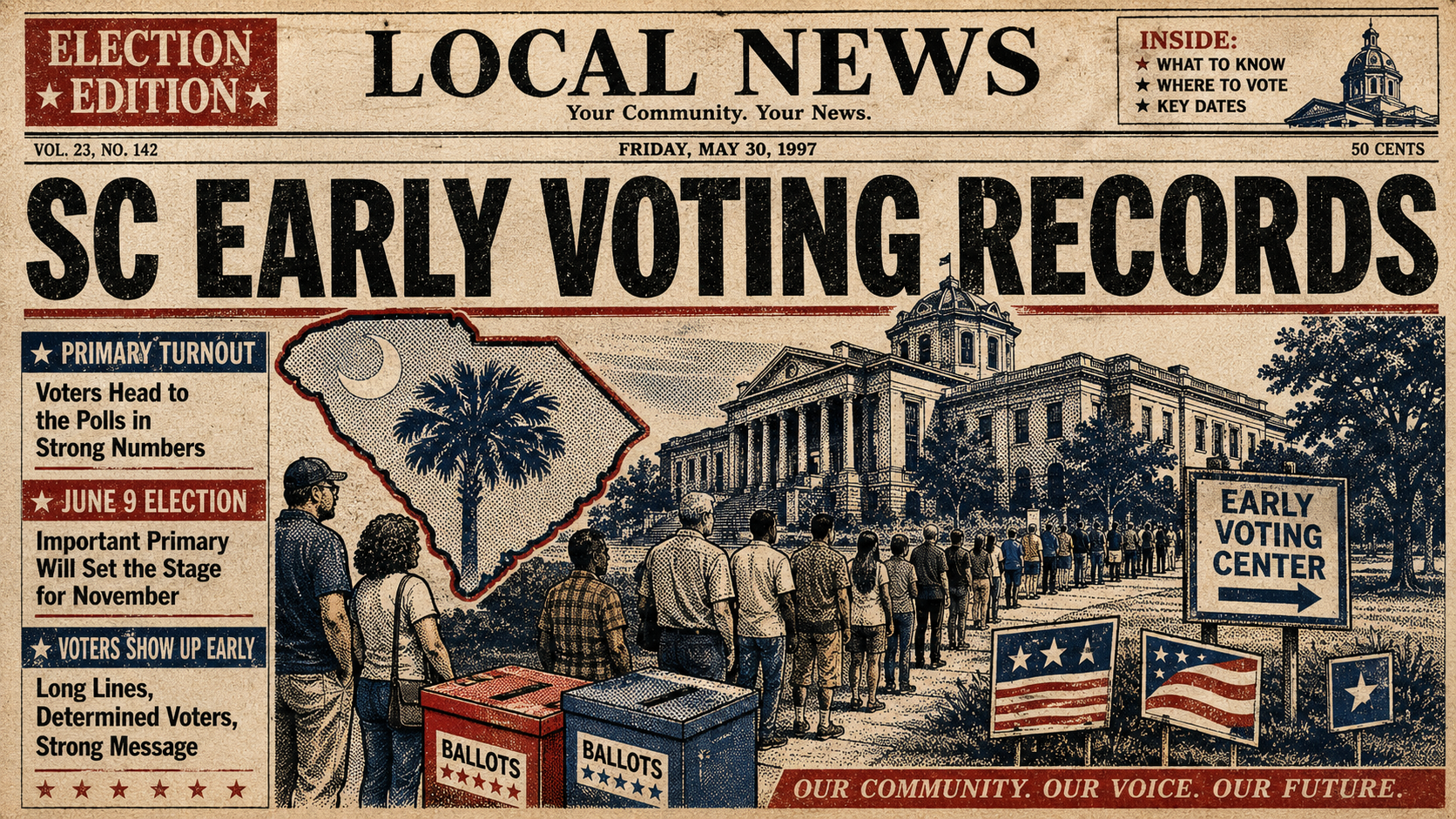
    South Carolina voters have been casting ballots at a record pace ahead of the June 9 primary, with the State Election Commission reporting more than 318,600 early votes by the end of the early voting period. That is a sharp increase from the last two statewide primary cycles and another sign that voters are using early voting more aggressively than they did when the system first became available.

    But turnout is not the same thing as a forecast.

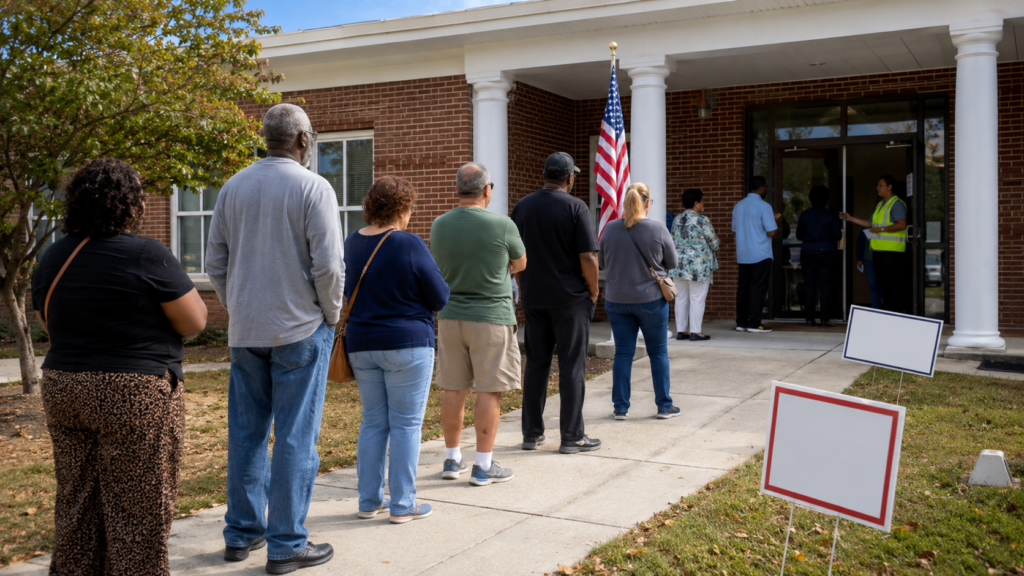
    A long line at an early voting center can tell you that voters are motivated. It cannot tell you, by itself, which candidate is winning, which message is breaking through, or whether the same voters would have shown up on Election Day anyway.

    That distinction matters because the simplest version of the story is easy: South Carolina voters are breaking records.

    The more accurate version is a little more careful: South Carolina voters are breaking records under a still-young early voting system, in a primary year shaped by redistricting fights, high-profile races, party mobilization, and a political environment where more voters now expect to cast ballots before Election Day.

    Record Numbers Keep Building

    According to the South Carolina State Election Commission, more than 318,600 ballots were cast statewide during the early voting period for the June primary.

    That figure is well above the early voting totals reported in the state’s last two primary cycles. South Carolina Public Radio reported that early voting participation reached 318,602 this year, compared with 120,178 in 2024 and 100,450 in 2022.

    That is not a small shift.

    It suggests early voting is no longer a side option used by a narrow group of voters. It is becoming part of the normal election calendar in South Carolina.

    ABC News 4 reported that more than 28,000 ballots were cast statewide on Wednesday alone, according to figures from the South Carolina State Election Commission. For comparison, the same point in the 2024 primary early voting period saw 13,423 votes reported.

    That kind of increase is hard to ignore.

    Still, it should be read as a participation signal, not a prediction.

    Why This Year Looks Different?

    South Carolina has not had this version of early voting for very long.

    True in-person early voting began in the state in 2022, meaning the comparisons are useful but limited. A record in a new system may show voter enthusiasm, but it can also show that voters are simply getting more familiar with a process that did not exist in the same form a few election cycles ago.

    That is the first caution.

    The second is that primaries are not general elections. Primary turnout can be shaped heavily by party-specific contests, candidate intensity, local races, congressional fights, and coordinated efforts by campaigns or outside groups.

    This year, several factors appear to be working at once.

    There are statewide races, congressional races, local contests, and the usual primary-year fights over party direction. There was also a high-profile debate over congressional redistricting as early voting began, which may have pushed some voters to cast ballots quickly before any political uncertainty could grow.

    That does not mean redistricting explains everything.

    It means turnout numbers need context.

    The First Day Set the Tone

    The first day of early voting signaled that this was not going to be a normal primary turnout cycle.

    South Carolina Public Radio reported that more than 44,000 people had voted early by 3 p.m. on the first day, setting a new state record for a single day of early primary voting. The previous single-day high was about 23,000 votes in 2024.

    WIS later reported that the State Election Commission counted 56,407 ballots on the first day, making it a new first-day record for a South Carolina primary.

    That kind of jump can happen when voters are motivated. It can also happen when early voting becomes more visible, more convenient, and more heavily promoted by campaigns.

    Both can be true at the same time.

    The question is not simply whether voters showed up. They did.

    The question is why they showed up early, and whether that early surge reflects new voters entering the process or regular voters changing when they vote.

    County Numbers Show Where the Energy Is

    According to ABC News 4, Richland County led the state in ballots cast, followed by Greenville, Horry, Charleston, and Lexington counties.

    That list makes sense.

    Those counties include large population centers, major suburban areas, and politically active communities where statewide and local races often draw attention. But even county rankings need careful interpretation.

    A county with more ballots cast is not always showing higher enthusiasm. It may simply have more registered voters. A smaller county with fewer total ballots may still be seeing unusually high participation compared with its own past turnout.

    That is why raw totals only tell part of the story.

    To understand turnout more precisely, you would need to compare ballots cast against registered voters, party participation, past primary turnout, and which local races are driving people to the polls.

    The headline number is important.

    The denominator matters too.

    What Early Voting Can and Cannot Tell You?

    Early voting is useful because it shows participation before Election Day. It helps campaigns adjust staffing, messaging, and turnout operations. It also helps election officials prepare for Election Day volume.

    But it does not answer the questions people usually want answered first.

    It does not tell us:

    • Which candidates are ahead.
    • Whether one party’s early advantage will hold.
    • Whether early voters are new voters or regular voters.
    • Whether Election Day turnout will rise or fall.
    • Whether local races are driving more participation than statewide contests.

    That is why election coverage has to be careful.

    High early turnout can mean enthusiasm. It can mean urgency. It can mean better voter education. It can mean campaigns are pushing people to bank votes early.

    It can also mean voters are simply adapting to a system that is becoming more familiar.

    Party Participation Adds Another Layer

    Early reports also showed differences in party participation.

    South Carolina Public Radio reported that, as of June 2, more ballots had been cast in the Democratic primary than in the Republican primary, based on State Election Commission figures available at that time.

    That detail is notable, but it also needs caution.

    South Carolina does not register voters by party, and voters can choose which party primary to participate in. That makes party-primary turnout more fluid than in states where party registration is locked in well ahead of time.

    So when one party shows stronger early voting numbers, it may reflect enthusiasm, organization, competitive races, or strategic behavior by voters. It does not automatically translate into a general-election advantage.

    Again, the pattern matters.

    But the explanation requires more than one number.

    For election officials, record early voting is not only a political story. It is an administrative one.

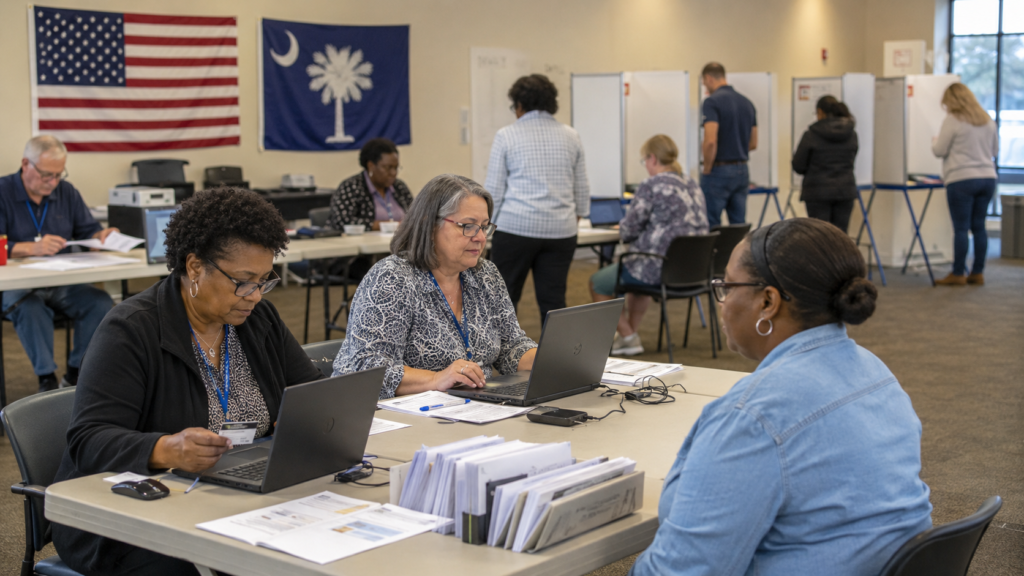
    More early voters can reduce pressure on Election Day polling places, but it also requires staffing, equipment, check-in procedures, security, ballot handling, and public communication over a longer period.

    That is one reason early voting totals matter even before any results are reported.

    A strong early voting period can show that voters understand the process and that counties are managing demand. But it also raises the stakes for transparency, especially when turnout rises quickly.

    Voters need to know where to go, what identification to bring, how to check registration, how absentee ballots work, and when results become official.

    The State Election Commission says voters must present photo identification when voting in person, and absentee ballots must be returned by 7 p.m. on Election Day.

    Those basic rules matter more when participation is high.

    Redistricting Remains Part of the Background

    This year’s early voting period also unfolded against a political backdrop involving South Carolina’s congressional maps.

    South Carolina Public Radio reported that a push to redraw congressional lines was effectively halted as early voting began. Some voters interviewed by the outlet said redistricting was part of why they cast ballots early.

    That does not mean every voter was responding to the same issue.

    But it helps explain why the first-day numbers were so unusual. When voters believe the rules of representation may be shifting, even temporarily, that can create urgency.

    The safest way to describe it is this: redistricting was part of the environment around the vote, not necessarily the sole driver of turnout.

    That is the difference between context and overstatement.

    What Happens Next?

    Early voting has ended, and Election Day is set for June 9.

    The next question is whether the early surge continues through Election Day or whether many voters who would normally show up Tuesday have already cast ballots.

    That will matter for campaigns reading the results.

    A high early vote total can front-load participation. It can also signal a larger overall turnout if Election Day voting remains strong.

    For now, the record is clear. The interpretation is still developing.

    County election boards will also handle post-election procedures, including provisional ballot decisions where required. Final certification will come through the normal election process after votes are counted and reviewed.

    The Bottom Line

    South Carolina’s early voting period set a new record, with more than 318,600 ballots cast statewide before Election Day.

    That is a major increase from the early voting totals reported in the 2022 and 2024 primary cycles.

    Richland, Greenville, Horry, Charleston, and Lexington counties were among the leading counties in ballots cast, according to reporting based on State Election Commission figures.

    But turnout data is not a crystal ball.

    It tells us voters are participating early in much larger numbers. It does not tell us, by itself, what the final electorate will look like, which party benefits most, or how individual races will break once Election Day votes are counted.

    The simplest version of the story is that South Carolina voters are breaking records.

    The more useful version is that early voting has become a real force in the state’s election process — and campaigns, voters, and election officials are all adjusting to what that means.