Aiman Tariq – Regional News Editor
Columbia, SC –
Early voting is one of the clearest numbers in politics. It is also one of the easiest numbers to overread.
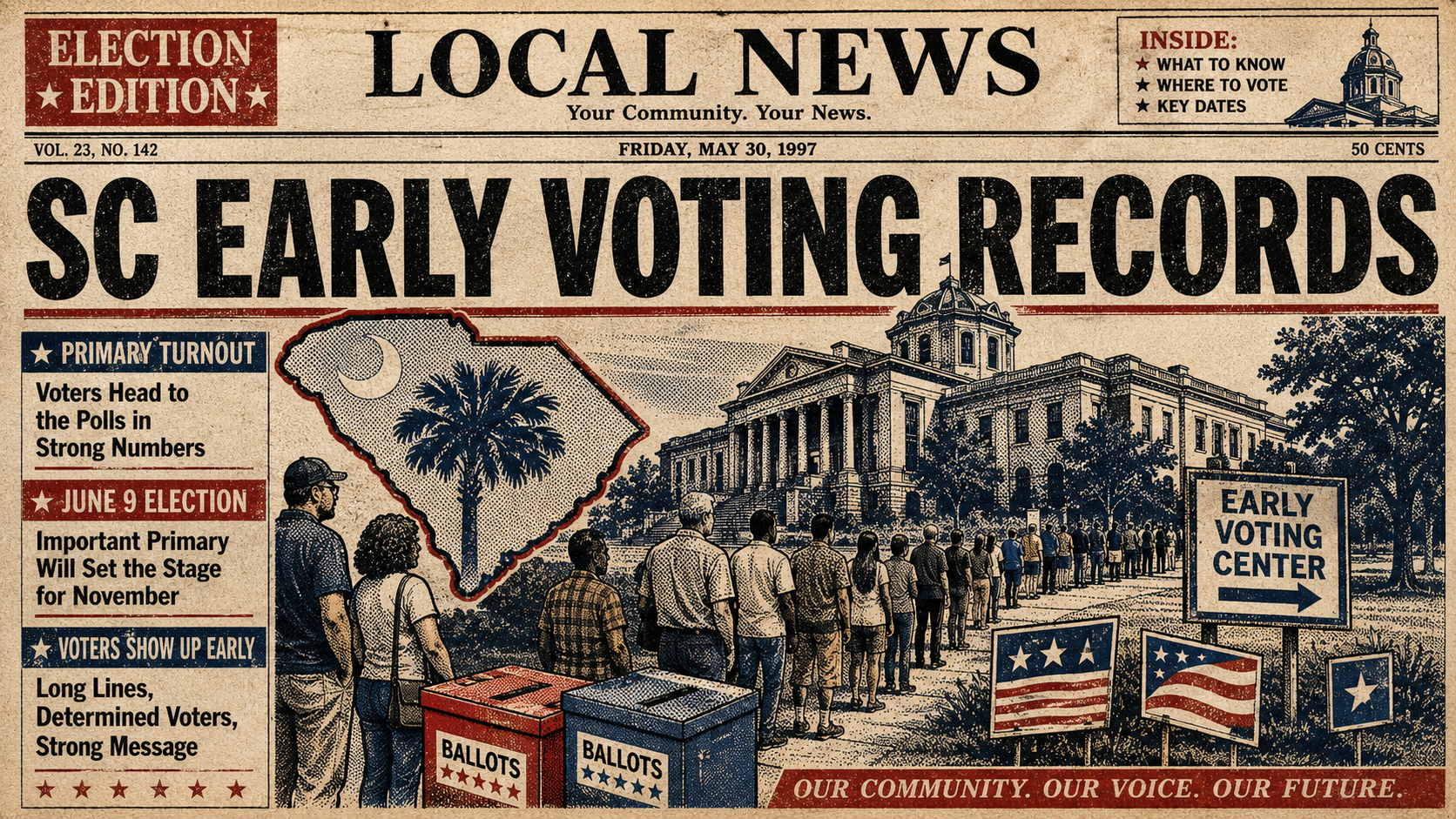
South Carolina voters have been casting ballots at a record pace ahead of the June 9 primary, with the State Election Commission reporting more than 318,600 early votes by the end of the early voting period. That is a sharp increase from the last two statewide primary cycles and another sign that voters are using early voting more aggressively than they did when the system first became available.
But turnout is not the same thing as a forecast.
A long line at an early voting center can tell you that voters are motivated. It cannot tell you, by itself, which candidate is winning, which message is breaking through, or whether the same voters would have shown up on Election Day anyway.
That distinction matters because the simplest version of the story is easy: South Carolina voters are breaking records.
The more accurate version is a little more careful: South Carolina voters are breaking records under a still-young early voting system, in a primary year shaped by redistricting fights, high-profile races, party mobilization, and a political environment where more voters now expect to cast ballots before Election Day.
Record Numbers Keep Building
According to the South Carolina State Election Commission, more than 318,600 ballots were cast statewide during the early voting period for the June primary.
That figure is well above the early voting totals reported in the state’s last two primary cycles. South Carolina Public Radio reported that early voting participation reached 318,602 this year, compared with 120,178 in 2024 and 100,450 in 2022.
That is not a small shift.
It suggests early voting is no longer a side option used by a narrow group of voters. It is becoming part of the normal election calendar in South Carolina.
ABC News 4 reported that more than 28,000 ballots were cast statewide on Wednesday alone, according to figures from the South Carolina State Election Commission. For comparison, the same point in the 2024 primary early voting period saw 13,423 votes reported.
That kind of increase is hard to ignore.
Still, it should be read as a participation signal, not a prediction.
Why This Year Looks Different?
South Carolina has not had this version of early voting for very long.
True in-person early voting began in the state in 2022, meaning the comparisons are useful but limited. A record in a new system may show voter enthusiasm, but it can also show that voters are simply getting more familiar with a process that did not exist in the same form a few election cycles ago.
That is the first caution.
The second is that primaries are not general elections. Primary turnout can be shaped heavily by party-specific contests, candidate intensity, local races, congressional fights, and coordinated efforts by campaigns or outside groups.
This year, several factors appear to be working at once.
There are statewide races, congressional races, local contests, and the usual primary-year fights over party direction. There was also a high-profile debate over congressional redistricting as early voting began, which may have pushed some voters to cast ballots quickly before any political uncertainty could grow.
That does not mean redistricting explains everything.
It means turnout numbers need context.
The First Day Set the Tone
The first day of early voting signaled that this was not going to be a normal primary turnout cycle.
South Carolina Public Radio reported that more than 44,000 people had voted early by 3 p.m. on the first day, setting a new state record for a single day of early primary voting. The previous single-day high was about 23,000 votes in 2024.
WIS later reported that the State Election Commission counted 56,407 ballots on the first day, making it a new first-day record for a South Carolina primary.
That kind of jump can happen when voters are motivated. It can also happen when early voting becomes more visible, more convenient, and more heavily promoted by campaigns.
Both can be true at the same time.
The question is not simply whether voters showed up. They did.
The question is why they showed up early, and whether that early surge reflects new voters entering the process or regular voters changing when they vote.
County Numbers Show Where the Energy Is
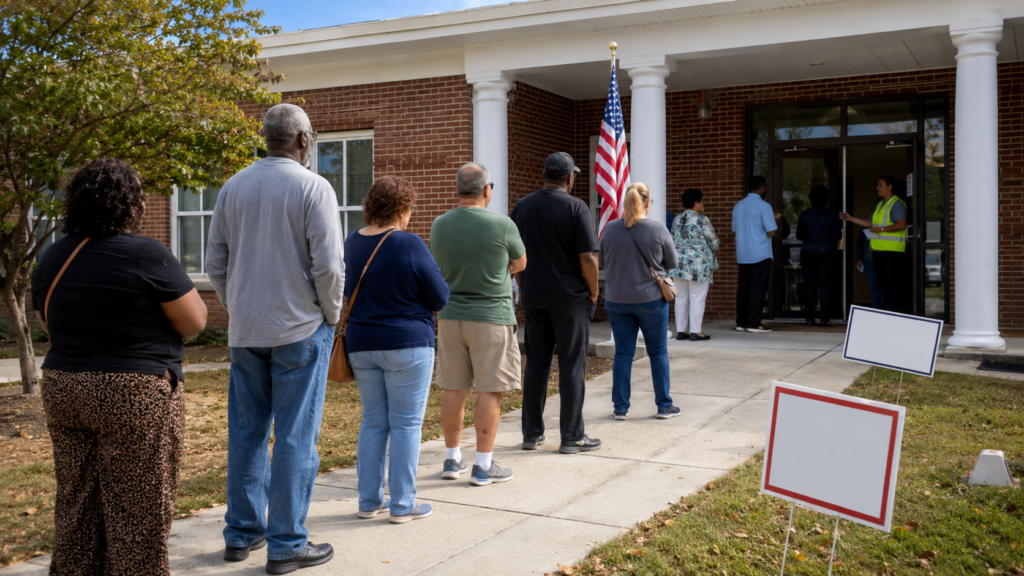
According to ABC News 4, Richland County led the state in ballots cast, followed by Greenville, Horry, Charleston, and Lexington counties.
That list makes sense.
Those counties include large population centers, major suburban areas, and politically active communities where statewide and local races often draw attention. But even county rankings need careful interpretation.
A county with more ballots cast is not always showing higher enthusiasm. It may simply have more registered voters. A smaller county with fewer total ballots may still be seeing unusually high participation compared with its own past turnout.
That is why raw totals only tell part of the story.
To understand turnout more precisely, you would need to compare ballots cast against registered voters, party participation, past primary turnout, and which local races are driving people to the polls.
The headline number is important.
The denominator matters too.
What Early Voting Can and Cannot Tell You?
Early voting is useful because it shows participation before Election Day. It helps campaigns adjust staffing, messaging, and turnout operations. It also helps election officials prepare for Election Day volume.
But it does not answer the questions people usually want answered first.
It does not tell us:
- Which candidates are ahead.
- Whether one party’s early advantage will hold.
- Whether early voters are new voters or regular voters.
- Whether Election Day turnout will rise or fall.
- Whether local races are driving more participation than statewide contests.
That is why election coverage has to be careful.
High early turnout can mean enthusiasm. It can mean urgency. It can mean better voter education. It can mean campaigns are pushing people to bank votes early.
It can also mean voters are simply adapting to a system that is becoming more familiar.
Party Participation Adds Another Layer
Early reports also showed differences in party participation.
South Carolina Public Radio reported that, as of June 2, more ballots had been cast in the Democratic primary than in the Republican primary, based on State Election Commission figures available at that time.
That detail is notable, but it also needs caution.
South Carolina does not register voters by party, and voters can choose which party primary to participate in. That makes party-primary turnout more fluid than in states where party registration is locked in well ahead of time.
So when one party shows stronger early voting numbers, it may reflect enthusiasm, organization, competitive races, or strategic behavior by voters. It does not automatically translate into a general-election advantage.
Again, the pattern matters.
But the explanation requires more than one number.
Why Election Officials Watch These Trends Closely?
For election officials, record early voting is not only a political story. It is an administrative one.
More early voters can reduce pressure on Election Day polling places, but it also requires staffing, equipment, check-in procedures, security, ballot handling, and public communication over a longer period.
That is one reason early voting totals matter even before any results are reported.
A strong early voting period can show that voters understand the process and that counties are managing demand. But it also raises the stakes for transparency, especially when turnout rises quickly.
Voters need to know where to go, what identification to bring, how to check registration, how absentee ballots work, and when results become official.
The State Election Commission says voters must present photo identification when voting in person, and absentee ballots must be returned by 7 p.m. on Election Day.
Those basic rules matter more when participation is high.
Redistricting Remains Part of the Background
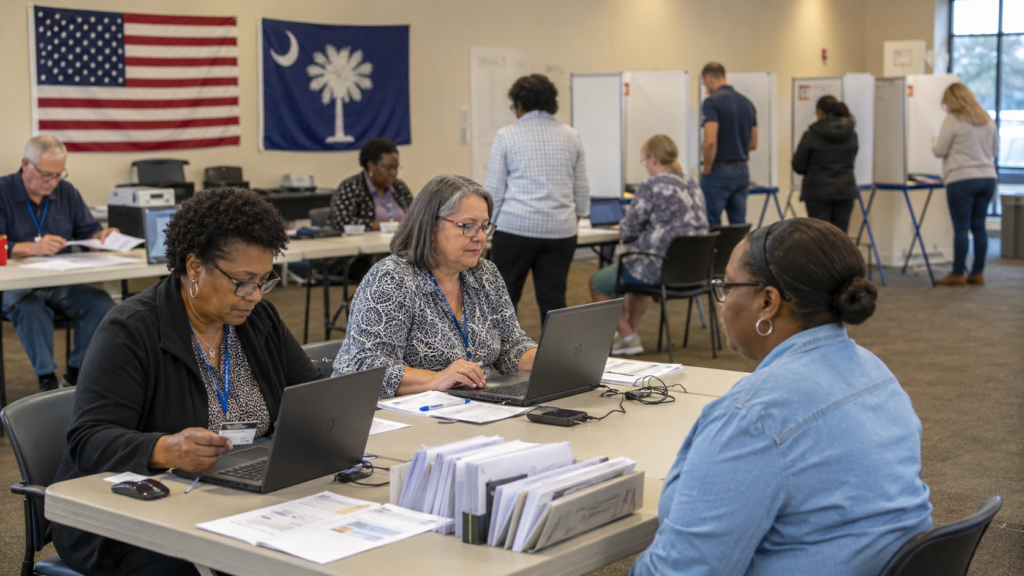
This year’s early voting period also unfolded against a political backdrop involving South Carolina’s congressional maps.
South Carolina Public Radio reported that a push to redraw congressional lines was effectively halted as early voting began. Some voters interviewed by the outlet said redistricting was part of why they cast ballots early.
That does not mean every voter was responding to the same issue.
But it helps explain why the first-day numbers were so unusual. When voters believe the rules of representation may be shifting, even temporarily, that can create urgency.
The safest way to describe it is this: redistricting was part of the environment around the vote, not necessarily the sole driver of turnout.
That is the difference between context and overstatement.
What Happens Next?
Early voting has ended, and Election Day is set for June 9.
The next question is whether the early surge continues through Election Day or whether many voters who would normally show up Tuesday have already cast ballots.
That will matter for campaigns reading the results.
A high early vote total can front-load participation. It can also signal a larger overall turnout if Election Day voting remains strong.
For now, the record is clear. The interpretation is still developing.
County election boards will also handle post-election procedures, including provisional ballot decisions where required. Final certification will come through the normal election process after votes are counted and reviewed.
The Bottom Line
South Carolina’s early voting period set a new record, with more than 318,600 ballots cast statewide before Election Day.
That is a major increase from the early voting totals reported in the 2022 and 2024 primary cycles.
Richland, Greenville, Horry, Charleston, and Lexington counties were among the leading counties in ballots cast, according to reporting based on State Election Commission figures.
But turnout data is not a crystal ball.
It tells us voters are participating early in much larger numbers. It does not tell us, by itself, what the final electorate will look like, which party benefits most, or how individual races will break once Election Day votes are counted.
The simplest version of the story is that South Carolina voters are breaking records.
The more useful version is that early voting has become a real force in the state’s election process — and campaigns, voters, and election officials are all adjusting to what that means.