Aiman Tariq – Regional News Editor
Winder, GA –
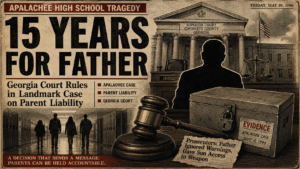
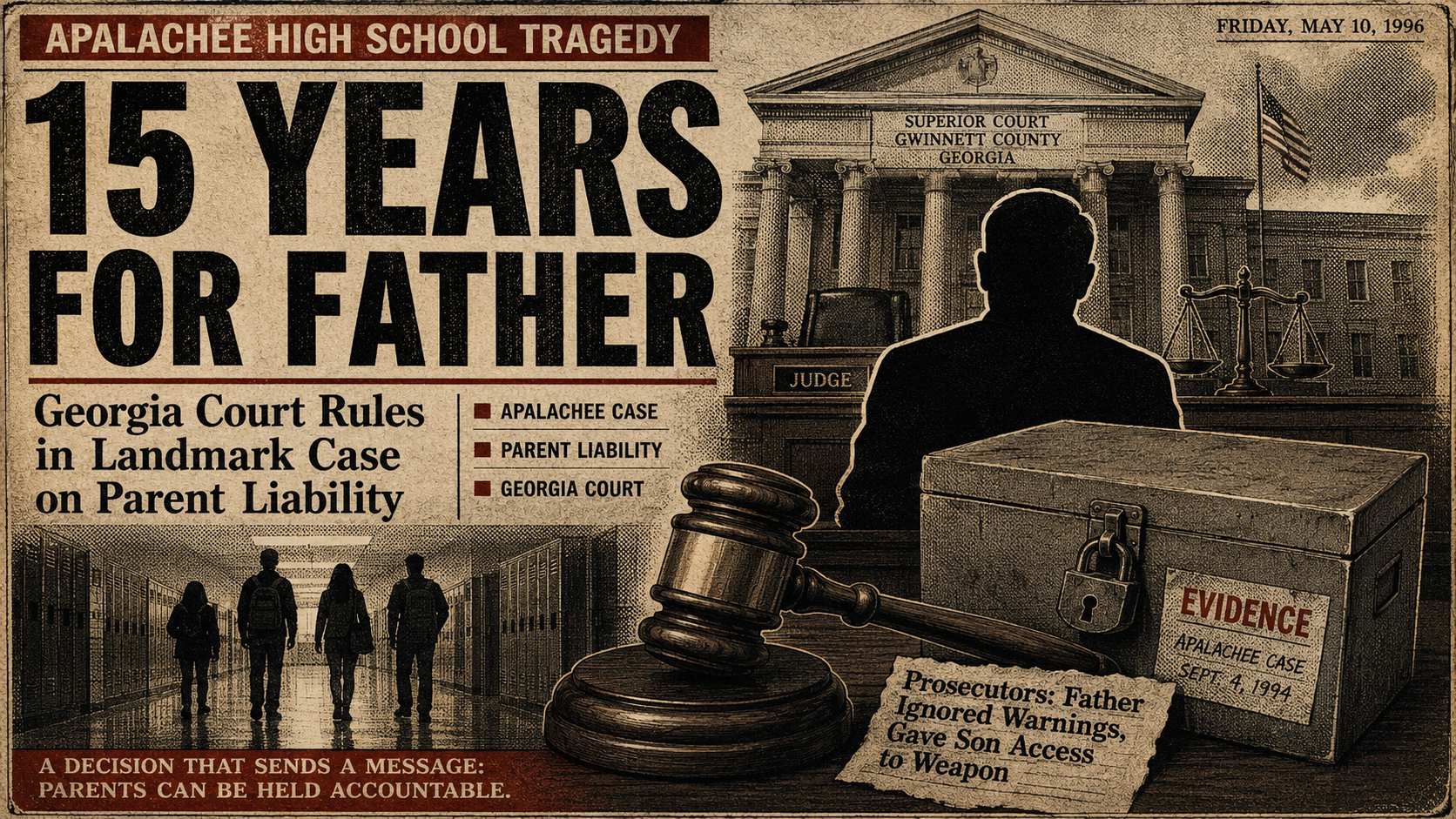
According to the Associated Press, Colin Gray, the father of the teenager who carried out the 2024 shooting at Apalachee High School, was sentenced Thursday to 15 years in prison after a Georgia jury found him criminally responsible for helping create the conditions that allowed the attack to happen.
The sentence comes days after his son, Colt Gray, was sentenced to life in prison without the possibility of parole after pleading guilty to murder and other charges tied to the Sept. 4, 2024 shooting at the high school in Winder, about 45 miles northeast of Atlanta.
This is not the usual criminal case that follows a school shooting. The person sentenced Thursday did not enter the school or fire the shots. The question for the court was different: when a parent gives a troubled child access to a firearm, and warning signs continue to build, where does negligence end and criminal responsibility begin?
That is what makes the Colin Gray case significant well beyond Barrow County.
Judge Says the Failure Was Parental, Not Intentional
Superior Court Judge Nicholas Primm, who also sentenced Colt Gray earlier in the week, said during sentencing that Colin Gray had failed as a parent, while also acknowledging that sentencing crimes of negligence is legally difficult because they do not involve the same intent as the underlying attack.
That distinction shaped the entire hearing.
Prosecutors had asked for a far longer sentence. Defense attorneys argued that Colin Gray should receive 10 years in prison followed by probation, saying the court should not erase the legal line between a person who intends harm and a person who fails to prevent it.
The judge ultimately imposed 15 years in prison.
It was a sentence that recognized the difference between the father and the son, but still treated the father’s conduct as criminally serious.
What the Jury Found?
A jury in March found Colin Gray guilty of second-degree murder in the deaths of two 14-year-old students, Mason Schermerhorn and Christian Angulo. Under Georgia law, second-degree murder can apply when the death of a child is caused during the commission of cruelty to children.
Gray was also found guilty of involuntary manslaughter in the deaths of teachers Richard Aspinwall, 39, and Cristina Irimie, 53. Another teacher and eight students were wounded, according to AP’s reporting.
Those convictions did not mean the jury found that Colin Gray planned the attack. They meant the jury accepted prosecutors’ argument that his conduct crossed a legal threshold — that he ignored a substantial risk and allowed access to the weapon used in the shooting.
That is a narrower point than saying he was the shooter. But it is still a major one.
Prosecutors Said the Warning Signs Were There
According to AP, prosecutors argued that Colin Gray gave his son the rifle as a Christmas gift, along with ammunition, a gun sight and other shooting accessories.
They also pointed to testimony about Colt Gray’s mental health, his interest in mass shooters, and warnings from his mother, Marcee Gray, who had urged Colin Gray to secure firearms and restrict their son’s access.
Barrow County District Attorney Brad Smith argued that Colin Gray was convicted based on what he knew, not what he failed to magically predict. That framing mattered.
The prosecution’s theory was not that Colin Gray knew the exact day, time or plan. It was that the risk was serious enough, visible enough and specific enough that giving access to a firearm became criminally reckless.
That is where these cases tend to turn.
A parent does not have to know everything to be held responsible for ignoring enough.
Defense Says the Son Hid the Depth of the Problem

The defense presented a different version of responsibility.
Colin Gray’s attorney argued that Colt Gray concealed the depth of his involvement in online spaces focused on mass shooters and that the warning signs were spread out across time rather than arriving as one obvious final alarm.
That argument is not unusual in cases built around foreseeability. Defense lawyers often focus on the difference between hindsight and real-time judgment.
After a tragedy, warning signs can look connected and obvious. Before it, they may look scattered, incomplete or ambiguous.
That does not mean they should be ignored. It does mean the legal question is harder than the public reaction often allows.
Judge Primm appeared to recognize that tension, but still concluded that Colin Gray had enough warning and enough control over the weapons to be held criminally responsible.
Families Asked the Court to See the Harm Left Behind
Families of the victims urged the judge to impose a severe sentence.
According to AP, Breanna Schermerhorn, whose son Mason was killed, said the shooting was preventable and that the choices made inside the Gray household left four families carrying grief. Shayna Aspinwall, whose husband Richard was killed, told the court that Colin Gray did not pull the trigger but purchased and left a firearm accessible to a minor.
Those statements reflected the emotional center of the sentencing: families were not asking the court to treat Colin Gray as the shooter. They were asking the court to treat his failures as part of the chain that made the shooting possible.
That is a difficult legal and moral space.
It is also the space where the criminal justice system is increasingly being asked to operate after school shootings.
A Rare Parent-Prosecution Case
Colin Gray is one of a small number of parents in the United States criminally charged after their child was accused or convicted in a school shooting. Reuters reported that his case marks the first time in Georgia that a parent has been convicted in relation to a mass shooting carried out by their child.
The comparison many lawyers and reporters have made is to Jennifer and James Crumbley, the Michigan parents convicted after their son killed four students at Oxford High School in 2021. AP noted that the Crumbleys are serving 10-year prison terms for involuntary manslaughter.
The Georgia case is not identical. No two cases like this are.
But together, they show a legal trend: prosecutors are increasingly willing to test whether parents can be held criminally responsible when they provide access to weapons despite clear warning signs.
That trend will almost certainly continue to draw debate.
The Line Between Negligence and Criminal Liability
The hardest part of this case is not the basic fact that adults should secure firearms around minors. That point is straightforward.
The harder question is when a failure becomes a crime.
Negligence exists on a spectrum. At one end are mistakes, bad judgment and parenting failures that may be serious but not criminal. At the other are choices that create an obvious and unjustifiable danger.
The jury placed Colin Gray’s conduct on the criminal side of that line.
Judge Primm’s sentence suggests the court saw the case as more than ordinary carelessness, but still different from the conduct of the person who carried out the attack.
That middle ground is uncomfortable. It is also why these prosecutions are likely to remain divisive.
What This Means for Georgia?
For Georgia, the sentencing adds another layer to the Apalachee High School case.
The criminal case against Colt Gray has already ended with a life sentence. The case against Colin Gray now ends with a 15-year prison sentence, unless appeals alter the result.
But the public-policy questions are not finished.
Schools, parents, law enforcement agencies and courts will continue asking what should happen when warning signs appear before violence. Those questions include mental health intervention, school threat reporting, safe firearm storage and the responsibility of adults who control access to weapons.
The law cannot answer all of that cleanly.
But the Colin Gray sentence sends one message clearly: in Georgia, a parent’s failure to secure a weapon after warning signs can carry consequences far beyond public blame.
The Bottom Line
Colin Gray was sentenced to 15 years in prison after being convicted of second-degree murder and involuntary manslaughter tied to the Apalachee High School shooting.
His son, Colt Gray, has already been sentenced to life in prison without parole after pleading guilty to murder and other charges.
The father’s case was not about who pulled the trigger. It was about access, warning signs and whether a parent’s failure to act became criminal negligence.
The court decided that it did.
For families of the victims, the sentence marks one step in accountability after a school shooting that changed their lives. For Georgia, it marks a rare and closely watched example of prosecutors holding a parent criminally responsible for a child’s attack.
The broader question now is whether this case becomes an exception — or part of a larger shift in how courts treat parental responsibility when warning signs and firearm access collide.
Follow us for updates on this developing story and more Georgia court coverage.