Aiman Tariq – Regional News Editor
Piedmont, SC –
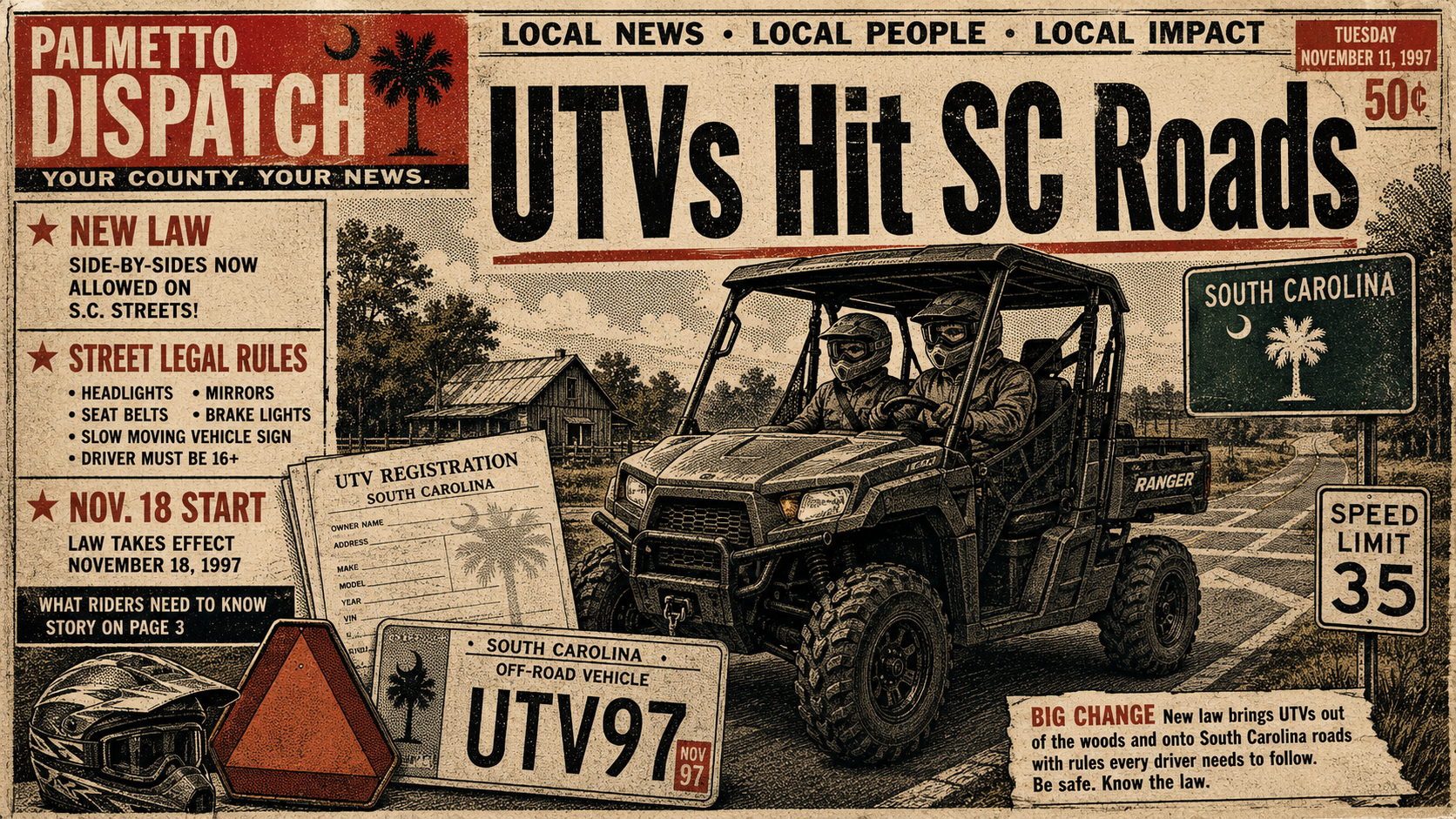
Utility terrain vehicles are about to get a new legal lane in South Carolina, but the change is not as simple as “side-by-sides can go anywhere now.”
A new state law signed by Gov. Henry McMaster in May will allow certain UTVs to operate on public roads beginning Nov. 18, 2026, according to the South Carolina General Assembly’s bill record. The law creates a registration system, sets insurance and equipment rules, and places limits on who can drive, where the vehicles can operate, and how far they can travel from the registered address.
That is the important part for drivers and local governments. The law opens the door, but it does not erase the difference between a road vehicle and an off-road machine.
What the New Law Allows?
Under Act 164, South Carolina will allow registered utility terrain vehicles, or UTVs, to operate on certain public highways and streets. The law defines a UTV as a side-by-side, four-wheel-drive, off-road vehicle designed to transport people or cargo, with specific requirements related to speed, engine size, width, steering, seating and weight.
That definition matters because not every off-road vehicle will automatically qualify.
The law is aimed at UTVs — often called side-by-sides — rather than ATVs, golf carts or other small vehicles. UTVs generally use a steering wheel and side-by-side seating, making them closer in layout to a small utility vehicle than a motorcycle-style ATV.
According to WYFF 4, the change has already drawn interest from riders and motorsports businesses in the Upstate, where some dealers expect demand to increase once owners understand the new requirements.
Not a Free Pass for Every Road
The new law does not make UTVs legal on every South Carolina road.
A registered UTV may not operate on interstate highways. The Department of Transportation may also prohibit UTV operation on any highway if it determines the restriction is necessary for safety.
In places where no local ordinance changes the rules, registered UTVs may operate only on secondary highways where the posted speed limit is 55 mph or less. They may also operate only within 10 miles of the address on the registration, or within 10 miles of the entrance and exit point of a gated community if the registered address is inside one.
That means the law is more limited than some owners may assume.
It may make short rural trips, farm-area travel and neighborhood-to-neighborhood movement easier. It does not turn a UTV into a normal commuter vehicle.
Who Can Drive a UTV on Public Roads?
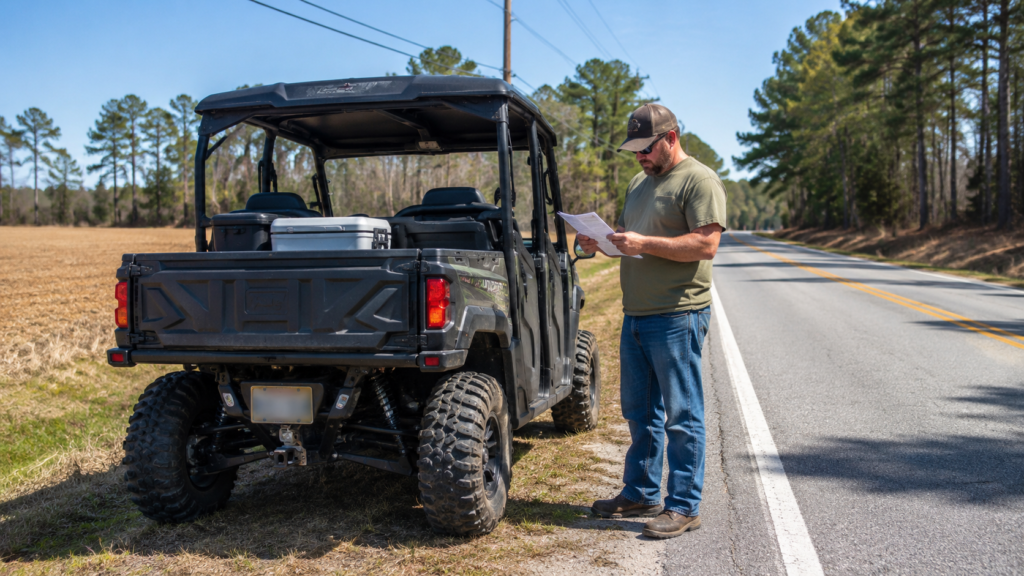
South Carolina’s new law requires a person operating a UTV on a public highway to be at least 17 years old and to hold a valid driver’s license that permits operation of a motor vehicle at any time. The driver must also have the license plate and registration certificate, proof of liability insurance, and a driver’s license in possession.
The law also spells out who does not qualify.
A person with only a beginner’s permit cannot operate a UTV on a public highway, even if a licensed driver is present. The same restriction applies to someone with only a moped operator’s license, a temporary alcohol license, a route-restricted license, a provisional license or only a motorcycle license.
That is likely to be one of the more important practical details once the law takes effect.
UTVs are often used in rural areas and by families, but the public-road version of the law treats them more like registered passenger vehicles than casual recreational equipment.
Passenger and Safety Rules
The law also limits passengers.
A child under 8 years old may not ride as a passenger in a UTV being operated on a public highway. Anyone under 21 operating or riding in a UTV on a public highway must wear the required protective gear.
Seat belts are also required. The law says a person operating or riding as a passenger in a UTV on a public highway must wear a fastened safety belt, and registered UTVs must be equipped with seat belt assemblies at designated seating positions.
The equipment rules go beyond seat belts.
A registered UTV must have operable headlights, brake lights, taillights and turn signals. The law also prohibits operating a UTV on a road if it has a modified exhaust system that makes it louder than its manufactured design.
That part of the law may matter for communities worried about noise as much as traffic.
Registration, Insurance and Fees
To operate a UTV on a public highway, the owner must present proof of ownership, proof of liability insurance, and pay a $10 biennial fee. The vehicle must be registered in the same general fashion as a passenger vehicle unless the UTV law says otherwise, and it must have a license plate attached to the rear in an unobscured way.
The law also says the Department of Motor Vehicles cannot register or renew the registration of a UTV unless a title has been issued or an application has been delivered.
That is another point that may catch some owners off guard.
Many UTVs were purchased and used as off-road vehicles. Under the new system, paperwork will matter more. A vehicle that has been used on farms, trails or private property may still need to meet the state’s title, registration, insurance and equipment requirements before it can legally be used on public roads.
How the Fee Is Allocated?
The $10 biennial registration fee is divided among state accounts.
According to the law, $2 goes toward DMV costs associated with producing and issuing new license plates, $4 goes to the State Highway Fund, and $4 goes to the South Carolina Transportation Infrastructure Bank.
The amount is small compared with most vehicle expenses, but the allocation shows the state is treating road-legal UTV operation as part of the transportation system, not simply as recreational permission.
Local Governments Still Have a Role
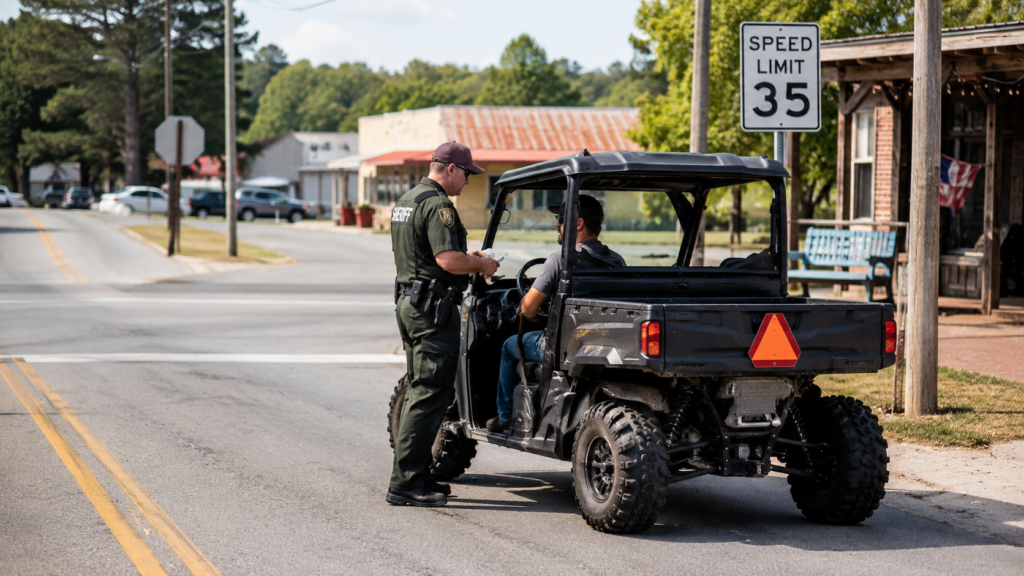
The law gives counties and municipalities room to shape how UTVs operate locally.
A municipality, or a county within its unincorporated areas, may pass ordinances setting hours, methods and locations for UTV operation. Those local rules still must stay within the broader limit that UTVs may operate only on highways where the speed limit is 55 mph or less.
Local governments may also permit UTV operation at night under certain circumstances, again limited to roads at or below the 55 mph threshold.
That means rules may not look exactly the same in every part of South Carolina.
A rural county may view UTV access differently from a fast-growing suburb with heavier traffic. A small town may want limited downtown access. A coastal or lake community may have its own concerns about visitors, safety and enforcement.
The state law sets the framework. Local ordinances may decide how that framework feels on the ground.
Farmers Get a Separate Provision
The law also includes a specific section for farmers.
A farmer with a valid SCATE card from the South Carolina Department of Agriculture and a valid driver’s license may operate a UTV or similar motorized vehicle with a top speed less than 55 mph without restriction if it is being operated within 10 miles of the operator’s agricultural operation.
That provision reflects one of the practical realities behind the bill.
In many rural areas, UTVs are not just recreational vehicles. They are used to move tools, check property, haul supplies and travel short distances between fields, barns and nearby roads.
The law appears to recognize that use while still creating a separate path for non-farm owners who want public-road access.
Why Businesses Are Watching Closely
Dealers and motorsports businesses are likely to pay close attention between now and November.
WYFF 4 reported that some Upstate businesses are already hearing from customers asking about the new law. Dealers interviewed by the station said other states, including North Carolina and Tennessee, have already allowed some forms of road use, and South Carolina owners have been waiting for similar treatment.
That interest is real, but it also comes with a warning.
The law may boost sales, upgrades and registration-related work. But buyers who assume every UTV can immediately become road legal may run into equipment, title or insurance issues.
For dealers, that means the sales conversation may now include compliance.
For owners, it means reading the law closely before spending money on upgrades or assuming a vehicle can be taken onto public roads.
Safety Questions Are Not Going Away
The state has made UTV road use legal under specific conditions, but that does not end the safety debate.
UTVs are often built for off-road use. They may handle differently from passenger cars, especially at higher speeds, on pavement, around turns or in mixed traffic. The law tries to address that by limiting where they can go, requiring lighting and seat belts, restricting younger operators, and allowing DOT to ban them from highways where safety concerns are stronger.
That does not make every situation simple.
A rural road with light traffic may be very different from a busy commercial corridor with fast-moving vehicles, distracted drivers and limited shoulders. Enforcement will also matter. Local police, sheriff’s offices and state agencies will have to distinguish between properly registered UTVs and vehicles being operated outside the law.
That may take time.
As with many transportation changes, the first months after implementation may reveal practical issues that were harder to see during the legislative process.
What Owners Should Check Before November?
For UTV owners, the safest takeaway is not just “the law changed.”
It is this: the law changed, but the checklist matters.
Before operating a UTV on a public road, owners should confirm:
- Whether the vehicle qualifies under the law’s UTV definition.
- Whether it can be titled and registered.
- Whether it has liability insurance.
- Whether it has a rear license plate.
- Whether it has headlights, brake lights, taillights and turn signals.
- Whether all riders meet age and safety requirements.
- Whether the route is within the 10-mile limit.
- Whether the road is eligible based on speed limit and local rules.
Those details may decide whether the new law is useful for a driver — or whether a trip that feels legal still violates the statute.
The Bottom Line
South Carolina’s new UTV law opens public roads to certain registered side-by-sides beginning Nov. 18, 2026.
But the change is narrower than a simple “street legal” headline suggests.
Drivers must be at least 17, properly licensed, registered and insured. Vehicles must meet equipment requirements. Children under 8 cannot ride on public highways. Riders under 21 must use required protective gear. UTVs cannot use interstates, and most operation is limited to roads with speed limits of 55 mph or less and within 10 miles of the registered address.
For rural residents, farmers and some small-town drivers, the law could make short trips easier and reduce the risk of citations for limited road use.
For everyone else, the practical message is simpler: the law gives UTVs a path onto public roads, but only under conditions.
The vehicle may be street legal. The trip still has to be legal, too.