Aiman Tariq – Regional News Editor
Atlanta, GA –
Georgia Republicans opened a special session Wednesday with one of the state’s most explosive political fights already pulled off the table.
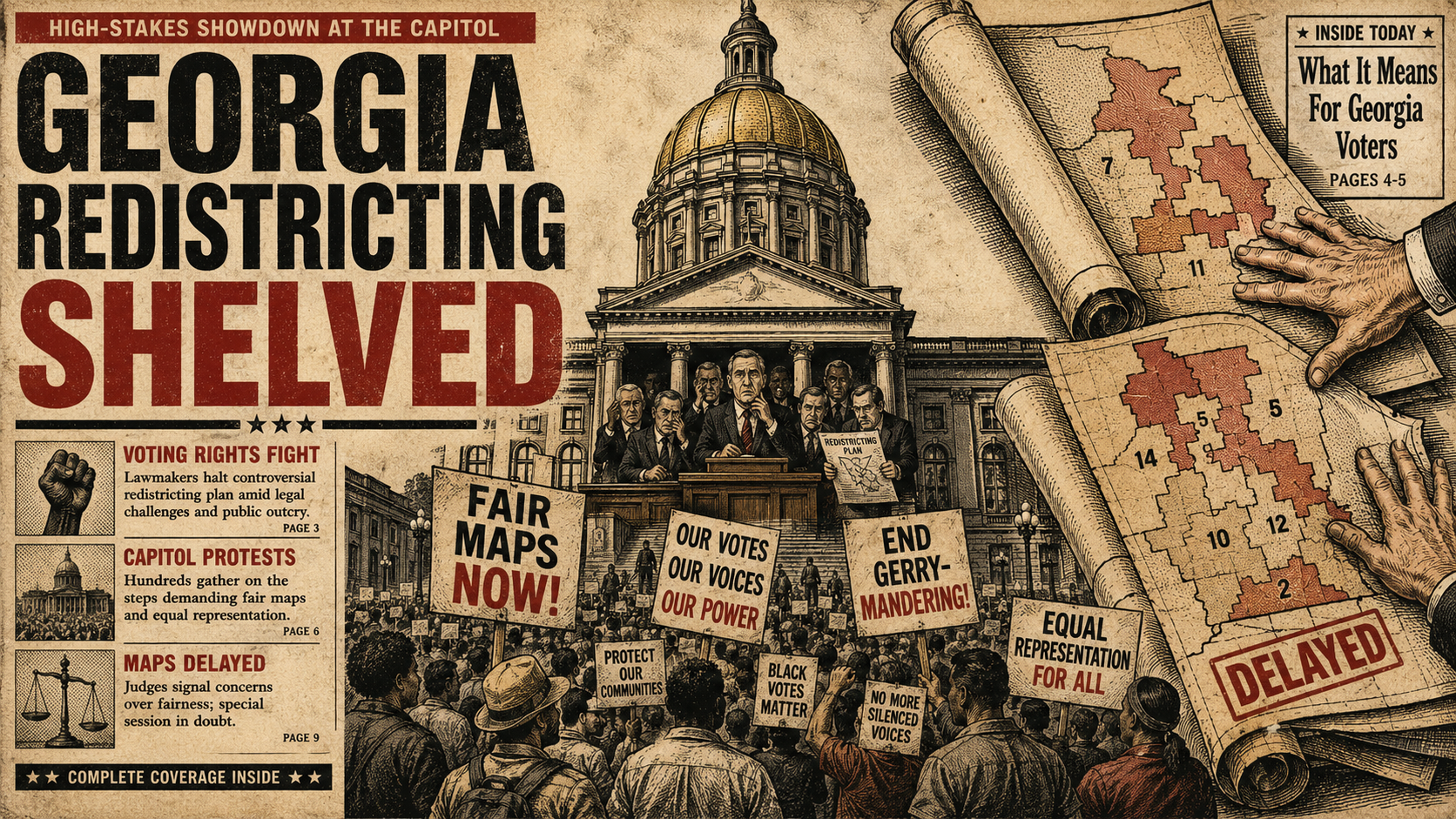
After weeks of pressure from voting rights groups, Democratic lawmakers, civil rights leaders and protesters, Republican leaders in the Georgia House said they would not take up new congressional or legislative maps during the special session, at least not for now.
That does not end the redistricting fight in Georgia.
It does change the timing.
The simplest version is that Republican leaders backed away from an immediate attempt to redraw political boundaries before a future election cycle. The more accurate version is that Georgia’s political landscape is complicated enough — legally, racially and electorally — that rushing new maps carried risks beyond the usual partisan math.
Redistricting Pulled Before the Session Began
The special session had been called by Gov. Brian Kemp to address redistricting and a separate election administration problem involving Georgia’s vote-counting system.
But less than an hour before lawmakers gaveled in, House Republican leaders said redistricting would not be part of the session.
House Speaker Jon Burns said Republicans would not take up congressional or legislative redistricting maps for the 2028 election cycle during this special session.
That announcement drew cheers from protesters and voting rights advocates gathered inside the Capitol.
For activists, the decision was a temporary win. For Republican leaders, it was framed as a decision to slow down and avoid rushing maps before courts and lawmakers have a clearer sense of the legal landscape.
Both things can be true at once.
The proposal may have stalled because of public pressure. It may also have stalled because redistricting in Georgia is not as simple as drawing a cleaner Republican map on paper.
Why the Maps Became a Flashpoint?
The immediate pressure for new maps came after a recent U.S. Supreme Court ruling weakened key protections under the Voting Rights Act and changed how states may approach districts designed around minority voting strength.
That ruling has triggered a wave of redistricting fights across the South.
In some Republican-led states, lawmakers moved quickly to redraw congressional maps in ways that could reduce the number of districts where Black voters have an effective opportunity to elect their preferred candidates.
Georgia was expected by some Republicans to follow that path.
The state’s current U.S. House delegation has 14 seats. Four are held by Democrats, all of whom are Black. The 13th District seat has been vacant since the death of U.S. Rep. David Scott.
That made redistricting in Georgia more than a routine mapmaking exercise. It was immediately understood by opponents as a fight over Black political representation.
That is why protests formed so quickly.
Protesters Claim a Win — For Now
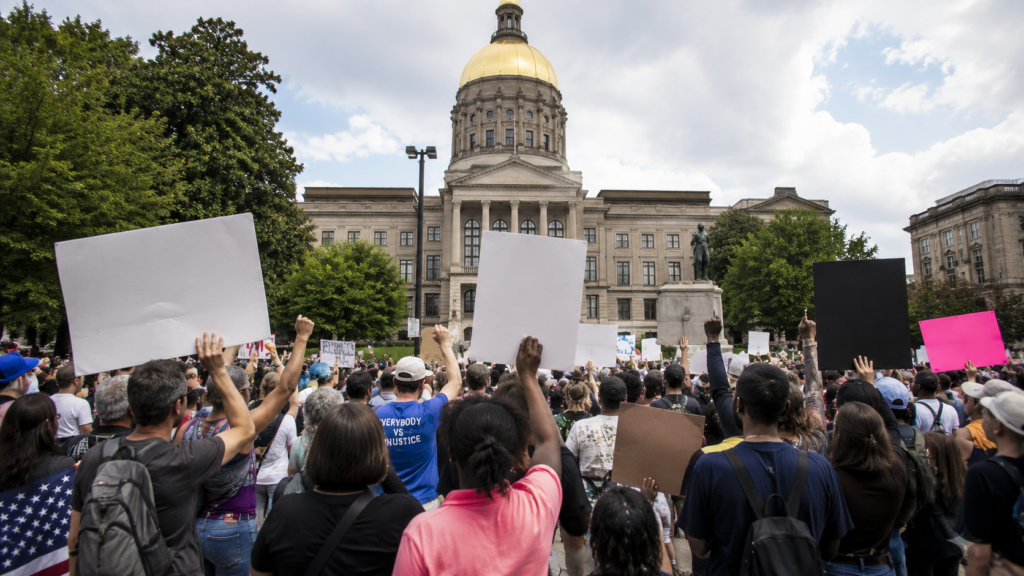
Civil rights leaders and voting rights groups gathered in Atlanta before the session, arguing that the proposal would weaken Black voting power and undo representation built through decades of organizing.
That history matters in Atlanta.
This was not just another policy fight at the Capitol. It unfolded in a city deeply tied to the civil rights movement, with many protesters explicitly connecting the redistricting debate to older fights over voting access and representation.
The decision to shelve the maps allowed activists to claim victory.
But even supporters of the decision were careful not to treat it as permanent.
The redistricting issue can return. The legal pressure that created the debate has not gone away. And Republican leaders did not say Georgia would never redraw maps. They said they would not do it during this special session.
That distinction matters.
Republican Leaders Cite Process and Legal Uncertainty
Republican leaders said they wanted a more deliberate process, including more public input and a better understanding of how legal challenges in other states will play out.
That is a reasonable explanation, but it is not the only context.
Georgia is not Tennessee, Alabama or Louisiana. It is still governed mostly by Republicans, but it has become the most competitive state in the Deep South. Democrats have won statewide races here. Suburban Atlanta has shifted. Black voters remain central to the state’s political balance.
That makes aggressive redistricting more politically dangerous.
A map designed to weaken Democratic districts could energize Democratic turnout ahead of major statewide races. It could also trigger litigation and deepen public backlash before voters go to the polls.
So the question for Republicans was not just whether they could draw new maps.
It was whether doing so now would help them more than it would hurt them.
The Pressure Inside the GOP
Not every Republican wanted to wait.
Some Republicans had pushed for Georgia to move quickly, especially after other Southern states took more aggressive steps following the Supreme Court ruling. The argument from that side was straightforward: Republicans have control of the state government now, and they should use it while they can.
But other Republicans appeared more cautious.
That divide says something about the moment Georgia Republicans are in. The party still has power, but it no longer operates in a state where Democratic resistance can be dismissed as symbolic.
Public anger can matter. Suburban voters can matter. Court challenges can matter. And in Georgia, the margin between smart strategy and political overreach can be thin.
That is why the decision to shelve redistricting looks less like a full retreat and more like a tactical pause.
The Black Representation Question
The most sensitive issue is not simply whether Republicans would gain seats.
It is how those gains would be achieved.
Opponents feared new maps could dismantle or weaken districts that have historically allowed Black voters to elect candidates of their choice. That is why Democratic lawmakers and civil rights leaders described the plan as an attack on Black voting power.
Republicans often frame these debates differently, arguing that race-conscious mapmaking can itself violate constitutional principles depending on how districts are drawn.
That tension is now at the center of redistricting fights nationwide.
The legal question is technical. The political impact is not. When a district changes, voters may find themselves grouped into new coalitions where their influence is reduced, diluted or redirected.
That is why redistricting battles rarely feel like paperwork to the communities affected by them.
The Special Session Still Has Work to Do
Redistricting may be off the table for now, but the special session is not over.
Lawmakers still have to address a separate election administration problem involving Georgia’s ballot tabulation system. A state law set to take effect July 1 would prohibit election officials from using QR codes to tabulate ballots.
That creates a practical problem because Georgia’s current voting system has relied on QR-coded ballot summaries since 2020.
This issue is less politically dramatic than redistricting, but it may be more urgent. If lawmakers fail to resolve it clearly, election officials could face confusion ahead of upcoming contests.
That is the kind of problem that can sound technical until it reaches voters.
Then it becomes a trust problem.
Why Timing Matters?
Timing is one of the reasons the redistricting push became so fraught.
Georgia has major statewide races on the horizon, including races for governor and U.S. Senate. Any attempt to redraw maps in that environment could become a mobilizing issue almost immediately.
It also would have placed lawmakers in the position of debating political boundaries while voters, candidates and parties were already preparing for the next election cycle.
That does not mean redistricting cannot happen later.
It means the cost of doing it now may have grown too high.
For Republican leaders, waiting allows more time to watch court cases in other states, evaluate the political fallout, and decide whether a future map can survive both legal scrutiny and public backlash.
For Democrats and activists, waiting provides more time to organize.
What This Means for Georgia Voters?
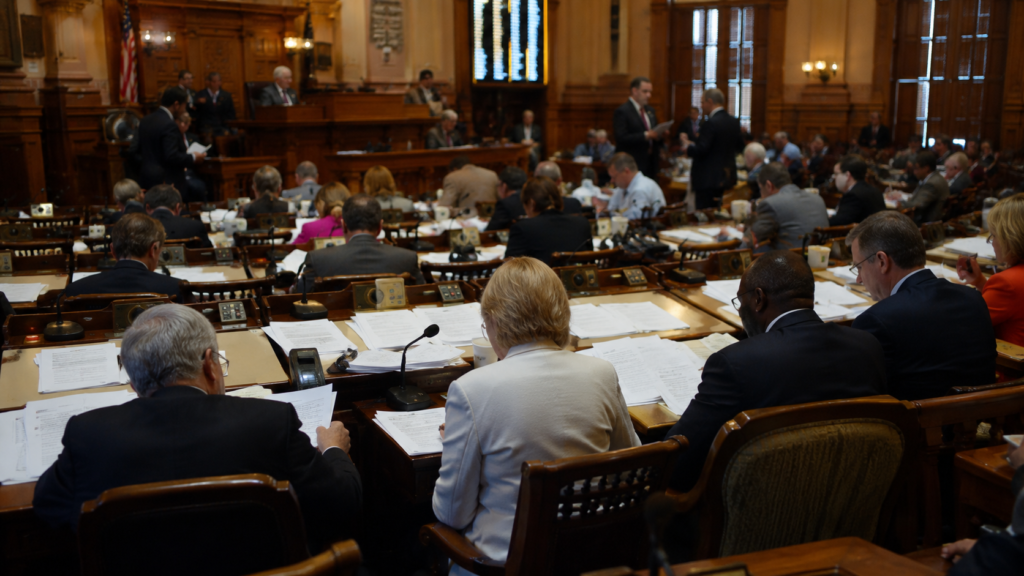
For voters, the practical effect is that Georgia’s maps will not be redrawn during this special session.
But the broader debate is still unresolved.
The Supreme Court ruling changed the legal environment. Republican lawmakers in other states have already moved. Georgia Republicans have not ruled out action later. And civil rights groups are unlikely to stand down simply because this session will not take up maps.
That makes this a pause, not a settlement.
Voters should expect the issue to return in some form, especially as court rulings from other states clarify how far legislatures can go under the new legal standards.
The next fight may be slower. It may be more procedural. It may involve hearings, draft maps and legal arguments rather than one dramatic special-session showdown.
But the central question will be the same: how much power should lawmakers have to redraw political boundaries in ways that reshape representation?
The Bottom Line
Georgia Republicans backed away from redistricting during Wednesday’s special session after protests, legal uncertainty and political risk converged at the Capitol.
Voting rights advocates are treating the decision as a victory, and in the immediate sense, it is one. New maps will not be taken up during this session.
But the redistricting fight is not over.
Republican leaders have left room to revisit the issue later, and the Supreme Court ruling that sparked the debate continues to shape map fights across the South.
For now, Georgia’s political maps remain in place.
The bigger question is whether that remains true once lawmakers have more time, more legal guidance and a clearer sense of the political cost.