

Augusta residents could see a lower rate on one part of their property-tax bill and higher charges for basic services under the city’s proposed 2027 budget. Whether a household comes out ahead requires more than checking a single millage number.
The proposal combines a new source of sales-tax-funded property-tax relief with increases in several service charges. It arrives as city leaders debate how to pay for existing operations and employees, and as water customers are raising questions about the accuracy of their bills.
The distinction matters before the Augusta Commission adopts a spending plan: a reduction in the county’s operating-tax rate is not a promise that the entire tax bill, much less the household’s combined cost of local government, will fall.
The changes on the table
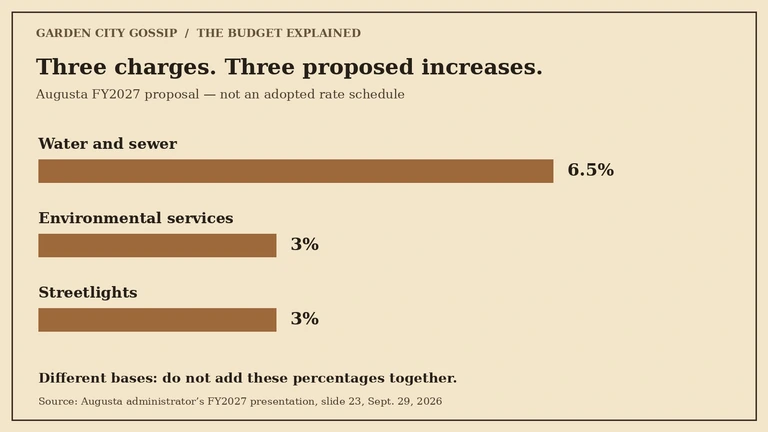
The administrator’s September 29 budget presentation proposes a 6.5 percent water-and-sewer rate increase, alongside 3 percent annual increases in environmental-services and streetlight fees. It also recommends increases of 0.2 mills for fire protection and 0.7 mills for urban services.
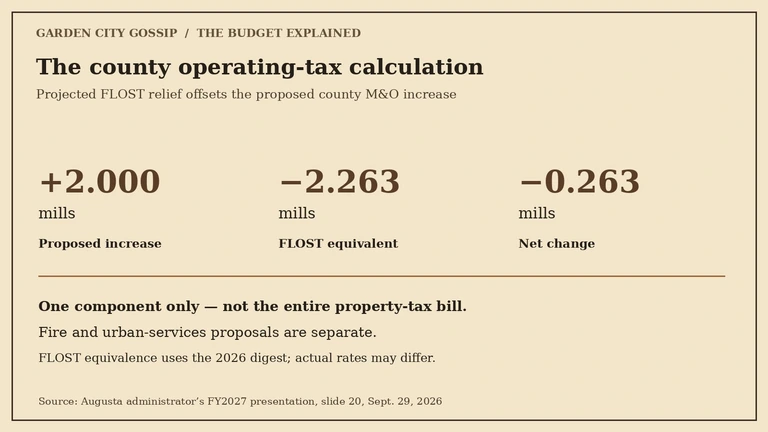
For county maintenance and operations, the presentation pairs a recommended 2-mill increase with projected sales-tax relief equivalent to 2.263 mills. That produces a net reduction of roughly 0.263 mills in that component, using the presentation’s assumptions. These are proposals, not a schedule of final adopted charges.
Where the property-tax relief comes from
Augusta’s official FLOST explainer describes the Floating Local Option Sales Tax as a half-percent sales tax approved by voters in May. Collections began October 1, with the resulting property-tax rollback beginning in 2027.
The money is earmarked for property-tax relief, specifically a portion of county maintenance and operations. Unlike the special-purpose sales tax used for capital projects, this tax changes how operating costs are financed. It shifts some of that funding from property to purchases, including purchases by visitors.
That distinction also matters for renters and other residents who do not receive a property-tax bill directly. They still encounter the sales tax on covered purchases. A property-tax rollback and the additional sales tax are parts of the same financing change, not two unrelated windfalls.
Why a household estimate needs its own math
A property-tax comparison needs the taxable value and the applicable tax lines for that particular property. Comparing only two headline millage rates leaves out the rest of the calculation. A homeowner should compare the same tax component in each year, then examine the other lines separately.
Service charges require a different calculation. A percentage applied to a water rate is not automatically the same percentage change in a customer’s final bill when consumption changes. Garbage and streetlight charges should be considered on their own terms rather than folded into a water-bill estimate.
The boxed example explains the arithmetic, rather than forecasting a typical Augusta bill. A household comparison still requires the property’s exemptions, applicable districts, service charges and usage.
The pressure behind the proposal
The full proposed budget totals about $1.261 billion across multiple funds. The administrator’s message cautions that much of that money is restricted to particular uses; it is not one unrestricted pot commissioners can freely move between services.
The plan replaces temporary resources used in 2026, including $2 million in Hurricane Helene-related landfill transfers and $800,000 in remaining federal pandemic-relief funding. It also includes a 3 percent employee cost-of-living adjustment and increased healthcare and software costs. The proposed General Fund contains no new programs or positions.
Those pressures have become a political choice about service levels and staffing. In WJBF’s report, updated October 28, Administrator Tameka Allen said rejecting the plan would force departments to reconsider personnel spending and could cost jobs. Commissioner Catherine Smith Rice expressed reluctance to raise charges, while Commissioner Francine Scott opposed potential layoffs.
That reporting describes a dispute over how to balance the budget, not an approved layoff plan. Residents weighing the increases need to know both what they would pay and what services or staffing would change under an alternative.
Water bills bring another question
The rate debate is taking place alongside a separate concern: whether customers can trust the usage figures on their bills.
WRDW/WAGT reported October 29 that Utilities Director Wes Byne acknowledged some meter and reading complaints were valid during the department’s October 23 budget presentation. He proposed completing a roughly 75,000-meter replacement program in three years rather than five, and said about 4,000 new meters had been installed.
According to that report, Byne said an annual 4.5 percent rate increase was required by the city’s 2024 bond financing; the additional two percentage points would support capital projects and operating costs. The station also reported that a replacement billing-system procurement remained under evaluation.
A rate decision and a disputed meter reading require different answers. Modernizing equipment may improve information available to customers, but it does not by itself resolve an individual disputed bill or establish the final rate commissioners will approve.
What to watch next
Augusta’s budget documents page is the place to follow the proposal and supporting materials. The city’s FY2027 budget page distinguishes the administrator’s preliminary recommendation from the budget adopted by commissioners.
As the plan moves through review, the central questions are specific: Which rates survive? What changes in spending accompany them? How much relief reaches each tax component? And what billing improvements can residents expect in return for higher service charges?
Until those decisions are made, both halves of the household calculation belong in the conversation: the tax relief and the bills that may rise.
Related GCG opinion: The County Line and the Cost of Prosperity examines how the region’s advantages and obligations are divided between Richmond and Columbia counties.