

Augusta asked people which services deserved priority in its next budget. Affordable housing finished first among the 1,294 people who answered. At Wednesday's hearing, the useful follow-up is what that priority means in dollars, programs and decisions.
The city has scheduled public comments for 10:30 a.m. Nov. 4 in the Lee N. Beard Commission Chamber. The notice says the meeting will be livestreamed on the city's YouTube channel. The administration's budget calendar lists Nov. 17 for adoption.
This is a preview of that hearing, not an account of comments or decisions made there. The hearing had not begun when this story was prepared.
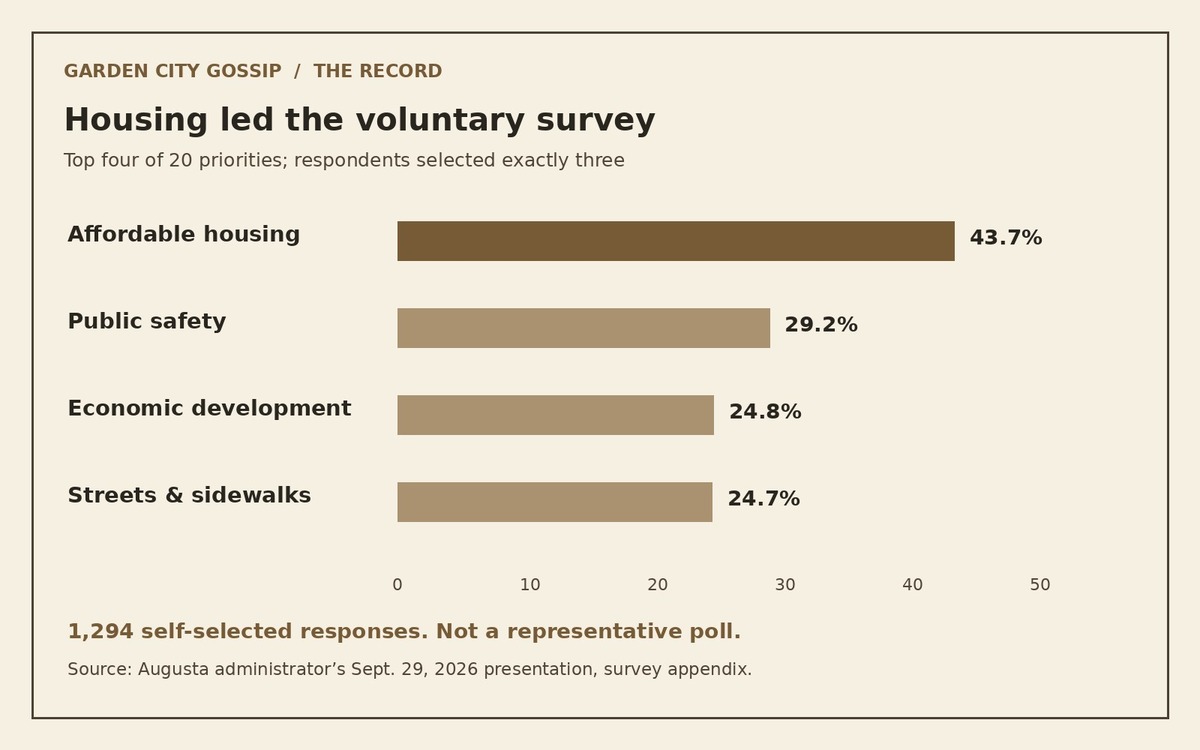
In the September 29 administrator's presentation, 565 respondents, or 43.7 percent, placed affordable housing among their top three funding priorities. Public safety followed at 29.2 percent, then economic development at 24.8 percent and streets and sidewalks at 24.7 percent.
Those figures describe an open, self-selected survey, not a representative poll of Augusta. Each respondent chose three priorities, so the percentages are not slices of a single 100-percent pie. They identify what engaged respondents asked the city to address; they do not establish a mandate to spend 43.7 percent of the budget on housing.
What the housing accounts show
The initial proposed budget provides a starting point for examining that request. Its Housing & Community fund, number 221, totals $10,245,460 in the administrator's 2027 recommendation, compared with $14,358,520 in the document's 2026 budget column. The difference is $4,113,060.
That is a comparison between budget columns in the September proposal, not a finding that housing services will fall by that amount or that commissioners have adopted a cut. The fund contains several grant programs and other costs, not one unrestricted affordable-housing appropriation. The document also records spending elsewhere in city government, so this fund is not a census of every housing-related dollar in Augusta.
Some specific lines make the comparison more useful. HOME Grant Projects moves from $2,243,650 in the 2026 budget column to $973,200 in the 2027 recommendation. CDBG Rehabilitation moves from $981,500 to $721,460. The separate HOME ARP Grant line rises from $1,161,070 to $1,220,810.
The proposal also lists $350,040 for HCD Rental Maintenance and $10,240 for maintenance of homes for sale. Both lines show a zero 2026 budget alongside 2026 spending recorded in the September proposal. A zero in that budget column therefore does not mean the city had no maintenance expense.
The revenue schedules show that these programs rely on different combinations of grants and program income. Before treating a lower line as a policy choice, residents need to know whether it reflects grant timing, completed projects, available funds or a change in service. Before treating a higher line as new help, they need to know what it buys.
Follow the request into a decision
The broader spending plan makes those distinctions important. The initial recommendation totals about $1.261 billion across multiple funds. Administrator Tameka Allen's message says much of that money is restricted to specific purposes and describes a General Fund proposal without new programs or positions.
That leaves a practical test for Wednesday's discussion and the final vote: Which requests have produced an amendment? Which are already covered by an existing program? Which remain unfunded, and why?
For housing, a useful answer would connect each appropriation to an outcome: homes repaired, rental properties maintained, households assisted or units brought into use. It would distinguish money available for a particular grant purpose from money commissioners can redirect. And it would identify any changes made after the September recommendation rather than asking residents to compare different versions on their own.
The survey itself shows why explanation matters. Fifty-six percent of respondents rated the value they receive for tax dollars as poor. No single approach to additional funding drew majority support: 34 percent preferred reducing lower-priority services, 35 percent collectively favored modest fee or tax increases, and 31 percent were unsure.
GCG's earlier budget explainer examined proposed tax and service-bill changes. The question at this hearing is the spending side of that same bargain: what the city will deliver, what it will defer, and how residents can trace the decision.
The city's FY2027 budget page links the preliminary recommendation and work-session materials. A public hearing records what people say. The adopted budget will show which requests became commitments.