
Aiman Tariq – Regional News Editor
Atlanta, GA –
The Georgia Supreme Court has cleared one legal hurdle that had continued to delay executions for a small group of death row inmates covered by a pandemic-era agreement.
In a unanimous opinion issued Tuesday, the court reversed part of a Fulton County judge’s ruling that had kept the state from moving forward with executions under the 2021 agreement. The decision does not appear to settle every dispute over the agreement. But it does remove one major argument that defense attorneys had used to keep the executions on hold: whether COVID-19 vaccines are “readily available” to all members of the public.
That makes the ruling important, but not simple.
The state won on the vaccine question. The fight over prison visitation — another condition in the agreement — is still expected to return to Fulton County Superior Court.
What the Court Decided?
The case centers on an agreement reached in 2021 between the Georgia Attorney General’s Office and lawyers representing some people on death row. That agreement laid out conditions that had to be met before the state would pursue execution warrants for certain inmates after the COVID-19 pandemic disrupted court and prison operations.
According to the Georgia Supreme Court opinion, the agreement said the Attorney General’s Office would not pursue an execution warrant before three conditions were met: the end of the state’s COVID-19 judicial emergency, the resumption of normal prison visitation, and a COVID-19 vaccine being readily available to all members of the public.
A Fulton County judge had ruled that the vaccine condition was not satisfied because COVID-19 vaccines had not been approved for children under 6 months old. The Supreme Court disagreed with that interpretation.
Justice Carla Wong McMillian wrote for the court that the vaccine condition had been wrongly construed. The court said the state had produced undisputed evidence that vaccine supply was adequate and that no legal barrier prevented vaccination if a medical provider deemed it appropriate.
That finding sends the case back to the trial court.
Why the Vaccine Issue Mattered?
The vaccine question may sound narrow, but it had become one of the main legal barriers in the case.
Defense attorneys argued that the agreement’s language required vaccine availability to all members of the public, and that infants under 6 months old still did not fall within that category. The state argued the agreement should not be read that way, particularly years after the pandemic emergency ended and vaccines became broadly available.
This is the difference between a legal condition and a public-health debate.
The court was not deciding whether COVID-19 policy was wise, whether the agreement should have been written differently, or whether executions should resume as a policy matter. It was deciding how the language of the agreement should be applied now.
On that question, the court sided with the state.
What the Ruling Does Not Decide?
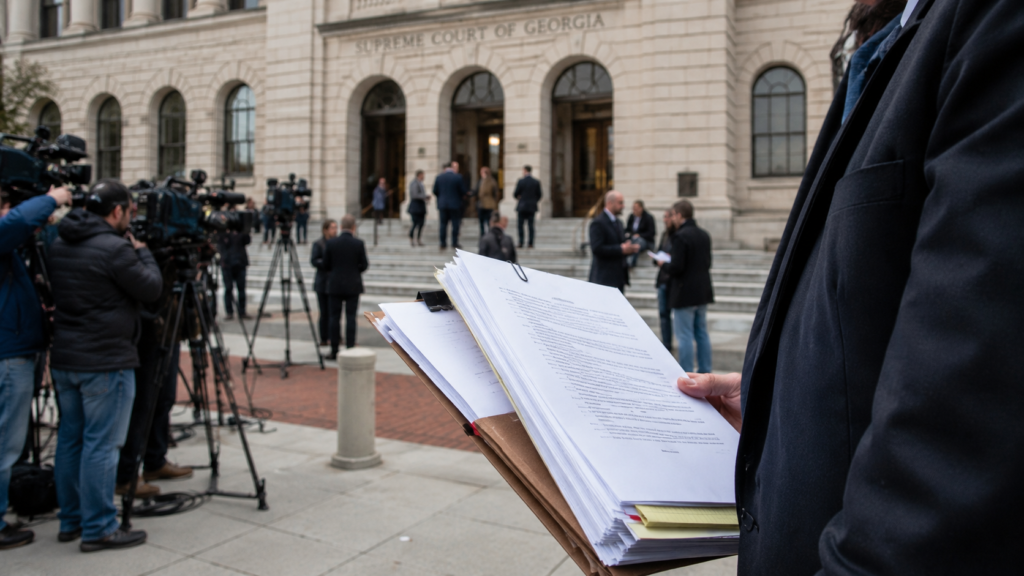
The ruling does not mean executions will automatically resume immediately for every person covered by the agreement.
That is an important line.
The Supreme Court reversed the trial court on the vaccine condition. But the opinion itself notes that the agreement’s condition regarding inmate visitation had not yet been litigated. The AJC also reported that the case now returns to Fulton County, where arguments are expected to focus on whether prison visitation in Georgia has returned to normal.
That means the state has cleared one obstacle, not necessarily the entire road.
There may also be further arguments about timing, notice, and which officials are bound by the agreement. Justice Benjamin Land wrote separately to emphasize that the agreement limits the Attorney General’s Office when it comes to pursuing execution orders, but does not bind district attorneys in the same way.
That distinction could matter if the litigation continues.
How the Pandemic Agreement Started?
Executions in Georgia stopped during the COVID-19 pandemic. But death penalty appeals continued moving through the courts, meaning some inmates became eligible for execution while pandemic restrictions were still affecting prisons, attorneys, and courts.
In 2021, a judicial task force committee instructed state lawyers and capital defense attorneys to come up with terms for resuming executions safely. The resulting agreement applied only to a specific group of prisoners, not everyone on Georgia’s death row.
The agreement later became the center of a contract fight after the state set an execution date for Virgil Delano Presnell Jr. in 2022. His lawyers, through the Federal Defender Program, argued the state had violated the agreement because the conditions had not all been met.
In 2022, the Georgia Supreme Court ruled that the email agreement was a valid and enforceable contract. That earlier ruling kept the dispute alive and delayed Presnell’s execution.
This week’s ruling does not erase that earlier decision. It narrows one part of the fight.
Why Presnell’s Case Keeps Coming Up?
Virgil Delano Presnell Jr. has been at the center of much of the litigation because his scheduled execution in 2022 triggered the lawsuit over the pandemic agreement.
Presnell was convicted in Cobb County in the 1970s in a case involving the death of a child and other serious charges. His lawyers have previously argued that he has significant cognitive and developmental impairments, but earlier legal and clemency efforts have not stopped the case from returning to the execution-track dispute.
That background explains why the case carries emotional weight on both sides.
For the state and victims’ families, the case is about decades of delay after a conviction and sentence. For defense attorneys, the case is about whether the state must honor procedural commitments it made during the pandemic before carrying out the most irreversible punishment available.
Both points can be true at once.
That is why the court’s ruling matters beyond one inmate. It affects how Georgia interprets the promises it made during a public-health emergency and how quickly the state may be able to move on covered execution cases.
Who Is Covered by the Agreement?
The agreement does not cover everyone on Georgia’s death row.
AP reported last year that the agreement applied to fewer than 10 of Georgia’s death row inmates. The AJC reported that Georgia had 33 inmates on death row as of March, citing the state corrections department.
That matters because some executions have already moved forward outside the group covered by the agreement. Willie James Pye was executed in 2024, and courts found he was not within the class of prisoners protected by the pandemic agreement.
So the legal fight is not about whether Georgia can ever carry out executions again. It is about whether this particular agreement still blocks execution efforts for this particular group.
That narrower frame is easier to miss in public debate.
The State’s Argument and the Defense Response
The state has argued that the pandemic is effectively over for purposes of the agreement and that the conditions have been met or should no longer block execution efforts. According to AJC reporting, Georgia Solicitor General John Henry Thompson argued in March that the pandemic is in the state’s “rearview mirror” and that the justice system is operating normally.
Defense attorneys argued that the plain language of the agreement still matters, and that the state should not be allowed to move forward unless all agreed conditions are satisfied. Earlier AP reporting noted that defense lawyers had pointed to both vaccine access for infants under 6 months old and prison visitation as unresolved issues.
The court’s decision rejects the vaccine argument.
It does not appear to fully resolve the visitation argument.
That leaves the case in a familiar place: the state has gained ground, but the litigation is not necessarily over.
What Happens Next?
The case now returns to the Fulton County trial court.
The most immediate question is likely whether Georgia prison visitation has returned to normal under the terms of the 2021 agreement. If the state prevails on that issue, prosecutors and state officials may have a clearer path toward seeking execution warrants for inmates covered by the agreement.
There may also be additional arguments over notice requirements and procedure. The original agreement included timing protections before the state could pursue certain execution warrants, including notice periods for covered prisoners.
That is why Tuesday’s ruling should be read carefully.
It is a significant development. It is not the final word on every remaining procedural issue.
The Bottom Line
The Georgia Supreme Court has ruled that the vaccine condition in a pandemic-era execution agreement no longer blocks the state from moving forward.
The court said the trial judge was wrong to treat the lack of FDA approval for children under 6 months old as meaning vaccines were not “readily available” to all members of the public.
That clears one major hurdle in a long-running dispute over a small group of death row inmates whose executions were delayed by the COVID-era agreement.
But the case is not necessarily finished. The fight now returns to Fulton County, where the remaining question appears to be whether prison visitation has returned to normal under the agreement.
The simplest version is that Georgia is closer to resuming some executions delayed by the pandemic agreement.
The more accurate version is that the state won a key legal issue, but the remaining terms of the agreement still have to be worked through before the path is fully clear.