Aiman Tariq – Regional News Editor
Atlanta, GA –
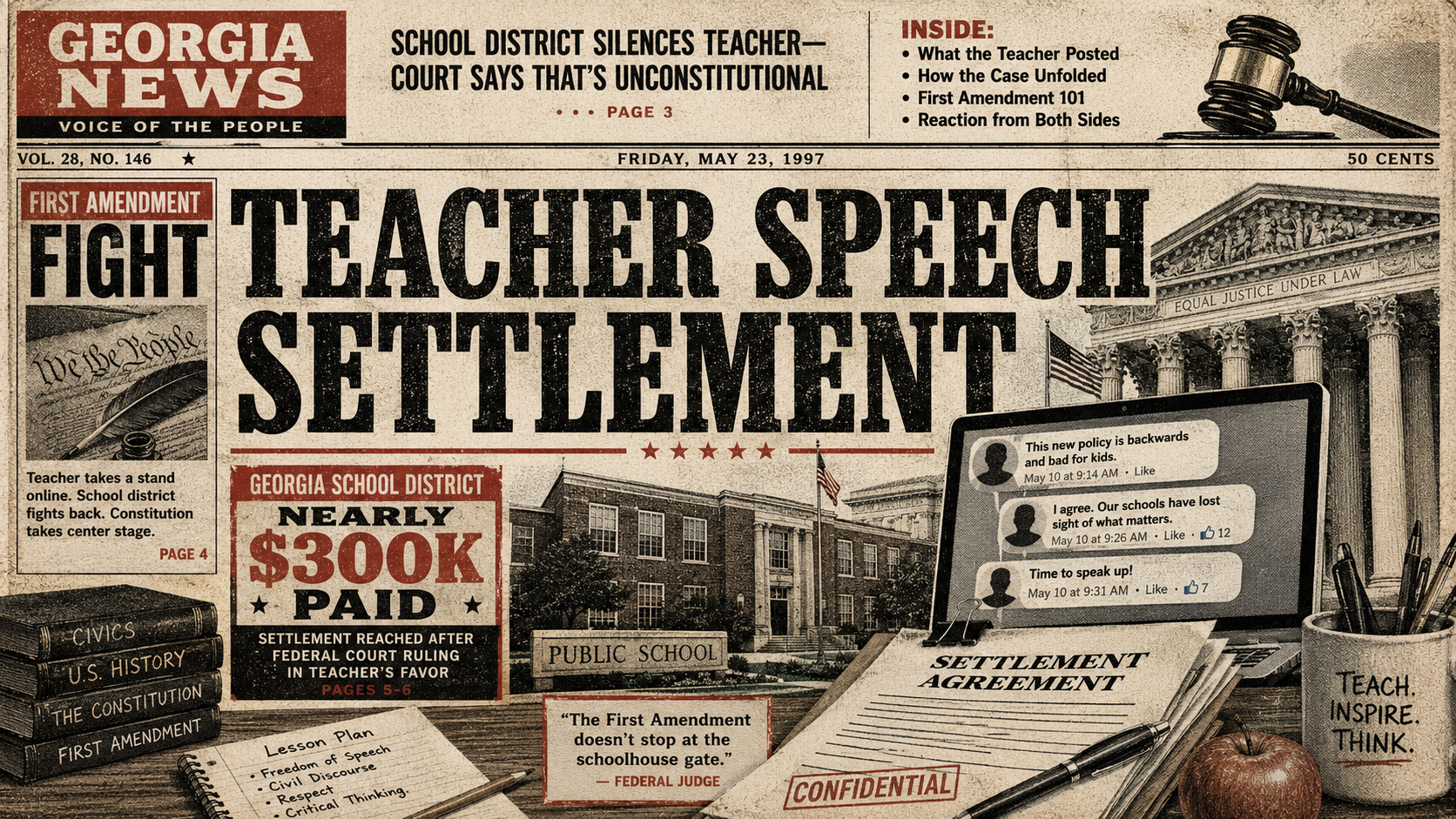
A former Georgia teacher has reached a nearly $300,000 settlement with the Oglethorpe County School District after she said she was removed from the classroom over private Facebook comments about conservative activist Charlie Kirk following his assassination.
The settlement ends a federal lawsuit filed on behalf of Michelle Mickens, a former Oglethorpe County High School English teacher and Georgia Teacher of the Year finalist, who claimed the district violated her First Amendment rights by placing her on indefinite leave and pressuring her to resign over comments made outside school, on her personal account.
That does not mean a court ruled that every statement she made was protected. It means the school district chose to settle rather than continue litigating the case.
But the settlement still matters.
It adds to a growing set of disputes over how far public schools can go when disciplining teachers for off-campus speech, especially when that speech is controversial, political, or offensive to some members of the community.
What the Settlement Shows?
According to reporting from The Atlanta Journal-Constitution, the Oglethorpe County School District paid nearly $300,000 to resolve the case. Fox News, citing records obtained by the AJC, reported that Mickens received approximately $270,420 for alleged emotional distress and $17,080 for legal fees.
The lawsuit was dismissed after the settlement, according to court filings cited in local and national coverage.
That number is large enough to draw attention, but it should not be read too broadly. Settlements often reflect risk, cost, disruption, and uncertainty, not necessarily an admission that every claim in a lawsuit would have succeeded at trial.
Still, for a small school district, nearly $300,000 is not a minor paperwork issue.
It is a signal that discipline over employee speech can become expensive quickly when constitutional questions are involved.
What Mickens Alleged
The Southern Poverty Law Center and the Georgia Association of Educators filed the federal lawsuit in October 2025 on Mickens’ behalf. The complaint alleged that the district punished her after she posted on her private Facebook page about Kirk, his own remarks on gun deaths, and her views about his political rhetoric.
According to Fox News, Mickens initially posted a quote attributed to Kirk about accepting some annual gun deaths as a cost of preserving Second Amendment rights. She later responded in a Facebook discussion, saying she did not condone violence but also sharply criticized Kirk and wrote that the world was “safer” without him.
That language was plainly controversial. It was also the kind of political speech that can create a difficult line for public employers.
Public school districts have an interest in avoiding disruption and maintaining community trust. Public employees also do not lose all First Amendment protection when they leave work and speak as private citizens on matters of public concern.
The dispute sat directly on that line.
How the District Response Became the Case?
According to the lawsuit and related reporting, the post was later shared more widely on X by someone outside the school system, drawing attention and complaints to Mickens’ employer. Mickens alleged that school officials initially told her to delete the post and apologize, and that she was later told to stay home, lost access to school email, and was encouraged to resign or face termination.
The district’s position has not been fully litigated in a final court ruling.
That matters because the public record at this stage is mostly the lawsuit, the settlement, and reporting based on both. The allegations explain why Mickens sued. The settlement explains how the parties ended the case. It does not provide a full judicial answer to every factual dispute.
That is why careful wording matters here.
The safest version is this: Mickens said she was punished for private political speech. The district settled the case. The legal question was serious enough that both sides avoided a final trial.
Why First Amendment Questions Are Complicated for Teachers?
Public school employees occupy a difficult position in free-speech law.
They are government workers, but they are also citizens. When they speak as employees, school districts generally have more authority to regulate that speech. When they speak as private citizens on public issues, the analysis becomes more complicated.
Courts often look at whether the employee spoke as a private citizen, whether the speech involved a matter of public concern, and whether the employer had a strong enough interest in preventing disruption to justify discipline.
The SPLC’s case docket says the lawsuit alleged Mickens was punished for exercising First Amendment rights by posting about Kirk on her personal Facebook page. The complaint also asserted claims involving First Amendment retaliation, viewpoint discrimination, and due process.
Those are serious claims.
But they are also claims. The settlement avoids the harder judicial step of deciding how those doctrines apply to these exact facts.
The Difference Between Offensive and Unprotected
This is where the case becomes bigger than one teacher and one post.
Speech can be offensive, poorly timed, or harsh without automatically becoming unprotected. That does not mean a public employer has no options when employee speech creates disruption. It means the employer has to be careful about the constitutional line.
That line is especially important when the speech concerns politics, public violence, gun policy, or a national figure.
Kirk’s killing at Utah Valley University in September 2025 led to intense reactions across the country. Several educators reportedly faced suspensions, firings, or investigations over social media comments about his death, according to coverage following the incident.
That pattern is part of why the Mickens case drew attention beyond Oglethorpe County.
It became one example of a broader debate: how should schools respond when teachers express controversial political views outside the classroom?
The Broader Teacher-Speech Debate
There is a simple version of this story: a teacher made a controversial post, the district responded, and the case ended in a large settlement.
The more accurate version is more complicated.
Teachers are trusted public employees. Communities expect judgment from them, especially when their comments become visible to students and parents. At the same time, if school districts punish every off-campus political statement that becomes unpopular online, public employees can end up speaking under a kind of informal veto from social media pressure.
That is the tension.
It is not difficult to understand why some parents and community members objected to Mickens’ comments. The remarks came after an assassination, and public reactions to political violence carry real weight.
It is also not difficult to understand why civil liberties groups saw the district’s response as a First Amendment problem. If the speech occurred on a private Facebook page, outside the classroom, about a public political figure and national debate, then the constitutional questions become harder for the district.
That does not make the speech wise.
It makes the discipline legally risky.
Why the Settlement May Matter for Georgia Schools?
The settlement is likely to be noticed by other districts in Georgia.
Not because it answers every legal question, but because it shows the cost of acting quickly in a politically charged speech dispute.
School leaders often face pressure from several directions at once: parents, students, staff, board members, outside activists, and social media users who may not live in the district at all. In that environment, the fastest response can feel like the safest response.
This case suggests that may not always be true.
A district can create more exposure by moving too quickly, especially if the employee speech is arguably private, political, and outside the scope of school duties.
That is why the phrase “according to the lawsuit” matters. It is also why districts tend to need careful legal review before treating an employee’s off-campus post as a firing matter.
What the SPLC Said?
After the settlement, SPLC senior supervising attorney Sam Boyd said the parties had reached a “mutually amicable settlement” and argued that courts have recognized that public school employees, including teachers, have constitutionally protected free-speech rights.
That statement reflects the plaintiff’s framing of the case.
The district’s full explanation has been more limited in public coverage. Fox News reported that it reached out to the Oglethorpe County School District superintendent and the SPLC for comment. CBS Atlanta also reported the settlement but did not describe a detailed public statement from the district explaining its reasoning.
That leaves some unanswered questions.
How much disruption did the district believe the post caused? What internal process did administrators follow? Did school officials consider less severe options before indefinite leave or possible termination? Those questions matter, but the settlement means they may not be tested in open court.
The Bottom Line
Michelle Mickens, a former Georgia teacher, has reached a nearly $300,000 settlement with the Oglethorpe County School District after suing over discipline tied to private Facebook comments about Charlie Kirk.
The case does not prove that every controversial post by a teacher is protected.
It does show that public school districts face real constitutional risk when they discipline employees for off-campus political speech, especially before a court has sorted out the balance between disruption and free expression.
The comments at issue were controversial. The district’s response was challenged as unconstitutional. The case ended with a major payment rather than a final ruling.
For Georgia schools, the lesson is not that employee speech has no consequences.
It is that when the government is the employer, consequences have constitutional limits.
As more political disputes move from classrooms to social media and back again, districts will likely face more of these cases — and the Mickens settlement gives them one more reason to slow down before turning public outrage into personnel action.