Aiman Tariq – Regional News Editor
Atlanta, GA –
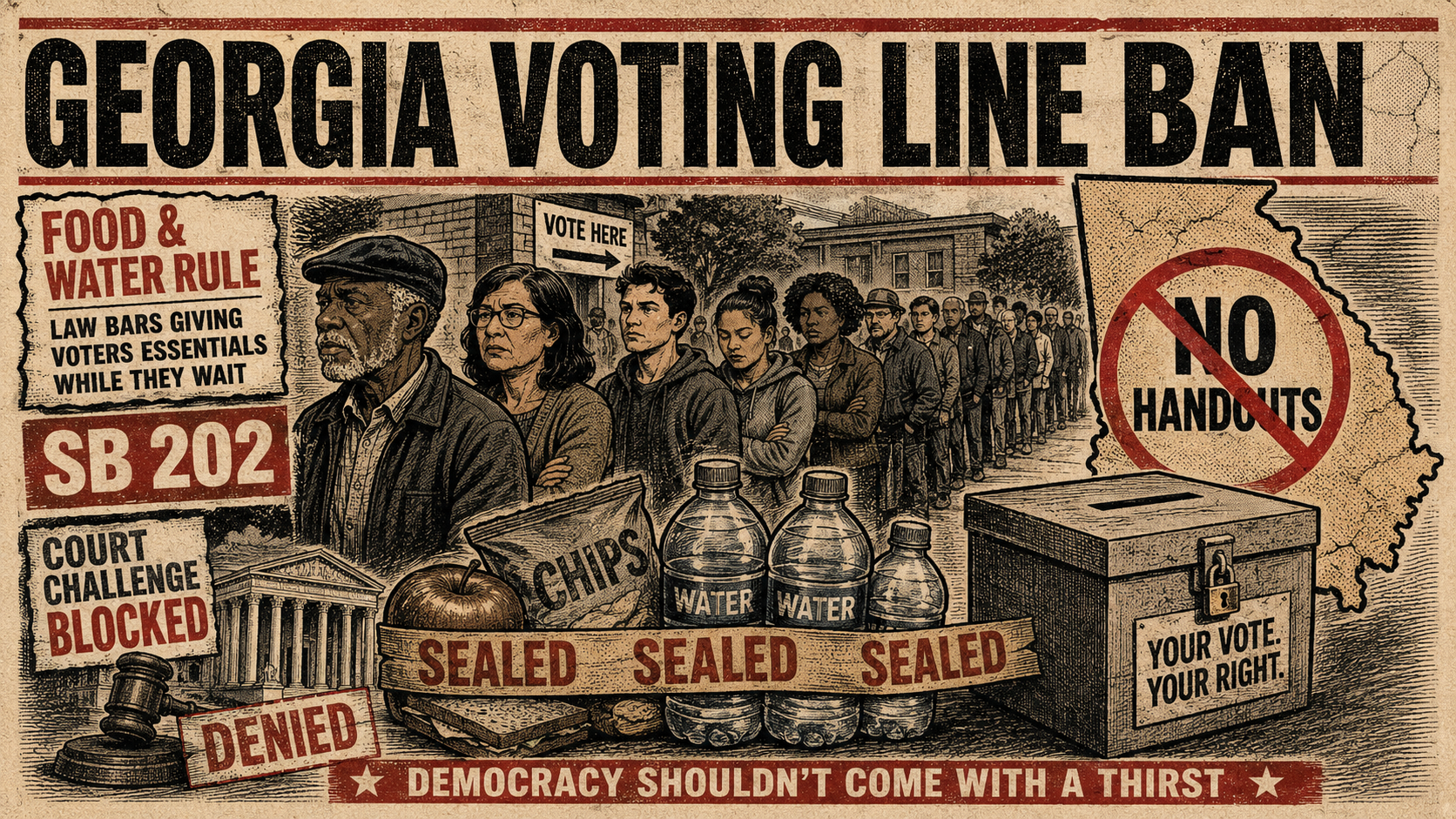
Georgia’s ban on giving food and drinks to voters waiting in line will remain in effect after a federal judge declined to block the law, keeping one of the state’s most debated election rules alive as the legal fight continues.
The ruling does not end the broader dispute over Georgia’s 2021 election law. It does, however, mean that organizations hoping to offer water, snacks, or other assistance to voters near polling places remain limited by the state’s “food, drink and gift” ban.
That is why the order matters. It is not just about a bottle of water. It is about where states draw the line between preventing voter influence and restricting basic assistance to people waiting to cast a ballot.
What the Judge Decided?
U.S. District Judge J.P. Boulee denied a request from voting-rights groups, churches, and other organizations seeking to stop state and county officials from enforcing the ban.
According to CBS Atlanta, Boulee focused heavily on who the plaintiffs sued. The named defendants included Gov. Brian Kemp, Secretary of State Brad Raffensperger, and members of the Georgia State Election Board.
The judge wrote that those officials do not enforce criminal laws or control whether prosecutors bring criminal charges. That matters because the ban carries criminal penalties, and the judge found that the plaintiffs had not shown that the named defendants could prosecute violations.
In other words, the ruling turned less on whether the food-and-water ban is good policy and more on whether the court could grant meaningful relief against the specific officials named in the case.
That distinction is important. A court can object to the way a challenge is framed without resolving every constitutional question underneath it.
The Procedural Problem
According to the order described by CBS Atlanta, Boulee wrote that plaintiffs had offered no evidence showing the defendants played a role in prosecuting violations of the food, drink, and gift ban.
He also noted that the plaintiffs had not shown those defendants could control a district attorney’s decision to charge someone if a violation occurred.
That is a narrow but powerful procedural point.
If a lawsuit asks a court to stop enforcement of a law, the plaintiffs generally have to sue someone who can enforce it. If the people named in the case cannot prosecute violations or impose criminal penalties, the court may find that blocking them would not solve the alleged injury.
That appears to be what happened here.
The judge also acknowledged that state officials had issued guidance about the ban, but he said that alone was not enough to show the kind of injury needed for the requested injunction.
What the Ban Covers?
The rule at issue is part of Georgia’s 2021 Election Integrity Act, commonly known as SB 202.
The law made several changes to Georgia election rules, including limits on absentee ballot drop boxes, new identification requirements for absentee voting, changes to early voting, and restrictions on giving food, drinks, or gifts to voters waiting in line.
The food-and-water provision has become one of the most recognizable parts of the law because of its practical simplicity. Supporters describe it as a guardrail against improper influence near polling places. Critics describe it as a restriction on civic assistance, especially when voters face long waits.
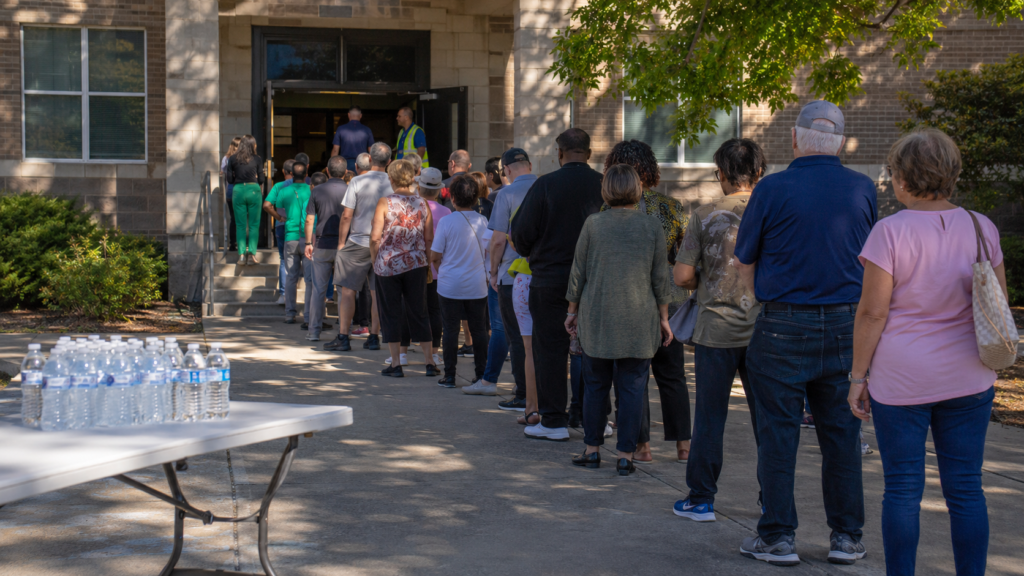
The law does not prevent poll workers from making self-service water available. But it does restrict outside groups and individuals from directly handing out food or drinks to voters within certain zones around polling places and voting lines.
That is the part that has kept the issue in court.
Why Has the Fight Lasted So Long?
The legal battle over SB 202 has moved through several stages since the law was passed in 2021.
Voting-rights groups have challenged multiple parts of the law, arguing that the restrictions burden voters and limit protected civic activity. State officials have defended the law as a set of election-security and anti-solicitation rules.
The food-and-water ban has been a particular flashpoint because it sits at the intersection of two different concerns.
One concern is electioneering. States have long regulated activity close to polling places to prevent campaigns from pressuring or influencing voters as they cast ballots.
The other concern is access. In Georgia, long lines have historically been part of the election debate, particularly in large metro counties and communities where voters have sometimes waited for hours.
That is where the issue becomes more complicated. A ban that looks like a neutral anti-solicitation rule on paper may feel different to voters standing outside in heat, waiting to vote after work, during lunch breaks, or with children nearby.
The Appeals Court’s Earlier Ruling
This latest order follows a December ruling from the 11th U.S. Circuit Court of Appeals that revived part of the ban after a lower court had previously blocked enforcement in some circumstances.
The appeals court vacated the earlier injunction, saying the lower court applied the wrong legal standard when it reviewed the ban’s 25-foot “polling-line” buffer zone.
That did not settle every issue. But it changed the posture of the case and put more weight back on challengers seeking to block the rule while litigation continued.
That is why Thursday’s order is another setback for groups opposing the ban.
It leaves the restriction in place, at least for now.
Supporters Say It Prevents Influence
Supporters of Georgia’s law argue that food, drinks, and gifts near voting lines can create opportunities for improper influence, even if the person handing them out does not explicitly ask for a vote.
Their view is that polling places should be free from pressure, campaigning, or anything that might appear to reward voters for showing up or staying in line.
That argument has some history behind it. States often create buffer zones around polling places for precisely that reason.
But the difficult question is whether giving a voter a bottle of water on a hot day is meaningfully different from campaigning.
Supporters say the line needs to be bright and easy to enforce. Critics say the state chose a blunt rule that restricts harmless assistance along with anything that might be improper.
Critics Say the Rule Burdens Voters
Critics of the ban argue that the law targets a form of civic support that became especially visible during elections where voters waited in long lines.
They say the rule is not just about protecting voters from influence. It also limits the ability of churches, community groups, and voting-rights organizations to assist people who may already face barriers to voting.
That does not mean every legal challenge to the ban will succeed. Courts may continue to focus on procedure, enforcement authority, and the exact zones covered by the statute.
But the public debate is likely to remain broader than the courtroom question.
For voters, the issue is simple: if lines are long and conditions are uncomfortable, should volunteers be allowed to offer basic relief without crossing into campaign activity?
Georgia’s answer, at least under current law, remains mostly no.
Why Do Long Lines Matter?
The food-and-water debate would carry less weight if long voting lines were rare or evenly distributed.
But in Georgia, wait times have long been part of election administration disputes. Long lines can result from precinct closures, equipment problems, ballot length, staffing issues, turnout surges, or population growth that outpaces election infrastructure.
That is why critics of the ban focus so heavily on practical effects.
A voter who can stand in line for three hours may experience the law differently from a voter who cannot. Older voters, voters with disabilities, parents with children, hourly workers, and people relying on public transportation may feel the burden more sharply.
That does not automatically decide the legal issue. But it explains why the ban remains politically charged.
The rule is written as an anti-influence measure. Its impact is felt most directly by people waiting in line.
What the Ruling Does Not Decide?
The latest ruling should not be read as a full endorsement of the food-and-water ban.
The judge did not say that every objection to the rule lacks merit. The decision, as described in reporting, focused on whether the defendants named in the case were the proper parties to be blocked from enforcement.
That leaves room for continued litigation, different arguments, or future challenges depending on how the law is enforced.
It also means the court did not resolve the broader civic question: whether giving water to voters is expressive activity, ordinary assistance, electioneering, or some combination of all three depending on the circumstances.
That question has been at the center of the public fight since SB 202 passed.
The Bigger Election-Law Context
SB 202 was passed after the 2020 election, when Georgia became a national battleground over voting rules, election administration, and claims of fraud.
The law’s supporters said it was needed to restore confidence and standardize election procedures. Opponents said it restricted access and responded to political pressure rather than proven problems.
The food-and-water ban became a symbol because it was easy to understand.
Most voters may not follow every detail about drop boxes, absentee ballot deadlines, or voter ID rules. But they understand what it means to hand someone water in line.
That simplicity is why the rule continues to generate attention even years after SB 202 became law.
What Happens Next
The ban remains enforceable while the broader litigation continues.
Voting-rights groups may seek other legal avenues, appeal parts of the decision, or focus on future enforcement disputes if charges or referrals occur.
State officials, meanwhile, are likely to continue defending the law as a reasonable restriction near polling places.
For election workers and outside organizations, the immediate message is practical: the restriction remains in place, and groups planning voter-support efforts will have to operate around it.
The Bottom Line
A federal judge has declined to block Georgia’s ban on giving food and drinks to voters waiting in line.
The ruling does not settle every constitutional argument over the law. It mainly turns on whether the officials named in the case have the authority to enforce the criminal penalties attached to the ban.
Supporters say the rule protects voters from influence near polling places.
Critics say it restricts basic civic assistance, especially in a state where long voting lines have been a recurring problem.
For now, the practical effect is clear: Georgia’s food-and-water ban remains in place, and the fight over what counts as voter protection — and what counts as voter burden — is not over.