The election did not make Alito right. It made the people who mistook the map for the electorate look smaller.
Months ago, in “Alito Broke the Voting Rights Act. Augusta Should Break the Racial Box,” I argued that the Supreme Court’s destruction of voting-rights protections was a danger, but that defending those protections did not require us to defend every political arrangement that had grown around them. Representation could become containment. A district could protect a community’s opportunity to elect someone and still become a comfortable place for an incumbent to hide.
But the argument was also about something less visible than district lines.
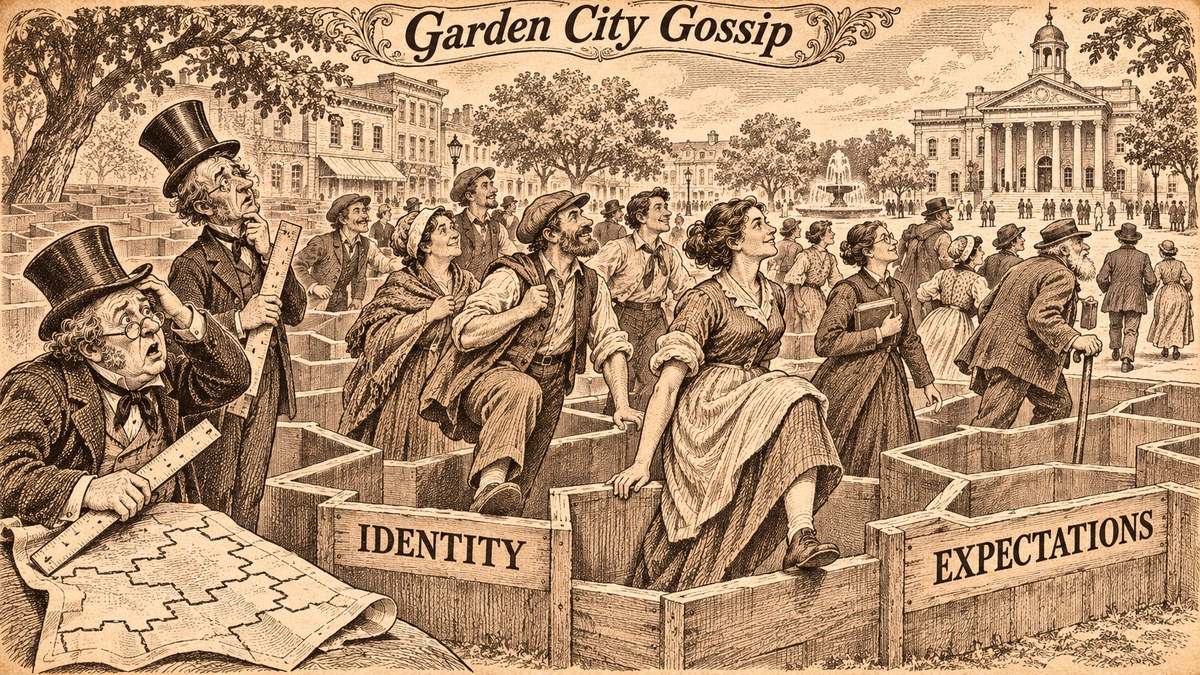
The map works because of the maps inside our heads.
It relies on assumptions about what people like us believe, whom people like us fear, and what it would mean to become the sort of person who votes for them. It turns experiences into categories, categories into expectations, and expectations into obligations.
I am a straight, white man from the South. Those are facts about me. They are not instructions.
I can vote for a Democrat without betraying some essential nature of my being. I can believe that a person whose life looks nothing like mine deserves security, dignity, and a meaningful chance at happiness without surrendering anything that makes me myself. I do not become less Southern because I refuse to confuse loyalty to the place I come from with obedience to its worst habits.
There is a difference between having an identity and being managed through it.
That difference is where this election becomes interesting.
The electorate did not stay where it was put
In Alabama, Shomari Figures won reelection in a district Republicans had redrawn to favor their candidate. The state’s unofficial returns show him at 53.67 percent. In North Carolina’s 1st District, Don Davis likewise survived, with 50.14 percent in the state’s November 11 unofficial count. These were not victories that the people drawing those lines had intended to make easier. Alabama results; North Carolina results.
Figures’s performance is particularly revealing. Alabama Daily News reported gains not just in Democratic strongholds but across newly added Wiregrass counties. Its analysis points to several forces: Black turnout, economic dissatisfaction, investment in the campaign, and voters becoming engaged where they had not previously felt their participation mattered. Those explanations complicate the story. They also make it more human. People were responding to conditions and choices, not simply performing the demographic identities assigned to them. Alabama Daily News.
Then there is Mississippi. The Associated Press called Scott Colom’s Senate victory on November 11. Its reporting describes strong turnout in the Delta, a broader leftward movement across the state, and a candidate who talked about the cost of living while going into places where Democrats were not expected to be welcome. Associated Press.
A statewide Senate election is not a test of congressional redistricting. Nor can county returns tell us what went through any individual voter’s mind. We should not turn a result into a story it cannot prove.
But these results do challenge the idea that a political category is a permanent condition.
They do not prove that weakening the Voting Rights Act was beneficial. People overcoming an obstacle does not vindicate the person who put it there. As election-law scholar Travis Crum cautioned, an extraordinary election does not erase the long-term damage of Callais or guarantee that the same voters can overcome the same disadvantages next time. Election Law Blog.
What the election offers is narrower, and more useful: evidence that the limits we have learned to accept are not necessarily the limits of what people can do.
Turn the question
In his recent New York Times essay, David Wallace-Wells argues that the country’s political center of gravity is closer to Obama than Trump. He sees more potential for a broad liberal majority than the familiar story of an immovably conservative country allows. He also acknowledges that a large electoral victory is not a permanent majority, and that the governing agenda remains uncertain.
There is something important in that argument. But I want to turn it on a different axis.
Perhaps the most interesting question is not whether America is really left or right. Perhaps it is how much of ourselves we have surrendered to the demand that we locate everything, including one another, on that particular line.
Left and right describe real disagreements. So do race, class, religion, geography, and gender. None of these disappears because we find the labels inconvenient.
But a useful description becomes a trap when we treat it as a complete explanation.
We ask whether a policy is liberal or conservative before asking what it does. We ask whether a person is strong or weak before asking what they are carrying. We ask whether helping someone will make them dependent without asking how dependent the rest of us already are on schools, roads, hospitals, workers, families, and strangers whose contributions we have learned not to notice.
Turn the question a little.
Not whether a person deserves to lose. Whether there is a reason someone has to lose at all.
Not whether a neighborhood is ours or theirs. Whether the children living there should have to grow up with the consequences of that distinction.
Not whether acknowledging another person’s suffering threatens our identity. What kind of identity requires their suffering to remain unacknowledged?
Learning is necessary. So is learning to unlearn.
That does not mean discarding everything we know. It means becoming capable of examining the habits we have mistaken for knowledge.
Nobody designed the whole machine
Political maps are deliberately drawn. Discrimination has been deliberately imposed. People have made conscious decisions to exclude, exploit, and control other people. Any account of our institutions that forgets that becomes an excuse.
But the whole system is not the product of one mind, or even one coherent plan.
It accumulates.
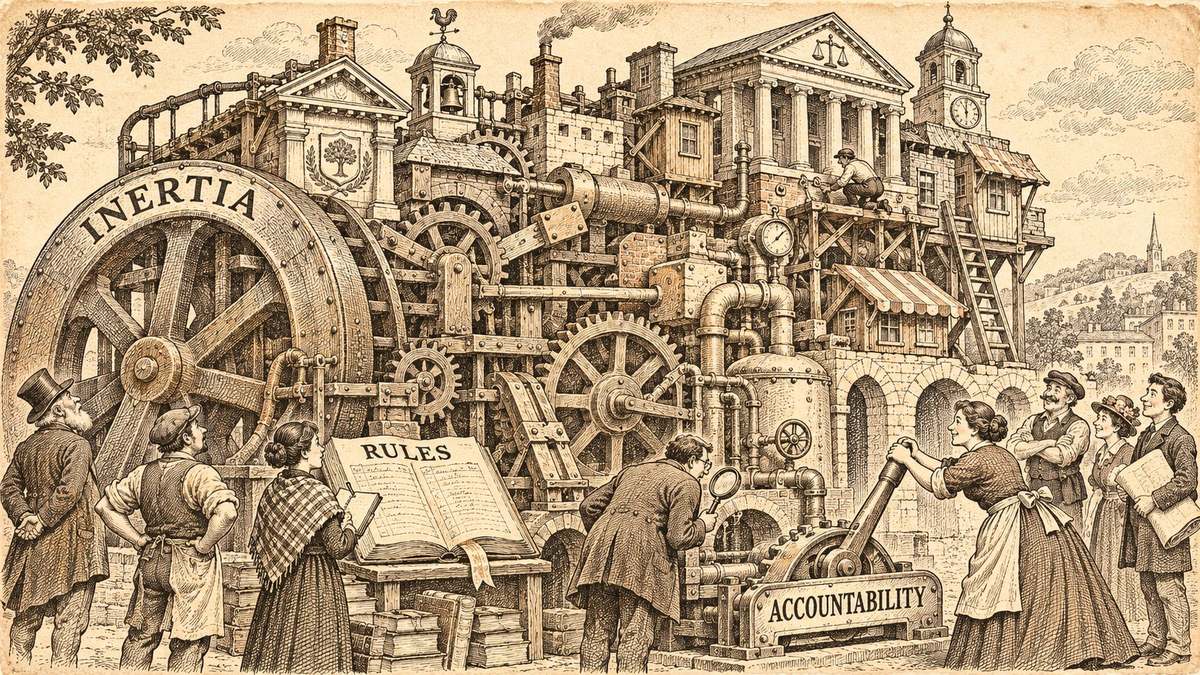
A compromise survives the circumstances that produced it. A temporary arrangement acquires a constituency. A defensive response becomes a tradition. A bureaucratic habit becomes a rule. Someone discovers how to profit from the rule, and eventually its beneficiaries begin speaking of it as though it were a law of nature.
People inherit the machinery, learn where its levers are, and make lives inside it. Some try to repair it. Some exploit it. Most do a mixture of things, often without seeing how their small decisions fit together.
That is not less disturbing than a conspiracy. In some ways it is more disturbing. A system can keep doing terrible things without requiring every participant to wake up intending to be terrible.
We are each stunningly human, even when that is awful.
We can be generous in one part of our lives and cruel in another. We can recognize injustice when it happens to someone we love and rationalize the same injustice when it happens to a stranger. We can defend arrangements that hurt us because admitting they hurt us would mean admitting that someone we trusted was wrong.
None of this absolves anyone. It does make the usual division between our good people and their bad people inadequate.
The point is not to stop holding people responsible. It is to build institutions that do not depend on everyone being better than human.
Clear authority. Meaningful oversight. Rules that can be understood and challenged. Public services that do not require personal connections. Elections in which a representative can actually be replaced.
And a political culture in which changing your mind is not treated as changing sides in a war against your own existence.
Augusta is not an abstraction
Here, the consequences are concrete.
A drainage problem does not become less urgent because the family dealing with it lives on the wrong side of a district line. A worker’s rent does not become more affordable because the official explaining why nothing can be done looks like that worker. A city department does not become accountable because the argument over who controls it has been successfully translated into the language of racial loyalty.
Race shapes all of these things. It shapes where investment went, whose complaints were heard, who accumulated wealth, and who was left to absorb the cost. Refusing to see that would be another way of defending the existing arrangement.
But recognizing that history should enlarge our ability to act, not reduce every possible future to a continuation of the same fight.
The old question is who has the votes.
The better question is what those votes can make possible.
Can Augusta make it easier for people to live here, rather than merely advertising how cheaply their labor can be purchased? Can it repair a street without turning the repair into a favor? Can it make public authority clear enough that someone is responsible when the work does not get done?
Can a commissioner answer a criticism without treating it as an attack on everyone the commissioner claims to represent?
Those are not questions that an election answers by itself. They are questions an election can give us the opportunity to ask differently.
What can we give?
Much of our politics begins with a premise so familiar that we scarcely hear it anymore: life is a contest over who gets to keep more of what we can scrape and claw from the earth and one another.
We argue over how the contest should be regulated. We argue over who cheated, who started ahead, and who deserves compensation for being held back.
Those arguments matter. Distribution is not a distraction when you cannot pay the rent.
But there is something impoverished about allowing the contest to become our entire account of being alive.
What if the question were also what we can give?
Not the sentimental version, in which the powerful offer occasional charity while preserving every arrangement that makes charity necessary. Not another demand that people with little should sacrifice more.
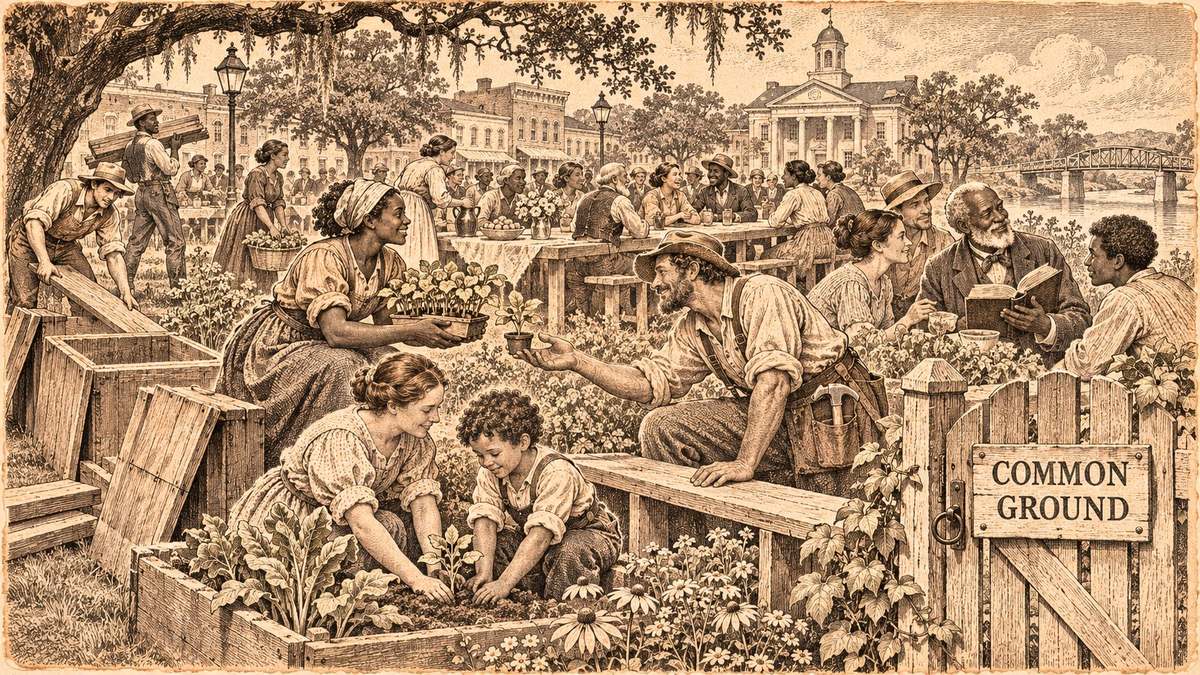
I mean what we can give one another by choosing how we organize our common life.
Time not consumed by preventable emergencies. Work that leaves room to live. The security to get sick without becoming destitute. Public places where people can meet without having to buy something. Institutions that do not humiliate people for needing them. A childhood not organized around the anxieties of adults who are barely getting through the week.
Those things require money, work, choices, and arguments. Generosity is not a substitute for competent government. It can be a reason to insist on it.
Nor is giving the opposite of having. Much of what makes a life worth having exists because somebody gave something before we arrived: effort, care, knowledge, a public institution, a chance they did not have to extend.
We are not merely competitors for the remains of the world.
We are capable of adding to it.
I do not know whether this election marks the beginning of that change. It may prove to be another turn of the wheel: anger, victory, disappointment, and anger again. A ballot cannot tell us whether the person casting it has reconsidered a lifetime of assumptions or simply had enough of the price of groceries.
But I think there is a spark here.
Enough people did something they were not supposed to do to remind us that prediction is not destiny. The identities we inherit need not determine the limits of our sympathy. The systems we inherit need not determine the limits of our imagination.
The box was never us.
It was an arrangement we learned to live inside.
We can learn something else.