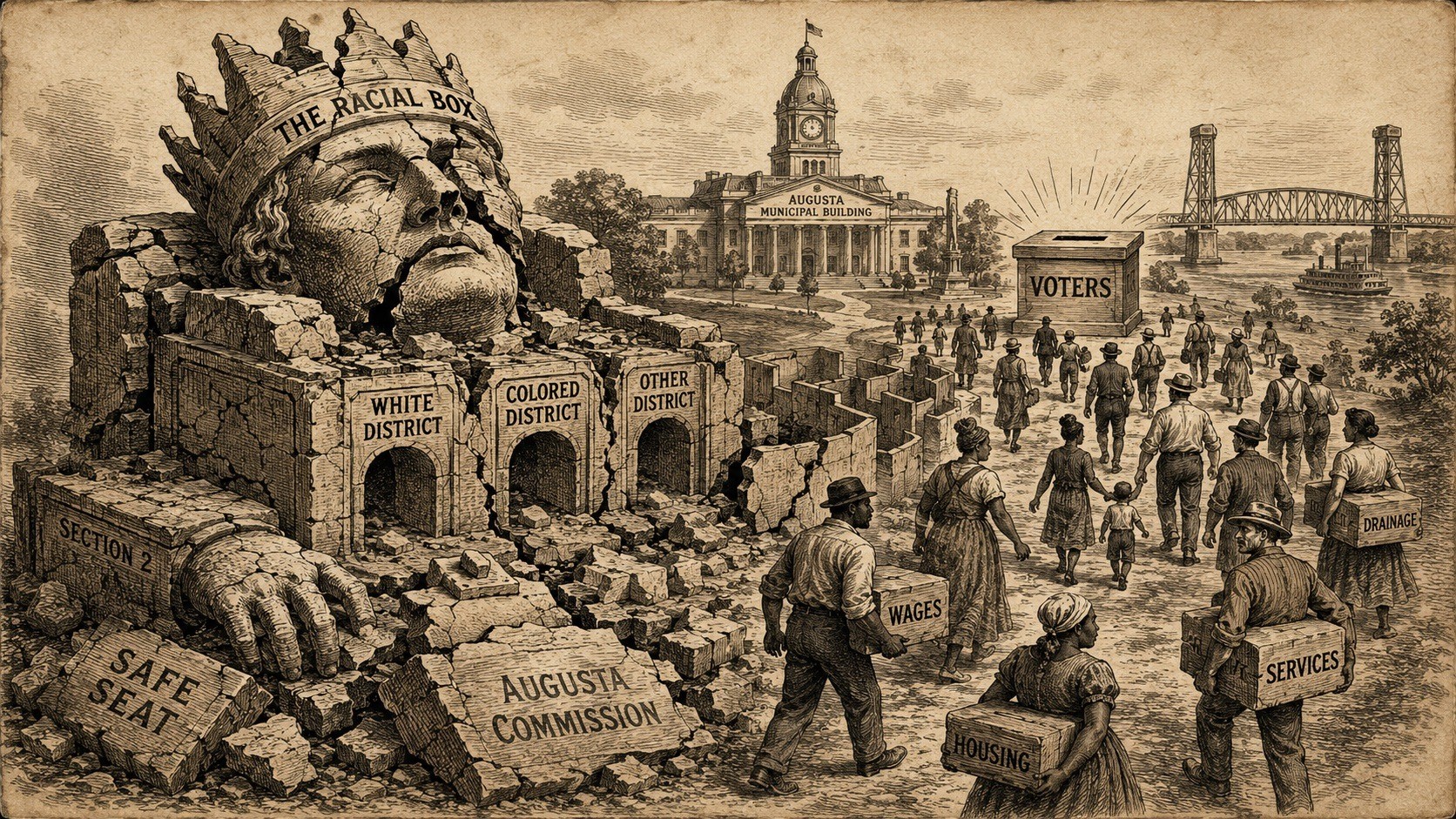
Augusta’s old racial armistice protected representation, but it also helped turn democracy into managed division.
by Charles Rollins, Publisher
The Supreme Court has turned Section 2 into a dead letter. That is a democratic emergency. But it may also be a chance for Augusta to escape a 1996 racial armistice that has too often protected incumbents, deadlock, and managed division.
Augusta, GA – Augusta has been living inside a racial box for nearly thirty years. But continuing to do so is a choice we do not have to make.
The box was built in the language of balance. Ten commissioners. Two super districts. A mayor originally allowed to vote only when the commission tied. A consolidated government born from the merger of Augusta and Richmond County, designed in the shadow of the Voting Rights Act, and locally understood as a government where Black political power and white political power had to be measured against each other like opposing weights on a scale.
Commissioner Bobby Williams once described the structure plainly: “You had basically five white districts and five Black districts, and to get the sixth vote, someone had to work across the aisle.”[1]
That is the best defense of the system. It is also the indictment.
Because what Augusta got was not merely balance. It got a political operating system that trained officials, candidates, consultants, neighborhood leaders, and voters to see power as a racial ledger. This seat belongs to this bloc. That seat belongs to that bloc. This vote is Black power. That vote is white power. This district must be protected. That district must be defended. This incumbent is not merely an incumbent; he is a racial position. That challenge is not merely a campaign; it is a threat to the balance.
That is not democracy. That is managed division.
And now the legal world that helped produce this local order is breaking apart.
In Louisiana v. Callais, Justice Samuel Alito and the Supreme Court’s conservative majority did not merely narrow Section 2 of the Voting Rights Act. They turned it into something close to a dead letter. Congress amended Section 2 in 1982 so minority voters would not have to prove discriminatory intent alone. Alito’s opinion drags the law back toward intent, blesses partisan advantage as a defense, and demands that plaintiffs disentangle race from party in a country where race and party have been fused by history, law, money, violence, housing, schools, and campaign strategy.[2]
Justice Elena Kagan called the result “all but a dead letter.” She is right.[3]
But this essay is not really about Alito. He is not that interesting. His opinion is partisan legal vandalism dressed as constitutional principle. That deserves to be said, then set aside.
The larger point is more important: if the Supreme Court has broken the old Voting Rights Act machinery, Augusta does not have to rebuild the same cage.
The end of the old regime is dangerous. It will be used by Republican legislatures to crack Black voting power, protect white conservative control, and dress naked partisanship in the thin robes of color-blindness. That is already happening.
But there is another possibility inside the wreckage.
For decades, the Voting Rights Act order opened doors that white supremacy had nailed shut. It made possible the election of Black members of Congress, legislators, council members, commissioners, judges, sheriffs, and local officials who would not have survived at-large elections, white bloc voting, or old-fashioned racial exclusion.
That was real.
But the same order also hardened race into political geography. It concentrated Black Democratic voters into protected districts. It made surrounding districts whiter, more conservative, and more Republican. It helped turn representation into containment. And in places like Augusta, it helped produce a political culture where racial balance became a substitute for actual power, economic justice, competent government, and material improvement in people’s lives.
So the VRA may be dead, but in this crisis, there is opportunity.
Not because racism is over. It is not.
Not because color-blindness is suddenly wisdom. It remains one of the favorite lies of people who benefit from not seeing what history built.
And not because the Supreme Court has done something noble. It has not.
The opening is this: Augusta can stop pretending that a 1996 racial armistice is the final form of democracy.
Tilting the lense of perception and finding explanation has been a trend
Garden City Gossip has spent months covering Augusta’s charter fight because the charter is not a technical document. It is the machinery of power.
As GCG reported in “The Quiet Rewrite of Power,” the charter review was about who hires, who supervises, who answers, and where authority sits when something goes wrong. The debates looked procedural. They were not. They were fights over whether Augusta’s government would have clear lines of authority or continue living inside a fog where everyone can blame everyone else.[4]
The fight over whether the city’s top lawyer should be called “City Attorney,” “General Counsel,” or something else was not really a fight over words. It was a fight over independence, accountability, and who controls legal interpretation inside a government where power often moves through ambiguity.[5]
GCG later published Gayla Keesee’s guest op-ed explaining how the charter effort stalled without a final vote, without a formally approved draft, and without an official submission to the legislative delegation. Major subjects remained unfinished, including ethics, transparency, audit oversight, and core operational details.[6]
Then GCG’s “Who Killed Augusta’s Charter?” made the political point more directly: the reform effort died under pressure, timing, and interference, leaving Augusta with the same structural problems it set out to fix.[7]
That is where this national debate lands locally.
The old Voting Rights Act order did not merely shape congressional maps. It shaped the expectations of local government. In Augusta, consolidation was not simply the merger of a city and county. It was a settlement among mistrustful communities, negotiated under the legal pressure of the VRA and the political memory of racial domination.
That context matters. Black voters needed protection. White political control in Georgia did not disappear because officials learned better manners. The Voting Rights Act was necessary because Southern political systems were built to dilute, suppress, and ignore Black power.
But necessity is not the same thing as completion.
The 1995 state act creating Augusta-Richmond County’s consolidated government established a mayor-chair and ten commission-council members. It created district seats and super districts. It repeatedly tied implementation to the federal Voting Rights Act. The original mayor could vote only to make or break ties.[8]
That design was not neutral. It was a governing armistice.
And armistices are not the same thing as justice.
For nearly three decades, Augusta has lived with a structure that can turn abstention into strategy, delay into power, ambiguity into cover, and racial balance into paralysis. In 2024, voters finally gave the mayor a full vote by a reported 74% to 26%. The vote passed because the public understood what many officials did not want to admit: the old rules were not sacred. They were choices. Choices can be changed.[9]
The official district data shows how deeply sorted the city remains. Augusta’s post-2020 district summary shows that Districts 1, 2, 4, 5, and 6 have majority-Black voting-age populations. Districts 7 and 8 have majority-white voting-age populations. District 3 is close to evenly divided. Super District 9, built from Districts 1, 2, 4, and 5, is roughly 64% non-Hispanic Black by voting-age population. Super District 10, built from Districts 3, 6, 7, and 8, is far closer to a split, with non-Hispanic white residents holding a voting-age plurality.[10]
That is not just representation. It is a map of managed separation.
And it is badly matched to the city Augusta actually is.
The Census Bureau estimates Augusta-Richmond County’s 2024 population at 201,737. The city is majority Black, with Black residents at 56.8% and white residents at 32.1%. But the same Census data shows a median household income of $55,485, per-capita income of $31,910, and a poverty rate of 20.1%.[11]
That is the fact that should shame every faction. Whenever your hear a politician or a corporation describe Augusta in a positive way as “affordable”, this is what they are proud of. How long have we allowed the fact that Augusta is “affordable” be a point of pride and a justification for paying people who live here less than they do elsewhere in the country for the same work? This is another artificial divide of the same sort that at least some politicians in Augusta should be screaming about, the fact that none are is striking evidence that the fundamental thesis of this article is correct.
A city with one in five residents living in poverty does not need a politics that begins and ends with which racial bloc controls which chair. It needs a politics of wages, housing, drainage, transit, public safety, health care, code enforcement, youth opportunity, procurement, taxes, schools, land, and competent administration.
The racial structure is real.
So is the economic structure.
The failure has been pretending Augusta can only talk about one at a time.
Color-blindness is a lie. Racial arithmetic is not justice.
There are two traps here.
The first is the conservative trap: stop talking about race and declare the problem solved.
That is childish. Race still structures wealth, housing, education, policing, turnout, medical access, infrastructure, political trust, and who gets treated as competent before they ever open their mouth. Race shapes whose anger is called passion and whose anger is called danger. Race shapes whose neighborhoods are “historic” and whose neighborhoods are “troubled.” Race shapes whose mistakes are individualized and whose mistakes are treated as group evidence.
Only a fool, or a federal judge pretending to be one, could look at Augusta and say race no longer matters.
But there is a second trap too.
That is the liberal managerial trap: treat racial arithmetic as justice.
Under that theory, democracy is achieved when each racial faction gets its quota of seats, its preferred brokers, its nonprofit class, its consultants, its symbolic champions, its safe districts, and its turn at the table. The public is told this is representation. Sometimes it is. Too often, it is containment.
A Black seat can matter and still be used to manage Black frustration.
A white seat can matter and still be used to feed white grievance.
A safe district can protect minority voters and still protect an incumbent more than the people.
A charter can prevent domination and still prevent government.
A map can comply with the old logic of voting rights while failing the deeper test of democracy.
Kimberlé Crenshaw’s work on critical race theory is useful here despite how the vulgar debate over CRT has been designed to make serious thinking impossible. Properly understood, critical race theory does not ask us to ignore structure. It asks us to see how law, categories, institutions, and power produce racial outcomes even when the language is formally neutral.[12]
That insight cuts both ways.
A formally color-blind system can hide racial domination. But a formally race-conscious system can also freeze racial categories into permanent political cages.
The answer is not to stop seeing race.
The answer is to see race clearly enough to stop letting politicians use it as a fence.
Divide and rule
Shashi Tharoor’s Inglorious Empire gives the old imperial name for this: divide et impera. Divide and rule.
The British did not govern India by inventing every difference among Indians. They governed by naming, measuring, hardening, rewarding, and administering differences that already existed or could be made politically useful. Religion, caste, region, language, census category, military recruitment, office, and electoral structure became instruments of rule. The point was not merely to divide people socially. It was to make division profitable to the governing class.[13]
America is not British India. Augusta is not the Raj.
But the structure rhymes.
Divide-and-rule inside a democracy does not require a foreign crown. It only requires a political class that benefits when ordinary people are sorted into mutually suspicious camps. It tells poor white voters that poor Black voters are the threat. It tells Black voters that challenging a Black incumbent is the same thing as betraying Black power. It tells working people to blame immigrants, renters to blame homeowners, homeowners to blame the poor, the old city to blame the county, west Augusta to blame south Augusta, and every neighborhood to suspect every other neighborhood before looking upward.
The American ruling strategy has always been cheapest when the people who need each other most can be convinced that they are each other’s problem.
That is what Augusta must break.
The next map should not begin with the question, “How do we preserve five Black seats and five white seats?”
It should begin with better questions.
Which neighborhoods share infrastructure burdens?
Which communities share drainage failures?
Which districts contain concentrated poverty?
Which areas share housing insecurity?
Which voters are tied together by work, transit, schools, hospitals, industrial corridors, environmental burdens, and public-service failures?
Which district lines would make elections more competitive?
Which district lines would force candidates to speak to people outside their inherited racial comfort zone?
Which lines would make commissioners answerable to voters who could actually replace them?
That is not color-blindness.
That is democracy.
The Voting Rights Act opened doors and built boxes
No serious person should deny what the Voting Rights Act accomplished.
Section 2, especially after the 1982 amendments, became a vital tool against vote dilution. The Justice Department describes Section 2 as permanent, nationwide, and applicable to voting practices that result in minority voters having less equal opportunity to participate in the political process.[14]
After the 1990 census, court-ordered and VRA-influenced redistricting created new majority-Black districts across the South. The effect was dramatic. At the start of the 103rd Congress, the number of Black lawmakers rose from 27 to 40. Seventeen Black lawmakers were elected in November 1992. Thirteen came from newly created majority-Black districts. Eight came from Southern states that had not elected a Black representative since the nineteenth century.[15]
Jim Clyburn’s election from South Carolina’s redrawn 6th District was part of that moment. He became South Carolina’s first Black member of Congress since 1897.[16]
That was not fake progress. It was real progress.
But the question is whether it was enough, and whether the structure that produced it eventually became part of the problem.
The old order opened doors. It also built boxes.
Black Democratic voters were concentrated into protected districts. Surrounding districts often became whiter and more Republican. Political-science work on the 1990s Southern realignment supports the careful version of this point: majority-minority redistricting was not the only cause of Democratic collapse in the South, but it was part of the structure that helped pack Democratic voters into fewer seats while white voters consolidated into the Republican Party.[17]
That distinction matters. The Voting Rights Act did not create Southern racial polarization.
It gave that polarization a map. And that map crystallized and solidified those differences. Enshrining them in laws that, on their face, were advancing a noble, liberal cause. The Viceroys of the Raj would recognize this immediately. We know what the end result of 200 years of divide and rule was on India: partition and its concommittant millions of deaths and untold suffering, followed by two nuclear armed states that have fought four wars in the time since that partition. We should not seek the same fate for ourselves.
Before 1994, white Southern Democrats still existed in meaningful numbers. Many white Southern voters had already become Republican at the presidential level, but they still supported Democrats in congressional and local races. That pattern eroded rapidly. By the mid-1990s, the white Southern congressional vote consolidated behind Republicans.[18]
The result was a political bargain that looked like representation but often functioned like containment.
The Black member got the district.
The Republican map got the state.
That is the cruel genius of the structure. It allowed civil-rights representation and conservative regional power to grow together. It gave Black voters officeholders while leaving state power, labor power, housing power, school power, capital power, and policing power largely intact.
James Baldwin articulated and anticipated the problems dramatically well.
Baldwin understood that symbolic inclusion can become another way of protecting the lie. He did not dismiss representation. He understood its emotional and moral force. But he also saw how America could absorb symbols while refusing transformation. The country could accept the exceptional Black face in the room while leaving the room itself unchanged.
That is the danger.
Representation matters.
But representation becomes containment when officeholding replaces transformation.
The tragedy is not that Black leaders won power. They had been denied power for generations. The tragedy is that the available form of power required too many leaders to defend the cage as the victory.
White racism has persistently been America’s Achilles Heel
These same patterns and divisions help explain the failure of labor in America to ever achieve significant success, leading directly to the economic malaise and pain that is being felt by Americans of all races today.
The American left’s recurring failure has been the refusal to build durable solidarity across race and class at the moments when solidarity mattered most.
The Pullman story remains one of the clearest examples. Railroad labor was racially stratified. Brotherhoods excluded or segregated Black workers. Pullman porters became a major Black workforce, but they were confined to service positions and denied equal labor power for decades. The Brotherhood of Sleeping Car Porters would not win its first major contract with Pullman until 1937.[19]
When white labor excluded Black labor, employers benefited.
When white workers chose whiteness over solidarity, capital kept the money.
When Black workers were told to wait, the whole working class weakened.
That same pattern has repeated in politics. White voters were told that racial equality threatened them. Black voters were told that symbolic inclusion should satisfy them. Poor people were divided into deserving and undeserving. Urban communities were turned into crime problems. Rural communities were turned into cultural problems. Labor was told to wait on race. Race was told to wait on labor. Capital kept collecting.
This is why Augusta cannot settle for a politics that merely reshuffles racial managers.
The city needs a politics that can say to poor Black neighborhoods and poor white neighborhoods, to renters and homeowners, to service workers and retirees, to downtown and south Augusta, to the old city and the county: the people telling you to fear each other are often the same people who benefit when nothing material changes.
Roosevelt saw the economic question. America refused to finish it.
Franklin Roosevelt understood something later liberals often forgot: political rights alone do not create freedom when economic life is governed by insecurity.
In his 1944 State of the Union address, Roosevelt argued that political rights had proved inadequate by themselves. “True individual freedom cannot exist without economic security and independence,” he said. He proposed what became known as the Second Bill of Rights: the right to a useful job, adequate income, decent housing, medical care, protection from economic fear, and education.[20]
That was the road not taken.
The New Deal was racially compromised. Southern Democrats protected Jim Crow. Many programs excluded or disadvantaged Black workers through occupational carveouts, local administration, and political concession. Roosevelt was transformative, but he was not innocent.
Still, Roosevelt understood that democracy required material foundations. He understood that freedom without economic security was a slogan.
The loss of Henry Wallace as vice president in 1944 mattered because it helped narrow the future. Wallace represented a more aggressive continuation of New Deal economic democracy. His replacement by Harry Truman signaled that party managers, Southern conservatives, corporate liberals, and Cold War realists were already closing the door on a more radical postwar settlement.
What followed was not nothing. The United States built real institutions. Social Security expanded. Labor had power for a time. The middle class grew. Public investment mattered.
But the economic constitution Roosevelt sketched was never enacted.
America chose political rights without full economic rights. It chose formal inclusion without universal security. It chose a welfare state too weak, too racialized, too local, too conditional, and too easy to attack.
That failure shaped everything that followed.
Johnson gave access. Kerner demanded reconstruction.
Lyndon Johnson did historic things. The Civil Rights Act, the Voting Rights Act, Medicare, Medicaid, federal education spending, and anti-poverty programs were not trivial. Anyone who says they were trivial is not serious.
But Johnson failed at the decisive point.
He could give access to the existing structure. He could not fully accept the demand to reconstruct the structure.
The Kerner Commission made that demand in 1968.
Its warning is still the sentence America has never escaped: “Our nation is moving toward two societies, one black, one white — separate and unequal.” The report did not hide behind euphemism. It said white racism was central. It said of the ghetto: “White institutions created it, white institutions maintain it, and white society condones it.”[21]
The Commission called for national action that was “compassionate, massive and sustained.” It called for jobs, housing, education, income support, anti-discrimination enforcement, and public investment at a scale equal to the crisis.[22]
Johnson recoiled. Again, there was a real opportunity for change, and again, it was a road not taken.
He had already spent enormous political capital on civil rights and the Great Society. He believed he had done enough to deserve gratitude. But the Kerner report concluded that Black Americans, though perhaps grateful in a theoretical sense, were not actually made happy because lofty rhetoric and promises hadn’t done anything at all to change the conditions on the ground for them, so Johnson did not get the gratitude he so sought. Black American had the gall to demand reconstruction.
That was the demand Johnson could not absorb.
As visionary as he was, he was completely unable or unwilling to avoid the trap he recognized in Vietnam, and that failure, grounded in the same hubris that made him think that people should be more grateful when he scatters breadcrumbs before the starving. War consumed money, attention, legitimacy, and imagination. The country spent itself into destruction abroad while refusing to build the economic foundations of peace at home.
Johnson wanted to be remembered as the man who gave Black America something. Kerner told him the country had to change the conditions that made the gift necessary, and he balked.
That was his great failure.
The Great Society did not fail because it did nothing. It failed where it mistook federal benevolence for institutional reconstruction.
It offered programs when the country needed power.
It offered access when the country needed economic citizenship.
It offered inclusion inside a structure that still produced inequality.
And when the structure kept producing anger, the country answered with police.
The law-and-order state replaced the reconstruction the Kerner Report demanded
When America refused to meet the crisis described in the Kerner report with what it recommended: jobs, housing, income, education, health care, and power; but instead it met the crisis with police, prosecutors, prisons, welfare restrictions, death penalty acceleration, and procedural barriers.
David Garland’s recent work is useful because it refuses the comforting story that America’s penal state is a criminal-justice accident. His structural account points to political economy, weak welfare institutions, community disorganization, state capacity limits, racialized control, and America’s extraordinary reliance on police violence, incarceration, and penal supervision compared with other developed democracies.[23]
That is the post-Kerner settlement.
If the state will not guarantee work, housing, medical care, income, and dignified community life, it will guarantee surveillance, punishment, and control.
Bill Clinton did not invent that settlement, but he signed some of its most important modern instruments.
The 1994 crime bill authorized money for more police, prison construction, and a vast expansion of federal criminal-justice policy. It also included the Violence Against Women Act and prevention programs, which is why the bill cannot honestly be reduced to one sentence. But the broader political message was unmistakable: Democrats would prove they could punish.[24]
The 1996 welfare law ended Aid to Families with Dependent Children as an entitlement and replaced it with Temporary Assistance for Needy Families, a block-grant system built around work requirements and state discretion.[25]
The 1996 Antiterrorism and Effective Death Penalty Act restricted habeas review and narrowed federal courts’ ability to revisit state convictions.[26]
These were not separate accidents. They were parts of a governing turn.
The state became stingier with help and more generous with force.
It told poor people to work in labor markets that did not pay enough, live in housing markets they could not afford, send children to schools shaped by property inequality, survive medical debt, and then submit to policing when predictable disorder arrived.
This is what happens when representation is allowed to substitute for transformation.
A few selected minorities are invited into the room. They are allowed to speak, negotiate, distribute favors, appear in photographs, and manage outrage. Some do good work. Some do not. But the structure remains.
Then their presence is used to legitimate what the structure continues to do to the many.
That is not justice.
It is political theater with human consequences.
Again, one is reminded of the Raj. Labouchère wrote a satirical response to Kipling’s racist “The White Man’s Burden” titled “The Brown Man’s Burden” at the outbreak of the Phillipine-American war in 1899 as America embarked on it’s own delusions of empire abroad that deserves to be quoted at some length (though not quite in full, for complete text, see: https://odp.library.tamu.edu/victorianpoetry/chapter/the-brown-mans-burden/ )
Pile on the brown man’s burden,
compel him to be free;
Let all your manifestoes
Reek with philanthropy.
And if with heathen folly
He dares your will dispute,
Then, in the name of freedom,
Don’t hesitate to shoot.
Pile on the brown man’s burden,
And if his cry be sore,
That surely need not irk you–
Ye’ve driven slaves before.
Seize on his ports and pastures,
The fields his people tread;
Go make from them your living,
And mark them with his dead.
Pile on the brown man’s burden,
And through the world proclaim
That ye are Freedom’s agent–
There’s no more paying game!
And, should your own past history
Straight in your teeth be thrown,
Retort that independence
Is good for whites alone.
Augusta does not need better racial management. It needs inclusive institutions.
Acemoglu and Robinson’s distinction between inclusive and extractive institutions helps clarify the local problem. Inclusive institutions distribute political and economic opportunity broadly. Extractive institutions concentrate power and benefits for narrower groups.[27]
A government can be racially balanced and still be extractive.
A commission can include Black and white officials and still preserve insider power.
A charter can prevent one bloc from dominating and still prevent ordinary voters from governing.
A district can be “represented” and still be neglected.
The question is not whether every faction has a flag.
The question is whether ordinary people can replace failed leaders, form new coalitions, and force government to deliver public goods.
By that test, Augusta has work to do.
The city’s charter has repeatedly produced blurred authority, public disputes, supervisory confusion, and legal ambiguity. GCG has already reported that much of Augusta’s dysfunction traces not merely to personalities but to structure. When authority is unclear, conflict fills the vacuum. When oversight is undefined, accountability weakens. When legal roles are loosely drawn, power shifts through interpretation rather than design.[28]
That is not an abstract issue. It affects whether streets get repaired. Whether drainage projects happen. Whether departments are supervised. Whether contracts are scrutinized. Whether legal advice is independent. Whether administrators can manage. Whether commissioners can micromanage. Whether the mayor can lead. Whether voters know who to blame.
A city with a over one in five of its residents living in poverty cannot afford a government designed to diffuse responsibility.
A city with sharp racial and economic divides cannot afford a map that tells people their political identity before candidates ever ask what they need.
A city with weak trust cannot afford a charter that turns every ambiguity into a power struggle.
And a city with this much need cannot afford politicians whose main skill is surviving inside dysfunction.
Augusta needs candidates who point to power
This is where national politics offers a useful contrast.
Maine is not Augusta. Graham Platner is not running here. His platform cannot be copied and pasted into Richmond County government.
But his campaign is worth noticing because he is doing something rare in modern politics: he is naming power. His platform says Maine is becoming unaffordable because of a government “by, of, and for billionaires.” He has called for a billionaire minimum tax, Medicare for All, stronger unions, housing action, higher wages, and a politics that confronts the economic architecture rather than politely managing decline.[29]
Maine Public reported that Platner proposed a 5% tax on wealth over a billion dollars and a cost-of-living exemption from federal income tax for working- and middle-class Americans. At a Labor Day rally with Bernie Sanders, he told the crowd that both parties want working people’s votes but have not done enough to earn them.[30]
That is the kind of structural language Augusta needs.
Not the exact platform. The posture.
A politics that asks who benefits.
Who owns the land?
Who gets the contracts?
Who profits from weak code enforcement?
Who benefits when poor neighborhoods flood?
Who benefits when the city cannot supervise itself?
Who benefits when the charter is ambiguous?
Who benefits when public money moves through familiar networks?
Who benefits when Black and white voters are trained to fear each other more than they scrutinize money?
That is the politics Augusta does not get enough of.
Too much local politics is personality management. Who has six votes? Who embarrassed whom? Who is with the mayor? Who is against him? Who can delay the item? Who can claim the racial high ground? Who can call reform a power grab while defending the same old machine?
A serious politics would be less polite.
It would point to the structure.
It would name the winners.
It would ask why a majority-Black city with deep poverty and enormous institutional assets still so often feels governed by scarcity, mistrust, and drift.
What the fuck?
The next map should be dangerous to incumbents
Augusta’s next map should not be drawn for incumbents.
It should not be drawn for racial brokers.
It should not be drawn for consultants.
It should not be drawn to preserve the old armistice.
It should be drawn to make government more answerable.
That means respecting one-person-one-vote, compactness, communities of interest, minority political opportunity, the Constitution, Georgia law, and whatever remains of Section 2 after Alito’s wreckage. Nobody should pretend Augusta can ignore the law.
But within those limits, the city should stop treating racial sorting as its highest civic achievement.
Every district should be as competitive as legally and practically possible.
Not competitive in the fake partisan sense, because Augusta local races are nonpartisan. Competitive in the democratic sense: no commissioner should feel that a seat belongs to them. No faction should inherit a district. No candidate should be able to win by speaking only to one racial story. No voter should be treated as a demographic object.
Before any new map is adopted, the city should publish district-level data in a form normal people can understand: race, voting-age population, income, poverty, housing tenure, rent burden, home values, infrastructure complaints, drainage projects, SPLOST allocations, code enforcement, turnout, uncontested races, margins of victory, and incumbent tenure.
Then residents should ask the only question that matters:
Does this map give voters more power, or does it protect the people already inside government?
That is the democratic test.
The Supreme Court may have opened a door it meant to close
Alito and the Court’s conservative majority may think they have done something permanent.
They may believe they have protected Republican maps from the last meaningful districting remedy in the Voting Rights Act. They may believe that by calling racial dilution “partisan advantage,” they can freeze power while pretending to honor the Constitution.
They may be right in the short term.
But they have also clarified the fraud.
For years, defenders of the old system could argue that racial districting was not merely one remedial tool but the necessary form of voting rights itself. That argument is harder now. If the Court has made the old remedy nearly impossible to defend, then reformers should stop defending the old remedy as the limit of democracy.
The answer to Alito is not nostalgia.
The answer is more democracy than the Voting Rights Act ever delivered.
That means refusing both lies.
The conservative lie says racism is over once the law stops naming it.
The liberal managerial lie says justice is achieved once each racial faction has an officeholder, a consultant, a nonprofit, a contractor, and a district to manage.
Both lies leave ordinary people where they are.
The conservative lie strips protection from Black voters.
The managerial lie converts protection into containment.
Augusta needs neither.
The Kerner Commission correctly diagnosed the problem and prescribed a real solution in 1968, that’s yet to be tried
The Kerner Commission told America what was coming.
The country was moving toward two societies. One Black. One white. Separate and unequal.
America chose not to listen.
It chose Vietnam over reconstruction. It chose policing over housing. It chose prisons over employment. It chose welfare discipline over income security. It chose procedural rights without economic power. It chose representation without transformation.
That choice shaped the country.
It shaped the South.
It shaped Augusta.
Now the Supreme Court has taken a hammer to one of the last remaining pieces of the civil-rights legal settlement. That should anger every person who cares about democracy. But anger is not a strategy.
The strategy should be to build what the Voting Rights Act never built: a politics capable of joining people across racial lines without denying race; a politics that attacks poverty, infrastructure neglect, housing insecurity, weak administration, elite extraction, and political cowardice; a politics that understands representation as a tool, not a shrine.
The old order said: protect the district and call it power.
The new order should say: empower the people and let them replace anyone who fails them.
Break the box
Augusta has a choice.
It can respond to Callais and the death of the VRA by retreating into fear. It can defend every old line because Alito attacked the statute. It can let racial managers on every side insist that any challenge to the old structure is betrayal. It can keep pretending that a government designed around racial veto math is the same thing as democracy.
Or it can do something harder.
It can admit that the Supreme Court is wrong and the old local structure is still inadequate.
It can say that voting rights matter and that safe-seat containment is not enough.
It can say that Black voters deserve power, not merely representation.
It can say that poor white voters are not enemies of Black power but possible partners in a city that has denied both groups material security in different ways and for different reasons.
It can say that the map should not be drawn for incumbents, brokers, consultants, courthouse factions, or professional fear merchants.
It can say that democracy requires danger.
Danger to incumbents.
Danger to contractors who depend on confusion.
Danger to politicians who hide behind race when the question is competence.
Danger to politicians who hide behind color-blindness when the question is justice.
Danger to a charter that lets everyone blame everyone else.
Danger to a map that tells voters who they are before they decide what they want.
Alito broke the Voting Rights Act.
Augusta should break the racial box.
Not because race does not matter. This is no time to be piling on the “Brown Man’s Burden,” that is the opposite of justice.
Because it matters too much to be left in the hands of people who profit from managing it.
The next map should not preserve a 1996 armistice.
The next charter should not preserve ambiguity.
The next politics should not preserve the comfort of people who have learned to survive inside dysfunction. We can avoid the fate decreed upon us so that we can be divided and ruled. We do not have to accept the fate of the Raj.
The Supreme Court may have meant to barricade power. but it also opened the door.
Augusta should walk through it with a hammer.
Related Prior Coverage from GCG:
Augusta’s Charter Rewrite Was Supposed to Be Independent. It Wasn’t.
🌺 UNDER THE AZALEAS 🌺 – Who Killed Augusta’s Charter? A Reform Effort Dies Under Political Pressure
Tax Day in Augusta: What the Affordability Debate Refuses to See
The Quiet Rewrite of Power: Inside Augusta’s Charter Review as a Mayoral Election Approaches
Notes
- WRDW, “Mayor now has a full vote at Augusta Commission meetings,” https://www.wrdw.com/2024/07/01/mayors-vote-takes-effect-augusta-commission/; WRDW, “Augustans decide to give mayor a full vote on commission,” https://www.wrdw.com/2024/05/22/i-team-augusta-mayor-gets-vote-commission/. ↩︎
- Legal Information Institute, Cornell Law School, “Louisiana v. Callais,” https://www.law.cornell.edu/supremecourt/text/24-109_2026-04-29; U.S. Department of Justice, Civil Rights Division, “Section 2 of the Voting Rights Act,” https://www.justice.gov/crt/section-2-voting-rights-act. ↩︎
- Legal Information Institute, Cornell Law School, “Louisiana v. Callais,” Kagan dissent, https://www.law.cornell.edu/supremecourt/text/24-109_2026-04-29. ↩︎
- Garden City Gossip, “The Quiet Rewrite of Power: Inside Augusta’s Charter Review as a Mayoral Election Approaches,” https://gardencitygossip.com/the-quiet-rewrite-of-power-inside-augustas-charter-review-as-a-mayoral-election-approaches/. ↩︎
- Garden City Gossip, “The Quiet Rewrite of Power: Inside Augusta’s Charter Review as a Mayoral Election Approaches,” https://gardencitygossip.com/the-quiet-rewrite-of-power-inside-augustas-charter-review-as-a-mayoral-election-approaches/. ↩︎
- Garden City Gossip, “Special Guest Op-Ed from Gayla Keesee of the League of Women Voters: Augusta’s Charter Effort Stalled — What Happened and Where We Go From Here,” https://gardencitygossip.com/augusta-charter-review-stalled/. ↩︎
- Garden City Gossip, “UNDER THE AZALEAS — Who Killed Augusta’s Charter? A Reform Effort Dies Under Political Pressure,” https://gardencitygossip.com/augusta-charter-reform-collapse/. ↩︎
- Georgia General Assembly, “Augusta-Richmond County consolidation act,” Georgia Laws 1995, Vol. II, https://dlg.usg.edu/record/dlg_zlgl_567352095. ↩︎
- WRDW, “Mayor now has a full vote at Augusta Commission meetings,” https://www.wrdw.com/2024/07/01/mayors-vote-takes-effect-augusta-commission/; WRDW, “How voters shattered the status quo on Augusta Commission,” https://www.wrdw.com/2024/05/22/how-voters-shattered-status-quo-augusta-commission/. ↩︎
- Augusta, Georgia, “State Approved Districts — Total Population Summary / Voting Age Population Summary,” https://www.augustaga.gov/DocumentCenter/View/15547. Super-district percentages calculated from the official district voting-age population table. ↩︎
- U.S. Census Bureau, “QuickFacts: Augusta-Richmond County consolidated government balance, Georgia,” https://www.census.gov/quickfacts/fact/table/augustarichmondcountyconsolidatedgovernmentbalancegeorgia/INC110223. ↩︎
- Columbia Law School, “Kimberlé W. Crenshaw,” https://www.law.columbia.edu/faculty/kimberle-w-crenshaw. ↩︎
- Shashi Tharoor, Inglorious Empire: What the British Did to India; Encyclopaedia Britannica, “Divide and rule,” https://www.britannica.com/topic/divide-and-rule. ↩︎
- U.S. Department of Justice, Civil Rights Division, “Section 2 of the Voting Rights Act,” https://www.justice.gov/crt/section-2-voting-rights-act. ↩︎
- U.S. House of Representatives, History, Art & Archives, “Power and Diversity, 1990–2022,” https://history.house.gov/Exhibitions-and-Publications/BAIC/Historical-Essays/Introduction/Power-Diversity/. ↩︎
- Live 5 News, “This Day in History: Nov. 3, 1992: U.S. Rep. Clyburn elected to Congress,” https://www.live5news.com/2025/11/03/this-day-history-nov-3-1992-us-rep-clyburn-elected-congress/; University of South Carolina, “James E. Clyburn,” https://sc.edu/about/our_history/university_history/presidential_commission/commission_reports/final_report/appendices/appendix-3/clyburn-james-e/index.php. ↩︎
- John R. Petrocik and Scott W. Desposato, “The Partisan Consequences of Majority-Minority Redistricting in the South, 1992 and 1994,” Journal of Politics; Kevin A. Hill and Nicol C. Rae, “What Happened to the Democrats in the South? U.S. House Elections, 1992–1996.” ↩︎
- Charles S. Bullock III, Donna R. Hoffman, and Ronald Keith Gaddie, “The Consolidation of the White Southern Congressional Vote,” Political Research Quarterly. ↩︎
- National Park Service, Pullman National Historical Park, “Pullman Porters,” https://www.nps.gov/pull/learn/historyculture/pullman-porters.htm. ↩︎
- Franklin D. Roosevelt Presidential Library and Museum, “1944 State of the Union Address Text,” https://www.fdrlibrary.org/pt/address-text; Franklin D. Roosevelt Presidential Library and Museum, “FDR’s Second Bill of Rights or Economic Bill of Rights Speech,” https://www.fdrlibrary.org/sotu. ↩︎
- National Advisory Commission on Civil Disorders, Report of the National Advisory Commission on Civil Disorders; George Mason University History Matters, “‘Our Nation Is Moving Toward Two Societies, One Black, One White—Separate and Unequal’: Excerpts from the Kerner Report,” https://historymatters.gmu.edu/d/6545/. ↩︎
- Office of Justice Programs, “National Advisory Commission on Civil Disorders, Report,” https://ojp.gov/ncjrs/virtual-library/abstracts/national-advisory-commission-civil-disorders-report; Othering & Belonging Institute, “1968 Kerner Commission Report,” https://belonging.berkeley.edu/1968-kerner-commission-report. ↩︎
- David Garland, “America’s extraordinary penal state: A structural explanation,” Punishment & Society, https://journals.sagepub.com/doi/abs/10.1177/14624745241302061; David Garland, Law and Order Leviathan: America’s Extraordinary Regime of Policing and Punishment, Princeton University Press, 2025. ↩︎
- Office of Justice Programs, “1994: Violent Crime Control and Law Enforcement Act,” https://www.ojp.gov/ojp50/1994-violent-crime-control-and-law-enforcement-act. ↩︎
- U.S. Department of Health and Human Services, Administration for Children and Families, “Personal Responsibility and Work Opportunity Reconciliation Act of 1996,” https://www.peerta.acf.hhs.gov/content/personal-responsibility-and-work-opportunity-reconciliation-act-1996. ↩︎
- Cornell Law School, Legal Information Institute, “Antiterrorism and Effective Death Penalty Act of 1996,” https://www.law.cornell.edu/wex/antiterrorism_and_effective_death_penalty_act_of_1996_%28aedpa%29. ↩︎
- Encyclopaedia Britannica, “Why Nations Fail: The Origins of Power, Prosperity, and Poverty,” https://www.britannica.com/topic/Why-Nations-Fail; Harvard Weatherhead Center for International Affairs, “Why Nations Fail,” https://www.wcfia.harvard.edu/publications/why-nations-fail. ↩︎
- Garden City Gossip, “The Quiet Rewrite of Power: Inside Augusta’s Charter Review as a Mayoral Election Approaches,” https://gardencitygossip.com/the-quiet-rewrite-of-power-inside-augustas-charter-review-as-a-mayoral-election-approaches/. ↩︎
- Graham Platner for U.S. Senate, “Platform,” https://www.grahamforsenate.com/platform. ↩︎
- Maine Public, “Graham Platner unveils tax plan that includes 5% tax on wealth over a billion dollars,” https://www.mainepublic.org/politics/2026-04-15/graham-platner-unveils-tax-plan-that-includes-5-tax-on-wealth-over-a-billion-dollars; Maine Public / Connecticut Public, “Bernie Sanders rallies thousands in Maine on ‘Fighting Oligarchy’ tour stop,” https://www.ctpublic.org/2025-09-01/bernie-sanders-rallies-thousands-in-portland-on-fighting-oligarchy-tour-stop. ↩︎