by Simone Raines
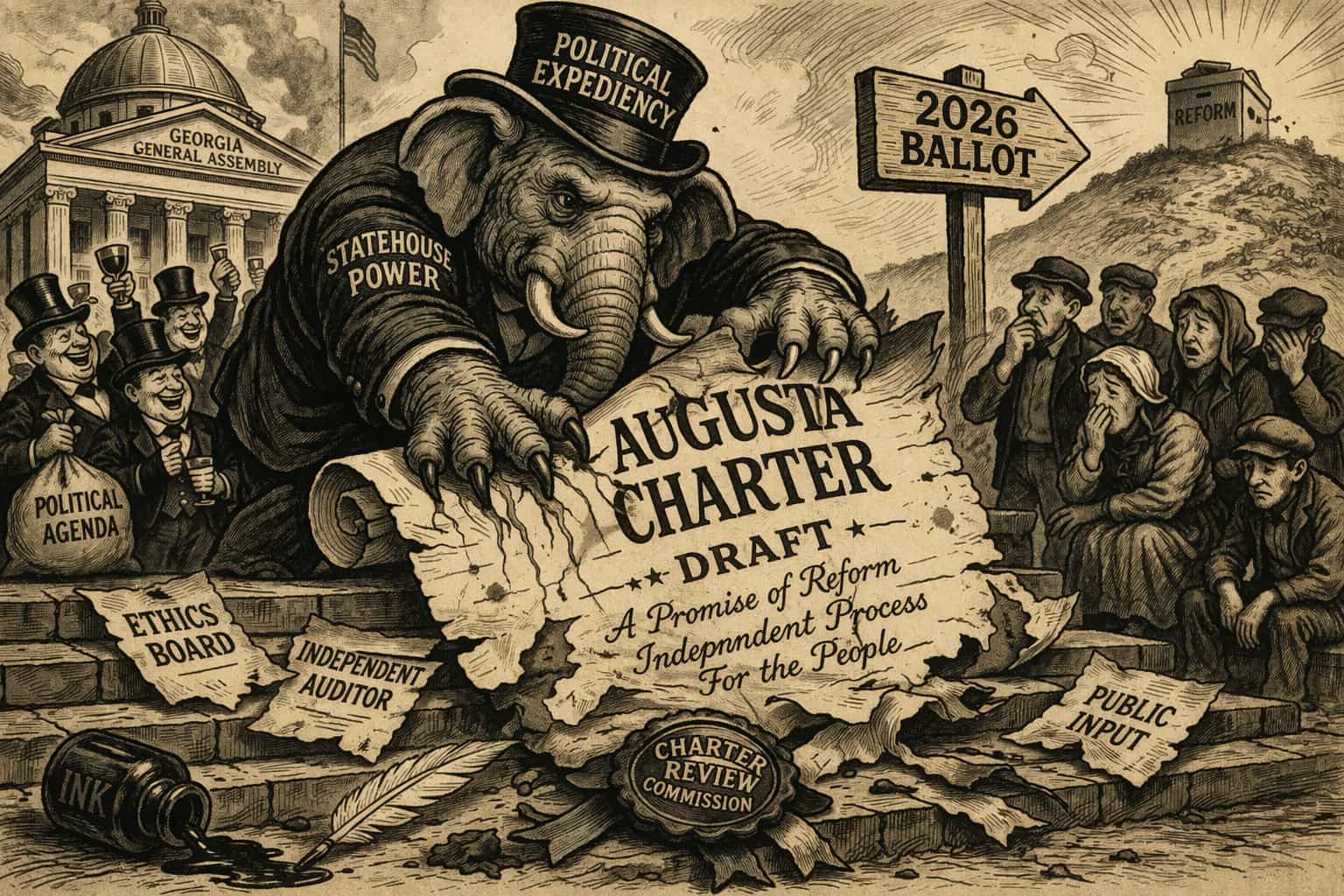
After months of work and a promise to keep politics out of the process, Augusta’s charter reform effort ended not with a vote—but with interference. The collapse in the Georgia General Assembly leaves Richmond County exactly where it started—and makes clear that the failure was not procedural, but political.
AUGUSTA, GA – There will be no new charter.
I’m writing just after sine die, the final day of the Georgia General Assembly—the body that drafts and passes the laws governing our daily lives. In many ways, what happens under the Gold Dome affects Augusta and Richmond County far more directly than anything coming out of Washington. This is where decisions are made about what is legal, how local governments operate, and what ultimately defines the structure of Augusta’s charter.
This year, the charter bill died.
What remained at the end was not a comprehensive reform package, but the limp corpse of a compromise—an attempt to place even a narrow change on the 2026 ballot. That effort failed. The bill, backed exclusively by Republicans with no Democratic co-sponsors, proposed only a minor adjustment: changing the county administrator to a county manager and sending that question to voters. Compared to larger structural reforms—like an independent ethics board or auditor—this was a small, almost symbolic step. (For prior discussion of proposed reforms, see GCG’s coverage of ethics board and auditor proposals.)
Even that could not pass.
And in order for that bill to fail, something had already gone wrong much earlier. The Mayor ended any real chance Augusta had at adopting a new charter.
The charter drafting process itself was never meant to be fast. It was designed to be deliberate, even frustratingly so—a point we noted earlier in our reporting on the Commission’s one-year mandate and structured timeline. Charter Review Commission members spent weeks of their lives working through details, debating provisions, and trying to produce a document that was as fair and functional as possible. There were disagreements, close votes, and inevitable imperfections. But the process was moving forward. And in public policy, perfection is often the enemy of good.
What gave that process legitimacy was a core promise: politics would stay out of it.
When the Charter Review Commission was formed in the fall of 2025, its members collectively committed to a “hands-off” approach from elected officials—a commitment widely discussed at the time and central to the Commission’s credibility. In a city as interconnected as Augusta, no one pretended politics would disappear entirely. But the principle mattered. For the final charter draft to have credibility, it needed to be developed independently and transmitted directly to the General Assembly without interference.
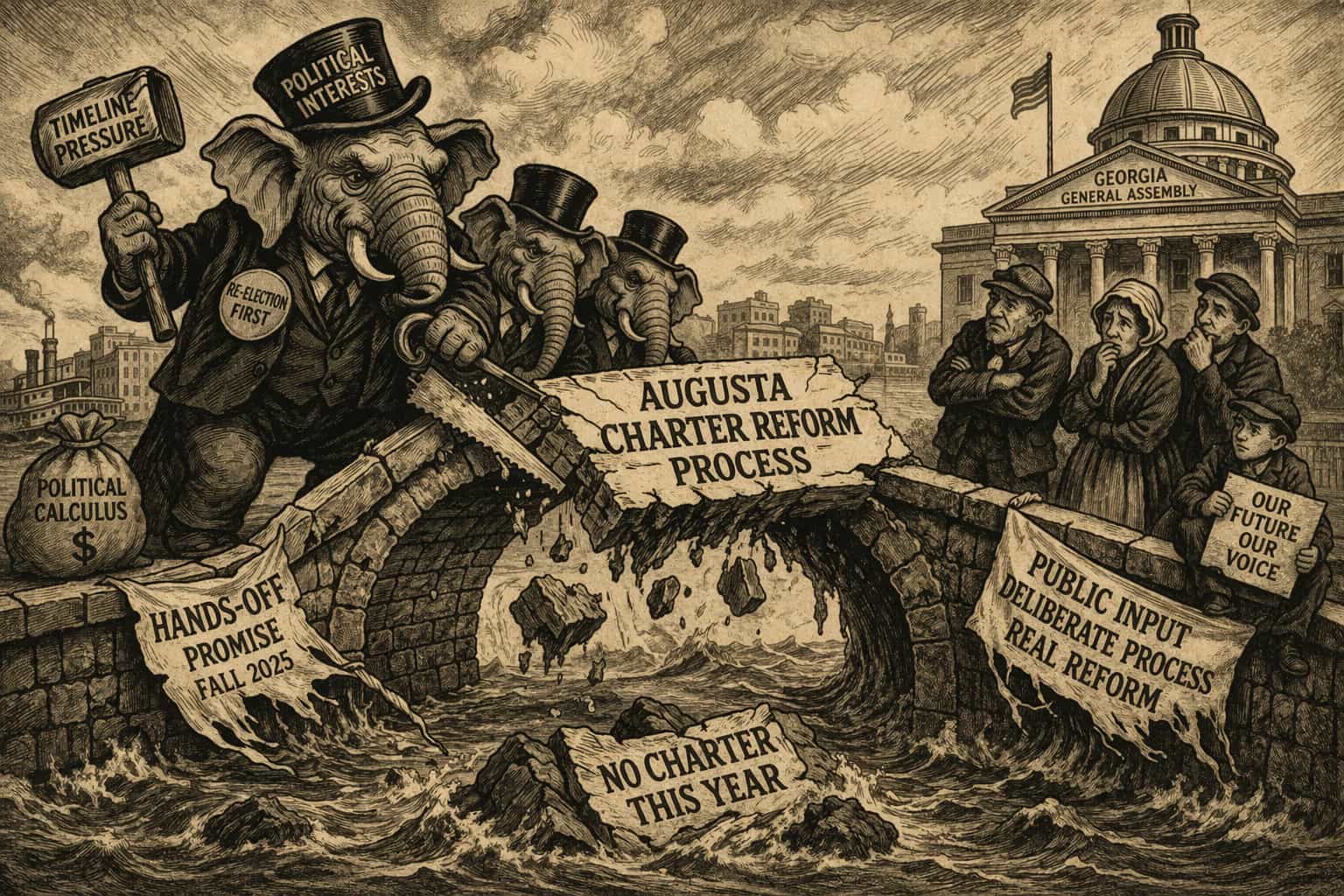
The Commission was given a year—until the end of March 2026—to complete its work.
But legitimacy and good intentions are no match for political timing.
The Mayor needed that draft sooner. He needed it in this legislative session so that a referendum could appear on the 2026 ballot—and, more importantly, so that he could run on it. As we’ve previously reported in examining election dynamics in Richmond County, turnout strategies and ballot composition matter. A charter vote could energize turnout, particularly among Republican voters, in a statewide election cycle expected to be competitive. The slow, deliberate pace of the Commission was not aligned with that timeline. March was simply too late.
So the process was rushed.
Commissioner Garrett, already on his way out and never known for compromise, became the vehicle to push the timeline forward. The effort resembled a baton handoff gone wrong—the Mayor wanted the General Assembly running before the charter draft was even complete. Republican legislators and Republican members of the Commission attempted to move ahead anyway, clumsily and without coordination, pushing for a rewrite before the process had finished. (For context on legislative involvement in local charter changes, see our prior reporting on statehouse influence over Augusta governance.)
In doing so, they broke the very rule that had given the Commission its legitimacy: the commitment to remain hands-off.
And once that line was crossed, the process began to unravel.
At the Commission’s final meeting on March 19, Chair Marci Willingham closed proceedings on what had become a deeply fractured effort. Her disappointment was evident. She had invested time and energy into an already difficult, thankless task—trying to shepherd a workable charter to completion. In the end, there was no draft to send forward.
Some commissioners had boycotted the meeting—a breakdown we’ve previously documented in coverage of internal Commission disputes. Others had shifted positions. Alliances fractured. Commissioner Smith-Rice ultimately sided with the Mayor, voting to accelerate the timeline in a way that served political interests rather than the broader public.
The result is stark.
There is no charter draft. The Charter Review Commission has disbanded. With sine die passed, any legislative effort must start over from scratch next year. Months of work, public input, and institutional effort have effectively been erased.
This was not an unavoidable failure. It was a political one.
Augusta’s opportunity to reform its government structure—imperfect but meaningful—was sacrificed to electoral strategy. And responsibility for that decision rests squarely with the Mayor.
The city now moves forward with the same structural problems it set out to address, carrying a process that promised reform but delivered nothing.
There will be no new charter.
And the question for Augusta isn’t just what happens next—but whether the public will remember who made sure it never happened.
Publisher’s Note: Garden City Gossip has closely covered the Augusta Charter Review process, including reporting on the Commission’s formation, timeline pressures, internal disputes, and legislative involvement. Readers seeking additional context can explore our prior coverage on those topics. This column is published as part of our opinion section and is written under a pseudonym. The views expressed are those of the author and do not necessarily reflect the views of Garden City Gossip, its publisher, or its editorial staff.
Augusta’s Charter Rewrite Rearranges the Furniture — But Does It Change the House?
Same Song, New Sheet Music: Augusta’s “Ethics Reform” Just Hit the Same Old Wall
🌺 UNDER THE AZALEAS 🌺 – The Curious Urgency of Augusta’s 2026 Charter Vote
🌺 UNDER THE AZALEAS 🌺 – The Charter Wasn’t Just Rushed—It Was Reclaimed
Augusta’s Charter Rewrite Was Supposed to Be Independent. It Wasn’t.