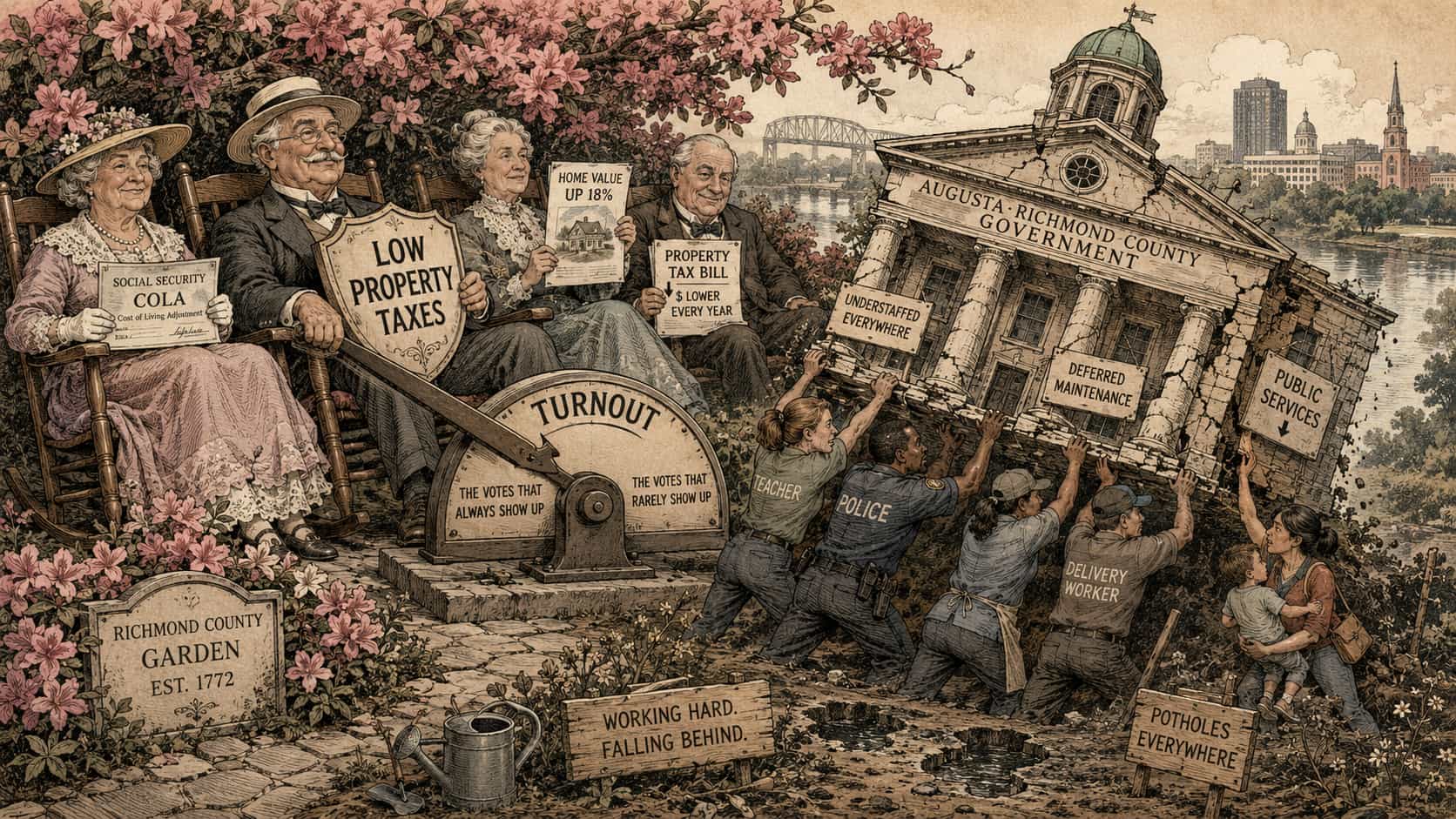
The voters who reliably show up can hold down taxes while the rest of Richmond County carries the public cost.
By Simone Raines
AUGUSTA, GA – Richmond County is not ruled by a conspiracy. It is ruled by the people who show up.
That is the useful, depressing fact beneath last week’s election. More than half of the voters were over the age of 65, according to the post-election turnout analysis supplied for this column. Put the county into two political parties — the Be Fair Party and the Give Everything to Old People Party — and the second party wins before the first yard sign goes in the ground. Not because its argument is better. Because its voters actually arrive.
There is a word for that kind of arrangement: gerontocracy.
It sounds exotic, like something from a political science textbook or a dying empire. In Richmond County, it is simply what happens when the people most likely to live with the long-term consequences of local government are the people least likely to vote in the elections that shape it.
The usual explanations are not very persuasive. This was not an election hidden in a cave. There was early voting. There were absentee options. There was enough public information for any reasonably attentive resident to know that decisions were being made. The problem was not that voting was impossible. The problem was that, for a large share of the county, voting no longer looks like a meaningful transaction.
That is not a defense of apathy. It is a diagnosis.
“Young” voters, which in Augusta now seems to mean workers, parents, teachers, public employees, police officers, service workers, renters, and anyone still trying to assemble a life from paychecks instead of assets, did not stay home because the offices on the ballot were irrelevant. Many of them were quite relevant. The people chosen in elections determine budgets, courts, roads, public safety, child support, local administration, and the basic machinery through which ordinary residents encounter government.
But relevance is not the same as belief.
A person who has watched the same broken machine run year after year can conclude, rationally enough, that changing the operator does not change the machine. The streets are still bad. Downtown is still perpetually being “revitalized.” Public safety is still treated as both a talking point and a budget problem. Washington Road, Gordon Highway, and the I-20 motel economy still carry the visible signs of a county that manages disorder more often than it solves it. Vape shops and smoke shops reproduce like kudzu. Every administration announces priorities. The lived environment changes by inches.
For many residents under 65, there is no remembered golden age of Richmond County government. There is only the same intolerable dysfunction, passed from one election cycle to the next.
That is why the argument that low turnout means broad satisfaction should be discarded. Satisfaction can produce apathy, yes. So can futility. And futility is the more convincing explanation here.
Everyone knows the government is broken. The charter fight only made the fact harder to deny. Commissioner Wayne Guilfoyle’s bleakest point about the failed charter process was also the clearest one: if Augusta cannot reform the structure after all that time, all that process, and all that public discussion, what exactly is left to defend?
That message did not stay inside the chambers. It filtered down to the people who most need a responsive county government: the people waiting on public safety, the people trying to raise children, the people paying taxes for services that arrive late or thin, and the people trying to carve out some small durable piece of Augusta for themselves.
Those people had more important things to do than vote.
And, in the narrow sense, they probably did.
Property taxes are the cleanest exhibit. At the state level, Georgia Republicans have spent the last several years making property-tax restraint one of the central pieces of their relief politics, including the statewide effort to cap how much a home’s rising value can translate into a higher tax bill. The argument is always framed as protection against being taxed out of one’s home.
Locally, Augusta’s own FY 2026 budget held the millage rate steady while reducing most General Fund departments by 5 percent. That is the real arithmetic of local politics: keep the tax line still, then make the departments absorb the strain.
To an older homeowner on a fixed income, that is not abstract ideology. It is survival politics. If your house rises in assessed value faster than your monthly check rises, the appreciation that looks like wealth on paper can feel like a bill in the mailbox. Social Security’s latest cost-of-living adjustment is 2.8 percent, and the formula is tied to the Consumer Price Index for Urban Wage Earners and Clerical Workers, not to an individual homeowner’s reassessment notice.
The CPI is a national statistical instrument, not a personal rescue plan. The Bureau of Labor Statistics is explicit that the CPI does not necessarily measure any individual household’s experience, and property taxes are only indirectly reflected through the method used to measure shelter costs.
So yes, older homeowners fight like hell to keep property taxes down.
But that does not make the politics neutral.
The reliable property-tax electorate is older, more likely to own its home, more insulated by assets, more likely to be retired, and more likely to vote in low-turnout elections. In Richmond County, that bloc can define public necessity downward. It can make tax restraint look like fiscal virtue even when the practical result is thinner service, deferred maintenance, harder hiring, and public employees asked to do more with less.
The county can call that discipline. The workers living under it may call it decay.
The sharper point is that America has trained itself to use the word “welfare” only in one direction. When poor people receive public assistance, it is dependency. When old people receive Social Security, Medicare, homestead exemptions, assessment caps, and millage-rate protection, it is dignity, prudence, and earned security.
Fine. Then say that.
Say that public protection is good. Say that people should not be ruined by a tax bill. Say that a government has a duty to keep people housed, stable, and secure.
But do not pretend that only one class of residents deserves that protection.
By the cruel vocabulary many voters use for everyone poorer than themselves, the older beneficiary class is also living inside a welfare state. The difference is that its welfare arrives with better branding, better turnout, and better lobbyists.
That is why the property-tax debate matters so much. It reveals the basic hierarchy. The county will organize itself around the fears of homeowners before it organizes itself around the needs of workers. It will protect a fixed-income retiree from a higher tax bill before it protects a deputy, a teacher, a young parent, or a renter from the daily costs of a government that refuses to build capacity.
The Mayor could have borrowed from the old Ron Cross playbook and slapped an “I did that” sticker on the property-tax bill. Politically, it would have made sense. The people who vote notice the bill they receive. They notice the assessment. They notice the millage rate. They notice the line item that touches their own household.
What they may not notice is the service that never gets built, the position that never gets filled, the pay scale that never becomes competitive, the public schools that somehow manage to reach a new low year-after-year, the road project that gets delayed, or the public-safety problem that is always discussed but never adequately funded.
That is the governing bargain Richmond County keeps making.
The old line is that Augusta politics is a knife fight in a closet. These days, the closet increasingly belongs to the people least likely to live through the thirty-year consequences of the fight. If the choice is between building something that pays dividends over a generation and protecting the immediate comfort of the voters who reliably show up, the immediate voters will win.
That is not because older voters are uniquely selfish. It is because they are behaving like every organized constituency behaves. They know what they want. They vote for it. They punish politicians who threaten it. No group of voters in American history has learned this lesson as well as the Baby Boomer generation, and they’ve used it to warp politics around what is best for them, even as that has changed over time.
But, the failure belongs to everyone else.
Younger voters have concluded that the system is broken and then, by staying home, have made sure the system remains accountable to the people least interested in changing it. Workers have decided politics does not matter and then left politics to the people whose property bills matter very much. Parents have decided local government cannot help them and then ceded local government to those whose children are grown. Renters have decided ownership politics is not their fight and then watched ownership politics define the budget.
No one should be surprised by the result.
The county keeps choosing residents who vote over residents who merely live here. The future is treated as a decorative concern, useful for speeches but not for budgets. Every candidate says the children matter. Every budget says the homeowners matter more.
And then, after the votes are counted, the average person looks around and wonders why everything is still broken.
The answer is not complicated.
In Richmond County, the future did not lose at the ballot box.
It never came to the polls.
Publisher’s Note
This column is published as part of Garden City Gossip’s opinion section under the “Under the Azaleas” series, and written pseudonymously. The views expressed are those of the author and do not necessarily reflect the views of Garden City Gossip, its publisher, or its editorial staff.
Prior Related Coverage:
🌺 UNDER THE AZALEAS 🌺 – Who Killed Augusta’s Charter? A Reform Effort Dies Under Political Pressure
🌺 UNDER THE AZALEAS 🌺 – The Charter Wasn’t Just Rushed—It Was Reclaimed
🌺 UNDER THE AZALEAS 🌺 – Who Killed Augusta’s Charter? A Reform Effort Dies Under Political Pressure