Aiman Tariq – Regional News Editor
Columbia, SC –
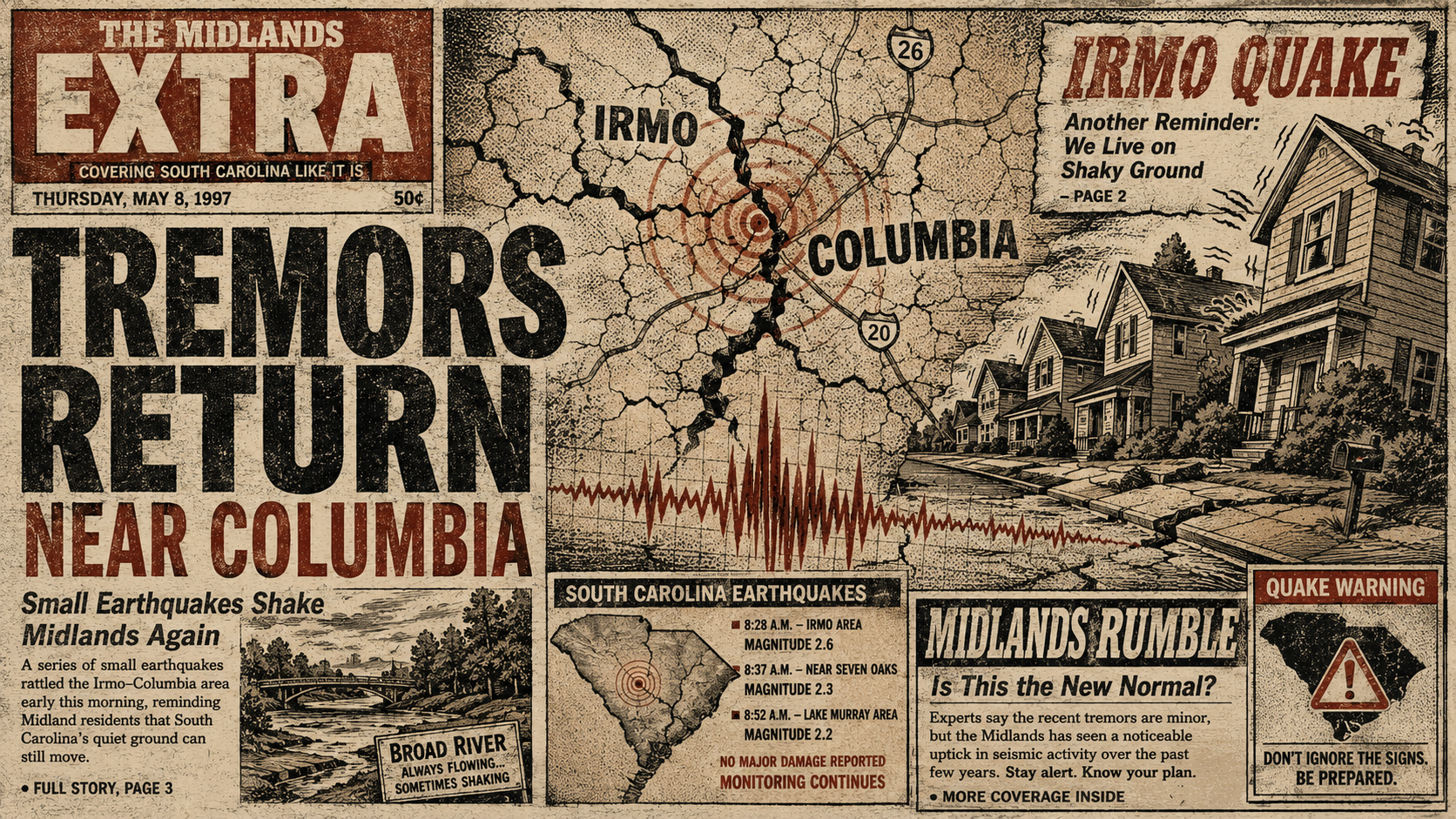
A small earthquake was recorded near the Columbia area Friday, adding another entry to what has become a noticeable stretch of seismic activity across South Carolina.
According to the U.S. Geological Survey and the South Carolina Emergency Management Division, the quake registered about 1.9 magnitude and was centered north of Irmo, a community northwest of Columbia. The tremor was recorded late Friday morning, with state emergency officials noting the event in a public update.
That does not make it a damaging earthquake. It does make it part of a pattern residents in the Midlands have become increasingly familiar with: small rumbles, scattered reports of shaking, and another reminder that South Carolina’s earthquake activity is not limited to history books.
Another Small Quake Near Irmo
The latest earthquake was recorded around 11:41 a.m. Friday, according to state emergency officials. USGS data cited in local reporting placed the quake about seven miles north of Irmo.
WIS reported there were no immediate reports of damage or injuries. That is typical for earthquakes in this range. Quakes below magnitude 2.5 are often not felt by most people and are usually detected by instruments, though nearby residents may notice a faint rumble depending on depth, soil conditions and location.
Still, small does not always mean ignored.
In South Carolina, even minor seismic activity tends to draw attention because the state has recorded repeated earthquake clusters in recent years, especially around the Midlands. For residents who have felt windows rattle or heard a short boom during earlier events, another tremor is not just a number on a map.
It is one more reason to ask what is happening under the ground.
Why the Columbia Area Keeps Showing Up?
The Columbia area has been a frequent location in South Carolina’s recent earthquake reporting.
According to data cited by The State, the latest quake means at least 21 earthquakes have been confirmed in South Carolina so far this year. The same report says 12 of the previous 13 were in the Columbia area, with several located in or near Irmo, Columbia and Lexington.
That concentration is the part readers should notice.
It does not mean a large earthquake is coming and also it also does not mean the recent activity is meaningless. It means the region is seeing repeated small seismic events, and the safest way to describe that pattern is exactly that: repeated small events, not a forecast.
Scientists are careful about this distinction because earthquakes are not like hurricanes. There is no reliable way to say a specific quake will happen at a specific time. The better question is whether the pattern shows a broader area of activity that deserves attention and public awareness.
In this case, the answer appears to be yes.
The Numbers Are Rising, But Context Matters

South Carolina is not California. Most earthquakes in the Palmetto State are small, and most do not cause damage.
But South Carolina is also not earthquake-free.
The South Carolina Department of Natural Resources Geological Survey maintains a recent-earthquake tool for events in or near the state, and state agencies regularly direct residents to USGS reporting tools when tremors are felt.
According to The State, South Carolina recorded 35 confirmed earthquakes in 2025, 30 in 2024, and 28 in 2023. The same report says the state has detected at least 188 earthquakes since the start of 2022, with most of them in the Midlands.
That is where the story gets easy to oversell.
More recorded quakes can mean more activity. It can also reflect better detection, more public attention, more reporting, and a pattern of small tremors clustered in a region that scientists are now watching more closely.
The responsible takeaway is not panic. It is awareness.
The Elgin Swarm Still Frames the Conversation
South Carolina’s recent earthquake conversation still traces back in large part to the Elgin-area swarm that began in late 2021.
The Washington Post reported that the Elgin swarm became the state’s most high-profile example of recent activity, with a 3.3 magnitude quake followed by several widely felt events above magnitude 3 and many smaller tremors afterward. The Post also noted that earthquake swarms are different from a single main shock followed by aftershocks; they are sequences of quakes that can continue over time in a similar area.
That matters because residents often think in terms of one big event followed by a return to normal.
A swarm does not always behave that way.
It can fade or it can continue. It can shift public attention from one part of the state to another. And because many of the quakes are small, the experience can be uneven. One household may feel a quick jolt. Another nearby may feel nothing at all.
That unevenness can make the public conversation confusing.
What Makes South Carolina Different
South Carolina’s earthquakes are not driven by the same kind of plate-boundary activity seen on the West Coast.
The Washington Post, citing scientists, described the state’s quakes as intraplate earthquakes, meaning they happen within the North American Plate rather than along the more familiar boundary between major tectonic plates. Scientists say those quakes are harder to interpret and may involve stress being released along old fault systems.
That is one reason small earthquakes in South Carolina can feel mysterious to residents.
There is no visible fault line running through daily life and there is no easy countdown. There is no practical way to predict whether the next event will be next week, next year, or not for a long time.
The uncertainty is the story.
And it is why officials generally focus less on prediction and more on preparation.
Damage Risk Remains Low for These Events
The recent Irmo-area quake was small, and there were no immediate reports of injuries or damage, according to WIS.
That fits the pattern for most recent South Carolina earthquakes.
The State’s report notes that the majority of recent quakes have been classified as microquakes and that no major damage or injuries have been reported from the recent seismic activity.
That does not mean earthquakes should be dismissed. It means the current pattern is mostly a public-awareness issue, not a damage-recovery issue.
There is a difference between “something happened” and “something dangerous happened.” Friday’s quake appears to fall into the first category.
Still, repeated small events can leave people uneasy, especially when they happen close to populated areas. For those who hear a boom, feel a floor shake or see a wall decoration move, the experience is real even when the official magnitude looks minor.
South Carolina’s Earthquake History Is Bigger Than Recent Tremors
The reason earthquake stories in South Carolina carry extra weight is history.
The state’s most famous earthquake struck Charleston in 1886. The Washington Post described it as the most damaging earthquake ever recorded in the eastern United States, killing about 60 people and damaging or destroying thousands of structures.
That does not mean another Charleston-level earthquake is imminent.
It does mean South Carolina has a real seismic history, and emergency officials have reason to keep reminding the public that earthquakes are part of the state’s risk profile.
In practical terms, the gap between a 1.9 magnitude tremor and a historic destructive quake is enormous. But the same public-safety lesson sits underneath both: people tend to think about earthquakes only after they feel one.
What Residents Can Do After a Tremor?

For a small quake like Friday’s, the immediate response is usually simple.
If residents felt shaking, they can report the experience to the USGS through its “Did You Feel It?” system. SCDNR’s earthquake page links residents to USGS observation tools and recent-earthquake resources.
For preparedness, emergency officials generally urge residents to know the basic rule: drop, cover and hold on during shaking. That means getting low, protecting the head and neck, and holding onto sturdy cover until the shaking stops.
For most South Carolina residents, earthquake preparation is not a daily concern. But it does not take much to secure heavy furniture, know where to take cover, and avoid assuming that small quakes are impossible.
The recent activity is a reminder that preparation does not have to be dramatic to be useful.
The Bottom Line
A 1.9 magnitude earthquake was recorded near Irmo Friday morning, adding to a series of small earthquakes in the Columbia-area region this year.
No immediate damage or injuries were reported.
The quake was minor, but it fits into a broader pattern of recent seismic activity in South Carolina, particularly in the Midlands.
Most of these earthquakes are small. Many are felt only lightly, if at all. But the repeated tremors have made earthquake awareness a more regular part of life for residents around Columbia, Irmo and Lexington.
The main takeaway is not that a major earthquake is coming. It is that South Carolina does have seismic activity, the Midlands remain active, and residents should know the basics before the next rumble arrives.