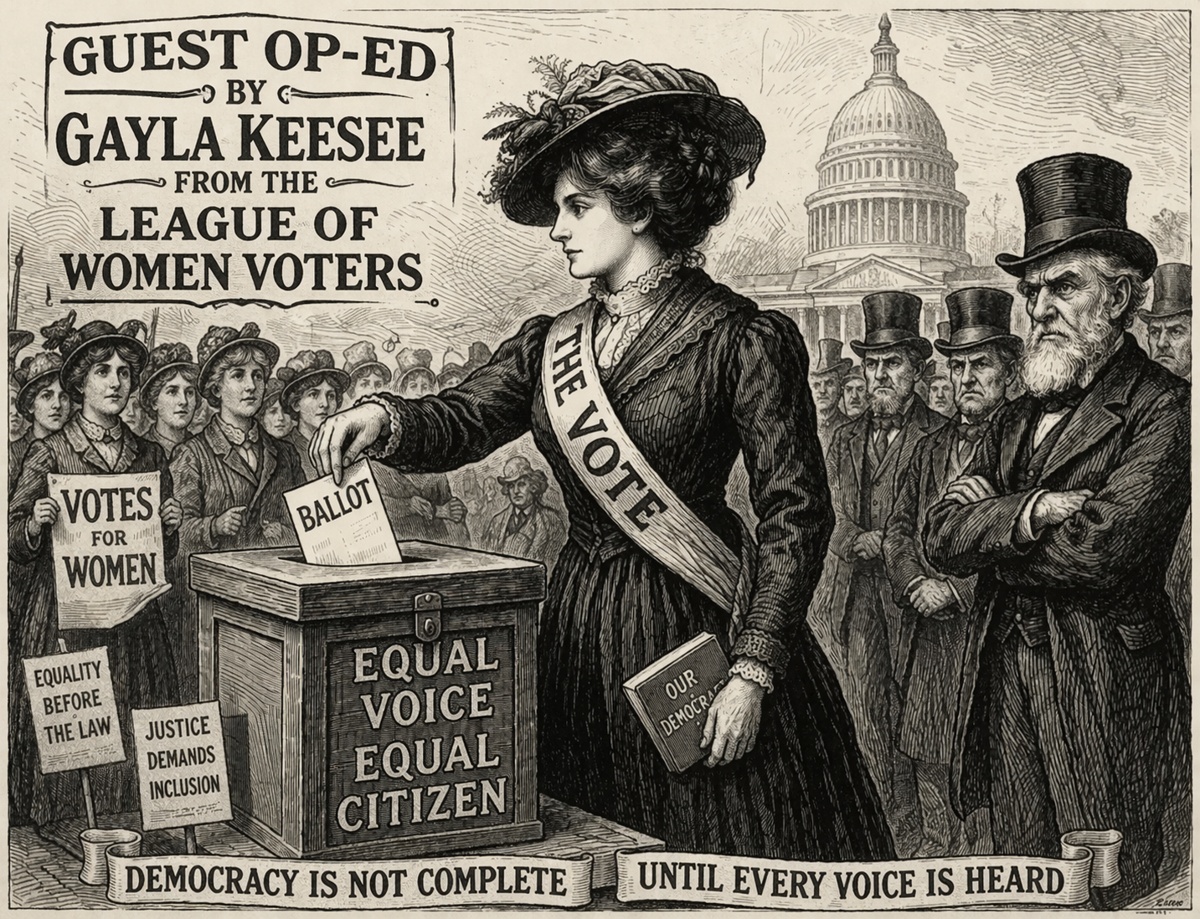
Guest Editorial
by Galya Keesee, Ph.D. – Co-President, League of Women Voters of the CSRA
Georgia lawmakers worked into the final hours of the legislative session to pass a slate of bills before sine die.
But one effort tied directly to Augusta did not make it across the finish line. The proposal to change the city’s form of government stalled, and the Charter Review process behind it never reached completion.
To understand why it stalled, you have to look at what was — and wasn’t — finished before it moved forward.
By the time the legislature adjourned on April 2, the Charter Review Committee had not completed its work. There was no final vote, no formally approved draft, and no official submission to the legislative delegation as required by the resolution that created the committee. Just days earlier, on March 31, the committee failed to reach a quorum at its final scheduled meeting. Without a quorum, no votes could be taken and no final document could be approved.
What remained unfinished at that point was not minor. The agenda for that final meeting still included major sections of the charter — ethics provisions, transparency language, audit oversight, and core elements of how the government would function. These are foundational decisions. Without them, there is no complete framework for how a new system of government would operate.
The Charter Review Committee had been given a deadline of March 31, 2026 to complete its work, with the option to extend for up to three additional months if needed. That timeline was intended to ensure the work was done thoroughly. It was not tied to the legislative calendar and did not require the committee to meet a deadline for placing a measure on the November ballot.
But as the legislative session progressed, the focus shifted. The initial push was to move something forward before crossover day. When that did not happen, the urgency shifted again — this time to getting something to the legislature before the end of the session.
Neither of those deadlines were part of the committee’s original charge.
Instead of completing the charter, the priority became meeting a moving legislative timeline. That shift reshaped how the process moved forward.
That shift was formalized on March 10, when the Augusta Commission passed a resolution asking the legislative delegation to advance a change in the form of government — even though the Charter Review Committee had not completed its work.
That action set the legislative process in motion.
Because the Charter Review Committee had not completed its work and had not submitted a full charter with the structural and operational details required for a city manager form of government, the legislation introduced at the state level was not built on a finalized local framework.
Instead, Senator Max Burns and Representative Mark Newton worked with legislative counsel to draft a bill intended to carry out the Commission’s request. Without a completed charter to rely on, legislative counsel had to construct key elements of the proposal independently.
As a result, the legislation did not fully reflect the work of the Charter Review Committee. It omitted elements that had been discussed or included in draft versions and introduced provisions that had not been part of the committee’s deliberations.
This was not the translation of a completed local plan into state law. It was an attempt to build one without a finished foundation.
As that legislation moved forward, it was presented to lawmakers as if the underlying work had been completed.
During the Senate committee hearing, Max Burns told members that the Charter Review Committee had reached agreement on moving to a city manager form of government and characterized that recommendation as having been completed.
But what had not been completed — and was not reflected in that description — was the supporting framework required to implement that form of government. The committee had not finalized the structure, authority, reporting relationships, and operational details necessary to make a city manager system function.
Nor were those elements fully developed in the legislation itself.
What was presented as a completed recommendation was, in reality, only one part of a larger, unfinished process.
The condition of the document itself reflects that breakdown. After the March 31 meeting failed to produce a quorum, a draft was assembled and delivered to the Commission. However, it was not a formally approved draft. The transmittal acknowledges that the committee did not complete its work and that the document reflects what members believed would have passed, rather than what was actually approved.
Supporting materials from the Carl Vinson Institute of Government confirm that the draft was still being finalized at the end of the process. Prior committee actions had not been fully incorporated into earlier versions, and some motions were not included at all because language had not been provided. Without a clear vote-to-language reconciliation, there is no way to verify that the final document reflects the will of the committee.
That raises important questions — not only about the document itself, but about the process that produced it. Augusta contracted with the Carl Vinson Institute of Government to guide the committee and develop a final charter draft.
And if the draft itself was acknowledged as incomplete, how can the committee’s work — or the work it contracted for — be considered finished?
Where is the final vote approving a completed draft?
The document was delivered to the Commission — but where is the formal submission to the legislative delegation and other required recipients outlined in the resolution?
And if those steps did not occur, on what basis is this process being treated as complete?
But this is not the end of the process — unless Augusta allows it to be.
Sine die has come and gone. The March 31 deadline has passed. But the timeline established in the original resolution has not run out. The Commission has the authority to authorize an extension of up to three additional months if it chooses to do so.
That means what happens next is not automatic. It is a decision.
The Commission can choose to continue the Charter Review Committee’s work and allow it to be completed properly. It can address the quorum issue so that the committee can function as intended. Or it can allow the process to end without a finalized charter.
Those are not equivalent choices.
Only one of them completes the work that was started.
And this is where the public matters.
This is an election year. Members of the Commission — and the mayor — are asking voters to return them to office. That creates an opportunity for the public to ask a simple question: will you finish this work, or will you leave it incomplete?
A complete charter can still be developed — one that fully reflects the committee’s work, is clearly documented, and is presented transparently to the public. That document can then be submitted to the legislature in the next session and placed on the ballot in November 2027.
Yes, that delays implementation.
But it also creates the time needed to finish the work properly, ensure the structure is clear and functional, and prepare for what comes next.
Because adopting a new charter is not the final step. It is the beginning of implementation. Every ordinance governing how Augusta operates would need to be reviewed and revised to align with the new structure. Those ordinances define procedures, authority, and day-to-day operations. Without that alignment, a new charter cannot function as intended.
Taking the time now allows that work to begin — instead of trying to retrofit it later.
Augusta does need a charter revision. That has not changed.
What this moment makes clear is that how it is done matters just as much as what is done.
This is the opportunity — for both the Commission and the public — to get it right.
Publisher’s Note:
This article is a Guest Op-Ed submitted by Gayla Keesee of the League of Women Voters of the CSRA. The views and opinions expressed are those of the author and do not necessarily reflect those of Garden City Gossip. We publish guest perspectives to encourage informed public discussion on issues affecting Augusta and our community.