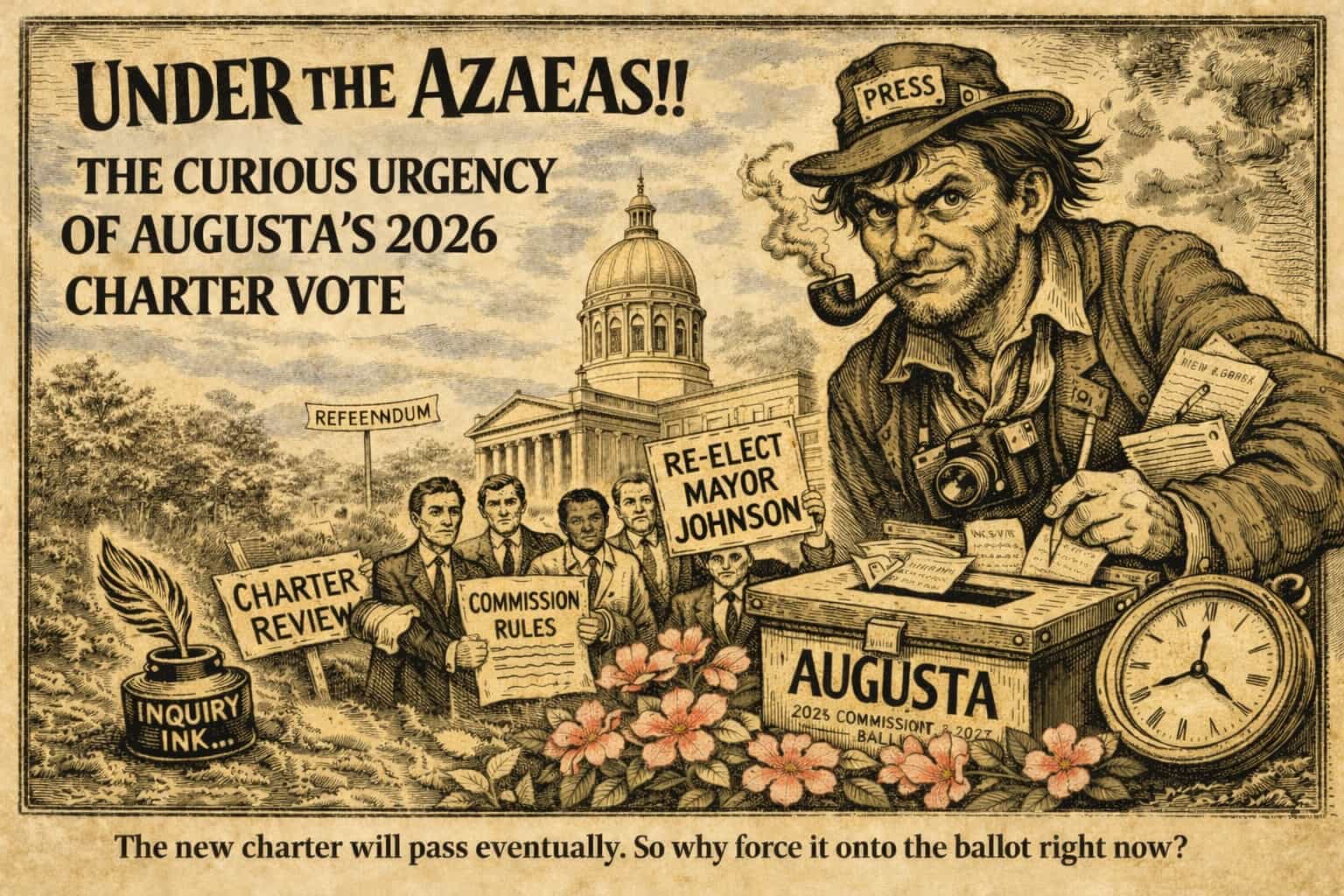
The new charter will pass eventually. So why abandon the process to force it onto the ballot now?
By Simone Raines
Why does it matter so much that Augusta’s revised charter appears on the 2026 ballot? Why has the Commission demonstrated such urgency—enough urgency, in fact, to discard the rules and procedures it established precisely to shield the Charter Review process from political influence and manipulation? These questions linger over the debate, particularly because the central premise underlying the rush is difficult to sustain. The proposed charter will pass regardless of when the referendum is held. Whether the vote occurs in 2026 or later, the outcome itself is not seriously in doubt. The real issue, therefore, is not whether Augusta will adopt a new charter. It is why the timeline has suddenly become so critical.
Augusta’s current charter—the governing document that effectively functions as the constitution of Augusta-Richmond County—was built upon two principal foundations. The first was the deliberate removal of meaningful executive authority from the Mayor. That change was a direct response to the financial collapse that followed Charles DeVaney’s failure to keep the city’s finances in balance. The drafters of the charter were determined to prevent a recurrence of that episode and therefore stripped the Mayor of the ability to make the types of unilateral financial decisions that had previously placed the city in jeopardy. The second foundational principle was the maintenance of racial balance in the elected leadership of county government. When the charter was adopted in 1996, the arrangement was straightforward and intentionally structured: five white commissioners, five black commissioners, and a white mayor. Under that framework, a deadlocked 5–5 vote among commissioners would be broken by the mayor, who was widely expected to align with the white commissioners. The design therefore embedded a particular political equilibrium into the structure of the government itself.
That arrangement ultimately failed, and it did so for two distinct reasons—one legal and one demographic. According to Senator Charles Walker, the original charter was drafted under extraordinary time pressure. The drafters had only a matter of days to assemble a comprehensive governing framework that would shape Augusta’s political system for decades. In order to compel cooperation between factions, they imposed a rule requiring six votes for the passage of any measure. The theory was simple: either commissioners from both racial blocs would reach consensus, or a 5–5 split would be resolved by the mayor’s tie-breaking vote, thereby producing the necessary six votes. Yet the speed with which the charter was drafted left an oversight. The authors did not anticipate that a commissioner could abstain from voting—a right commissioners possess and one that was explicitly confirmed by the courts in 2007. Once abstention entered the equation, the entire logic of the six-vote requirement began to unravel. A vote could easily become four in favor and five opposed. That result produced neither a tie nor the required six votes, meaning the measure failed automatically. What had been intended as a structural incentive for consensus instead became a mechanism that routinely produced deadlock.
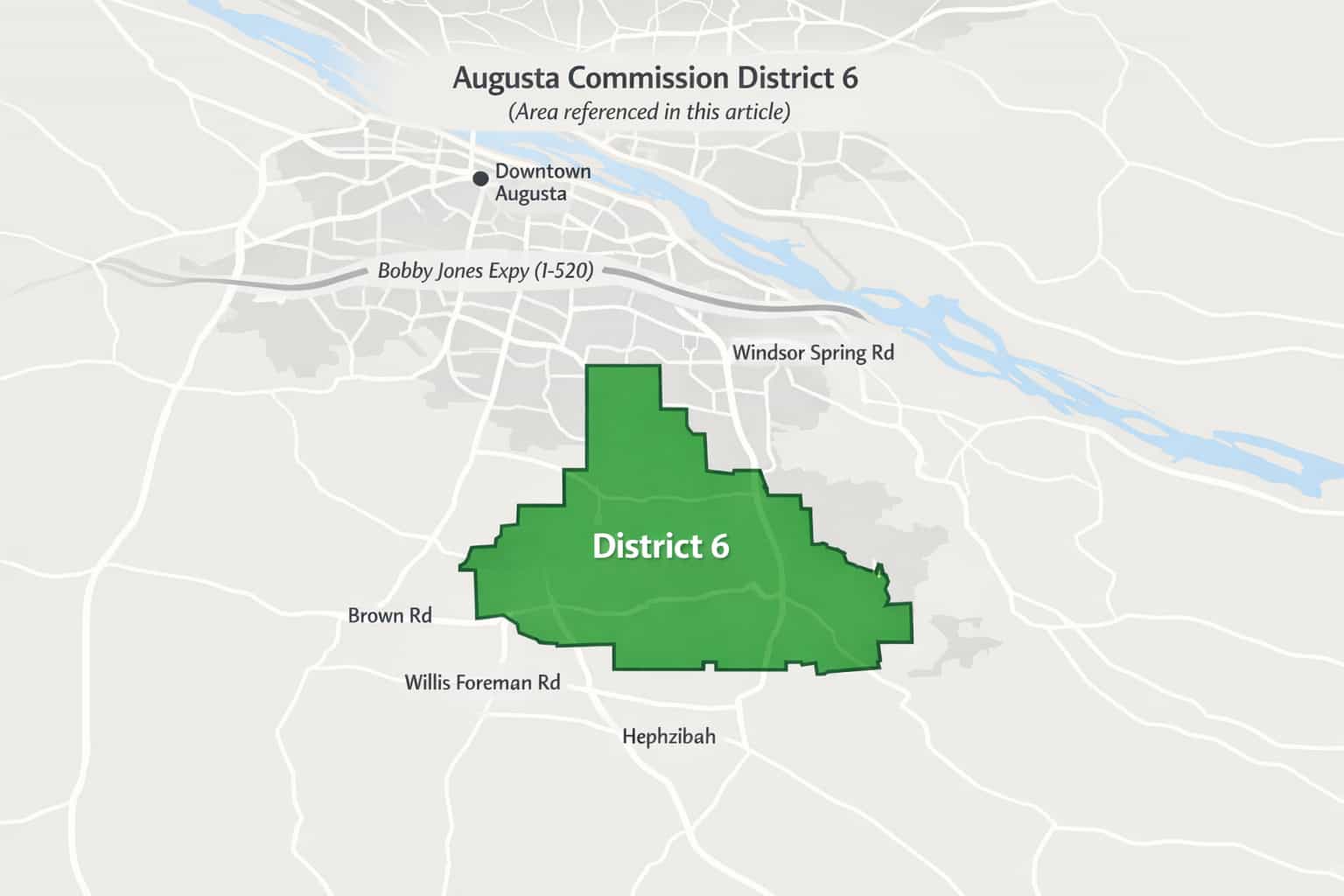
The second factor was demographic change, most notably within District 6, the area located north of Brown Road and Willis Foreman Road and south and west of Windsor Spring Road. In 2014, Joe Jackson was defeated by Ben Hasan in that district, a result that shifted the Augusta Commission to a six-to-four black majority. That election permanently disrupted the racial balance that had defined the Commission’s composition for roughly two decades. There had been an earlier moment when the balance appeared to tilt—when Matt Aiken won the District 1 seat—but Aiken served only a single term before losing to Bill Fennoy, returning the Commission to its prior alignment. District 6, however, proved decisive. With that change, the equilibrium around which the charter had been constructed ceased to exist.
More than ten years have now passed since the demographic assumptions underlying Augusta’s charter collapsed, yet the structure of the government has remained largely unchanged. In the meantime, the practical exercise of executive authority has increasingly migrated away from elected officials and toward interim administrators, attorneys, and department directors. These unelected figures now occupy much of the space where executive leadership would ordinarily reside. Meanwhile, the political leadership of the city has remained locked in a persistent stalemate. Since Mayor Garnett Johnson won his election four years ago, Augusta’s government has been waiting—often without success—for some force capable of breaking the cycle of institutional deadlock. Given these circumstances, few observers doubt that a revised charter will eventually be adopted. The system’s shortcomings are now widely acknowledged across the political spectrum.
If the charter’s eventual adoption is all but certain, however, the insistence that the referendum must occur in 2026 requires explanation. The practical realities of Augusta’s political landscape suggest that little will change in the Commission’s composition in the near future. Even if a new charter were implemented at the beginning of 2027, the municipal government would require years to adjust to the structural changes it introduces. Institutional transformations of this magnitude rarely occur overnight. From a purely administrative perspective, therefore, there is no pressing operational reason to force the referendum onto the 2026 ballot. The most plausible explanation instead lies in the political calendar: the mayor’s reelection campaign.
The push to accelerate the timeline became particularly evident during the debate over a resolution urging that the charter referendum appear on the 2026 ballot. Steve Foushee, a member of the Charter Review Commission—though notably not its chair—addressed the Commission and pressed for adoption of the resolution. Yet he offered no substantive justification for the urgency. Indeed, throughout the discussion, no participant articulated a concrete reason why the referendum must occur in 2026 rather than at a later date. Supporters of the resolution treated the proposed timeline as if it were self-evidently virtuous, an assumption that went largely unexplored even as the Commission moved forward with the measure.
The real source of the urgency appears to lie not in Augusta but in Atlanta. Under Georgia law, cities and counties do not possess the authority to place referendums on the ballot on their own initiative. That power belongs to the Georgia General Assembly, which must authorize such measures before they can appear before voters. In practical terms, this means the Board of Elections answers to the state rather than to the city government. Because the Charter Review Commission had not yet finalized its draft, the legislative window for securing authorization from the General Assembly was rapidly closing. Rather than allowing the review process to proceed at its originally promised pace, the mayor’s political allies pushed the resolution forward in order to preserve the possibility of legislative approval during the current session.
Even now, however, the effort faces a significant obstacle. The proposed referendum must still receive approval from Augusta’s local legislative delegation before it can proceed. The legislative calendar offers little encouragement for those hoping for swift action. The General Assembly has already passed Crossover Day, and numerous bills compete for attention and priority ahead of this local referendum. The resolution passed by the Commission carries no binding legal authority; in effect, it is simply a request transmitted to the legislature. The ultimate decision therefore rests with the members of the local delegation in Atlanta, who are under no obligation to act in accordance with the mayor’s preferences. They must now decide whether to authorize a 2026 referendum under circumstances critics argue represent a clear departure from the procedures and safeguards originally designed to insulate the Charter Review process from political influence.
Prior swigs from the 128 oz. sweet tea bucket we purchased at the Circle K:
🌺 UNDER THE AZALEAS 🌺 – New Columnist! – Alvin Mason Running Again?