Aiman Tariq – Regional News Editor
Winder, GA –
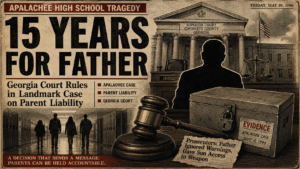
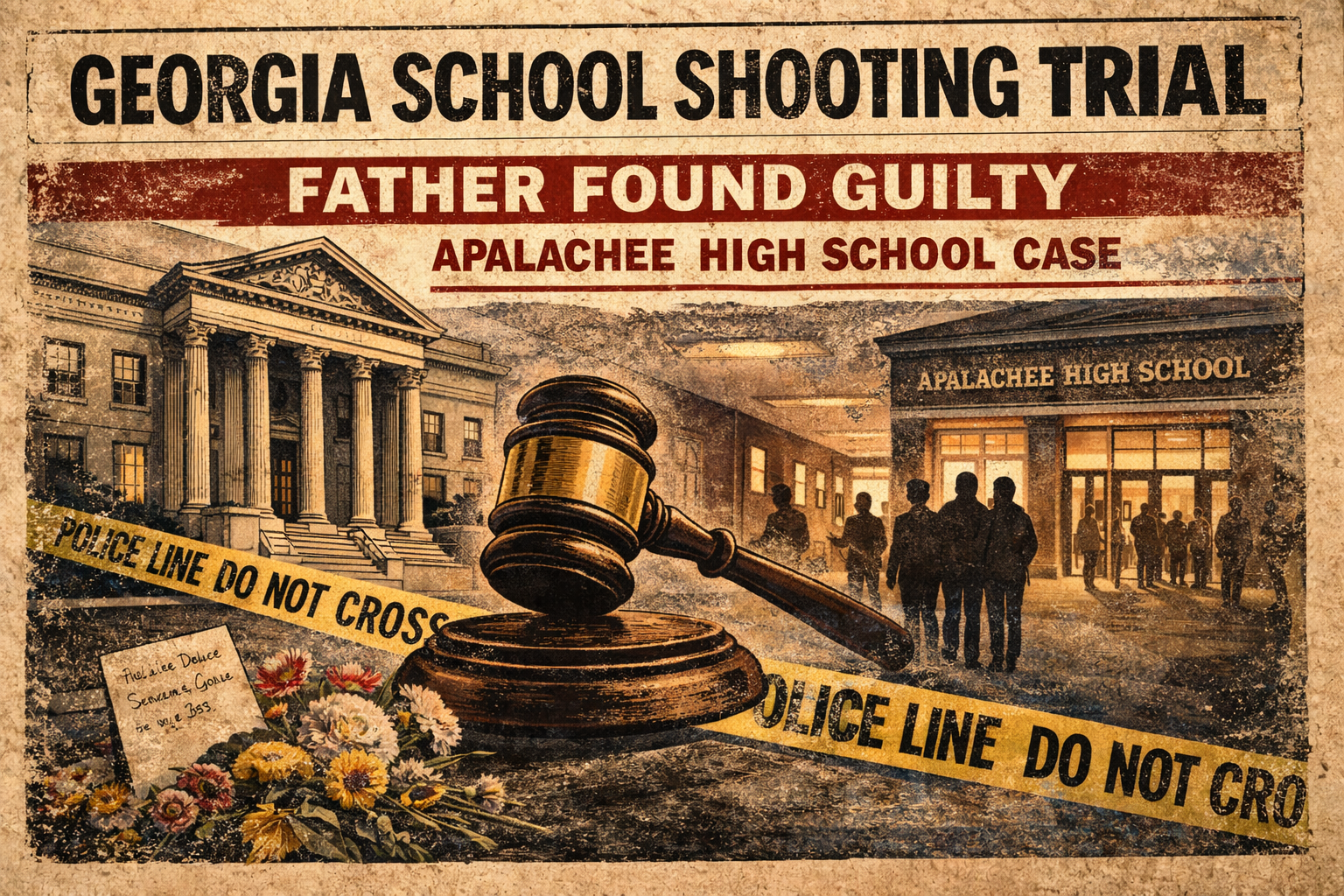
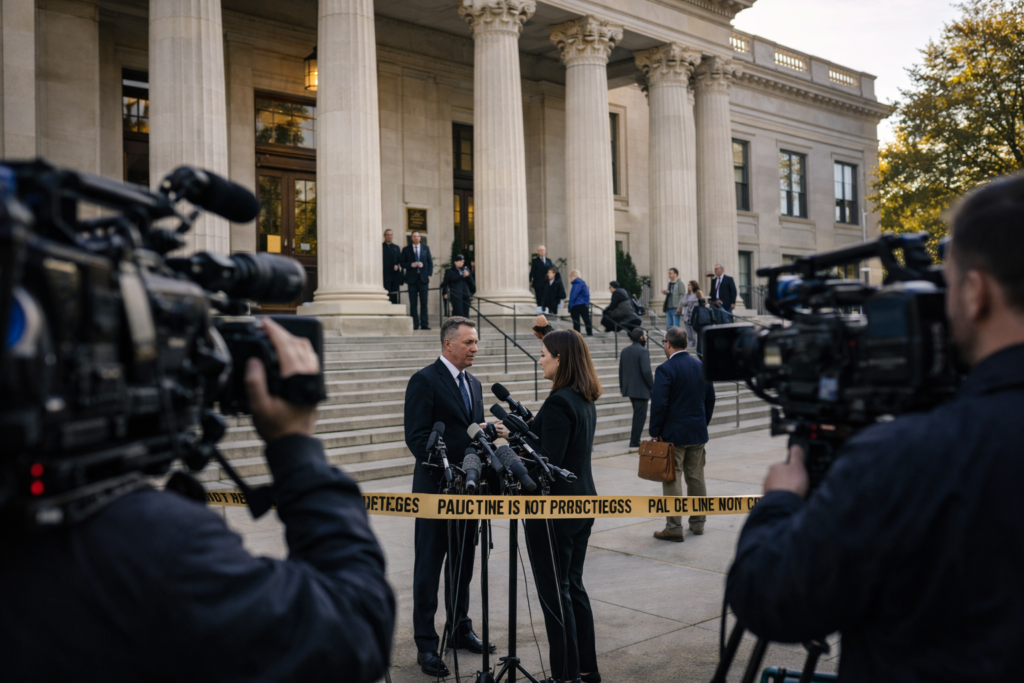
A Georgia jury has convicted Colin Gray on all charges connected to the 2024 attack at Apalachee High School, a decision that places new legal scrutiny on the responsibilities of parents in cases involving a teenage school shooter.
The verdict came after roughly two hours of jury deliberations following a two-week trial in Barrow County Superior Court. Prosecutors argued that Gray played a critical role in the chain of events that led to the attack by allowing his son access to the rifle allegedly used in the shooting.
The case centers on the Sept. 4, 2024 attack at Apalachee High School in Winder, northeast of Atlanta, where four people were killed and several others injured.
The Verdict and the Charges
Jurors found Colin Gray guilty on 29 charges, including second-degree murder, involuntary manslaughter, reckless conduct, and multiple counts of cruelty to children.
According to court reporting from Georgia media outlets and national coverage, prosecutors argued that Gray ignored warning signs about his son’s deteriorating mental state and allowed access to firearms despite those concerns.
The shooting left two teachers and two students dead.
Those killed included teachers Richard Aspinwall and Cristina Irimie, along with students Christian Angulo and Mason Schermerhorn.
The teenager accused of carrying out the attack, Colt Gray, was 14 at the time of the killing shooting. His own criminal case has not yet gone to trial.
A Rare Prosecution of a Parent
Legal experts note that prosecutions of parents in mass-violence cases remain unusual.
The Gray case follows a similar prosecution in Michigan involving the parents of a teenager responsible for the 2021 Oxford High School shooting. In that case, both parents were convicted of involuntary manslaughter.
With the conviction in Georgia, Colin Gray becomes one of only a handful of parents in the United States to be held criminally liable in connection with a mass school shooting.
Prosecutors argued during trial that Gray was “the one person who could have prevented” the attack, citing what they described as a series of warning signs about his son’s behavior.
Defense attorneys countered that the responsibility lies primarily with the individual who carried out the attack.
What Prosecutors Told the Jury?
During the trial, prosecutors described how the rifle used in the shooting had been given to Colt Gray as a Christmas present.
They argued that the father knew his son had shown troubling behavior before the attack and still allowed him access to firearms and ammunition.
According to testimony cited in courtroom coverage, authorities had previously interviewed the father and son after law enforcement received a tip about online threats connected to a potential time shooter scenario.
Investigators later said there was not enough evidence at that time to make an arrest.
The prosecution used that earlier investigation to argue that Gray should have taken stronger precautions.
They also presented evidence including surveillance video and testimony from students who survived the attack.
The Defense Argument
Defense lawyers attempted to shift responsibility back to the teenager accused of carrying out the shooting.
“This is the person who went into the high school and shot and killed four people,” defense attorney Jimmy Berry told jurors, according to reporting from the courtroom.
The defense argued that the son acted independently and secretly.
But prosecutors maintained that warning signs were visible long before the attack.
Assistant District Attorney Patricia Brooks told jurors that after seeing signs of his son’s mental instability and violent thoughts, the defendant still failed to prevent access to the weapon.
How the Shooting Unfolded
Investigators say the alleged shooter carried the rifle to school in a backpack before the attack began.
Witnesses described how students and teachers were caught in the chaos as shots were fired inside the school.
Prosecutors also highlighted the actions of one victim, Christian Angulo, who they said tried to push the gunman away from his classroom before being fatally shot.
Officials said his final act was shutting the classroom door in an attempt to protect other students.
In the hours immediately after the attack, confusion spread through the community as parents and police tried to determine have they found the shooter and whether the threat had ended.
Authorities eventually confirmed that a suspect had been taken into custody.
A Case That Raises Broader Questions
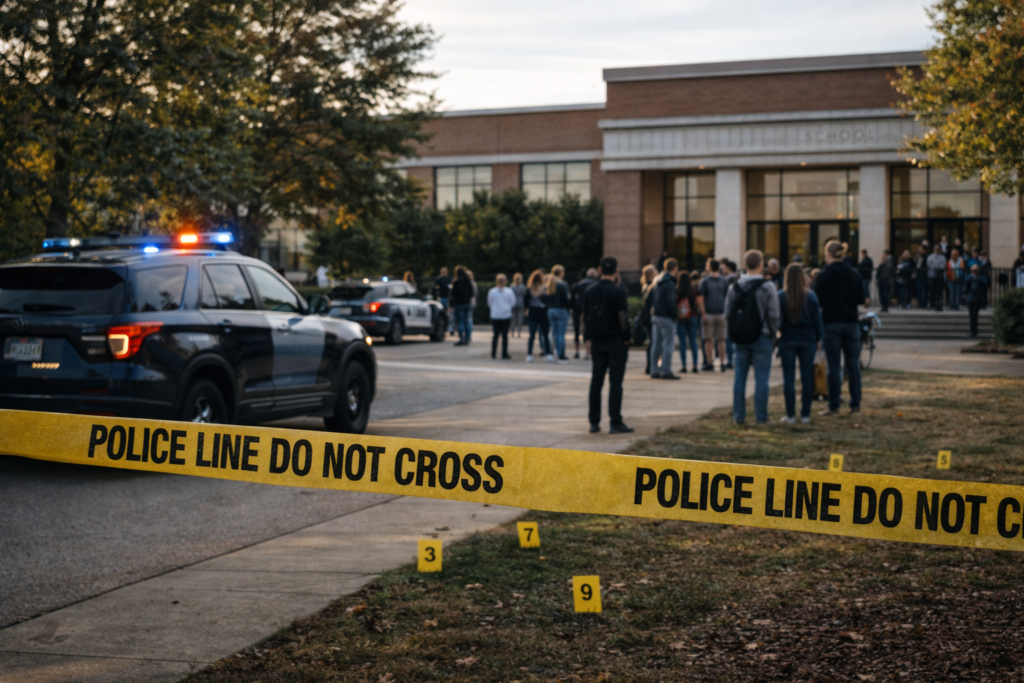
The conviction arrives amid an ongoing national debate about accountability in school shootings.
For decades, criminal responsibility has almost always rested with the person who carried out the attack.
But in recent years prosecutors have begun exploring whether parents can also face charges when firearms used in shootings were obtained from the home.
Those cases raise difficult legal questions.
Supporters argue that parents who ignore warning signs or fail to secure weapons should face consequences.
Critics say criminal liability for parents risks stretching criminal law into uncertain territory.
For now, courts are still defining where those lines should be drawn.
What Happens Next
Colin Gray now faces a possible sentence of up to 180 years in prison under Georgia law. A sentencing date has not yet been scheduled.
Meanwhile, the criminal case against Colt Gray remains pending.
Prosecutors say they are prepared to move forward with that trial once court scheduling allows.
For families affected by the shooting, the verdict closes one chapter but not the entire case.
The legal system will still have to determine the outcome of the charges against the teenager accused of carrying out the attack.
The Bottom Line
A Georgia jury has convicted Colin Gray on all counts connected to the 2024 Apalachee High School shooting.
Prosecutors argued that he allowed access to the firearm used in the attack despite warning signs about his son’s behavior.
The teenager accused of carrying out the shooting will face his own trial at a later date.
As the legal process continues, the case is likely to remain a reference point in the growing national debate about how responsibility is assigned in tragedies involving a school shooter.
The verdict also underscores a broader question that continues to surface after each mass-violence incident: who, beyond the person who pulls the trigger, bears responsibility when warning signs appear before the violence begins.