Aiman Tariq – Regional News Editor
Atlanta, GA –
Georgia’s forestry economy has long depended on a simple assumption: if landowners keep growing trees, there will be enough buyers, mills, and markets to make the cycle work. Lately, that assumption has looked less secure.
According to WABE, a string of paper mill closures, combined with the damage Hurricane Helene inflicted across large parts of Georgia in 2024, has put new pressure on an industry that still plays an outsized role in the state’s economy.
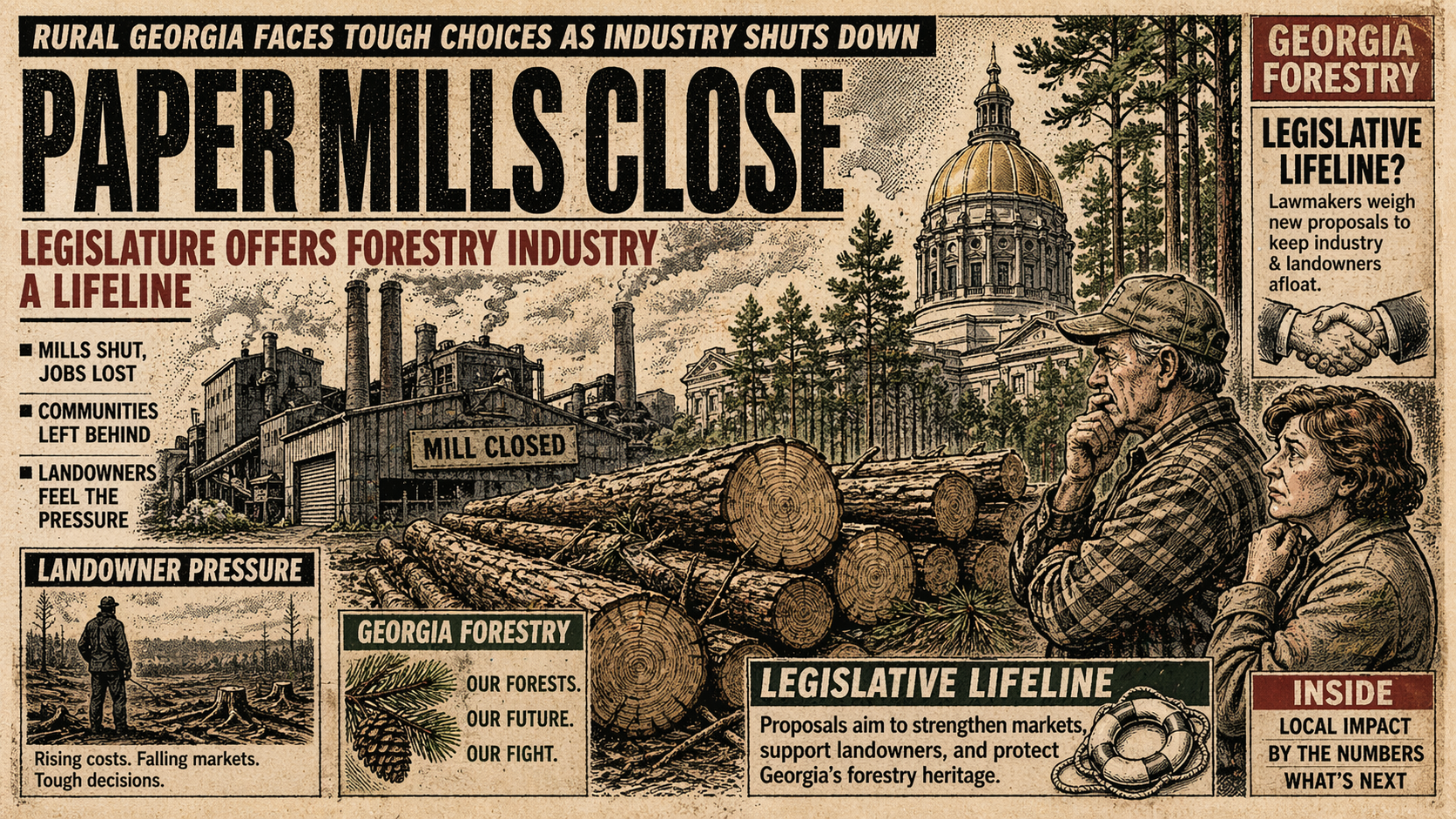
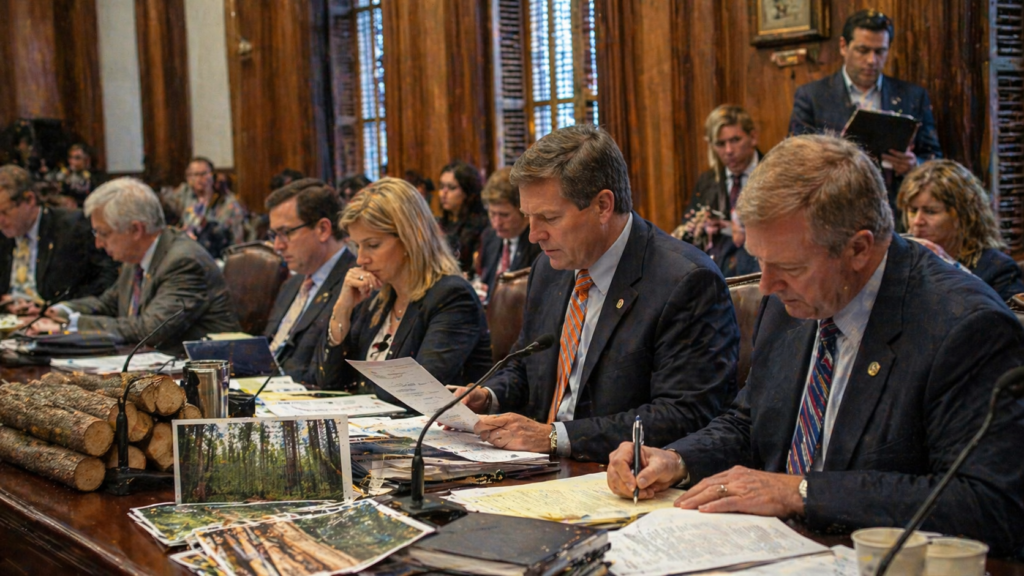
In response, lawmakers spent the final days of the 2026 legislative session pushing through a cluster of measures aimed at helping forest landowners, manufacturers, and researchers keep that system viable.
That does not mean the legislature solved the problem. It means state leaders appear to have concluded that recent mill closures are not just an industry story. They are also a land-use story, a rural-economy story, and, increasingly, a question about what happens when keeping land in timber no longer makes obvious financial sense for the people who own it.
What Lawmakers Actually Passed?
WABE reported that lawmakers approved several bills intended to give the forestry sector more flexibility. Among them was a measure allowing some forest landowners who receive conservation tax benefits to also participate in carbon markets, a tax-credit update designed to attract forestry manufacturers, and legislation preventing local governments from banning mobile sawmills on agricultural land. Another proposal — eliminating sales tax on timber harvesting — passed the House but did not clear the Senate.
The state budget also included about $8.9 million for research tied to replacing fossil-fuel-based materials with wood-based inputs for products such as textiles and pharmaceuticals. Georgia Tech said the funding supports the Georgia Forestry Innovation Initiative and is meant to help move lab research into larger-scale demonstration work.
That mix of legislation and research spending suggests lawmakers are trying to do two things at once: help landowners and mills survive the immediate pressure, while also searching for new uses for wood products beyond traditional paper making.
Why Mill Closures Matter Beyond the Mills?
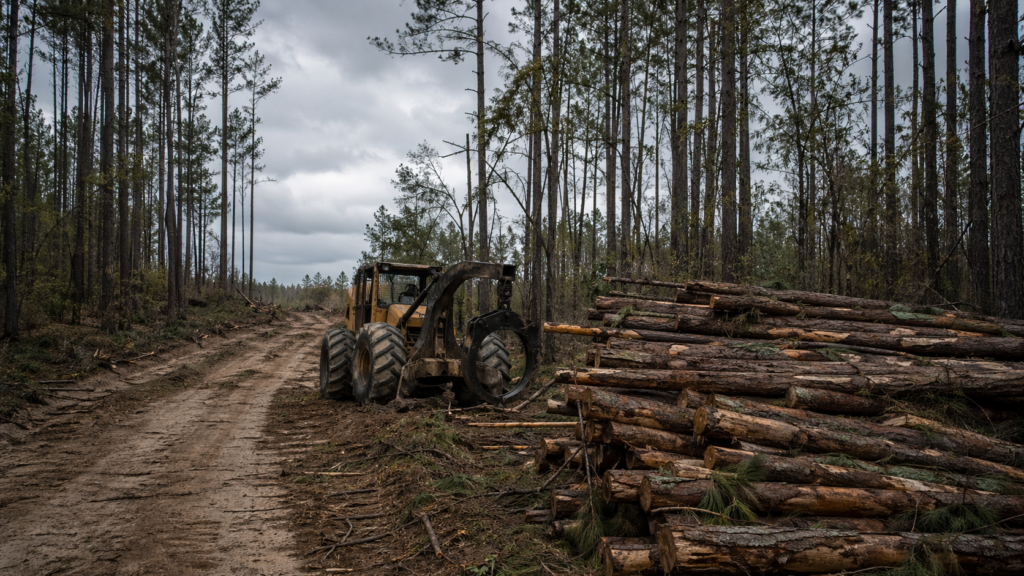
Georgia’s forestry sector is large enough that plant closures ripple outward quickly. The Georgia Forestry Association says the state ranks first nationally in annual timber harvest volume and in forest-product exports, and Georgia’s forest industry supports more than 141,000 direct and indirect jobs.
But the structure of ownership is just as important as the size of the industry. WABE reported that about 92% of Georgia’s forests are privately owned, and many of those owners are individuals or families rather than major corporations. That means mill shutdowns are not just a corporate problem. They can directly affect whether landowners replant, hold, harvest, or sell.
This is where the story gets more complicated than a simple business-cycle downturn. If fewer mills are operating, the path from trees to revenue gets weaker. And if the economics weaken enough, forest owners may decide their best option is no longer timber at all. WABE’s reporting noted that industry experts worry some landowners could instead sell to developers or move land into other uses.
The Pressure on Landowners
For people outside the industry, forestry can sound abstract — something distant, technical, maybe even quaint, like old questions about how to make a paper football out of a notebook page. But on the landowner side, the decisions are much less casual.
According to WABE, many private owners treat timberland as part of a long-term family plan, whether for retirement, college costs, or inherited property they want to keep productive. If the market for pulpwood, chips, and lower-value timber weakens, the pressure to convert that land can rise.
That is part of why the state’s response has focused not only on mills but on market alternatives. If lower-value wood can be turned into higher-value chemicals, textiles, or other products, then some of the land that now looks economically shaky may remain worth keeping in forest. Georgia Tech’s Renewable Bioproducts Institute says its work is aimed at converting biomass into value-added products that can scale beyond the lab.
Hurricane Damage Made a Bad Situation Worse
The industry strain did not begin with recent legislation, and it did not begin with mill closures alone. WABE’s reporting places Hurricane Helene squarely in the story, describing it as a major blow to Georgia timberlands in 2024.
That timing matters. A state can often absorb one shock more easily than two. But when storm losses hit near the same time as mill demand weakens, the result is a more fragile market for the very landowners the state is now trying to reassure.
For some owners — including those in places like Pickens County, which WABE used to illustrate the strain on working forests — this is not an easy pickens choice between simply waiting things out and keeping the same management plan. If the local market changes, so do the incentives.
Climate, Carbon, and the Long View
There is another layer here. WABE reported that commercially managed forests offset about a third of Georgia’s greenhouse gas emissions, citing research from Drawdown Georgia. That does not make every forestry policy a climate policy by default. But it does mean large-scale land conversion has implications beyond rural economics.
That is also part of the logic behind carbon-market legislation. Supporters see it as one more revenue stream that could help landowners keep forests standing rather than selling off parcels when market conditions tighten. Critics and skeptics, meanwhile, are likely to watch closely to see whether those markets are dependable enough to matter at scale.
What the Debate Is Really About?
The public version of this debate can sometimes collapse into overly simple talking points: mills closing, lawmakers reacting, research money arriving. The underlying question is more structural.
What Georgia is really confronting is whether the economics of cutting trees down still support the broader system that has kept so much private land in managed forest. If the answer becomes less certain, the result is not just pain for mills. It is a different landscape — literally and economically.
That does not mean every closure will lead to subdivision growth, and it does not mean every legislative fix will work. But it does help explain why lawmakers appeared willing to move quickly once the industry signaled that the pressure had reached a more serious point.
The Bottom Line
Georgia lawmakers are trying to give the forestry industry a buffer after paper mill closures and storm damage put new strain on landowners, manufacturers, and researchers. The state’s response includes market flexibility, tax changes, and nearly $8.9 million in research funding tied to new wood-based products.
The argument behind those moves is fairly straightforward: if private forest owners lose enough revenue options, some may decide not to keep their land in timber at all. In a state where forestry remains a major economic engine, that is not a small concern.
Whether the new measures are enough is harder to say. For now, the legislature has offered the industry a lifeline. The real test is whether it proves strong enough to keep the market — and the land beneath it — from shifting in a more permanent way.