Aiman Tariq – Regional News Editor
Columbia, SC –
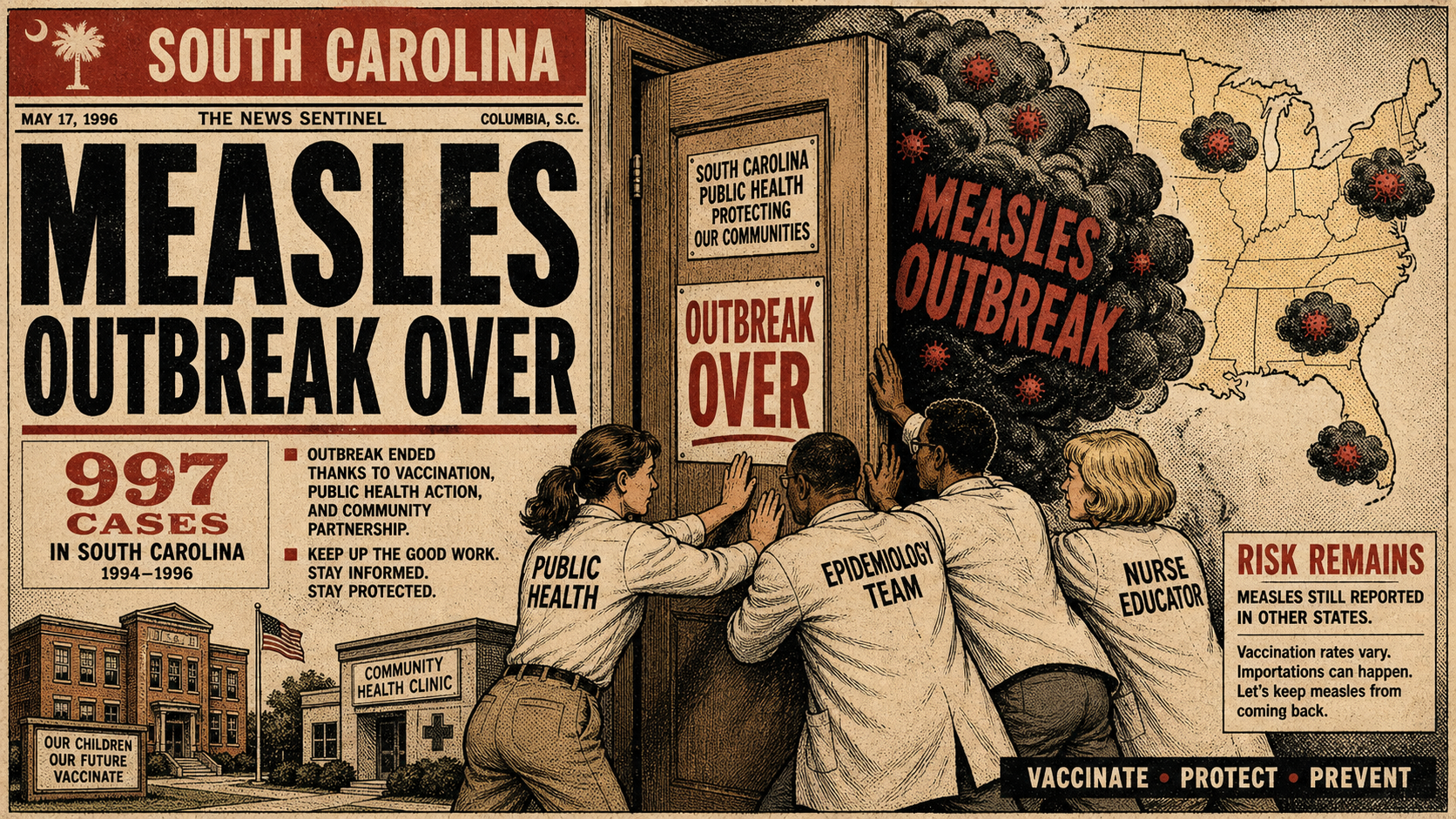
South Carolina health officials say the state’s largest measles outbreak in decades is over, after 42 days passed without a new outbreak-related case.
That is the clean version of the story.
The more cautious version is that South Carolina contained one major outbreak, but the conditions that allowed it to spread have not disappeared. Vaccination gaps remain. Other outbreaks are active around the country. And health officials are still warning that measles can return quickly when it reaches communities with too little immunity.
According to NPR’s reporting, South Carolina officials declared the outbreak over Monday after the state reached the 42-day mark with no new cases tied to the cluster. Over roughly six months, beginning last October, 997 people were infected, most of them unvaccinated children. At least 21 people were hospitalized with complications.
The outbreak was centered largely in Spartanburg County, rather than spreading statewide. Public health officials credited timely investigations, contact tracing, quarantine measures, and increased vaccination for bringing it under control.
That matters. But it does not mean the larger measles problem is over.
Why the 42-Day Mark Matters?
Public health officials do not declare a measles outbreak over simply because case numbers slow down.
According to Reuters, South Carolina waited 42 days after the last reported outbreak-related case before formally declaring the outbreak over. That window is twice the maximum incubation period for measles, which gives health officials greater confidence that the chain of transmission has stopped.
That is a meaningful milestone.
It also explains why the declaration came weeks after the outbreak appeared to be slowing. Public health agencies are cautious with measles because the virus spreads easily and because one missed case can restart transmission.
The state’s conclusion, then, is not that measles is gone from the world or even gone as a risk in South Carolina. It is narrower: this specific outbreak chain appears to have ended.
That distinction matters for families, schools, churches, clinics, and health departments still watching national case counts rise.
A Six-Month Outbreak With Real Costs
The outbreak sickened 997 people in South Carolina and sent at least 21 people to the hospital, according to AP and Reuters reporting. State officials estimated the response cost about $2.1 million.
Those numbers are important because measles is sometimes described as a routine childhood illness. Most people recover, but that does not mean the disease is harmless.
The CDC says measles can lead to complications including pneumonia and brain swelling, and that before widespread vaccination, an estimated 48,000 people were hospitalized and 400 to 500 died in the United States each year.
That is why public health officials tend to treat measles differently from many other childhood infections. It is highly contagious, it can move quickly through undervaccinated groups, and it can create a large response burden even when most cases do not become severe.
In South Carolina, that burden included quarantine letters, case investigation calls, school disruptions, and direct costs to the state response. AP reported that the state sent nearly 2,300 quarantine letters, made more than 1,670 case investigation calls, and worked across seven school districts to quarantine 874 students.
Vaccination Helped Slow the Spread
One of the clearest lessons from the South Carolina outbreak is also the oldest one: vaccination matters.
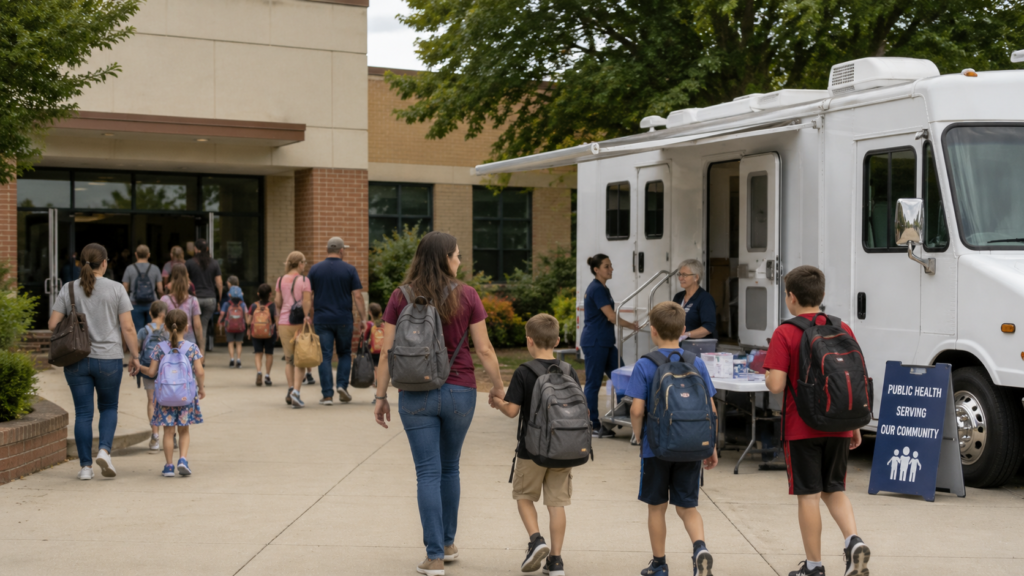
AP reported that public health workers, doctors’ offices, and pharmacies administered nearly 82,000 measles vaccines from October through March, more than 30% higher than the same period a year earlier. Spartanburg County saw a 94% increase in vaccinations.
That does not prove vaccination was the only reason the outbreak ended. Outbreaks can slow for several reasons, including prior infection, isolation, quarantine, and fewer remaining susceptible contacts.
But health officials have pointed to increased vaccination as one of the factors that helped South Carolina avoid broader statewide spread.
The CDC says one dose of the measles, mumps and rubella vaccine is about 93% effective against measles, and two doses are about 97% effective.
That is the part of the story that can get lost in political debates over mandates. The vaccine does not just protect one household. It helps reduce the number of places where the virus can keep moving.
What Made Spartanburg Vulnerable?
The outbreak did not spread evenly across South Carolina.
Reuters reported that more than 90% of infections were in Spartanburg County. Of the 997 cases, 932 occurred in people who had never been vaccinated, and children ages 5 to 17 made up the largest share, with 639 cases.
That pattern is not unusual for measles. The virus is especially good at finding pockets of low immunity.
The CDC says more than 95% community vaccination coverage is generally needed for herd immunity against measles. National kindergarten MMR coverage has fallen from 95.2% in the 2019–2020 school year to 92.5% in 2024–2025, leaving about 286,000 kindergartners at risk during the 2024–2025 school year.
That gap can look small at the national level. At the local level, it can be the difference between an exposure that fizzles and an outbreak that runs for months.
That is why our earlier coverage of South Carolina’s outbreak warned that the case count could keep climbing if vaccination gaps remained. The end of this outbreak is good news, but it does not erase the conditions that made the outbreak possible in the first place:
Why Health Officials Are Still Cautious?
The end of an outbreak is not the same as the end of risk.
AP reported that health officials were still on guard after a separate case linked to international travel in Saluda County led to 41 people having to quarantine. Reuters also noted that South Carolina’s outbreak ended against a worsening national backdrop.
That is why public health officials keep coming back to the same point: measles does not need much room.
The CDC says measles spreads through the air when an infected person coughs or sneezes, and a person can get measles simply by being in a room where an infected person has been.
That makes imported cases especially important. Even after a local outbreak ends, travel can reintroduce the virus. If the virus reaches a group with low immunity, the same cycle can begin again.
This is where the public message becomes difficult. Officials want to acknowledge progress without giving people the impression that the danger has passed completely.
The National Picture Is Moving the Wrong Way
South Carolina’s outbreak may be over, but measles is still spreading nationally.
According to the CDC, as of April 30, 2026, the United States had reported 1,814 confirmed measles cases across 37 jurisdictions, along with 24 new outbreaks in 2026. The agency also reported that 93% of confirmed cases were outbreak-associated.
For all of 2025, the CDC reported 2,288 confirmed cases, with 48 outbreaks. That was far above the 285 cases reported in 2024.
The trend line matters because measles elimination in the United States depends on stopping continuous domestic transmission. The CDC notes that measles was declared eliminated in the United States in 2000, but that falling vaccination coverage, local pockets of undervaccinated people, and global measles activity increase the chances of outbreaks.
So the national story is not simply that South Carolina succeeded. It is that South Carolina succeeded while the country remains vulnerable.
The School Question
Schools are central to this story because measles spreads quickly in close-contact settings.
That does not mean every school is unsafe or that every unvaccinated child will become infected. It means schools can become efficient transmission points when enough students lack immunity.
The CDC says local vaccine coverage can vary considerably even in states with high overall rates. Pockets of unvaccinated people can exist inside broader populations that appear protected on paper.
That is why statewide averages can be misleading.
A state can have decent overall vaccination coverage and still contain a school, church network, neighborhood, or social group where measles can spread. The virus does not care about statewide averages. It moves through the people it can reach.
That is also why public health officials focus so heavily on case investigations, contact tracing, quarantine, and rapid vaccination during outbreaks.
Those tools are not abstract bureaucracy. They are how officials try to stop one exposure from becoming a chain.
The Debate Is Not Going Away
The South Carolina outbreak also sits inside a broader political argument over vaccination requirements, parental authority, and public health rules.
That debate will not end because one outbreak ended.
For some parents, the outbreak appears to have changed the risk calculation. NPR reported that pediatricians heard from previously hesitant families who returned to request the measles vaccine after seeing the disease affect their community.
That is not surprising. Public health decisions often feel theoretical until the disease becomes local. Once cases appear in schools, churches, clinics, and everyday public spaces, the abstract debate becomes a practical question: what happens if this reaches my child?
The hard part for public health officials is that they need to rebuild trust without dismissing parents who are worried or skeptical.
That takes more than repeating statistics. It requires clear communication, visible local response, and enough patience to explain why one family’s decision can affect many others.
What Families Can Do Now?
For families, the guidance remains fairly straightforward.
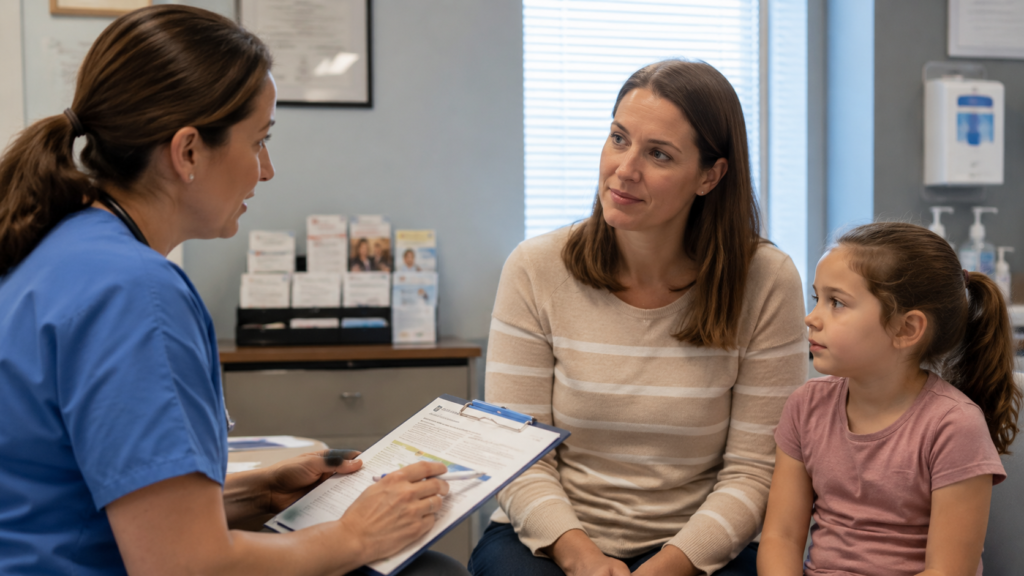
Health officials generally advise parents to check vaccination records, confirm whether children have received both MMR doses, and contact a healthcare provider if exposure is suspected.
People who think they may have measles are usually advised to call ahead before going to a clinic or emergency room so healthcare workers can reduce the risk of exposing others.
For communities near the Georgia-South Carolina line, the issue is not distant. Regional travel for work, school, sports, church, shopping, and family visits means outbreaks do not always stay neatly inside county or state borders.
That does not mean panic is useful. It means records matter, symptoms matter, and quick communication with health officials matters.
The Bottom Line
South Carolina’s measles outbreak is over, according to state health officials.
That is good news.
But it is not the same as saying the measles threat is over.
The outbreak sickened 997 people, hospitalized at least 21, cost the state an estimated $2.1 million, and required a large public health response across schools and communities.
Vaccination increases, quarantine measures, contact tracing, and public cooperation helped end this outbreak. But national case counts continue to rise, and pockets of low immunity remain the weak point that measles is most likely to exploit.
The simplest version of the story is that South Carolina stopped a major outbreak.
The more accurate version is that the state bought time — and what happens next depends on whether communities use that time to close the gaps that allowed the outbreak to spread in the first place.