Aiman Tariq – Regional News Editor
Marietta, GA –
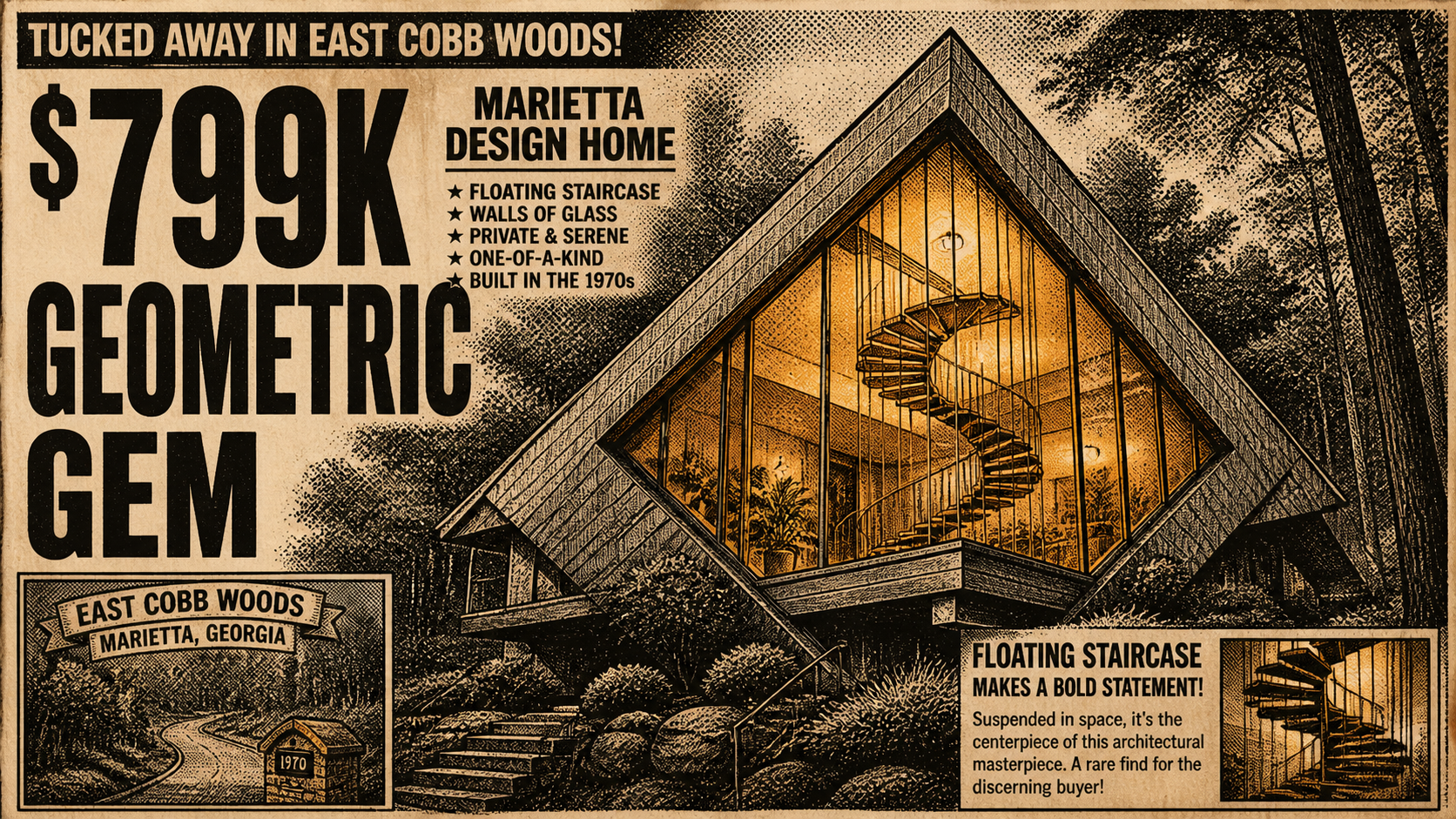
A diamond-shaped home in East Cobb is drawing attention for the kind of feature that real estate listings do not usually get to claim: a spiral staircase that appears to float.
The Marietta property, listed for $799,000, was designed by architect Tom Mozen and built in 1976, according to listing details and reporting from Realtor. The home sits in a wooded setting on Pond View Court and includes geometric windows, wood-beamed ceilings, a split-level layout and a suspended spiral staircase that has become the center of the listing’s appeal.
That does not automatically make it a bargain, or even the right house for every buyer. But it does make the listing unusual in a market where many homes compete on updated kitchens, school districts and square footage. This one is also competing on design history.
A House Designed to Be Noticed
Some houses are built to blend in. This one was not.
From the outside, the home’s sharp angles and diamond-like shape give it the feel of a small architectural object tucked into the woods. Realtor.com described the property as a “geometric gem,” while the listing presents it as a rare chance to own a piece of local design history tied to Mozen’s 1970s influence in the neighborhood.
That framing is doing a lot of work here. A buyer is not only being asked to evaluate bedrooms, bathrooms and finishes. They are being asked to value a house as a design statement.
That can be powerful, but it also narrows the audience. A dramatic home tends to attract buyers who already know they want something different. It can also turn away buyers who prefer conventional layouts, traditional curb appeal or easier resale math.
The Staircase Is the Main Character
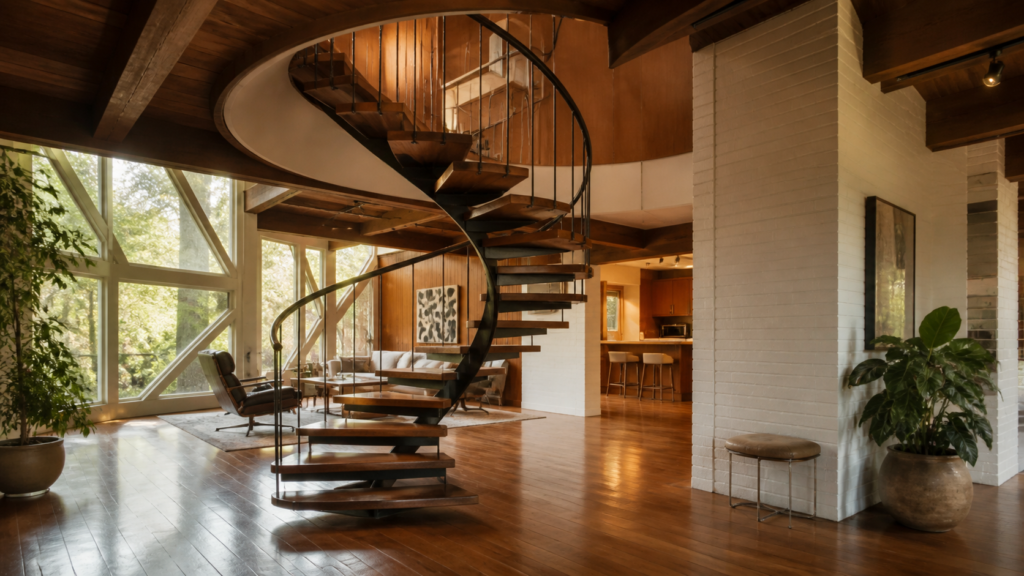
The suspended spiral staircase is the feature most likely to stop people mid-scroll.
According to the listing, the staircase is one of Mozen’s signature design elements and helped define the interior. Realtor.com reported that listing agent Caitlin Markli described it as Mozen’s “flagship design” and said it influenced the neighborhood’s architectural style during the 1970s.
That is the kind of detail that gives a house a story.
Still, there is a difference between an eye-catching feature and a practical one. A floating-style spiral staircase may be visually memorable, but buyers will likely weigh the look against everyday questions: how it feels to use, how it affects furniture movement, how it works for children, guests or aging residents, and whether it requires specialized maintenance.
That is not a criticism of the design. It is the normal tradeoff with architect-driven homes. The features that make them memorable are often the same features that require a more committed owner.
What the Listing Says Has Been Updated?
The home is not being marketed as a preserved time capsule.
The listing says the sellers purchased the property for $340,000 in June 2025 and later made substantial improvements, including a new roof, updated electrical panel, new water heater, kitchen updates and bathroom upgrades. Realtor.com also noted that the kitchen now includes quartz countertops, new appliances, custom cabinetry and a breakfast bar.
Those improvements matter because unusual architecture can become harder to sell if basic systems lag behind. Buyers may be more willing to consider a distinctive 1970s home if the roof, electrical system and interior finishes have already received attention.
But the price history will also get attention.
A home purchased for $340,000 in June 2025 and listed for $799,000 less than a year later is the kind of move buyers notice. That does not prove the price is unreasonable. It does mean the quality and scope of renovations, local demand and comparable sales will likely matter more than usual.
The Rental Angle Adds Another Layer
The property has also reportedly been used as a short-term rental.
According to Realtor.com, the listing agent said the home had been “pretty much booked out every weekend.” That claim may interest investors or buyers who like the idea of a property with rental appeal.
But as with any rental-related claim, the responsible reading is cautious.
A busy rental calendar can suggest demand, but it does not answer every question. Buyers would still need to review income records, expenses, local rules, insurance requirements, taxes, cleaning costs and any neighborhood restrictions that may apply.
In other words, the house may have rental appeal because of its look. Whether it works as an investment is a separate calculation.
Why Does East Cobb Matters?
Location is part of the listing’s pitch.
The home is in East Cobb, across from Pope High School, according to Realtor.com and property listing details. East Cobb is often marketed around schools, suburban access and established residential neighborhoods, which may help explain why a highly unusual home can still sit inside a conventional buyer conversation.
That combination is interesting.
Architectural homes are sometimes located in remote settings where the house itself is the main asset. This one appears to combine a design-heavy identity with a more familiar suburban location. For some buyers, that may be the draw: a house that feels like a retreat without being far outside the everyday Atlanta-area orbit.
Still, the same location could make the price more complicated. East Cobb buyers may compare it not only against other unique homes, but against more traditional properties with similar school access, updated interiors and easier layouts.
The Risk and Reward of a One-of-One Home
Unique homes can be harder to price because there are fewer clean comparisons.
That is true here. A diamond-shaped 1976 architectural home with a suspended staircase does not fit neatly into the same bucket as a standard renovated suburban house. The features that make it special also make it harder to benchmark.
That can work in the seller’s favor if the right buyer appears.
A buyer who loves the staircase, the wooded setting, the deck, the geometric windows and the architectural backstory may see the home as irreplaceable. A buyer who is more focused on bedroom count, maintenance simplicity and resale predictability may hesitate.
This is why unusual listings often become less about average market demand and more about match quality. The right buyer may pay for the feeling of owning something rare. The wrong buyer may see the same features as complications.
A 1970s Design That Still Stands Out
The broader appeal of the listing is not just nostalgia.
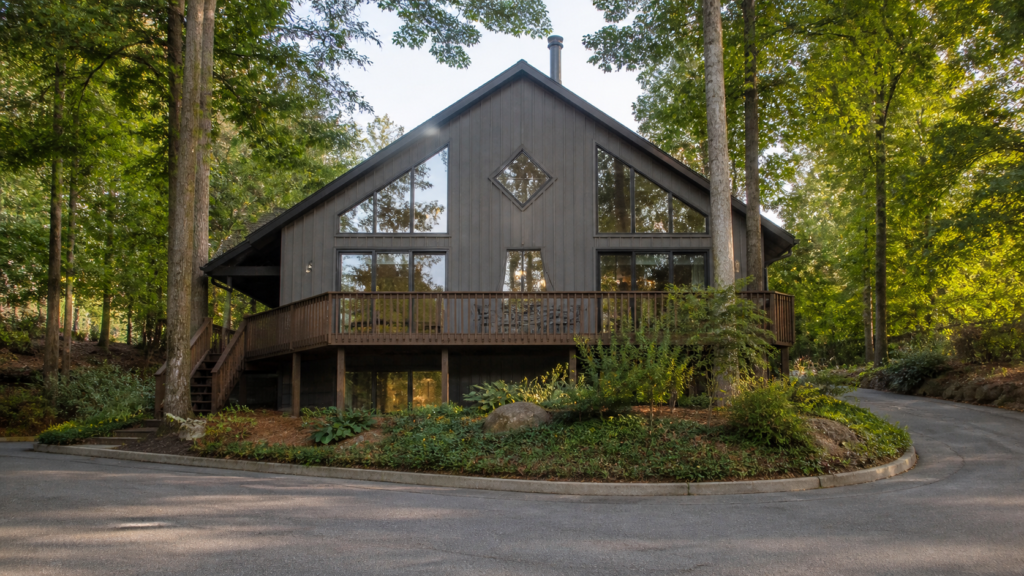
Many 1970s modern homes were designed around openness, natural light and indoor-outdoor sight lines. This one appears to lean into those ideas with large windows, vaulted spaces, wood details and a deck that connects the house to the wooded lot. The listing specifically emphasizes open, light-filled living spaces and intentional sight lines throughout the interior.
That can make the home feel current, even if its design roots are nearly 50 years old.
The real question is whether buyers see the style as timeless or too specific. Architectural homes age differently from conventional homes. When maintained carefully, they can feel distinctive for decades. When updated poorly, they can lose the very thing that made them worth preserving.
The listing appears to be making the preservation argument: this is not just a renovated house. It is a design object that needs a buyer who understands what it is.
The Bottom Line
A $799,000 geometric home in Marietta is drawing attention because it offers something most listings cannot: a dramatic 1970s design story built around a suspended spiral staircase.
According to listing details and Realtor.com reporting, the Tom Mozen-designed home was built in 1976, sits in the East Cobb woods and includes major recent updates, including a new roof, updated electrical panel, kitchen improvements and bathroom renovations.
The house is unusual enough to stand out. That is its advantage.
It is also unusual enough that the buyer pool may be more specific. The next owner will likely need to value the architecture as much as the updates.
For now, the listing is less a standard suburban sale than a test of how much today’s buyers are willing to pay for a house that still looks like it came from someone’s very confident 1970s sketchbook.