Aiman Tariq – Regional News Editor
Columbia, SC –
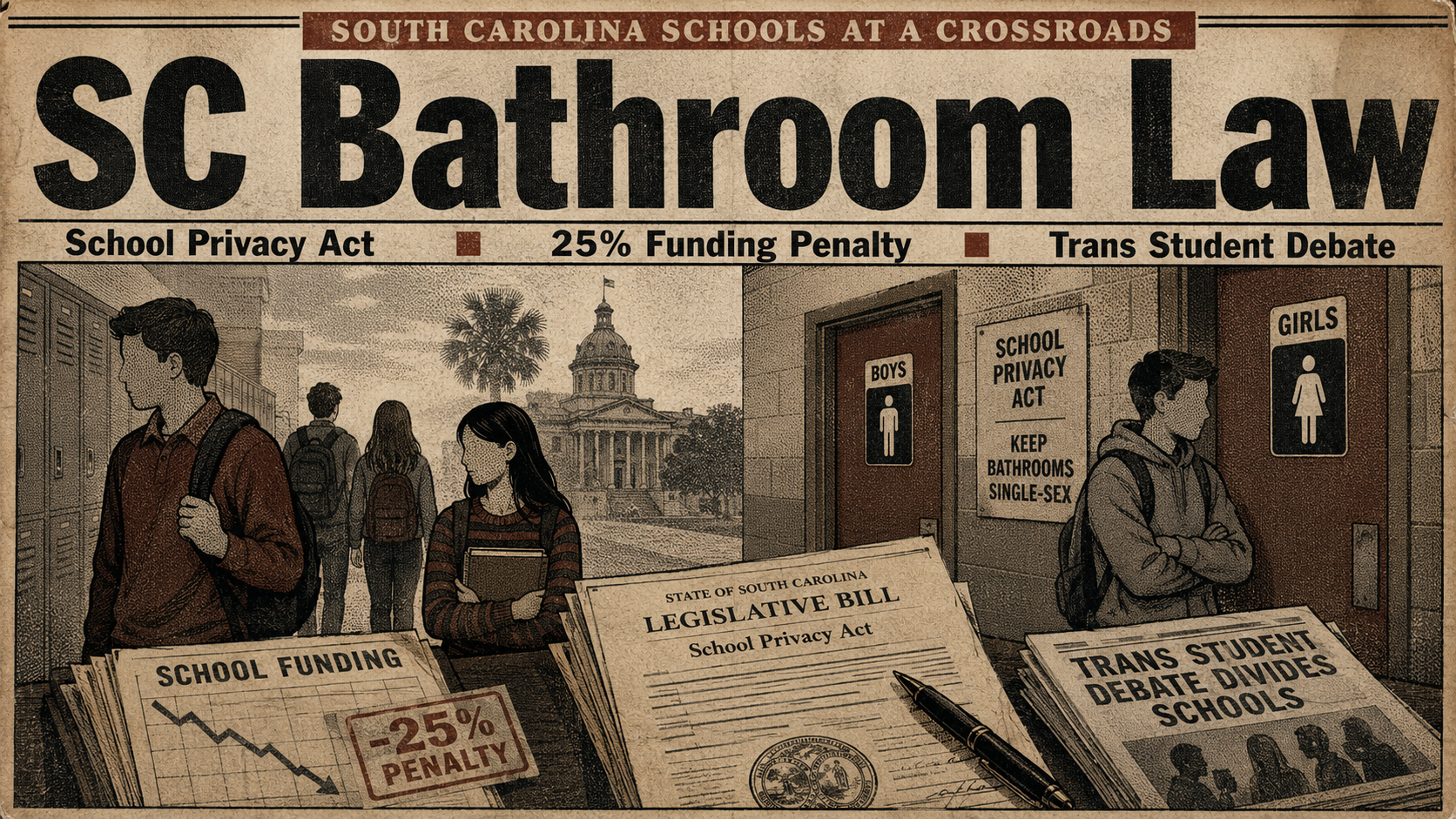
South Carolina public schools and colleges are now required to designate multi-person bathrooms, locker rooms and changing facilities by sex, after Gov. Henry McMaster signed the Student Physical Privacy Act into law.
The law takes effect immediately and applies to public K-12 schools as well as public institutions of higher learning. It requires multioccupancy restrooms and changing facilities to be used only by members of one sex at a time, with sex defined in the law as biological sex observed or clinically verified at birth.
Supporters describe the measure as a privacy and safety rule. Opponents say it is another law aimed at transgender students, placing schools in the middle of a legal and administrative fight over who can use ordinary public facilities during the school day.
That is the tension at the center of the law. The text is written in the language of privacy. Its practical effect will be felt most directly by students who do not fit neatly into the categories the state has chosen to enforce.
What the New Law Requires?
The Student Physical Privacy Act requires public schools and public colleges to designate multi-person restrooms, locker rooms and changing areas for use by one sex at a time.
Under the statute, no person may enter a restroom or changing facility designated for one sex unless that person is a member of that sex, with limited exceptions for custodial work, medical assistance, emergencies, young children needing help, and similar circumstances.
The law also requires schools and colleges to provide a single-user restroom, changing facility or other accommodation. The accommodation does not necessarily have to be a separate restroom and changing room, but the law does require some alternative access.
That may sound straightforward on paper. In practice, it raises several questions that schools will now have to answer quickly: Where are single-user restrooms located? How far must a student walk to reach one? Who decides whether an accommodation is adequate? And how will schools enforce the law without singling out students in ways that make them more vulnerable?
Those questions are not minor details. They are where policy becomes daily school life.
A 25% Funding Penalty Raises the Stakes
The law gives the state a powerful enforcement tool.
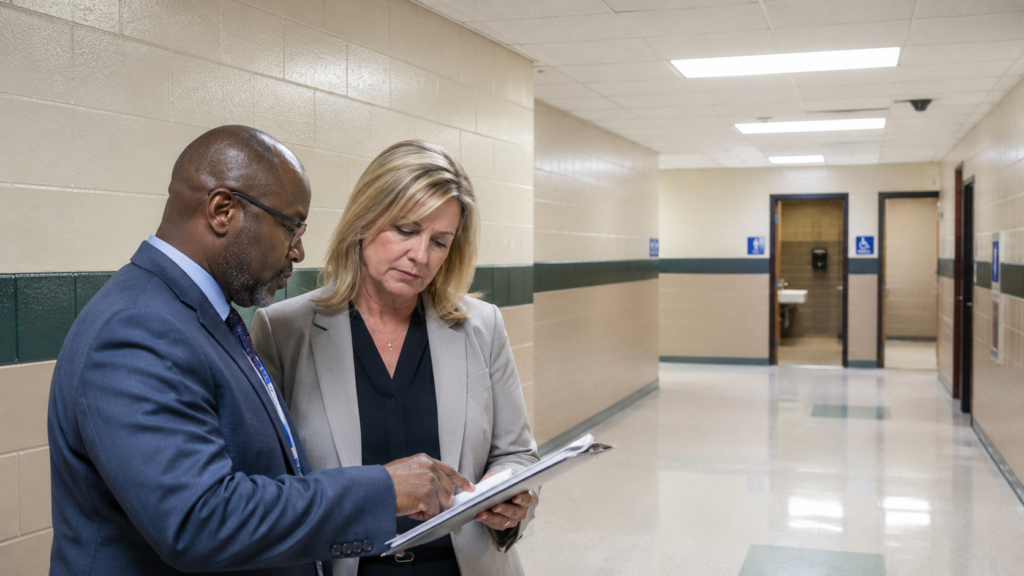
If a public school district violates the law, the South Carolina State Board of Education must direct the Department of Education to withhold 25% of state funds used to support that district’s operations until the district is found to be in compliance. Public colleges face a similar 25% funding penalty through the South Carolina Commission on Higher Education.
That matters because schools are not just being asked to update signs or rewrite policy manuals. They are being told that failure to comply could threaten a significant portion of their operating support.
When money is tied to compliance, behavior changes. Schools may adopt the most restrictive interpretation of the law simply to avoid becoming a test case.
That is not unusual in education policy. Districts often respond to legal uncertainty by minimizing institutional risk. The difference here is that the burden may fall most heavily on a small group of students who are already likely to feel watched, questioned or exposed.
Private Lawsuits Add Another Layer
The law also creates a private cause of action.
Under the statute, an individual who is using a restroom or changing facility designated for that person’s sex and encounters someone of the opposite sex may sue the school or public college if the institution granted permission for that person to use the facility or failed to take reasonable steps to prevent it. A similar lawsuit provision applies to overnight sleeping quarters.
That provision may be just as important as the funding penalty.
It gives parents, students and others a legal path to challenge schools directly. It also gives school administrators another reason to enforce the law aggressively, even in close or complicated cases.
This is why civil rights groups describe these laws as more than symbolic. A district does not have to be sued repeatedly for the law to reshape its behavior. The possibility of litigation can be enough.
Supporters Say the Law Protects Privacy
Supporters of the law argue that the state is drawing a clear line around privacy in spaces where students may be changing clothes or using restrooms.
South Carolina Attorney General Alan Wilson applauded the General Assembly for passing H.4756, saying the bill prioritized the “safety and well-being of women and girls” and protected privacy in dedicated spaces.
Local television coverage has also described the law as a measure requiring school bathrooms, locker rooms and changing facilities to correspond with sex assigned at birth.
That is the supporters’ frame: privacy, safety and clear rules.
The question is whether the law solves a documented statewide problem or whether it creates a new one by forcing schools to police students’ identities in bathrooms, locker rooms and overnight settings.
ACLU Says Trans Students Are the Target
The ACLU of South Carolina criticized the law immediately after McMaster signed it, calling it an anti-trans bathroom bill and saying it discriminates against transgender students in schools, colleges and universities.
The organization argued that the law makes life harder for a small group of students already facing increased risks of bullying, harassment and violence.
That is the part supporters tend to understate.
For most students, the new law may mean little more than different signage or a policy notice. For transgender students, it may determine whether they can use the restroom nearest their classroom, whether they must explain themselves to adults, and whether they feel safe participating in school life without being singled out.
The law requires accommodations. But separate access is not always equal in practice, especially if the alternative restroom is far away, locked, monitored, or known around campus as the place certain students are sent.
That is where the debate shifts from theory to lived experience.
Colleges Are Included, Too
The law is not limited to K-12 schools.
Public colleges and universities are also covered. That includes restrooms, changing facilities, overnight lodging, and housing policies at public institutions of higher learning. The law says a public institution that offers student housing must provide students the option to be housed only with persons of the same sex.
That expands the reach of the law beyond children and into public higher education.
College campuses tend to have more complex facilities, more events, more overnight travel, more shared housing, and more students living away from home. That means implementation may require more than posting signs outside bathrooms.
It could affect dorm policies, athletic facilities, student trips, campus events, and disciplinary rules.
The law gives institutions some room for single-user and family facilities. But it also sets a clear state mandate that schools and colleges will now have to build around.
Why Does Implementation May Get Messy?
The simplest version of the story is that South Carolina has passed a sex-based bathroom law.
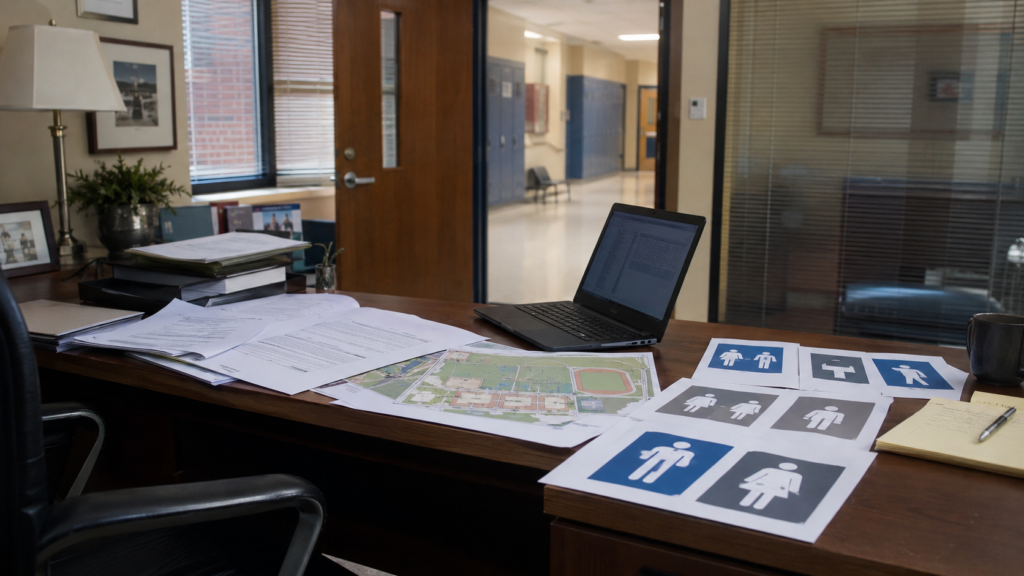
The more complicated version is that every public school district and public college must now translate that law into policy, signage, enforcement, accommodations, staff training and student discipline.
That work can get messy quickly.
Administrators may have to decide how complaints are investigated. Teachers and staff may be asked what they are supposed to do if someone reports a violation. Coaches may need new rules for locker rooms and travel. Students may be told to use alternative facilities without wanting their classmates to know why.
Those are not side issues. They are the mechanics of enforcement.
A law written at the State House becomes a school principal’s hallway problem, a teacher’s supervision problem, and a student’s daily anxiety.
What Is Still Unclear?
There are several practical questions the law does not fully answer in public-facing coverage.
How quickly must schools update their facilities and policies? How will the state determine noncompliance? What kind of complaint triggers a review? What happens if a school has limited single-user restrooms? How will colleges handle older buildings that were not designed around these requirements?
The statute lays out broad rules, penalties and legal rights. But the day-to-day implementation will likely depend on state guidance, district policy, campus administrators, and, eventually, litigation.
That is often how these laws work. The bill signing is the headline. The consequences appear later, case by case.
The Broader Debate
South Carolina’s law arrives during a larger national debate over transgender students, parental rights, school authority and state control over education policy.
Supporters see laws like this as restoring clear boundaries in private spaces. Opponents see them as government intervention into the daily lives of vulnerable students.
Both sides use the language of protection.
The difference is who they believe needs protecting most, and from what.
For supporters, the concern is privacy in bathrooms, locker rooms and overnight lodging. For opponents, the concern is that transgender students will be isolated, scrutinized or pushed out of full participation in public education.
That disagreement is unlikely to end with McMaster’s signature.
The Bottom Line
South Carolina’s Student Physical Privacy Act is now law.
Public schools and colleges must designate multi-person bathrooms and changing facilities by sex, provide single-user or alternative accommodations, and comply with state rules or risk a 25% funding penalty.
Supporters say the law protects privacy and safety in sensitive spaces.
Civil rights groups say it targets transgender students and will make school harder for children and young adults who already face higher risks of harassment.
The immediate question is how schools will implement the law. The larger question is whether the state has made students safer — or simply moved the pressure onto a smaller, more vulnerable group.
For now, districts and colleges will have to adjust quickly. Students will feel the effects first.