Aiman Tariq – Regional News Editor
Athens, GA –
Athens is known for the University of Georgia, downtown music history, college football weekends and the kind of civic identity that makes a midsize city feel larger than its population.
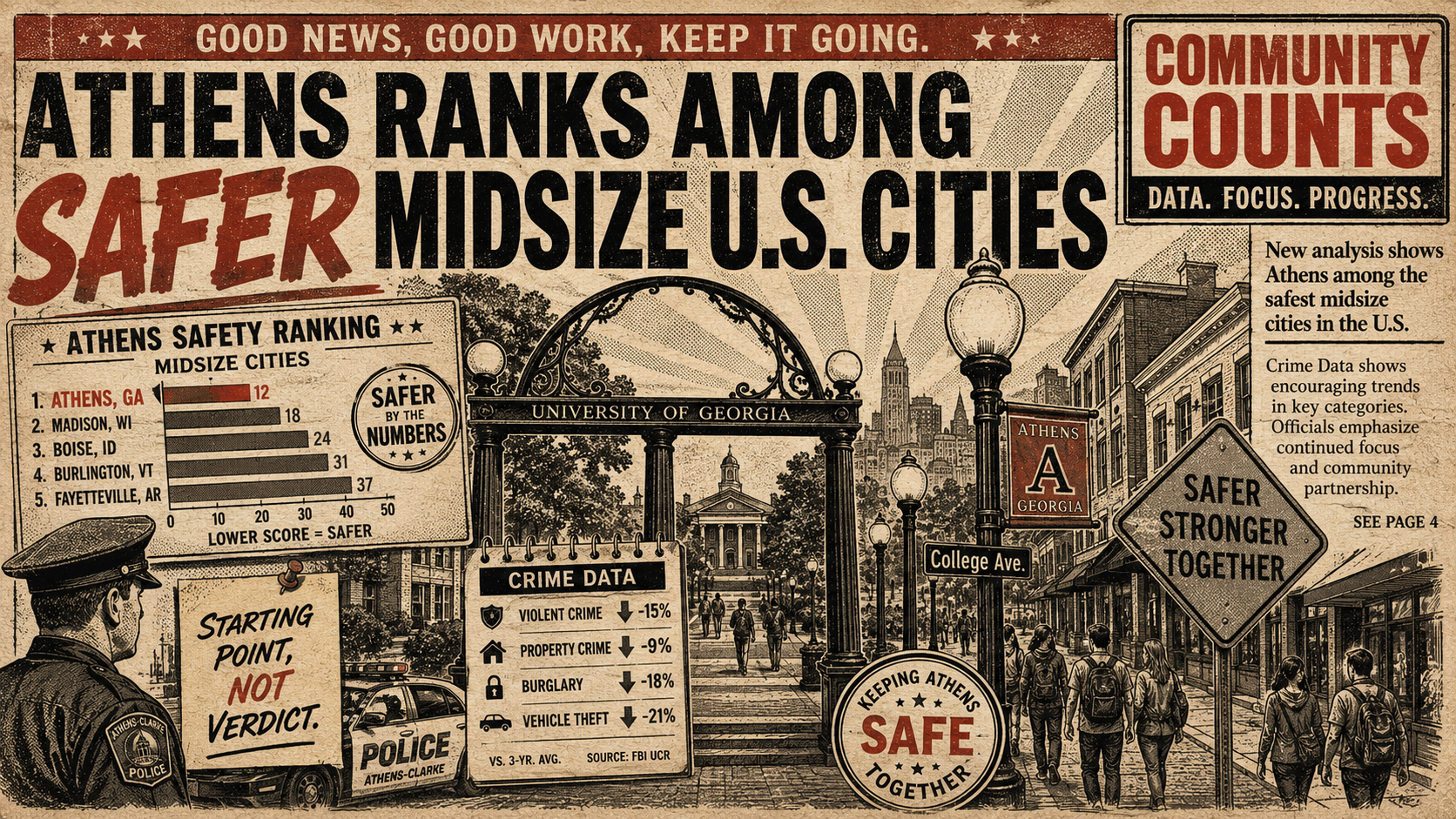
Now, according to a new SmartAsset ranking, it also lands in the upper tier for safety among midsize American cities.
SmartAsset ranked more than 300 cities with populations between 65,000 and 250,000, using a composite score built from violent crime, property crime, traffic fatalities and natural disaster risk. Athens ranked No. 59 overall, placing it in roughly the top fifth of the midsize cities reviewed.
That sounds straightforward. It is not quite that simple.
A ranking like this can be useful as a broad signal. It can show how a city compares to similar-sized places using the same basic yardstick. But it should not be treated as a complete measure of whether residents feel safe on a particular street, in a particular neighborhood, or outside a particular downtown bar at 1 a.m.
That is the difference between a data ranking and lived experience.
What the Ranking Says About Athens?
According to the Ledger-Enquirer’s summary of the SmartAsset study, Athens ranked as the 59th safest midsize city in the country. The city’s listed safety measures included 4.06 violent crimes per 1,000 residents, 22.76 property crimes per 1,000 residents, 10.07 auto fatalities per 100,000 residents, and a relatively low natural disaster risk score based on FEMA’s National Risk Index.
Those numbers help explain why Athens scored better than many midsize cities.
The violent crime rate is not zero. The property crime rate is not especially invisible. But compared with the full field of cities in the study, Athens performed well enough across the combined categories to land high on the list.
That matters because SmartAsset did not rank cities only on crime.
It also included traffic fatalities and disaster risk, which means a city could benefit from lower natural hazard exposure or road fatality numbers even if residents are still worried about car break-ins, assaults or late-night disorder.
Why “Safe City” Can Be True and Still Incomplete?

The phrase “safe city” does a lot of work.
It can mean low violent crime, fewer property crimes, and safer roads. It can mean lower risk from hurricanes, floods or wildfires. This also means something less measurable: whether people feel comfortable walking home, parking downtown, sending students across campus, or letting children move through public spaces.
The SmartAsset ranking is best read as one version of safety, not the whole thing.
The study used FBI crime data, CDC traffic fatality data and FEMA disaster risk data, according to SmartAsset’s methodology. That gives the ranking structure. It also gives it limits.
FBI crime data depends on what is reported to law enforcement and how agencies classify incidents. Traffic fatality and disaster risk figures can be measured at broader county levels rather than perfectly matching city boundaries. And a composite score can smooth over pockets of concern inside a city.
That does not make the ranking useless. It means the ranking should be read the way crime and safety data should usually be read: as a starting point, not a verdict.
As we noted in an earlier look at why crime numbers can trend down while still leaving holes in the data, the “how we know” matters almost as much as the headline number.
What Athens Has Going for It?
Athens has several features that may help its standing in a ranking like this.
It is a university city, which brings both challenges and resources. The University of Georgia creates heavy traffic, late-night activity and large event crowds. But it also brings campus safety systems, public visibility, transportation planning and institutional pressure to manage high-traffic areas.
Athens-Clarke County also maintains a public police transparency hub where residents can review crime-related information, maps and department data. That does not solve crime by itself, but it gives the public a clearer place to examine what is being reported and where.
Local officials have also pointed to recent improvements in some crime categories. Grady Newsource reported earlier this year that Athens leaders credited youth programs, staffing and public safety strategies as part of a decline in major violent crimes in 2025. That is an official and local narrative, not an independent audit, but it adds context to why Athens may be appearing more favorably in safety discussions.
Still, the important word is “context.”
City officials can cite improvements. Rankings can show favorable comparisons. Residents can still have specific concerns about downtown safety, apartment corridors, campus-adjacent areas or property crime.
Those things can all be true at once.
Property Crime Still Shapes How People Experience Safety
For many residents, property crime is the safety issue they encounter most directly.
A stolen car, a broken window, a porch theft or a burglary can shape how safe a neighborhood feels, even if violent crime is comparatively low.
That is why Athens’ property crime figure — 22.76 per 1,000 residents in the SmartAsset ranking — matters. It is not a catastrophic number in the context of the study, but it is high enough to remind readers that “safer” does not mean “free from everyday crime.”
This is one of the places where a composite ranking can flatten reality.
A city can rank well overall because it performs reasonably across several measures. But a resident whose car was broken into last month is not thinking about FEMA disaster risk or national comparisons. They are thinking about whether the place where they live, work or park feels secure.
That is why public safety reporting should avoid treating rankings as a civic trophy.
They are more useful when they start a conversation than when they end one.
Traffic and Disaster Risk Matter More Than People Think
One reason Athens scored well is that the SmartAsset study looked beyond police reports.
That is worth noting.
Safety is often discussed almost entirely as crime, but road deaths and natural hazards affect daily life too. A city with lower violent crime but dangerous roads may still present serious risk. A city with moderate crime but high flood or hurricane exposure may rank differently once disaster risk is included.
Athens’ listed auto fatality rate was 10.07 per 100,000 residents, according to the Ledger-Enquirer summary of the study. Its disaster risk was described as relatively low based on FEMA’s National Risk Index.
That gives Athens an advantage over some cities that may face higher traffic-death rates or more severe natural hazard exposure.
But again, those measures do not capture everything. A relatively low disaster-risk rating does not tell a parent whether a road near school feels safe. A traffic fatality rate does not capture near-misses, pedestrian anxiety or whether certain corridors feel poorly designed.
The data is useful. It is not personal.
How Athens Compares Nationally?

SmartAsset’s top-ranked midsize city was Broomfield, Colorado, which posted low violent and property crime rates and the only “very low” FEMA disaster risk rating in the study. Other top-ranked cities included State College, Pennsylvania; Warwick, Rhode Island; Ames, Iowa; and Logan, Utah.
Athens did not land in that top group.
Its No. 59 placement is better understood as a strong but not elite showing. It suggests Athens compares favorably with many midsize cities, but not that it has solved every public-safety problem.
That kind of distinction matters in a city like Athens, where public perception can swing quickly based on student safety, downtown incidents, traffic deaths or high-profile crimes.
A ranking may reflect the broad numbers. Public confidence depends on whether residents see those numbers reflected in daily life.
Why Local Claims Still Need Careful Reading?
This is where the same rule applies to safety rankings that applies to crime press releases.
The responsible response is not to dismiss the ranking automatically. It is to ask what the ranking measures, what it leaves out, and how the local experience compares with the data.
There are several built-in limits:
- FBI crime data reflects reported offenses, not every incident that occurs.
- Crime categories depend on classification rules and agency reporting practices.
- County-level traffic and disaster data may not perfectly describe city-level conditions.
- Composite rankings can hide neighborhood-level differences.
- University towns can have seasonal population swings that complicate per-capita comparisons.
That does not mean Athens is unsafe. It means “safe” needs a careful definition.
For residents, the better question is not simply whether Athens ranked 59th. It is whether the city is improving in the categories people actually experience: fewer assaults, fewer break-ins, safer roads, better lighting, quicker response times and more trust in public data.
The Bottom Line
Athens’ placement among the safer midsize cities in the United States is good news for the city, at least as measured by SmartAsset’s composite ranking.
The numbers suggest Athens performs relatively well when violent crime, property crime, traffic fatalities and disaster risk are weighed together. That is a meaningful signal, especially in a state where safety debates often focus on larger cities and headline-grabbing incidents.
But it is still only a signal.
A ranking cannot fully measure whether residents feel safe in their neighborhoods, whether students trust the areas around campus, or whether downtown visitors feel secure late at night.
The simplest version of the story is that Athens ranked well.
The more accurate version is that Athens ranked well under one national methodology, while the details still matter.
For local readers, that means the ranking is worth noting — but not worth turning into a victory lap. The real test is whether Athens continues to reduce crime, improve road safety, strengthen transparency and make residents feel safer in the places where daily life actually happens.