Aiman Tariq – Regional News Editor
Atlanta, GA –
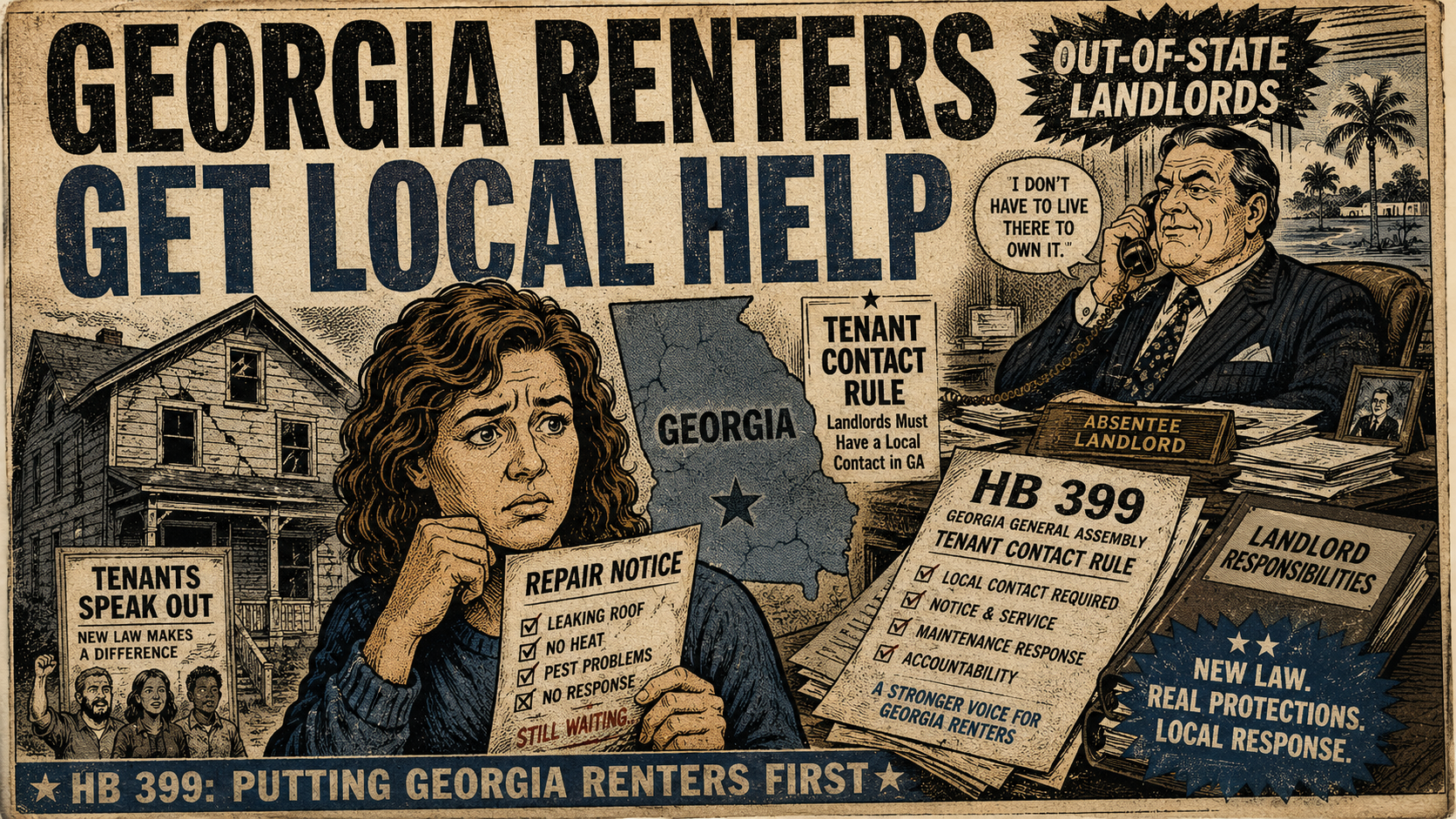
Georgia renters who live in single-family homes or duplexes owned by out-of-state landlords now have a clearer right to reach someone closer to home when maintenance, rent, or property issues come up.
The change comes through House Bill 399, a new Georgia law aimed at absentee landlords who own or operate rental houses and duplexes in the state while living elsewhere. The law requires those nonresident landlords to use a licensed broker and, if needed, have someone located in Georgia responsible for receiving and responding to tenant communications.
That does not solve every problem renters face. It does not cap rent and it does not stop evictions. It does not guarantee that every repair will be handled quickly.
But it does address one basic issue: when something goes wrong in a rental home, tenants should know who is responsible for answering.
What The New Law Requires?
Under HB 399, any landlord who is not a Georgia resident and owns or operates single-family or duplex rental properties in the state must employ a broker licensed under Georgia law. If that broker is also not located in Georgia, the broker must employ at least one person in the state who is responsible for receiving, coordinating, managing, and responding to tenant communications about maintenance and other property issues.
That language matters because it creates a local accountability point.
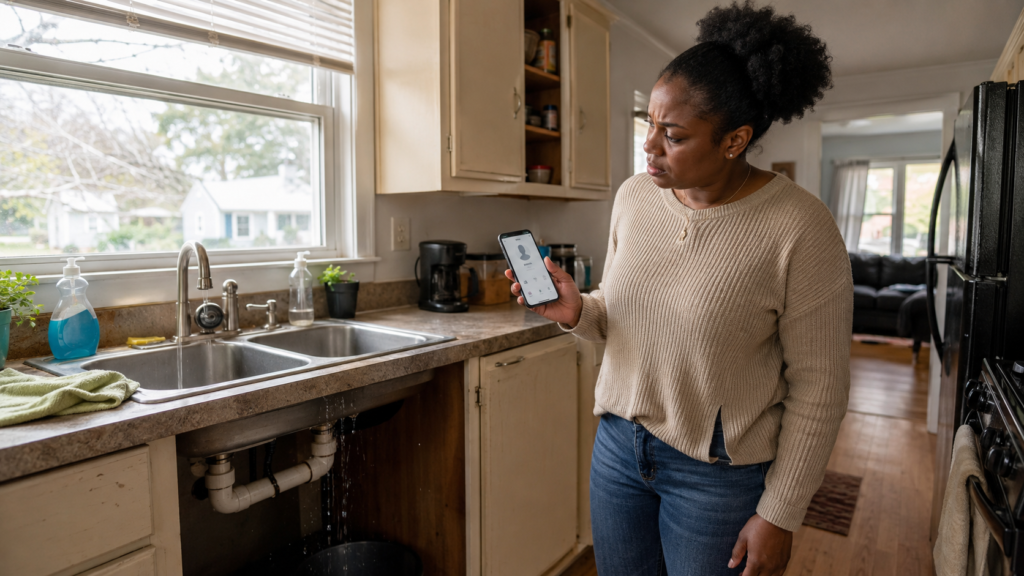
For years, tenants have complained about rental homes owned by companies or investors that are hard to reach, especially when repairs are delayed or property conditions decline. A tenant may know where to send rent but not know who can actually respond when plumbing fails, air conditioning breaks, or a code officer needs information.
HB 399 is built around that gap.
The law does not say every landlord must live in Georgia. It does not block out-of-state ownership. It says that if an out-of-state landlord rents certain homes here, there must be a Georgia-linked management structure that tenants and local governments can reach.
Why Out-Of-State Ownership Became The Issue?
The debate did not appear out of nowhere.
Out-of-state investors have bought large numbers of single-family homes across Georgia, especially in metro Atlanta and other fast-growing markets. The concern is not simply that homes are being rented. The concern is that ownership can become difficult to trace once properties are held through layers of companies, investment firms, and management structures.
According to reporting by the Statesboro Herald, seven corporations owned more than 51,000 single-family homes in the 21-county metro Atlanta region, citing an Atlanta Regional Commission analysis.
That number does not tell the whole story. Corporate ownership is not the same in every community, and not every out-of-state landlord is neglectful.
But it does explain why lawmakers focused on contact and accountability rather than trying to ban investor ownership outright.
A broader effort to cap how many homes large investors could own did not move forward after constitutional concerns were raised. HB 399 became the more limited bill that actually passed.
Why Tenants May Notice The Change?
For renters, the practical effect should be simple: there should be someone they can contact in Georgia, or through a Georgia-licensed management arrangement, when property issues arise.
That could matter most in ordinary situations.
A broken water heater is not a political issue. Neither is a leaking roof, a failing air conditioner, a pest problem, or an unsafe porch. But those problems can become serious when tenants cannot get a landlord or property manager to respond.
This is where the law may have its biggest effect. It turns “who do I call?” from a private frustration into a legal requirement for certain landlords.
The Georgia Municipal Association summarized the intent of HB 399 as ensuring “better accessibility and responsiveness” for tenants renting from large, out-of-state property owners. It also noted that code enforcement professionals may receive property manager contact information when there is probable cause of a code violation.
That is a modest goal. But in housing, modest goals can still matter if the alternative is silence.
What Code Enforcement Can Ask For?
HB 399 also matters because it connects tenants, property managers, and local code enforcement.
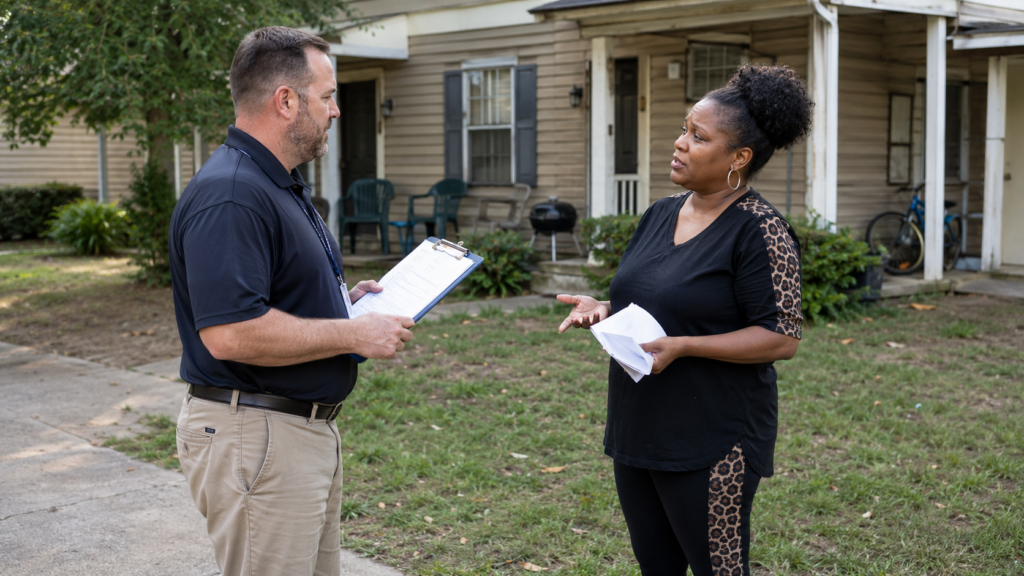
The bill says that when a residential rental property is managed by a licensed person and there is probable cause to believe a code violation exists, a code enforcement officer may request the property manager’s name, license number, and contact information from the tenant.
That can help local officials identify who is responsible when a property falls into disrepair.
But it also creates a practical question. Tenants have to know the correct contact information in the first place. If that information is buried, unclear, or never provided in a useful way, enforcement may still be harder than the law assumes.
That is why the new requirement is best understood as a starting point, not a full solution.
A Win For Renters, But With Limits
Tenant advocates have generally described HB 399 as a step toward greater accountability. But some have also warned that the law may not go far enough.
Atlanta Civic Circle described the bill’s passage as a “minor win” for affordable housing advocates, while noting concerns that tenants who report living-condition problems may still fear retaliation.
That caution is important.
A local contact does not automatically make a landlord responsive. It does not guarantee repairs. It does not remove the power imbalance between a renter worried about housing stability and an owner or management company with more resources.
This only makes the chain of responsibility clearer.
That can still be useful. But it should not be confused with a complete tenant-protection system.
How This Fits With Georgia’s Larger Rental Law Changes?
HB 399 follows another major housing change in Georgia: the Safe at Home Act, passed through HB 404.
That law established minimum habitability standards for rental housing in Georgia and capped security deposits at no more than two months’ rent. The National Low Income Housing Coalition described it as a long-awaited tenant-protection measure aimed at substandard living conditions.
Together, HB 404 and HB 399 show a gradual shift in Georgia landlord-tenant law.
For years, Georgia was often described by housing advocates as having weaker tenant protections than many other states. These new laws do not fully change that picture. But they do suggest lawmakers are responding to pressure around rental conditions, corporate ownership, and maintenance delays.
The pattern is cautious, not sweeping.
Georgia is not adopting aggressive rent regulation. It is not barring large investors from the market. It is not creating a broad public housing enforcement system.
Instead, it is adding narrow rules: rentals must meet minimum habitability standards, deposits face a cap, and out-of-state landlords of certain properties must have a management structure tenants can reach.
What Landlords Need To Know?
For nonresident landlords, the main requirement is straightforward: they cannot simply manage covered Georgia rental homes from far away without a licensed management arrangement.
The law applies to out-of-state landlords who own or operate single-family or duplex residential rental properties in Georgia. They must employ a Georgia-licensed broker. If the broker is not located in the state, that broker must have at least one person in Georgia responsible for handling tenant communications related to maintenance and other property issues.
That means lease documents, tenant portals, emergency contacts, and maintenance procedures may need to be updated.
It also means landlords should not assume that using a national call center or out-of-state email address will be enough if no Georgia-linked management structure is in place.
What Renters Should Watch For?
For tenants, the key question is not whether the landlord has a polished website. It is whether there is a clear, accountable contact who can respond when something goes wrong.
Renters should look for:
- The name of the property manager or broker.
- A license number, if available.
- A phone number or email for maintenance issues.
- Written instructions for emergencies.
- Updated lease or tenant portal information reflecting the management structure.
If a complaint is being investigated by code enforcement, tenants may also be asked to provide the property manager’s contact information. That makes it important for renters to keep a written record of who they contact and when.
This is not legal advice. But as a practical matter, written records matter. Maintenance requests, photos, emails, text messages, and call logs can help establish what was reported and how long a response took.
The Bottom Line
Georgia’s new out-of-state landlord law gives renters in covered single-family homes and duplexes a clearer path to a local or Georgia-linked contact for maintenance and property concerns.
It is not a sweeping tenant-rights law. It does not solve affordability and does not guarantee repairs. And it does not remove the fear some tenants may feel when raising complaints.
But it does make absentee ownership harder to hide behind.
For renters dealing with distant landlords, that matters. A name, a license number, and a reachable local contact may not fix every problem. But they can make it harder for property owners to disappear when the house they rent out needs attention.
The real test will be enforcement: whether tenants actually receive usable contact information, whether code officials can identify responsible managers, and whether out-of-state landlords treat the new rule as a paperwork exercise or a real accountability requirement.