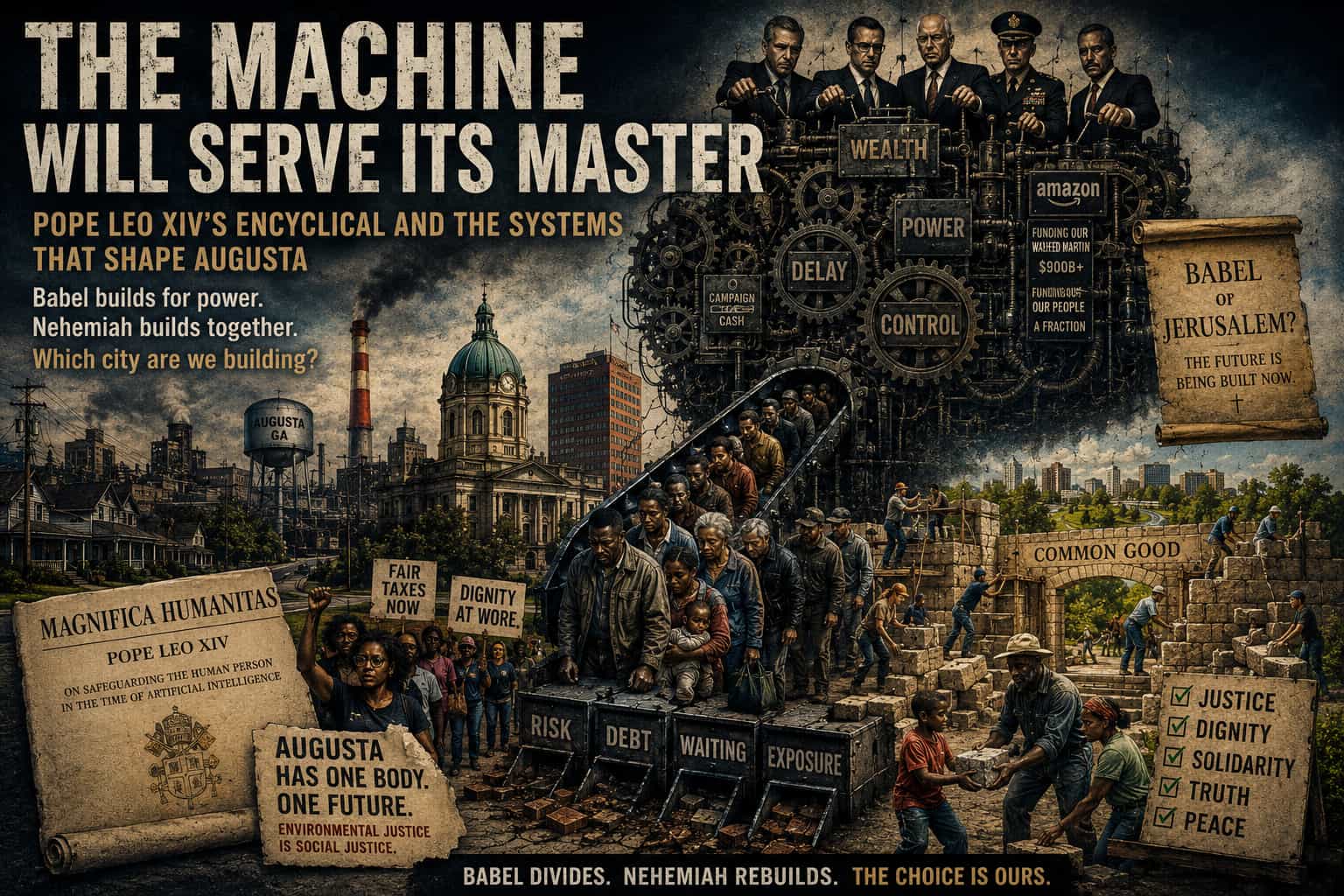
The machine will serve its master; the question is whether Augusta rebuilds Babel or Jerusalem.
by Charles Rollins, Publisher
Pope Leo XIV’s new encyclical is about artificial intelligence, but its deeper warning is older than the machine.
No technology, institution, tax code, government, market, platform, agency, or political party exists in a vacuum. The systems we build carry the assumptions of the people who build them. They measure what their masters tell them to measure. They ignore what their masters can afford to ignore. They reward what their masters already value. They punish what their masters have already decided is expendable.
The machine will serve its master.
That is the central point of Magnifica Humanitas, even when Pope Leo is writing in a universal register. He is not issuing a municipal reform memo. He is not writing for one country, one party, one county commission, one labor market, or one civic fight. He is speaking as the Bishop of Rome to the whole Church and, beyond it, to all people of goodwill.
That matters. The encyclical is careful about the relationship between the Church and civil authority. Pope Leo does not argue that the Church should assume the functions of the State. He honors the proper responsibilities of civil institutions. But he also insists that the Gospel cannot be sealed off from the systems that shape human life. The Church, he writes, does not supplant civil institutions, but it cannot ignore the real suffering of the men and women of our time. Magnifica Humanitas, nos. 18-24.
That is where his argument and mine meet.
The Pope names the universal reality. I have been trying to name its local machinery.
In the encyclical, Pope Leo turns to two biblical images: Babel and Nehemiah’s rebuilding of Jerusalem. Babel is not simply an ancient story about arrogance. It is a picture of a public project built around power, uniformity, and self-assertion. It has one language, one technology, one direction, and one goal: ascent. It is impressive, but it sacrifices human dignity to efficiency and control.
Against it, the Pope places Nehemiah. Nehemiah does not impose a solution from above. He prays, examines the ruins, gathers the people, assigns the work, listens, coordinates, and rebuilds relationships before rebuilding stones. Magnifica Humanitas, nos. 7-10.
That contrast is the heart of the matter.
Babel is what happens when a system is built for power and then described as progress. Nehemiah is what happens when a people rebuild a common life through shared responsibility. Babel centralizes. Nehemiah organizes. Babel homogenizes. Nehemiah gathers. Babel climbs over the vulnerable. Nehemiah begins with the ruins.
The Pope applies that contrast to artificial intelligence because AI is one of the great construction sites of our age. But the logic is not limited to software. The same question can be asked of every machine we have built: the tax machine, the governing machine, the military machine, the financial machine, the development machine, the campaign machine, the public-comment machine, the bureaucratic machine, the nonprofit machine, the platform machine.
Who built it?
Who owns it?
Who benefits from it?
Who is processed by it?
Who can appeal?
Who is told to wait?
Who is discarded when no longer useful?
Pope Leo says technology is not neutral in practice because it takes on the character of those who devise, finance, regulate, and use it. He names the “Babel syndrome” as the idolatry of profit, the sacrifice of the weak, and the reduction of the person into data and performance. Magnifica Humanitas, nos. 9-10.
That is not a narrow criticism of artificial intelligence. It is a criticism of every system that hides human decisions inside technical language and then asks the public to treat the result as inevitable.
This is the common thread I have been pulling on in Augusta.
In my Tax Day piece, the point was not simply that people pay too much or too little in taxes. It was that the tax code helps organize the economy. It decides which income is visible, which wealth is protected, which obligations are enforced, and which households are left exposed to rent, wages, insurance, debt, child care, and medical costs.
In “You Cannot Serve God and Wealth,” I tried to say the quieter part more plainly. The tax code is not just a technical document. It is a statement of worship. It protects ownership, disciplines labor, and teaches the public to mistake small adjustments for structural change. It tells us which master the law has been trained to serve.
In the charter-collapse piece, the same structure appeared in local government. The failed charter process mattered, but the deeper story was the system beneath it: delay, opacity, managed scarcity, and a governing order that turns public need into dependence and access into privilege.
In the environmental-justice piece, the structure became geography. Augusta is often described as separate neighborhoods, separate districts, separate burdens, separate problems. But air, water, labor, capital, illness, and opportunity do not respect those borders. The city is one body, even when its politics pretends otherwise.
These are not separate arguments. They are one argument moving through different rooms.
The Pope’s encyclical helps name why.
Social justice, Pope Leo writes, is not only about individual behavior. It concerns the way society is conceived and organized. Injustice can arise from structures, mechanisms, and economic and cultural systems that produce inequality almost automatically. Magnifica Humanitas, nos. 77-80.
That is the language of Catholic social doctrine, but it is also the language of anyone who has watched an ordinary person try to get a fair result from an unfair system.
People’s instincts are correct. They are not getting anything like a fair deal from their government or their society.
They are being squeezed by wages that do not match costs, housing markets that turn shelter into extraction, insurance systems that price risk back onto the vulnerable, tax systems that see labor more clearly than wealth, public agencies that move slowly for those without influence, and political parties that ask for gratitude while leaving the underlying machinery intact.
When people are no longer useful to capital, they are too often treated as a budget problem, a workforce-transition problem, a public-health problem, a crime problem, a demographic problem, or a line item.
But they are not problems.
They are persons.
That is where Pope Leo’s insistence on human dignity becomes more than a church phrase. He argues that human dignity does not depend on ability, wealth, position, productivity, or even the choices a person has made. Human dignity is given by God and precedes every system that tries to measure it. Magnifica Humanitas, nos. 50-53.
A political order that forgets this will eventually build machines that forget it too.
That is why the encyclical’s warning about AI is also a warning about money and power.
Pope Leo is explicit that technological power is increasingly held by private, transnational actors with resources and reach exceeding many governments. Magnifica Humanitas, no. 5. He warns that when control over platforms, infrastructure, data, and computing power rests with major economic and technological actors, they can set the terms of access, visibility, participation, and opportunity. Magnifica Humanitas, nos. 71-72, 95-96.
That is not paranoia. It is description.
And it applies beyond Silicon Valley.
Local politicians, national politicians, tech oligarchs, finance, defense contractors, consultants, developers, insurers, monopolists, bureaucracies, party committees, and donor networks all understand the same basic fact: whoever controls the machine controls the range of acceptable outcomes.
This is one reason both major American political parties are so bad at solving the problem. They are not identical. They are not equally cruel in every circumstance. There are material differences that matter, especially for people directly targeted by law and policy. But both parties, in different ways, have become managers of machines they did not build for ordinary people.
The modern Republican approach is more openly brutal. It barely pretends to offer a material solution to the suffering people feel. Instead, it finds someone weaker and more vulnerable, points to that person, and tells voters that the powerless are somehow the cause of their powerlessness. The migrant, the poor mother, the trans child, the prisoner, the addict, the Black voter, the public-school teacher, the city resident, the person on assistance — someone must be made small enough to blame.
The Democratic approach is often more frustrating because it can diagnose parts of the problem correctly. It can see inequality, racism, labor exploitation, climate risk, medical debt, housing instability, and the cruelty of market fundamentalism. But its solutions too often become technocratic reshufflings of the chairs on the Titanic. A better formula. A new credit. A pilot program. A dashboard. A stakeholder process. A means-tested benefit. A grant cycle. A reform that improves the management of suffering without changing the structure that produces it.
That is why even real victories can fail to materially transform the lives of the people in whose name they are won.
The clearest historical example is Lyndon Johnson. Johnson did not do nothing. The Great Society, civil-rights legislation, voting-rights legislation, anti-poverty programs, Medicare, Medicaid, and federal investments were real. But the Kerner Commission, which Johnson himself created after the urban uprisings of the 1960s, told him a truth he did not want to hear.
The Commission warned that America was moving toward “two societies, one black, one white — separate and unequal,” and that avoiding that future required massive, sustained national action. National Advisory Commission on Civil Disorders, 1968. It also said white society was deeply implicated in creating, maintaining, and condoning the conditions that produced urban unrest. History Matters, excerpts from the Kerner Report.
Johnson wanted credit for what his administration had done. He did not want a commission report telling him that what had been done, while real, was insufficient to master the machine that had produced the crisis. The report did not become the governing program its own findings demanded.
Martin Luther King Jr. understood the budget logic more clearly. In “The Other America,” King argued that the Great Society had been “shot down on the battlefields of Vietnam,” because America could find vast sums for war while resisting the investment required to repair the lives of its own poor. Martin Luther King Jr., “The Other America,” 1967.
The machine had to be fed. The people did not.
That is not only a story about Johnson. It is a story about the limits of liberal reform when reform cannot get outside the machinery it hopes to manage. Johnson could pass historic legislation, but he could not fully break with the imperial, racial, financial, and political systems that constrained what America was willing to do for its own people. He could recognize suffering. He could not fully reorder power.
That is why Pope Leo’s distinction between Babel and Nehemiah’s reconstruction of Jerusalem is so useful.
Babel can be public. Babel can have a ribbon-cutting. Babel can use the language of progress, safety, innovation, growth, efficiency, development, patriotism, equity, or reform. Babel can be announced by Democrats or Republicans. Babel can be built by government, corporations, nonprofits, universities, or public-private partnerships. Babel’s problem is not that it lacks a mission statement. Babel’s problem is that it is built around the wrong master.
Nehemiah begins differently. He does not deny the ruin. He does not issue a press release about resilience. He does not ask the displaced to be grateful for symbolic inclusion. He looks at the broken wall. He listens. He organizes. He assigns responsibility. He rebuilds with the people, not merely for them.
The Pope says Nehemiah’s project rebuilds relationships before stones. Magnifica Humanitas, no. 8.
That is the politics Augusta needs.
Not a politics that merely names problems. Not a politics that congratulates itself for diagnosing inequity. Not a politics that replaces one faction’s control with another faction’s control. Not a politics where citizens are invited to comment after decisions have effectively been made. Not a politics where poor neighborhoods become evidence for grant applications but not partners in power. Not a politics where South Augusta’s burdens are treated as district-level issues instead of civic injuries. Not a politics where working people are praised as essential and then priced out, ignored, surveilled, underpaid, and asked to wait.
A Nehemiah politics would begin from the ruins.
It would ask why public systems work quickly for some and slowly for others. It would ask why labor is exposed while ownership is protected. It would ask why development is celebrated before the public knows who gains, who pays, and who bears the risk. It would ask why environmental burdens follow familiar geographies. It would ask why government can find energy for spectacle but not for repair. It would ask why “public input” so often means inviting people to react to machinery already in motion.
The Pope gives those questions theological weight.
He says social justice must shape the design of systems from the outset, not arrive later as a charitable correction. Magnifica Humanitas, no. 109. He says we can no longer rely solely on the invisible hand of the market, and that politics must orient economies and technologies toward dignified work, social inclusion, and an equitable distribution of innovation’s benefits. Magnifica Humanitas, nos. 154-157.
He says data cannot simply be treated as private property to be sold off or entrusted to a select few. Magnifica Humanitas, no. 108. He says workers must not be forced to adapt to the speed and demands of machines while losing agency, dignity, and skill. Magnifica Humanitas, nos. 149-153.
Those are not small claims. They are not culture-war distractions. They are a direct challenge to the masters of the machine.
They also explain why local politics matters.
The Pope must speak universally. He should. The Church’s social doctrine is not a party platform, an economic model, or a municipal ordinance. But the encyclical itself says universality does not erase local responsibility. Pope Leo XIV, drawing on Paul VI, says it is unrealistic to think that Catholic social doctrine can offer one response valid in every context. Each Christian community must interpret its own reality with clarity and responsibility. Magnifica Humanitas, no. 26.
That is where theology becomes public work.
Not because the Church takes over the State, but because conscience refuses to let the State, the market, or the machine become god.
In Augusta, that means the common good cannot remain a phrase. It has to become a method.
If local government uses automated systems, the public should know where, how, why, and with what right of appeal. If contractors collect public data, that data should not become private leverage over the public. If economic-development incentives are offered, the public should know who benefits, what jobs are created, what wages are paid, what environmental burdens follow, and what happens if promises are broken.
If a commission district carries disproportionate environmental risk, that is not a district problem. It is a one-body problem. If public meetings are structured in ways working people cannot meaningfully access, the process is not neutral. It is serving someone.
This is also why journalism matters.
Pope Leo says truth is a common good, not the property of those with power or influence. He calls for serious journalism, verification, transparency, and public spaces where argument has more weight than reaction. Magnifica Humanitas, nos. 132-138.
That is one way to understand what a local publication can do. It can pull on the thread. It can refuse the fragmentation that keeps people from seeing how their injuries are connected. It can show that tax, labor, race, environment, governance, and technology are not separate towers. They are parts of the same civic body.
That body is wounded.
But the wound is not the end of the story.
The Pope’s appeal returns to the construction site. He tells Christians not to be afraid to get their hands dirty in the work of the present age, placing God at the forefront of their actions and the human person at the center of their choices. Magnifica Humanitas, no. 16.
That is the better frame for local politics.
Not domination. Not nostalgia. Not resentment. Not technocracy. Not scapegoating. Not management of decline. Reconstruction.
The machine will serve its master. So the question is not whether Augusta will have machines. It already does. The question is whether those machines will serve wealth, power, extraction, party, race, empire, and fear — or whether they can be forced, reformed, rebuilt, and in some cases dismantled so that they serve human dignity, shared responsibility, and the common good.
Pope Leo calls the wrong path Babel.
I have mostly called it structure.
But we are speaking about the same thing.
And in Augusta, the structure has names, addresses, budgets, districts, facilities, donors, boards, contracts, agencies, and habits. Pull the thread long enough, and the pattern begins to show. Money becomes power. Power builds systems. Systems produce outcomes. Outcomes are then described as natural, neutral, inevitable, or too complicated to change.
That is the lie.
The Gospel does not permit that lie. Catholic social doctrine does not permit that lie. The dignity of the person does not permit that lie. And the lived experience of ordinary people in this city does not permit that lie.
Babel is always impressive from a distance.
The work now is to stand close enough to see whom it crushes.
Sources and related reading
- Pope Leo XIV, Magnifica Humanitas, Vatican
- Charles Rollins, “You Cannot Serve God and Wealth,” Garden City Gossip
- Charles Rollins, “Tax Day, Augusta, Affordability, Taxes, Race, and Structure,” Garden City Gossip
- Charles Rollins, “Augusta’s Charter Collapse Shows the Same System Remains,” Garden City Gossip
- Charles Rollins, “Augusta, Inequality, and Environmental Justice,” Garden City Gossip
- National Advisory Commission on Civil Disorders, Kerner Report, 1968
- History Matters, excerpts from the Kerner Report
- Martin Luther King Jr., “The Other America,” Civil Rights Movement Archive