Aiman Tariq – Regional News Editor
Columbia, SC –
South Carolina parents may soon get a more direct view of how their children are performing in class, after Gov. Henry McMaster signed a new law barring public schools from using so-called “grade floors.”
The change, which takes effect in the upcoming school year, prohibits school districts from requiring teachers to assign a minimum grade or score that is higher than a student’s actual performance. Supporters say the law is about transparency. Critics of grade-floor policies argue the practice can make students appear closer to passing than they really are.
That is the simple version of the story.
The more complicated version is that grading is not only a record of what a student knows. It is also a tool schools use to manage motivation, recovery, parent communication, and graduation timelines. Removing grade floors may make report cards more honest. It may also put new pressure on schools to intervene earlier when students fall behind.
What are the New Law Changes?
The new law adds language to South Carolina education code saying that no public school district or public school may adopt a grading system requiring a teacher to assign a minimum grade or score that exceeds a student’s actual performance on required assignments.
In practice, that means a district cannot require a teacher to turn a very low score into a higher minimum grade simply because of a local grading policy.
The common example is a student who earns a 30 on an assignment but receives a 50 or 60 because the district uses a grade floor. Supporters of the new law say that kind of adjustment can distort the record and make it harder for parents to know when a student is seriously struggling.
According to WIS reporting, districts that continue using grade-floor practices could risk losing 10% of their state funding.
That is not a small enforcement tool. It signals that lawmakers do not want this treated as a suggestion.
Why Grade Floors Became Controversial?
Grade floors have often been defended as a way to keep one bad score from mathematically destroying a student’s chance to recover.
That argument is not imaginary. In a 100-point grading system, a zero can be far more damaging than a single high grade is helpful. Some educators have argued that minimum grades keep students from giving up after one missed test or assignment.
But opponents say the policy can create a different problem: it can hide how far behind a student really is.
That is where the new South Carolina law is aimed. It does not say students cannot recover from failure. It says the grade itself should reflect the work completed and the performance shown.
Patrick Kelly of the Palmetto State Teachers Association told WIS that grade floors have left some students and parents with an inflated sense of academic performance. That is the core concern driving the law: if the number on the report card is softened too much, it may delay the moment when families realize help is needed.
The Parent Transparency Argument

Supporters are framing the law as a transparency measure.
The idea is straightforward: if a student earns a failing grade, the parent should see the failing grade. If a student is missing assignments, the record should show that. If a student is not mastering the material, the report card should not blur the signal.
That does not mean every low grade tells the full story. A child may be struggling because of illness, instability at home, language barriers, disability, attendance problems, or something else entirely.
But supporters argue that schools cannot respond clearly if the grades themselves are not clear.
Dr. Dena R. Crews, president of the South Carolina Education Association, told WIS that more accurate grades could help parents have earlier conversations with teachers and school staff about support.
That is probably the strongest argument for the law. It does not assume grades are perfect. It assumes that if grades are going to be used at all, they should at least reflect what students actually submitted and understood.
Credit Recovery Also Gets New Limits
The law also changes how students can access credit recovery programs.
Under the new requirements, students must submit all required assignments before enrolling in credit recovery. Supporters say that provision is designed to make sure students show effort before using a recovery pathway to regain credit.
That part of the law may matter as much as the grade-floor ban.
Credit recovery can be useful when students fall behind and need a structured way to make up work. But critics have long worried that, if used loosely, it can become a way for students to pass courses without fully completing the work expected in the original class.
The new law appears to draw a line between second chances and shortcuts.
That distinction matters because almost everyone agrees students should have a path back after failure. The argument is over what they should have to do to earn it.
Benchmark Tests Are Also Limited
The legislation also limits how district benchmark tests can be used in grading.
Under the law, districts cannot require the inclusion of certain benchmark or formative assessment scores in a student’s final grade unless the material has already been taught and students have had time for review.
That provision addresses a different kind of fairness question.
Benchmark tests can be useful for teachers and administrators because they help show whether students are on track. But if a benchmark includes material students have not been taught, counting it toward a final grade can punish students for a pacing problem or curriculum calendar rather than their own performance.
So the law does two things at once. It tells districts not to inflate grades above actual performance, and it tells them not to use certain assessment scores in ways that may not reflect what students were reasonably prepared to show.
That balance is important. It suggests lawmakers are not only demanding tougher grading. They are also trying to limit grading practices that could produce misleading results in the other direction.
What This Means for Teachers?
For teachers, the law could restore some discretion that district grading policies may have limited.
If a district required a minimum grade, teachers may have had little choice but to enter a number higher than the score a student actually earned. Under the new law, that kind of requirement is barred.
That could make grades more accurate, but it also puts teachers in a more visible position.
A teacher who records a very low grade may now be the first person to deliver a difficult truth to a family. That can be necessary. It can also be uncomfortable.
The practical question is whether districts will pair the new grading rules with enough support systems: tutoring, parent outreach, attendance interventions, special education review, counseling, and clear communication before a student reaches the point of failure.
Without that support, more accurate grades may identify the problem without solving it.
What Does This Means for Students?
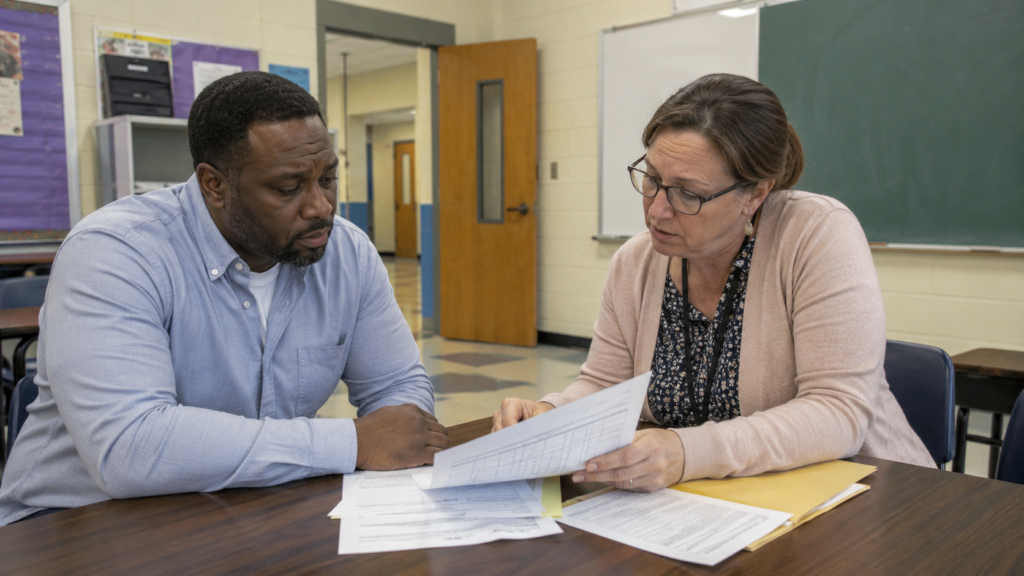
For students, the law may change the consequences of missing work or performing poorly on assignments.
A low score may now remain a low score. Missing assignments may carry more visible academic weight. Credit recovery may require more complete effort before enrollment.
Supporters say that is the point. They argue that students should understand that work habits, deadlines, and performance matter before they leave school.
Still, there is a risk if schools treat the law only as a punishment tool.
The better test will be whether districts use clearer grades to intervene earlier, not just to record failure more accurately. If a student earns a 30, the next question should not simply be whether the grade is “real.” It should be what the school does once the real grade appears.
Why the Policy Debate Is Not Over?
The grade-floor ban will likely be popular with parents who have worried that report cards were not telling the full truth.
It may also be welcomed by teachers who felt pressured to assign grades they believed were not accurate.
But implementation will matter.
Districts will need to review grading policies, credit recovery procedures, benchmark assessment practices, and parent communication systems before the new school year. If schools change the numbers without changing the supports around struggling students, the law may produce more transparency without enough follow-through.
That is where the next debate is likely to move.
The question will not only be whether grades are honest. It will be whether schools respond constructively when honest grades show that students are far behind.
The Bottom Line
South Carolina’s new law bans grade floors, meaning public schools cannot require teachers to assign minimum grades that exceed a student’s actual performance.
Supporters say the change will give parents a clearer view of academic struggles and make student performance harder to mask.
The law also tightens rules around credit recovery and limits how benchmark assessments can be used in final grades.
The case for the law is straightforward: grades should mean what they say.
The harder part begins next school year, when districts have to turn that principle into daily practice. More accurate grades may help parents and teachers identify problems sooner. But the real test will be whether schools use that information to get students help before a low number becomes a lost year.