
Aiman Tariq – Regional News Editor
Columbia, SC –
President Donald Trump has endorsed South Carolina Lt. Gov. Pamela Evette in the state’s crowded Republican primary for governor, giving one candidate the prize nearly every major contender had been chasing.
The endorsement came less than two weeks before the June 9 primary and just days after South Carolina lawmakers ended a redistricting fight that had already turned into a test of Trump’s influence inside the state Republican Party.
That timing matters.
Trump’s endorsement does not end the race. It does not guarantee Evette avoids a runoff. And it does not erase the fact that several candidates in the Republican field had spent months trying to show voters they were aligned with Trump’s agenda.
But it does change the shape of the final stretch.
Trump Picks Evette in a Crowded GOP Field
Trump announced his support for Evette on Friday, describing her as a longtime ally and praising her as a strong candidate for governor.
Evette, who has served as lieutenant governor under Gov. Henry McMaster, quickly welcomed the endorsement and tied her own political rise to Trump’s influence on the Republican Party.
That is not a small detail in South Carolina politics.
McMaster, who is term-limited, has also backed Evette as his preferred successor. Trump’s endorsement effectively puts the former president and the outgoing governor on the same side of the Republican primary.
The field remains crowded. The Republican race includes Evette, U.S. Rep. Nancy Mace, U.S. Rep. Ralph Norman, Attorney General Alan Wilson, former business executive Rom Reddy and state Sen. Josh Kimbrell.
That creates the basic problem for every candidate not named Evette: how to argue they are the real Trump-aligned choice after Trump has already picked someone else.
Why the Endorsement Matters
Trump endorsements can matter most in primaries where voters already agree on most of the issues.
That appears to be the case here.
The leading Republican candidates have all tried, in different ways, to position themselves as conservative fighters. Several have emphasized immigration, election rules, redistricting, opposition to Democrats and loyalty to Trump’s broader political movement.
When policy differences are narrow, the fight often shifts to identity and credibility.
Who is closest to Trump? Who fought harder? Who was there first? Who can turn support into votes?
Those questions have now become more difficult for Evette’s opponents.
Redistricting Fight Adds Context

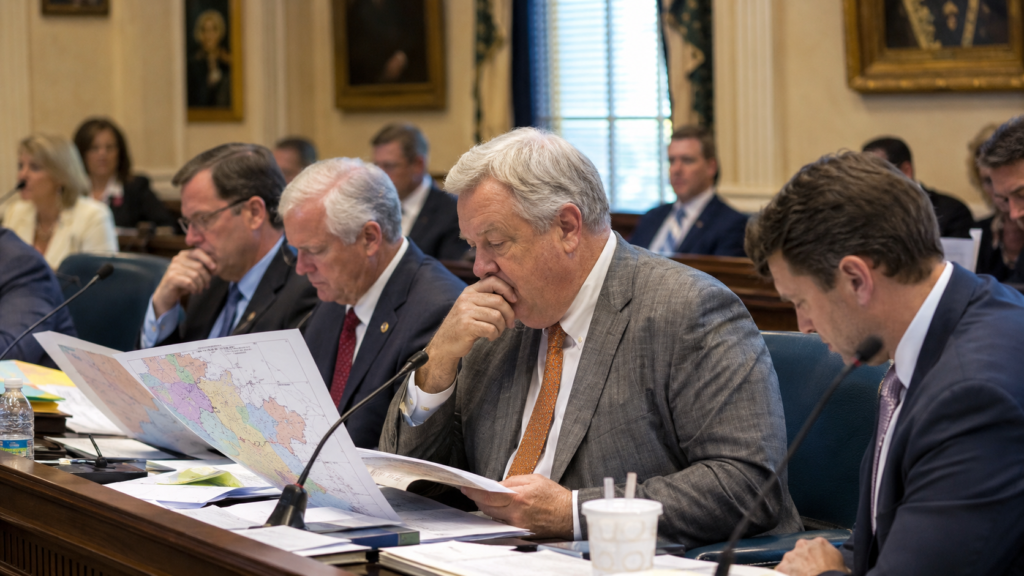
The endorsement also came shortly after a high-profile redistricting push collapsed in the South Carolina Senate.
That effort would have redrawn the state’s congressional map in a way supporters said would strengthen Republican chances in the midterms. Critics said it was designed to weaken South Carolina’s only majority-Black district and target Democratic U.S. Rep. Jim Clyburn’s seat.
Evette had been one of the more visible supporters of the redistricting effort.
That matters because the endorsement did not arrive in a vacuum. It followed a fight where Trump had also pushed South Carolina Republicans to act — and where state senators ultimately declined to move the map forward.
In practical terms, voters are now seeing two related questions at once.
Can Trump still pressure Republican lawmakers in South Carolina to move his agenda?
And can Trump still help decide a contested statewide primary?
The first question became more complicated after the Senate resisted the redistricting push. The second will be tested at the ballot box.
A Race Where Loyalty Has Been the Message
For months, Trump’s support loomed over the Republican primary.
That was true even before he made an endorsement. Candidates had little incentive to criticize him directly, and several had clear reasons to prove their loyalty before he made a choice.
Evette’s campaign has leaned heavily into her relationship with Trump and McMaster. Her supporters argue that she represents continuity with the current Republican administration and with the national direction of the party.
Wilson has also emphasized his defense of Trump-aligned policies and his legal fights on conservative issues. Mace, who has built a national profile through media appearances and sharp messaging, has argued that she has repeatedly defended Trump and his agenda.
Norman, too, has long positioned himself as a conservative member of Congress aligned with the party’s right flank.
That is why the endorsement is useful but not simple.
Trump’s backing gives Evette a clear advantage in messaging. But it also sharpens the arguments from rivals who will now have to say, in effect, that voters should look beyond the endorsement.
Mace Pushes Back After the Snub
Mace’s response showed how complicated that can be.
Before the endorsement, she had publicly questioned Evette’s ties to Trump and accused her of overstating her relationship with him. After Trump endorsed Evette, Mace defended her own record and suggested her position on releasing Epstein-related files may have cost her the former president’s support.
That argument may appeal to some voters who see Mace as independent or willing to break with party pressure.
It may also be a harder sell in a Republican primary where Trump’s approval among GOP voters remains a central force.
That is the balance Mace now has to strike: stay close enough to Trump’s base while explaining why the base should reject Trump’s choice.
Early Voting Makes the Timing More Complicated
Trump’s endorsement also landed after early voting had already begun.
South Carolina voters began casting early ballots in the primary on May 26, and early voting continues through June 5. That means some voters may have already chosen a candidate before Trump made his pick.
That does not make the endorsement irrelevant. Far from it.
But it does mean the impact may be uneven. Some votes are already locked in. Other voters may now reconsider, especially if they were undecided or choosing among several Trump-friendly candidates.
That is one reason the crowded field still matters.
If no candidate wins a majority, the race could move to a runoff later in June. In a runoff, Trump’s endorsement could become even more important, especially if Evette makes the final two.
McMaster’s Shadow Over the Race
Evette’s candidacy is also closely tied to McMaster.
That can help her. McMaster remains a familiar figure in South Carolina Republican politics and has long been a Trump ally.
But it can also give opponents a target.
Rivals can argue that Evette represents the state’s existing political establishment at a moment when many Republican voters say they want disruption, not continuity.
That is especially true in a primary where several candidates are trying to claim the anti-establishment lane.
Still, Trump’s endorsement may blunt some of that argument. If Trump is backing the lieutenant governor and McMaster is backing the lieutenant governor, Evette can frame herself as the unity candidate rather than the establishment candidate.
Whether voters accept that framing is the larger question.
The Redistricting Angle Won’t Disappear
The failed redistricting push may remain part of the race, even if the governor’s primary is not formally about congressional maps.
Supporters of the effort argued that Republicans should use every legal tool available to protect their House majority. Opponents, including some Republicans, worried about process, timing and the political risk of changing maps after early voting had already begun.
The Senate’s refusal to advance the plan was a rare moment when Trump’s pressure did not produce the result he wanted in a Republican-led state.
Evette’s support for redistricting may help her with voters who wanted lawmakers to fight harder. It may also connect her more directly to a failed legislative push that some Republicans thought was rushed.
That is the kind of issue that can matter in a close primary.
It gives candidates a way to argue not only about loyalty, but about judgment.
Democrats Watch From the Sidelines
The Republican primary is getting most of the attention because South Carolina remains a deeply Republican state in statewide races.
Still, Democrats are watching the contest closely.
A bruising Republican primary could shape the general election tone, especially if the eventual nominee spends the next several weeks defending party divisions, redistricting fights or attacks from rivals.
That does not mean Democrats suddenly have an easy path.
South Carolina has not elected a Democratic governor in decades, and the Republican nominee will likely begin the general election with structural advantages.
But in a crowded race, the primary can still matter beyond the Republican electorate. It can define the nominee before the general election campaign even begins.
What Happens Next?
The immediate question is whether Trump’s endorsement consolidates enough Republican support behind Evette to push her over the majority threshold.
If it does, the race could end on June 9.
If it does not, South Carolina may see a runoff where the endorsement becomes the central argument: Trump picked Evette, and Republican voters must decide whether that should settle the matter.
For Evette, the endorsement gives her the clearest lane she has had so far.
For her rivals, it creates a tougher but not impossible challenge: persuade Republican voters that Trump’s choice is not necessarily the right choice for South Carolina.
The Bottom Line
Trump’s endorsement of Pamela Evette gives South Carolina’s lieutenant governor a major advantage in a crowded Republican race for governor.
It also ties the race more tightly to two larger questions already shaping state politics: Trump’s influence over the Republican base and the fallout from South Carolina’s failed redistricting push.
Evette now has the backing of both Trump and Gov. Henry McMaster.
Her opponents still have time, but the race has changed.
The endorsement does not automatically decide the primary. Early voting had already begun, the field remains crowded, and a runoff is still possible.
But as the campaign enters its final days, the central question is now clear: whether South Carolina Republican voters follow Trump’s lead — or whether the state’s GOP primary becomes another place where his influence is tested rather than simply assumed.