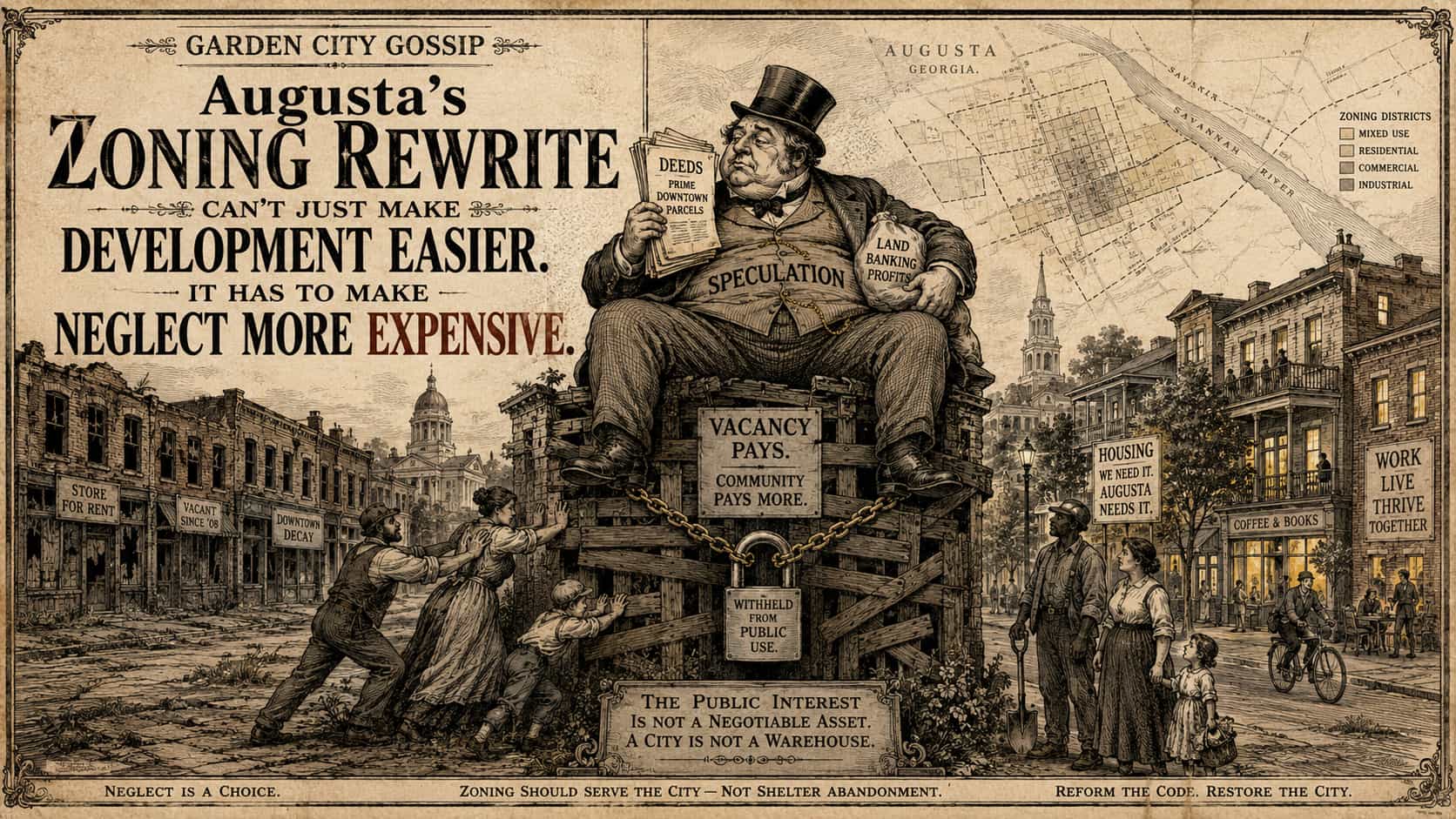
Augusta’s zoning rewrite must make neglect more expensive, not merely make development easier. Illustration: Garden City Gossip.
By Charles Rollins, Publisher
That distinction matters because zoning is the kind of subject local government can easily bury in diagrams, use tables, district names, parking ratios, buffers and consultant language. By the time ordinary people realize what has happened, the decision has often moved from politics into administration. It is no longer a question of what kind of city Augusta wants to be. It is a question of whether an application satisfies the code.
That is how structure hides. Not by disappearing, but by becoming procedure.
Garden City Gossip reviewed the public meetings connected to Augusta’s zoning rewrite and a written response from one of the city’s zoning consultants to specific questions raised after the May 27 community presentation. The public meetings show officials and consultants trying to explain a complicated rewrite that is already far along. The written response shows something more revealing: when pressed on the hardest questions — data centers, density, trees, blight, public hearings, personal care homes, buffers and downtown vacancy — the answers often moved toward future refinement, staff coordination, separate ordinances or later legal process.
That does not mean the rewrite is bad. It means the rewrite is not just a planning project anymore. It is a test of whether Augusta can turn land-use power into public rules before the next fight arrives already half-decided.
The city is right about the first premise. Augusta’s zoning ordinance is old. In the community presentation, the consultant said the code was first adopted in 1963 and has been amended repeatedly, but not comprehensively rewritten in the way a modern city needs. He also made the essential distinction between Envision Augusta as the policy document and zoning as the rule of law — the thing that determines what can be built, where, how large, with what buffers, with what parking, and through what process. Watch at 21:18.
That distinction is exactly why the rewrite matters. Zoning is not clerical. It is where a city decides who gets protection, who gets burden, who gets delay, who gets speed, whose property rights become sacred, and whose neighborhood gets described as an opportunity.
At one public meeting, city officials acknowledged that an earlier steering committee meeting “did not go as smooth” as expected because members had “valid concerns.” Watch at 9:33. At another meeting, the consultant told stakeholders the project was roughly three-quarters of the way through and moving toward an adoption-ready draft, before adding the most important caveat of the entire process: “maybe we’re not ready yet.” Watch at 32:34.
That is the honest place to begin. Maybe it is not ready yet.
Not because Augusta does not need a new zoning code. It does. Not because the consultants are acting in bad faith. That is not what the record shows. And not because every resident objection should become a veto. That is not government.
It may not be ready because the public is only now beginning to understand that this rewrite is not merely about legal housekeeping. It is about data centers, density, trees, downtown vacancy, public hearings, long-stay hotels, personal care homes, buffers, commercial corridors and the old Augusta habit of letting decisions become inevitable before ordinary people can describe them.
The strongest critique of the rewrite is not that it does too much. It is that it may do the wrong kind of thing too well. It may make redevelopment easier without making neglect harder. It may make approval cleaner without making power more accountable. It may make the code more legible to developers while leaving the public to discover the consequences one project at a time.
Zoning Cannot Promise A Grocery Store
One of the written questions challenged the presentation’s language around grocery stores and food access. The concern was straightforward: zoning and urban planning do not solve everything. A zoning code can be perfectly flexible and a corporate grocer can still decide not to locate in East Augusta, South Augusta or any other underserved area.
The consultant response clarified the point. The ordinance is not intended to guarantee specific businesses; it is supposed to create a regulatory framework that supports reinvestment, housing and neighborhood-serving commercial uses over time.1
That is the right answer. It should also be the public answer.
Zoning can make small markets, corner stores, farmers markets, food pantries, adaptive reuse and mixed-use development easier. It can make it less legally absurd to bring daily necessities back into older neighborhoods. It can help put enough residents near commercial corridors to support neighborhood-serving retail. But zoning cannot make a grocery chain care about a neighborhood. It cannot force a lender to finance a small grocer. It cannot repair decades of income loss, disinvestment, transportation fragmentation and market abandonment by changing a use table.
This is a recurring mistake in local government: taking a structural problem and offering a procedural tool as if the tool were the solution. That does not make the tool useless. It makes honesty necessary.
The Data Center Question Is Political
The same is true of data centers.
The old code was not written for the current wave of data-center development. The consultants acknowledged data centers as an emerging land-use issue during the community presentation. Watch at 22:02. The issue also came up in the stakeholder meeting when a Haines Station resident said she became involved after learning about the data center issue. Watch at 17:02.
That is why the data-center question cannot be left to technical drafting. It is not enough for the new code to tuck data centers under some neutral-sounding industrial, utility or technology category. A data center is land, power, water, generators, noise, heat, lighting, security, infrastructure, tax treatment, emergency planning and neighbors who may not realize the decision has already acquired momentum until the momentum is nearly impossible to stop.
This is not an abstract concern. Recent research on data centers and public water systems describes water capacity as an emerging bottleneck for host communities, especially during peak heat, and recommends coordinated water-power planning as part of responsible siting.2 Another recent study on data centers in Texas identifies electricity consumption, cooling systems and diesel backup generators as major environmental and air-quality considerations for local communities.3 Augusta does not have to import another city’s controversy wholesale to understand the point. These are industrial-scale infrastructure decisions, not ordinary office buildings.
If Augusta wants data centers, it should say where, how many, under what conditions, with what buffers, with what noise standards, with what generator limits, with what water review and with what public vote. If Augusta does not want them in certain places, the Commission should have the courage to say that too. A zoning code that cannot answer the data-center question is not modern. It is merely newer.

“Rooftops” Is Not A Policy
The same ambiguity appears in the language of housing.
The rewrite appears to contemplate more housing types: accessory dwelling units, duplexes, triplexes, quadplexes, cottage courts, townhomes, compact residential development and mixed-use residential districts. There is nothing inherently wrong with that. Augusta needs more housing, and it needs more kinds of housing.
But the language matters. The written questions warned the consultant about using “rooftops” as an umbrella term when some local officials and residents may use that word to mean detached single-family houses only. In planning and economic-development language, “rooftops” often means households. More households can support shops, transit, grocery stores, restaurants and services. In neighborhood politics, the word can mean something very different: apartments, renters, traffic, parking pressure and loss of control.
A serious zoning rewrite cannot hide that disagreement inside a friendly word. Augusta should say plainly where duplexes will be allowed, where triplexes will be allowed, where townhomes will be allowed, where cottage courts will be allowed, and what will happen by right rather than by public hearing.
The city should also stop pretending that illustrative maps are harmless. When a sample map shows high-density residential circles in West Augusta, people will not treat that as an academic exercise. They will treat it as a warning. The consultant response said the city is still coordinating on a future land-use map and zoning map update, and that further refinement is anticipated.4
That is exactly why the public deserves the actual map before the political conversation hardens around a pretend one.
Trees Are Not Outside The City
The tree question exposes another weakness in the process.
At the public presentation, the consultant explained that the subdivision ordinance, historic preservation and the tree ordinance are outside the zoning ordinance, and that the current project is focused on zoning districts, permitted uses, dimensional requirements and administrative procedures. Watch at 24:30. In the written response, the consultant similarly said the tree ordinance is outside the scope of the zoning rewrite, while acknowledging that the team is coordinating references between the zoning ordinance and the tree ordinance.5
Technically, that may be true. Civically, it is inadequate.
Trees do not care which ordinance contains the sentence that saves them. Zoning controls lot size, setbacks, parking, buffers, open space, density, building placement and site layout. Those rules determine whether mature canopy survives redevelopment or whether Augusta ends up with a few decorative plantings beside a heat island.
This is the problem with the phrase “outside the scope.” It is often accurate in the narrowest administrative sense and false in every way that matters to the public. A tree ordinance may live somewhere else in the code. But if the zoning rewrite makes infill easier without making canopy protection real, the tree loss will still be a zoning consequence.
Blight Is Where Zoning Runs Out Of Power
The most important missing piece may be blight.
The consultant response said the zoning ordinance includes new provisions to aid redevelopment of existing vacant lots and buildings, and that new mixed-use districts can broaden the types of uses permitted.6 That should happen. Old zoning codes can make old buildings difficult to reuse. Parking requirements can make small projects impossible. Narrow lots can become functionally trapped by dimensional rules written for a different kind of development. Mixed-use redevelopment can be made harder than it needs to be.
But Augusta needs to be clear about what that solves and what it does not. A zoning rewrite can remove barriers for owners who want to redevelop. It does not create consequences for owners who do not.
That difference is not small. It is the center of the downtown problem.
Everyone in Augusta knows the dead-mall version of this story because everyone knows large commercial property in ruins. But downtown has its own quieter version: old commercial buildings, some beautiful and some not, sitting vacant, underused, unfinished or functionally mothballed while the city talks about vibrancy. The problem is not only aesthetic. A dark storefront makes the next storefront harder to lease. An empty upper floor is housing that does not exist. A boarded building tells pedestrians they are not expected. A dead block teaches investors to look elsewhere.
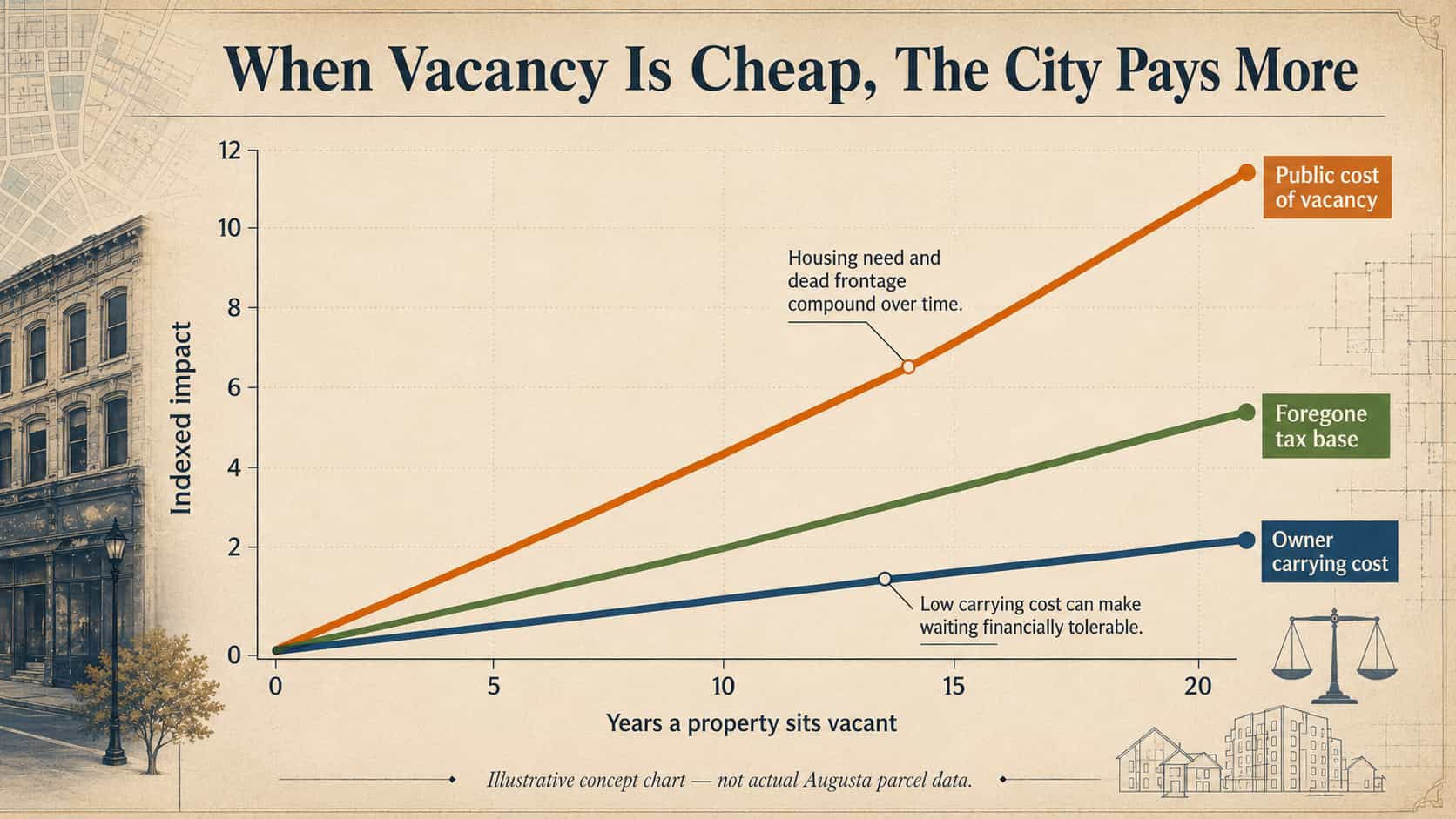
And the owner can wait. The renter cannot. The worker cannot. The small business cannot. The person who needs housing now cannot wait 30 years for a property owner’s internal rate of return to mature.
This is the same structural point I have made before in writing about Augusta as one body: the city is not a collection of disconnected parts. The map suggests clean divisions, but land, capital, labor, environmental burden and political power do not stay inside the lines. They circulate. They accumulate. They shape the whole. In “Augusta Is One Body,” I wrote that the map lies because it makes division look natural when it is often structured.7 Zoning is one of the ways that lie becomes enforceable.
Real estate is where that structure becomes visible on the street. Georgia property taxes are tied to assessed value, with taxable tangible property generally assessed at 40 percent of fair market value.8 Federal tax law also gives real estate ownership a set of tools that wage earners do not have. Nonresidential real property is generally depreciated over 39 years under the IRS’s recovery-period table, and Section 1031 like-kind exchanges can allow gains to be deferred when real property held for investment or business use is exchanged for other like-kind real property.9
None of that proves misconduct. It proves something more basic: the system is built to be patient with capital. It is not built to be patient with the people who need homes, storefronts, sidewalks, shade and public revenue now.
If vacancy is cheap, vacancy will persist. If mothballing a building is financially tolerable, some owners will mothball buildings. If the city makes redevelopment easier but leaves nonuse painless, it is only helping the owners already inclined to act.
Atlanta has started moving in a more aggressive direction. Its proposed “blight tax” would allow municipal court judges to increase tax bills on specific blighted properties up to 25 times the current city tax rate, while exempting occupied properties to avoid displacement. Large property owners would also have to agree to redevelopment plans addressing neighborhood priorities such as connectivity, transportation and public amenities.10
That is not a perfect model. Augusta should not copy any city blindly. But Atlanta has grasped the basic distinction Augusta must now confront.
Zoning answers: what can be built?
A blight and vacancy policy answers: what happens if the owner refuses to build, sell, occupy, maintain or redevelop?
Those are different questions. Augusta needs both answers.
The Use Table Is Where The Fight Will Hide
This is why the use table matters.
The public tends to notice zoning when a sign goes up, a rezoning notice appears, or a controversial project lands on an agenda. But by then, much of the real decision may already have been made. The use table determines whether a use is allowed by right, allowed with conditions, allowed only after a public hearing, or prohibited. That is where power lives.
The written questions sent to the consultant raised animal processing, shooting ranges, personal care homes, vegetative buffers, signage variances, long-stay hotels and public spaces connected to homelessness. The consultant response varied: some points were acknowledged as useful, some were described as being updated to Georgia or peer-community standards, and some were placed partly outside the zoning ordinance itself.11
That is not inherently improper. A zoning code cannot solve homelessness. It cannot solve mental health. It cannot make downtown safe by declaring it walkable. It cannot make every corporate sign standard compatible with local character. It cannot turn every vacant building into housing. But it can decide whether these fights happen in public or behind the counter.
It can decide whether a neighborhood learns early or late. It can decide whether buffers are real or symbolic. It can decide whether public approval is required or whether the code has already said yes. That is why the rewrite needs plain-language tables showing the public what changes from current law to proposed law. Not consultant summaries. Not presentation slides. Not a general assurance that standards are being modernized.
A real comparison: current rule, proposed rule, who decides, public hearing or not, notice or not, appeal or not.
Anything less is not transparency. It is translation after the fact.
Process Is A Form Of Power
The committee confusion also matters.
The written questions noted inconsistent references to an advisory committee and a steering committee, raising concern about whether different groups were shaping the rewrite in different ways. The consultant responded that the team is working with staff to make terminology and committee references more consistent, and pointed to livestreamed meetings as evidence of transparency.12
That response is not sufficient. Transparency is not the existence of a livestream. Transparency is a usable record: who served on the committee, who selected them, when they met, what they objected to, what changed because of their objections, where the drafts are, where the recordings are and where the transcripts are.
This is not a new problem in Augusta. In GCG’s charter coverage, the question was not only whether reform language existed. It was who controlled the timing, who interfered with the process, and whether structural reform had been reclaimed by politics before the public could vote on it. As GCG reported in “Who Killed Augusta’s Charter?”, the failure was not merely procedural; it was political.
The zoning rewrite is different, but the danger is similar. A process can be public and still be functionally illegible. A meeting can be open and still be too late. A draft can be available and still be too technical for meaningful democratic review. A map can be illustrative and still shape political reality.
Augusta Is One Body
The deepest issue is not whether one district gets more density or another gets more protection. It is whether Augusta can finally stop pretending that land-use decisions stay where they are placed.
They do not.
Zoning is one of the ways the map learns to lie politely. It turns moral questions into districts. It turns economic power into dimensional standards. It turns displacement into “infill.” It turns long-term ownership strategy into “market conditions.” It turns public frustration into “stakeholder feedback.”
The consultants are right that Augusta needs a clearer, more modern zoning ordinance. But clarity for whom? For the developer trying to know what can be built? For the staff member trying to process an application? For the commissioner trying to avoid a surprise fight? For the resident trying to understand whether the house next door can become a quadplex? For the neighborhood trying to know whether a data center can appear across the road? For the downtown worker who wonders why buildings sit empty while rent climbs?
A good zoning code should serve all of them. A merely efficient one will serve the people already best positioned to use it.
What The Rewrite Must Do Before Adoption
Before Augusta adopts this rewrite, it should do five things.
First, publish a plain-language comparison between the current code and proposed code for every major residential, commercial, industrial, mixed-use, lodging, institutional and care-related use.
Second, publish the actual proposed zoning map and future land-use map with enough time for residents to understand parcel-level consequences before hearings become theater.
Third, define data centers directly and politically. Say where they are allowed, how they are reviewed, what standards apply and who gets to vote.
Fourth, pair the zoning rewrite with a real blight and vacancy strategy. If Atlanta can consider making serious neglect expensive, Augusta can at least ask whether cheap vacancy is compatible with a housing shortage and a downtown revitalization agenda.
Fifth, make the committee and draft history public in one place: names, dates, agendas, recordings, transcripts, drafts, comments and revisions.
None of this is anti-growth. It is the opposite. A city serious about growth should not be satisfied with a code that merely accelerates private applications. It should want a code that organizes growth toward public purpose: housing now, active storefronts now, trees now, clear rules now, real hearings now, consequences for vacancy now.
Not someday. Not when the market finds it convenient. Not when the owner’s horizon finally overlaps with the city’s needs.
The Choice
Augusta has a chance to do something useful. It can replace an old, patched-together zoning code with a clearer and more modern one. It can allow more housing. It can support reuse of old buildings. It can make downtown development less absurd. It can stop treating every small deviation from an obsolete code as a special favor.
But if that is all it does, it will not be enough.
The city cannot keep saying it wants housing while tolerating long-term vacancy as an investment posture. It cannot keep saying it wants downtown vibrancy while leaving dead frontage cheap to carry. It cannot keep saying it wants transparency while asking residents to interpret planning jargon three-quarters of the way through the process. It cannot keep saying it wants tree canopy while placing trees outside the scope. It cannot keep saying it wants food access while implying that zoning can summon a grocery store. And it cannot keep saying data centers are an emerging issue while refusing to make the political decision plain.
The zoning rewrite should proceed, but not as a consultant document sliding toward adoption. It should proceed as a public confrontation with the structure beneath Augusta’s land-use failures.
Because the problem is not only what the old code forbids. The problem is what the whole system allows. It allows delay to look neutral. It allows ownership to be passive while the public cost is active. It allows vacant property to remain cheap. It allows maps to imply what officials will not say. It allows political decisions to arrive dressed as administrative necessity.
That is what has to change.
A zoning code can help build a city, but only if the city first decides whom it is being built for.
Related GCG Coverage
- Augusta Is One Body: How Division Still Shapes the City
- Who Killed Augusta’s Charter? A Reform Effort Dies Under Political Pressure
Notes
- Written response from zoning consultant to questions from a concerned member of the public, May 28, 2026, reviewed by GCG. ↩
- Yuelin Han, Pengfei Li, Adam Wierman and Shaolei Ren, “Small Bottle, Big Pipe: Quantifying and Addressing the Impact of Data Centers on Public Water Systems,” arXiv, March 2026, https://arxiv.org/abs/2603.02705. ↩
- Ebrahim Eslami, “Air Quality and Greenhouse Gas Emissions Assessment of Data Centers in Texas: Quantifying Impacts and Environmental Tradeoffs,” arXiv, September 2025, https://arxiv.org/abs/2509.21312. ↩
- Written response from zoning consultant to questions from a concerned member of the public, May 28, 2026, reviewed by GCG. ↩
- Written response from zoning consultant to questions from a concerned member of the public, May 28, 2026, reviewed by GCG. ↩
- Written response from zoning consultant to questions from a concerned member of the public, May 28, 2026, reviewed by GCG. ↩
- Charles Rollins, “Augusta Is One Body: How Division Still Shapes the City,” Garden City Gossip, March 31, 2026, https://gardencitygossip.com/augusta-ga-inequality-environmental-justice/. ↩
- Georgia Code Section 48-5-7, “Assessment of Tangible Property,” https://law.justia.com/codes/georgia/2022/title-48/chapter-5/article-1/section-48-5-7/. ↩
- IRS Publication 946, “How To Depreciate Property,” https://www.irs.gov/publications/p946; IRS, “Like-kind exchanges – Real estate tax tips,” https://www.irs.gov/businesses/small-businesses-self-employed/like-kind-exchanges-real-estate-tax-tips. ↩
- Thomas Wheatley, “Atlanta ‘blight tax’ comes up for City Council vote,” Axios Atlanta, Aug. 5, 2024, https://www.axios.com/local/atlanta/2024/08/05/atlanta-blight-tax-vote. ↩
- Written response from zoning consultant to questions from a concerned member of the public, May 28, 2026, reviewed by GCG. ↩
- Written response from zoning consultant to questions from a concerned member of the public, May 28, 2026, reviewed by GCG. ↩