Aiman Tariq – Regional News Editor
Atlanta, GA –
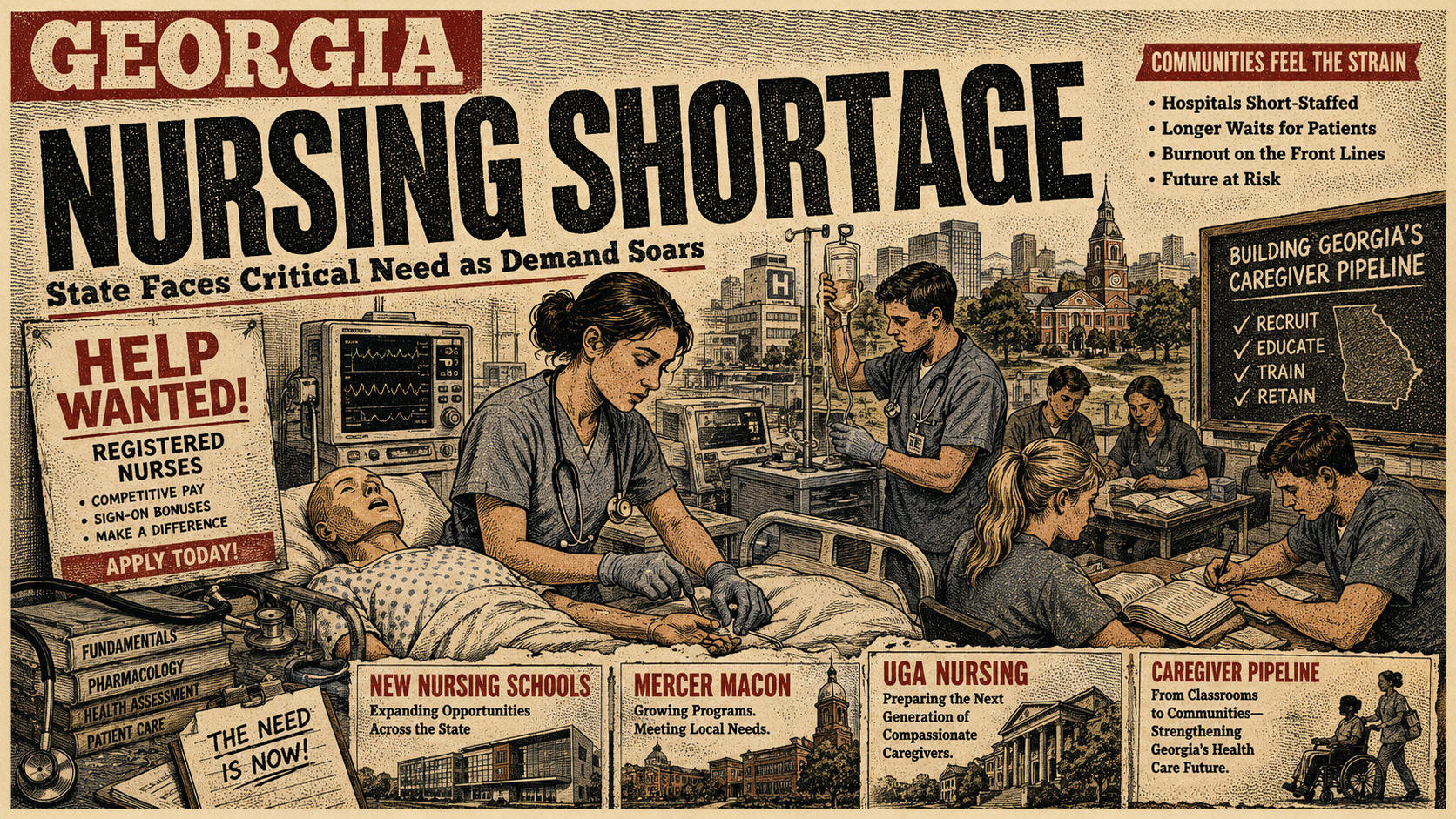
Georgia’s nursing shortage is one of those problems that sounds simple until you look closely.
Hospitals need more nurses. Students want stable careers. Universities want to expand health care training. Patients want shorter waits, safer staffing, and more people at the bedside when care is needed most.
That is the easy version.
The harder version is that nursing shortages are not solved by opening one building, naming one program, or adding one new class. They are built over years, through population growth, retirements, burnout, faculty shortages, clinical training limits, and the uneven distribution of health care workers across rural and urban Georgia.
That is why two new nursing expansions in Georgia matter — and why they should be treated as a starting point, not a cure.
According to the Atlanta Journal-Constitution, Mercer University’s new Macon nursing campus and the University of Georgia’s first nursing school are expanding opportunities for future caregivers at a time when Georgia’s health care system continues to need more trained nurses.
Two Programs, One Larger Workforce Problem
Mercer University’s Georgia Baptist College of Nursing has expanded its nursing program to Macon, giving students in central Georgia another route into nursing education without having to leave the region.
The University of Georgia, meanwhile, is moving toward its first independent School of Nursing in Athens. The University System of Georgia Board of Regents authorized the school in 2025, and UGA officials have said the program is expected to welcome its first nursing students as early as fall 2027.
Those timelines matter because the shortage is already here.
National health workforce projections from the Health Resources and Services Administration show the United States is expected to face significant nurse shortages in the years ahead. In its 2023-2038 nurse workforce projections, HRSA listed Georgia among the states expected to have one of the largest projected registered nurse shortages by 2038.
That does not mean every hospital unit in every Georgia county will feel the shortage in the same way. It does mean the state is part of a broader national squeeze that is unlikely to resolve on its own.
Why New Nursing Seats Matter?
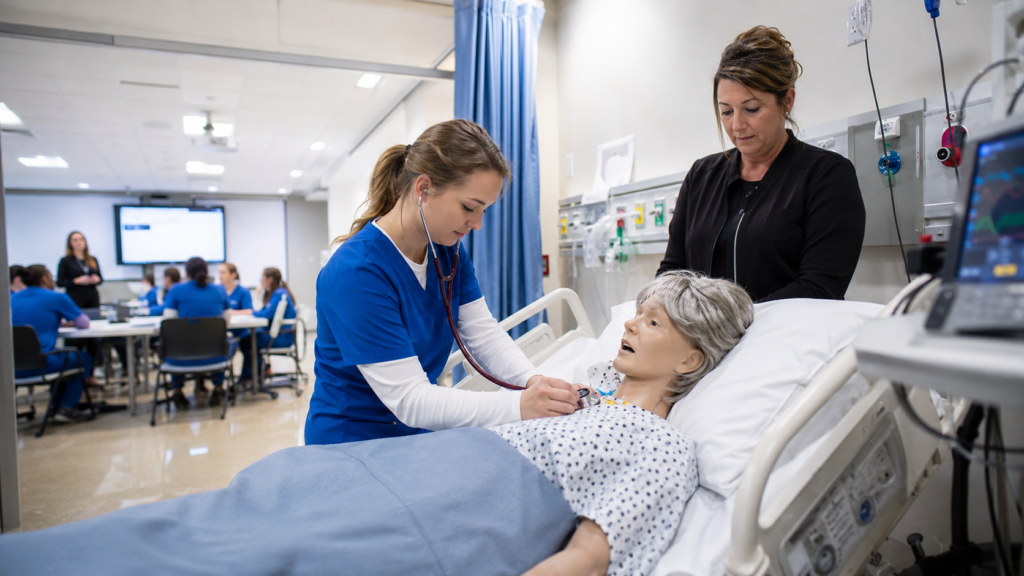
When people talk about the nursing shortage, the conversation often begins with job openings. But the pipeline starts much earlier.
A student has to choose nursing. A school has to admit that student. Faculty must be available to teach. Clinical sites must be able to place students. Hospitals and health systems must have the staffing and supervision capacity to train them. Then graduates still have to pass licensure requirements and decide where to work.
That is the difference between an announcement and an outcome.
Mercer’s Macon expansion is important because it places nursing education in a city with a long medical footprint and access to clinical training environments. For students in central Georgia, that can reduce distance and make a nursing degree more reachable.
UGA’s new nursing school is important for a different reason. It gives the state’s flagship university a direct role in producing nurses, not only through undergraduate training but eventually through graduate and advanced practice pathways.
According to UGA, the Board of Regents recommended that the new school initially offer a Bachelor of Science in Nursing, with plans for graduate programs such as a Master of Science in Nursing and Doctor of Nursing Practice later.
That is not a small shift. It places nursing alongside UGA’s broader health education expansion, including the university’s new medical school.
The Faculty Question
One of the least visible constraints in nursing education is faculty.
It is not enough to have applicants. Schools need qualified instructors, simulation lab staff, clinical supervisors, and partnerships with hospitals that can absorb students into real patient-care settings.
That is where the shortage can become circular. Georgia needs more nurses. But nursing schools also need more nurse educators to train them.
UGA has acknowledged that Georgia needs more nurses and that the region also needs more nursing faculty. That is a useful admission because it keeps the story from becoming too neat. If the state wants more graduates, it also has to build the teaching capacity behind them.
The same challenge appears nationally. The American Association of Colleges of Nursing has repeatedly pointed to faculty shortages, clinical placement limits, and resource constraints as barriers to expanding nursing enrollment.
That means the question is not simply whether Mercer and UGA can attract students.
The question is whether Georgia can build enough teaching and training capacity to turn interest into licensed nurses.
Students Are Still the Center of the Story
The AJC story begins with Catherine Costner, a Mercer nursing student whose interest in the profession came from a personal experience with hospice care in her own family.
That kind of detail matters because workforce stories can become too abstract.
A shortage is not just a number. It is a family waiting for home care. It is a rural hospital trying to cover a night shift. It is an emergency department trying to move patients through safely. It is a student deciding whether the training cost and stress are worth it.
Nursing has long attracted students who want a direct, human role in care. But the profession is also demanding. Burnout, long shifts, workplace stress, and staffing pressures can affect whether nurses stay once they enter the field.
That is why expanding nursing schools is necessary but incomplete.
Georgia needs more people entering the pipeline. It also needs workplaces where they can stay.
Rural Georgia May Feel the Stakes Differently
The shortage is not evenly distributed.
Metro Atlanta, Macon, Athens, Augusta, Savannah, and other larger health care hubs have major institutions and training networks. Rural communities often have fewer hospitals, fewer clinical sites, and a harder time recruiting specialized workers.
That is where new programs can help, but only if they produce graduates who remain in Georgia and serve communities outside the largest markets.
Mercer has long emphasized health care education across Georgia, and its Macon expansion fits that pattern. UGA’s new nursing school may also become a larger player in addressing workforce needs across both rural and urban communities.
Still, geography matters.
A nurse trained in Athens or Macon does not automatically become a nurse in rural south Georgia. Workforce planning depends on incentives, clinical placements, scholarship programs, job availability, and whether students build ties to the communities that need them most.
That is why state leaders should be careful about claiming success too early.
New schools create capacity. Retention and placement determine impact.
The National Trend Behind Georgia’s Decision
Georgia is not unusual in facing this problem.
HRSA’s national projections show ongoing shortages for registered nurses and licensed practical nurses in coming years, with larger gaps expected in nonmetropolitan areas. The agency projects the shortage will be worse in many rural areas than in metropolitan ones.
That national context helps explain why Georgia universities are moving now.
If the state waits until every vacancy becomes a crisis, the education pipeline will already be years behind. Nursing degrees cannot be produced on emergency timelines. It takes faculty, facilities, clinical partnerships, accreditation work, and student progression.
That is what makes Mercer’s and UGA’s moves significant. They are not instant fixes. They are infrastructure.
And workforce infrastructure tends to matter most years after the ribbon cutting.
Why Is Shortage Hard to Measure Cleanly?

There is also a data problem.
Health care workforce shortages are often described using projections, vacancy reports, licensing counts, and employer surveys. Each tells part of the story. None tells the whole thing.
A licensed nurse may not be working at the bedside. A hospital vacancy rate may not reflect long-term regional demand. A statewide projection can smooth over severe local gaps. A national forecast may miss what is happening in a specific county.
That does not make the shortage fake.
It means readers should treat workforce numbers the same way they should treat crime numbers, school staffing numbers, or housing shortage numbers: useful, but not perfect.
The broad signal is clear enough. Georgia needs more nurses.
The precise measurement — how many, where, and how soon — is more complicated.
What Happens Next?
Mercer’s Macon campus gives students another pathway into nursing now, while UGA’s program is still developing toward its first incoming nursing class.
UGA has already named its school the Victoria Kay Ivester School of Nursing after a major gift supporting the program. The university has also named Carolyn Clevenger as founding dean, giving the school leadership as it moves from approval toward enrollment.
Those are meaningful steps.
But the real test will come later: how many students enroll, how many graduate, how many pass licensure, and how many remain in Georgia’s health care workforce.
That is the part the public will not see in a single announcement.
The Bottom Line
Mercer’s Macon expansion and UGA’s first nursing school are important additions to Georgia’s health care training pipeline.
They give future nurses more places to train and give the state more institutional capacity at a time when workforce projections point to continued pressure.
But they do not solve the nursing shortage by themselves.
The shortage is bigger than admissions. It is about faculty, clinical placements, hospital staffing conditions, rural access, burnout, and whether new graduates stay in the communities that need them.
The simple version is that Georgia is adding nursing education capacity.
The more accurate version is that Georgia is trying to build a longer-term response to a workforce problem that has been growing for years.
That makes these programs worth watching — not because they end the shortage, but because they show the state is finally adding more structure to the pipeline that has to carry the next generation of nurses.