
Aiman Tariq – Regional News Editor
Atlanta, GA –
Housing is one of the easiest problems to describe and one of the hardest to fix.
Congress has now passed a major bipartisan housing package, the 21st Century ROAD to Housing Act, with supporters calling it one of the most significant federal housing efforts in decades. But for Georgia families trying to buy a first home, rent near work, or stay in a neighborhood that is getting more expensive, the immediate effect is harder to measure.
That’s why the headline should be treated as a starting point, not a solution.
The bill could help. It could create more financing options, encourage more construction, support smaller lenders and expand tools for affordable housing development. But Georgia’s housing shortage did not appear overnight, and a federal package cannot erase local zoning, land costs, construction delays, investor pressure and wage gaps by itself.
What Congress Passed?
The 21st Century ROAD to Housing Act is a broad housing package that combines dozens of provisions aimed at increasing supply, easing regulatory barriers and expanding access to housing finance.
The Senate passed the measure by a wide bipartisan margin, and the House followed with another large vote. Supporters in both parties have described the bill as a rare attempt to deal with housing costs at the national level rather than leaving the issue entirely to cities, counties and state governments.
But the politics are not finished.
According to national reporting, President Donald Trump withdrew support for an immediate signing ceremony and linked the bill’s future to other political demands. That has left the package in a strange position: passed by Congress, broadly supported on paper, but still caught in the larger politics of Washington.
For Georgia, that uncertainty matters less than the mechanics of what the bill actually does. The more practical question is whether any of the federal changes can help a state where demand has been rising faster than the homes many families can afford.
Why Georgia Is Watching Closely?
Metro Atlanta’s housing problem is no longer limited to the city of Atlanta.
The 11-county metro region needs about 367,000 new homes by 2035 to support projected job and population growth, according to regional housing research cited by the Atlanta Regional Commission. Of those, about 116,000 homes are needed at rents below $1,300 per month.
That gap is the center of the issue.
A new subdivision in an outer county may add supply, but it does not necessarily help a service worker who needs to live closer to MARTA, a nurse trying to rent near a hospital, or a first-time buyer priced out of a starter home. The region can build and still miss the affordability target if the homes being produced do not match household incomes.
That is why housing advocates tend to separate two questions:
· Are enough homes being built?
· Are enough of them affordable to the people who need them?
Georgia often struggles with both at once.
What the Bill Could Do?
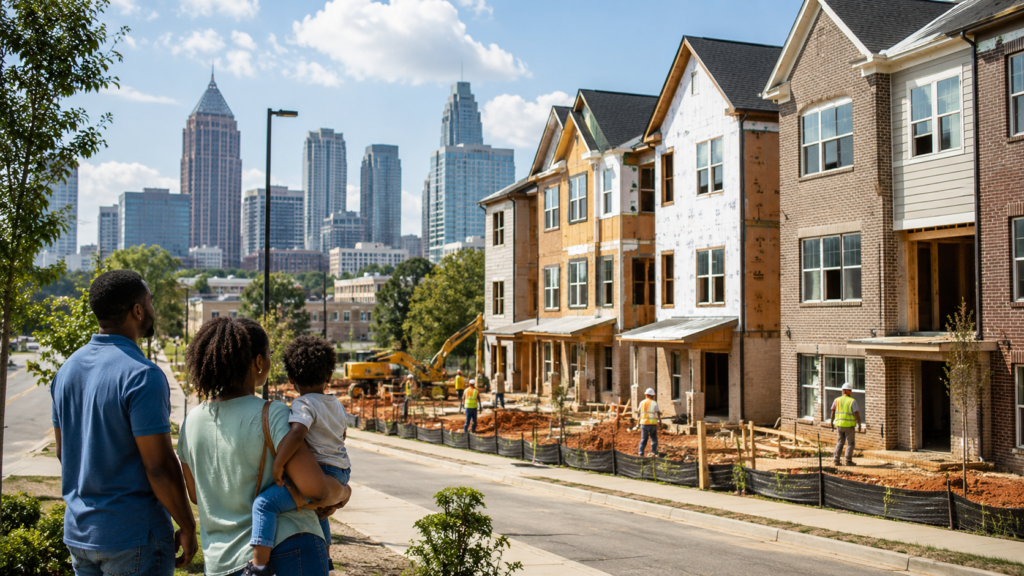
The federal package appears to focus heavily on supply and financing.
That includes efforts to reduce some regulatory barriers, support local planning, make certain housing finance tools easier to use, and expand pathways for homeownership and rental development. Housing industry groups have praised the bill because they see it as a way to lower friction in a system where building often takes too long and costs too much.
That does not mean the bill creates affordable homes automatically.
Federal housing legislation can provide incentives, funding structures and regulatory changes. But actual housing still has to be permitted, financed, built and connected to local infrastructure. In Georgia, those decisions often run through city councils, county commissions, zoning boards, development authorities and neighborhood politics.
This is where broad federal ambition meets local reality.
A bill passed in Washington may help unlock some tools. It does not decide whether a city allows duplexes, whether a county approves apartments near job centers, or whether infrastructure can support new housing at the pace employers need.
The Investor Question
One of the most closely watched parts of the national housing debate involves institutional investors and single-family homes.
In Georgia, that issue is not abstract. Metro Atlanta has been one of the major markets where large investors purchased single-family homes after the foreclosure crisis and during later rental-market growth. For families trying to buy entry-level homes, investor competition can matter because it affects both availability and price.
The new federal package includes provisions aimed at limiting the role of large investors in single-family housing under certain conditions. Supporters argue that could help protect buyers from being crowded out by firms with deeper pockets.
But here again, the effect may be limited.
Investor ownership is one piece of the affordability puzzle. It is not the whole puzzle. Even if investor activity slows, buyers still face high mortgage rates, elevated insurance costs, construction expenses and a shortage of lower-cost homes in many desirable areas.
That’s why the investor provision may be directionally meaningful without being decisive.
What It Means for Renters?
For renters, the bill’s impact is even less immediate.
Georgia renters are dealing with a mix of higher rents, limited supply near job centers and older affordable units that are at risk of being lost or redeveloped. In metro Atlanta, advocates have warned that preserving existing affordable housing may be just as important as building new units.
That distinction matters.
New construction often takes years. Preserving an existing apartment complex can protect affordability faster, especially for households already living near work, schools or transit. But preservation usually requires money, legal tools and coordination between public agencies, nonprofits and private owners.
The federal bill may support some of those efforts through financing and housing-credit provisions. But whether those tools reach the neighborhoods most under pressure in Georgia will depend on implementation.
A law can create a program. It cannot guarantee that the program reaches the families most at risk of displacement.
Why Local Rules Still Matter?

Housing policy is often national in debate but local in practice.
A federal bill can encourage more development. It can offer grants or financing reforms. It can push agencies to streamline processes. But it cannot, by itself, rewrite every local zoning rule or settle every neighborhood fight over density.
That matters in Georgia because local opposition can slow or shrink projects even when regional data shows a clear shortage.
Apartments may be needed, but opposed. Townhomes may be more affordable than detached homes, but still face resistance. Accessory dwelling units may help some homeowners and renters, but local governments vary in how easily they allow them.
This is why the housing shortage can persist even when nearly everyone says more housing is needed.
The system is not blocked in one place. It is blocked in many smaller places at once.
What Georgia Buyers Should Expect?
For families hoping the bill will quickly lower home prices, expectations should be cautious.
Housing affordability usually changes slowly unless the market experiences a major shock. More supply can help over time, especially if it is built near jobs and transportation. Better financing tools can help some buyers. Limits on investor purchases may reduce pressure in certain markets.
But none of those changes are likely to make homes suddenly affordable for families who are already stretched by high prices, interest rates and insurance costs.
The practical effect may be more visible over several years than over several months.
That does not make the bill meaningless. It simply means readers should be careful with the political framing. A major housing bill can be important without being a quick fix.
The Georgia Test
Georgia’s test will be whether federal tools align with local action.
If metro Atlanta and other fast-growing areas use new federal support to build and preserve homes at price points workers can afford, the bill could matter. If local governments continue to approve housing slowly or resist lower-cost forms of development, the effect will be weaker.
The same is true outside Atlanta.
Communities near job growth in manufacturing, logistics, health care and higher education are also facing pressure. Housing costs may not look the same in every county, but the pattern is familiar: jobs arrive, demand increases, and lower-cost housing becomes harder to find.
That is why Georgia’s housing problem is not only an Atlanta problem.
It is a growth-management problem.
The Bottom Line
Congress has passed a major housing package, and supporters say it could expand supply, improve financing and help families struggling with affordability.
For Georgia, the bill arrives at a moment when the need is clear. Metro Atlanta alone is projected to need hundreds of thousands of additional homes by 2035, including a large number at lower rent levels.
But the more accurate version is this: the bill may provide tools, not guarantees.
Georgia’s housing shortage will still depend on local decisions about zoning, permitting, infrastructure, preservation and development. It will also depend on whether public and private partners use federal support to build the kinds of homes families actually need.
The simplest version of the story is that Washington has acted on housing.
The more useful version is that Georgia now has to see whether that action can survive politics, reach local communities and turn into homes people can actually afford.