Aiman Tariq – Regional News Editor
Columbia, SC –
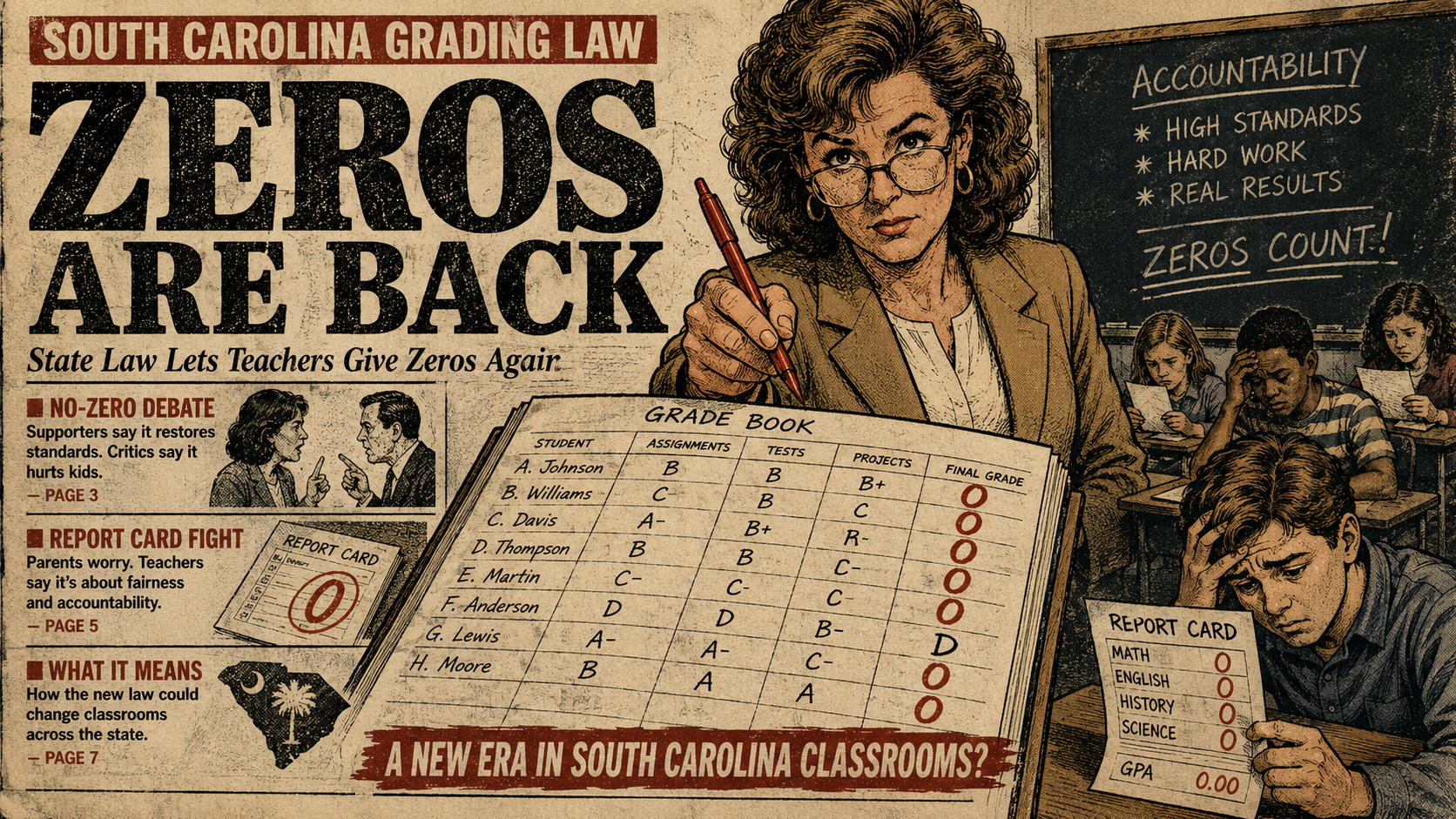
South Carolina has become the first state to formally restrict “no-zero” grading policies, giving teachers clearer authority to record the grade a student actually earns — including a zero when no work is submitted.
The new law took effect July 1, 2026, after Gov. Henry McMaster signed House Bill 5073 in May. It bars public school districts from requiring teachers to assign a minimum grade or score that exceeds a student’s actual performance on required assignments. Districts that violate the law can lose 10% of their State Aid to Classroom funding, according to the South Carolina General Assembly.
That is the simple version of the story.
The more complicated version is that South Carolina has not really solved the grading problem. It has taken a side in one part of it.
No-zero policies were adopted in many districts for a reason: on a traditional 100-point scale, one missing assignment can do far more damage than many parents realize. But critics of grade floors have a point, too. A 50 or 60 on work that was never submitted can make a report card look more honest than it really is.
That is why the new law is not just a fight over zeros. It is a fight over what grades are supposed to measure in the first place.
What South Carolina’s New Law Does?
Under H.5073, public school districts and public schools cannot adopt a grading system that requires teachers to give a minimum grade higher than what the student actually earned. The law also applies to charter schools.
That means if a student does not submit required work, a teacher cannot be forced by district policy to enter a 50, 60, or any other minimum score simply to keep the student mathematically closer to passing.
The law also changes how students can access credit recovery and content recovery. To be eligible, students must submit all required assignments for the course or relevant portion of the course in a way that follows district rules for timely submission.
That part matters. The law is not only about a zero on one assignment. It also reflects a broader concern among lawmakers and some educators that grading and recovery systems can sometimes make failure too easy to reverse without requiring the underlying work.
WRDW/WAGT reported in May that supporters described the change as a way to give parents a clearer picture of what students actually earned. The station also reported that schools continuing to use grade floors could lose 10% of state funding.
Why No-Zero Policies Became Popular?
No-zero grading did not appear out of nowhere.
The basic argument behind it is mathematical. On the 0-to-100 scale, a passing grade usually starts around 60. That means failure occupies 60 points, while all passing grades fit into the remaining 40.
A student who earns several strong grades and then takes one zero can see an average collapse quickly. In that sense, a zero is not just a low score. It can become a deep hole.
That is why some districts adopted grade floors. The idea was not always to reward missing work. In many cases, the goal was to keep students from giving up after one bad week, one missed assignment, or one family disruption.
Supporters of minimum grading argue that a 50 still counts as failure, but it leaves a student with some path to recovery. They also argue that teachers grade differently, and a floor can create more consistency across classrooms.
That is the strongest case for no-zero grading. It treats grades as a recovery system, not only as a record.
But it comes with a problem.
Why Critics Say Grade Floors Hide the Truth?
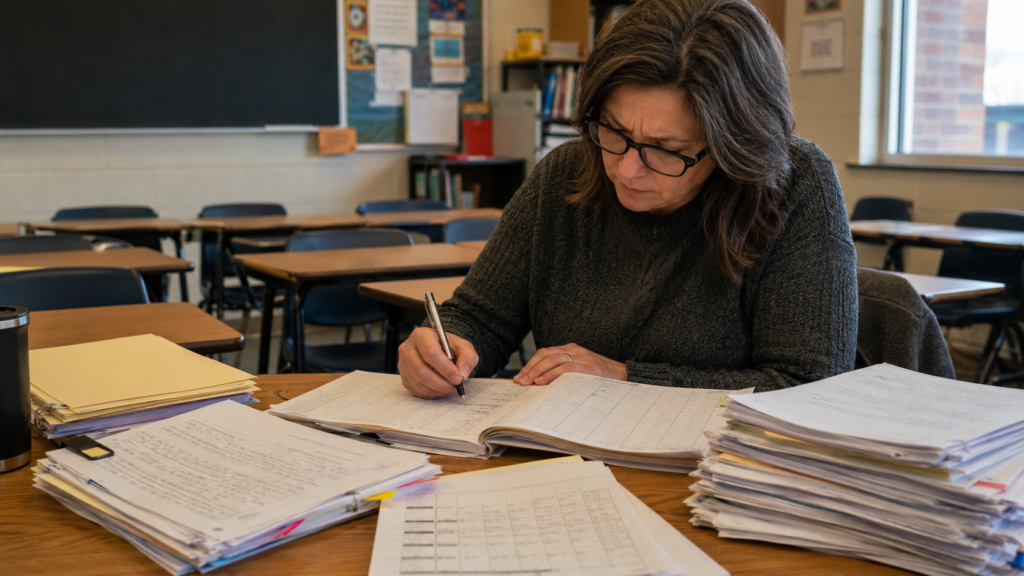
Critics see the same policy from a different angle.
If a student turns in no work and still receives 50 points, the grade no longer tells parents what happened. It may look like the student attempted the assignment and performed poorly. In reality, there may have been no submission at all.
That is not a small distinction.
A low score can mean a student tried and misunderstood the material. A missing assignment can mean something different: absence, disengagement, avoidance, family problems, confusion, or simply refusal to do the work.
Those situations may call for different responses. If the grade disguises them as the same thing, parents and teachers lose useful information.
This is where the South Carolina law lands hardest. It favors accuracy over cushioning.
But even that framing has limits. A zero may be accurate as a record of missing work. It may not be accurate as a measure of what the student knows.
That is the part the law does not fully settle.
The Deeper Problem With the 100-Point Scale
The bigger issue is the scale itself.
On a 100-point scale, a zero carries enormous weight. It is not just the lowest level of performance. It is a 60-point drop below the usual passing mark.
That can make the math of failure harsher than the reality of learning.
A student who earns 90, 90, 90, 90 and then one zero averages 72. The final grade says “C,” even though most of the submitted work showed strong performance.
That does not mean zeros should never exist. It means a single number may be trying to do too much.
Grades often combine several things at once:
- What a student learned.
- Whether the student completed the work.
- Whether the work was on time.
- How the teacher handles late assignments.
- Whether participation, behavior, or effort count.
Those are related, but they are not the same.
That is why the grading debate keeps coming back. The fight over zeros is visible. The deeper problem is that one final grade often tries to measure learning, work habits, compliance, and persistence all at once.
What Teachers Gain Under the New Rule?
For teachers, the law restores a measure of discretion.
A teacher who believes a missing assignment should be recorded as a zero now has stronger protection against a district policy requiring a higher minimum. That is likely to be welcomed by educators who felt grade floors made their records less honest.
Teachers have long complained that minimum-grade policies can weaken classroom accountability. If students know a missing assignment will still receive 50 points, some may treat the floor as a safety net rather than a warning sign.
That does not happen in every classroom. But it is a common concern.
The law also puts pressure on districts to explain recovery options more clearly. If a student must submit required assignments before entering credit recovery, schools will have to track missing work more carefully.
That could improve accountability.
It could also create new burdens for teachers, counselors, and administrators who already manage large caseloads and complicated student needs.
What Students Could Lose?
The risk is that some struggling students may fall faster.
That is the central concern from grading-reform advocates. A zero can make recovery mathematically difficult, especially for students already dealing with instability outside school.
A missing assignment is not always laziness. Sometimes it reflects transportation problems, caregiving responsibilities, illness, unstable housing, mental health concerns, or a lack of academic support.
A grading system that records zeros without strong intervention may identify failure more honestly, but still do little to prevent it.
That is why banning grade floors is not the same as building a better support system. It removes one controversial tool. It does not automatically replace it with tutoring, counseling, parent communication, attendance support, or better early-warning systems.
That distinction matters.
A Task Force Signals the Debate Is Not Finished

The law itself appears to recognize that the grading question goes beyond zeros.
H.5073 directs the State Board of Education to establish a task force before the 2026-2027 school year. The group is supposed to include superintendents, principals, teachers, school board representatives and high school students.
Its job is to evaluate possible revisions to the state’s Uniform Grading Policy, including how grades measure college and career readiness, how grade point averages reflect academic achievement, and whether the 100-point scale should be reconsidered.
That is a telling detail.
If the only issue were whether teachers can give zeros, the state would not need a broader grading task force. The task force suggests lawmakers know the grading system itself may need work.
The group must report findings before June 1, 2027, and districts are expected to implement any adopted updates by the 2028-2029 school year.
That timeline means the current law may be only the first step in a longer fight over grading.
What Grades Can and Cannot Tell Parents?
Grades are powerful because they look simple.
A 92 feels clear. A 50 feels clear. A zero feels clear.
But those numbers often hide the questions parents most need answered.
Did the student understand the material? Did the student turn in the work? Was the student absent? Did the student need extra time? Was the assignment missing because of behavior, confusion, or something happening outside school?
A single grade can point to a problem. It rarely explains the problem by itself.
That is why the most useful report cards may be the ones that separate academic performance from work habits. A student could receive one score for mastery and another for completion, effort, or timeliness.
That would give families more information, not less.
It would also make the zero debate less explosive. A missing assignment could be recorded honestly without necessarily pretending that it fully measures what the student knows.
The Bottom Line
South Carolina’s new law gives teachers the right to record grades that reflect actual performance, including zeros when students do not submit work.
That is a real shift, and it responds to a real concern: grade floors can make report cards less transparent.
But the law does not end the deeper grading debate.
No-zero policies can hide missing work. Zeros can distort averages. Both can mislead parents if schools do not explain what the grade actually represents.
The better question is not simply whether teachers should be allowed to give a zero. It is whether the grading system gives families a clear picture of learning, effort, and academic risk.
South Carolina has taken the first question off the table. The second one is still very much alive.
Follow us for updates on education policy across South Carolina and Georgia.