
Aiman Tariq – Regional News Editor
Atlanta, GA –
OpenAI’s planned $20 billion data center near Savannah was the project that grabbed the headlines. That was expected.
A project that large, tied to one of the most recognizable artificial intelligence companies in the world, was always going to dominate the public conversation. But the more important Georgia story may be broader than one company or one county.
According to reporting from The Atlanta Journal-Constitution, two other major data center projects filed key state paperwork the same day OpenAI’s Effingham County plan was announced: a proposed $13 billion data center campus in Lovejoy and a $1 billion expansion tied to Google’s campus in LaGrange.
That is why this is not just an OpenAI story. It is a Georgia infrastructure story.
The state is not seeing one large technology project. It is seeing a cluster of them — and clusters create different questions than single developments.
Three Projects, One Bigger Pattern
OpenAI’s Project Camellia is planned for Effingham County, near the Savannah Gateway Industrial Hub. OpenAI says the site is a long-term data center project supported by a power agreement with Georgia Power for 3.2 gigawatts of electricity, delivered in phases between 2028 and 2032.
The AJC reported that the project could involve a $20 billion investment near Georgia’s coast and may become one of the largest private development projects in state history. The company has said the project is expected to create hundreds of permanent jobs when it opens, with more positions projected by 2032.
But the same day, two other proposals were moving through the state’s development review process.
One is Stillwater Technology Park in Lovejoy, a small city in Clayton County. According to the AJC and Data Center Dynamics, Stillwater Development filed plans for a roughly 3.5 million-square-foot campus that could include up to 15 data center buildings and two on-site substations.
The other is a proposed $1 billion expansion to Google’s in-development data center campus in LaGrange. Data Center Dynamics reported that the filing describes a 470,000-square-foot building at 411 Pegasus Parkway, with construction potentially running until 2029.
That makes the timing difficult to ignore.
Why the Paperwork Matters?
The projects filed Development of Regional Impact, or DRI, paperwork.
That sounds procedural, and in one sense it is. But DRI filings matter because they are how large-scale projects enter a broader regional review process. Georgia’s Department of Community Affairs says the DRI process exists for developments that are large enough to potentially affect regional systems, neighboring governments, infrastructure and resources.
A DRI filing is not the same thing as a final approval. It does not settle whether a project should be built, how it will be powered, how much water it will use, or whether nearby communities will support it.
It is a starting point.
That distinction matters because data center proposals often arrive with large dollar figures and broad promises: jobs, investment, tax revenue, infrastructure upgrades, community benefits. Those may be real. But they do not answer the harder questions by themselves.
The harder questions are usually about power, water, land use, road capacity, tax incentives and who carries the risk if projections turn out to be too optimistic.
OpenAI’s Coastal Project Raises the Biggest Questions
OpenAI’s Effingham County proposal is the most visible because of its scale.
According to Reuters, Southern Company’s Georgia Power subsidiary signed a 25-year power supply agreement with OpenAI for the Effingham County project. Reuters also noted the broader issue surrounding artificial intelligence infrastructure: rapid growth in data centers is straining power grids and forcing utilities and technology companies to negotiate who bears the cost and risk.
CBS Atlanta reported that Georgia Power says OpenAI will pay the full cost of infrastructure and electric service needed for the project, meaning existing residential customers would not subsidize the facility under rules approved by the Georgia Public Service Commission in 2025. CBS also reported that OpenAI agreed to reduce its electricity use during periods of high demand through a demand response commitment.
That is an important claim. It is also one that residents and regulators will likely continue to scrutinize.
Power commitments on paper are one thing. Long-term grid impact is another. When a single facility is expected to use gigawatts of electricity, the public question is not only whether the company pays for its own service. It is whether the grid, the community and the region can absorb the cumulative demand of several large projects at once.
Water and Land Are Part of the Same Story?
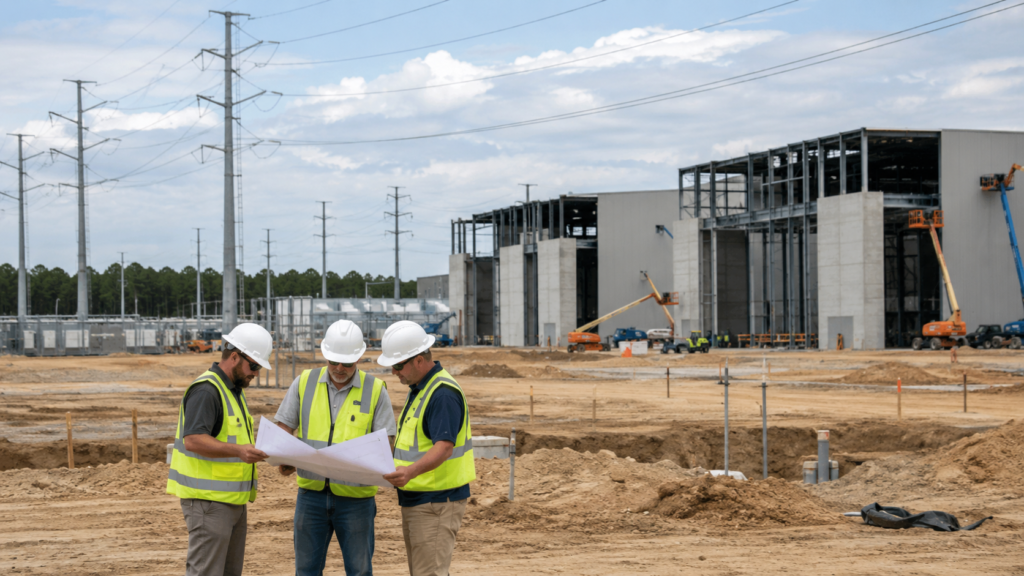
OpenAI has said its data center will use a closed-loop water system designed to recirculate water rather than continuously withdrawing and discharging it. CBS Atlanta reported that the company says ongoing water needs will mainly support workplace functions such as restrooms, kitchens and maintenance.
That may ease one concern. It does not eliminate the broader one.
Georgia Public Broadcasting reported that the Effingham site sits within five miles of the Savannah River and that the region is already seeing major water infrastructure development tied partly to large industrial users, including Hyundai’s Metaplant. GPB also reported that a $320 million water treatment facility is being developed to draw up to 24 million gallons per day from the Savannah River.
That does not mean OpenAI’s project will use that water at that scale. It means the area is already under pressure from overlapping industrial, power and infrastructure demands.
This is the difference between a project-level claim and a regional reality.
A single project may say its water use is limited. A region still has to consider what happens when industrial growth, data centers, power plants, warehouses, roads and new housing all arrive in the same corridor.
Lovejoy Adds Another Layer
The proposed Stillwater Technology Park in Lovejoy raises a different set of local questions.
According to Data Center Dynamics, the project could span about 400 acres at 11760 Panhandle Road and total 3.465 million square feet at full build-out. The report says Central Georgia EMC could provide a grid connection of up to 1.25 gigawatts, with a first phase possibly completed by 2031.
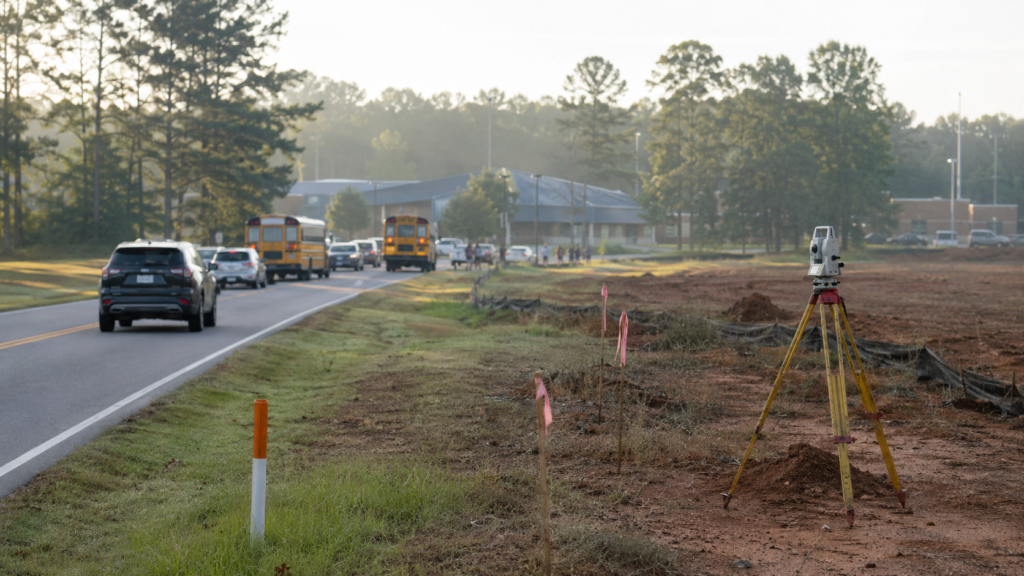
The AJC reported that the proposed site is across the street from Michelle Obama STEM Elementary Academy and Eddie White Middle Academy. According to the AJC, Lovejoy Mayor Marci Fluellyn wrote in the DRI submission that additional traffic “will cause considerable impact and delays for regular traffic, school buses, and parents dropping children off at school.”
That kind of concern is not a small detail.
Data centers are often described as low-traffic uses once operational. But construction traffic, road changes, school access and utility work can still matter, especially when a large project is near schools or residential areas.
This is why local review is not just bureaucracy. It is where broad economic development language meets daily life.
Google’s LaGrange Expansion Looks Quieter — But Still Matters
Google’s LaGrange project has drawn less controversy, at least so far.
That may be partly because Google already has a visible data center presence in Georgia. On its own data center location page, Google says it has invested more than $3 billion in Georgia since establishing its first data center in the state and notes operations in Douglas County and LaGrange.
The new LaGrange filing, according to Data Center Dynamics, would add a second building to an in-development campus and is valued at $1 billion.
That is smaller than OpenAI’s plan and smaller than Stillwater’s proposed campus. But in most local economies, a $1 billion industrial expansion would still be a headline project.
The fact that it can be overshadowed tells readers something about the scale of Georgia’s data center boom.
The Tracking Problem
One of the most useful points in the AJC’s reporting is not just that projects are large. It is that they are moving quickly.
The AJC reported that metro Atlanta has become one of the world’s largest data center hubs and that Georgia’s data center market has been expanding so fast that even recent studies can become outdated quickly.
That is the tracking problem.
Large developments usually move through public meetings, planning documents, utility filings and local approvals. But data centers can involve multiple layers: land acquisition, tax incentives, power agreements, water commitments, shell companies, DRI paperwork and construction phasing.
By the time the public understands one project, three more may already be in the pipeline.
That does not mean every proposal is bad. It means the information environment is difficult for residents to follow, especially when companies and local governments release details in pieces.
What Georgia Communities Are Really Being Asked to Decide?
The data center boom is often framed as a choice between economic growth and opposition to technology.
That frame is too simple.
The better question is what kind of growth Georgia is getting, where it is being placed, what it consumes, and how transparent the public process is before commitments are made.
Supporters point to tax revenue, construction jobs, permanent tech jobs, school funding and long-term investment. Those benefits can be significant, especially for counties trying to expand their tax base.
Critics point to power demand, water concerns, land conversion, tax abatements, limited permanent employment compared with project size, and the possibility that local residents learn too late to meaningfully shape the outcome.
Both sets of questions belong in the public record.
The issue is not whether Georgia should reject data centers outright. The issue is whether the state is building a system that can evaluate them honestly before the next major filing appears.
The Bottom Line
OpenAI’s $20 billion Effingham County project is the headline-grabber. It probably will remain that way.
But the same week also brought movement on a proposed $13 billion Stillwater campus in Lovejoy and a $1 billion Google expansion in LaGrange. Together, those filings suggest Georgia’s data center boom is no longer concentrated in one corridor or one company.
The simple version is that Georgia is becoming a major hub for artificial intelligence and cloud infrastructure.
The more accurate version is that Georgia is being asked to absorb a wave of power-heavy, land-heavy development faster than many communities can fully evaluate it.
For now, the projects remain at different stages. OpenAI has made public commitments. Stillwater has filed plans. Google is expanding a campus it already has in motion.
What happens next will determine whether Georgia treats these projects as isolated wins — or as part of a larger infrastructure shift that needs more public scrutiny, not less.
Follow us for updates on this developing story and more Georgia business coverage.