Aiman Tariq – Regional News Editor
Atlanta, GA –
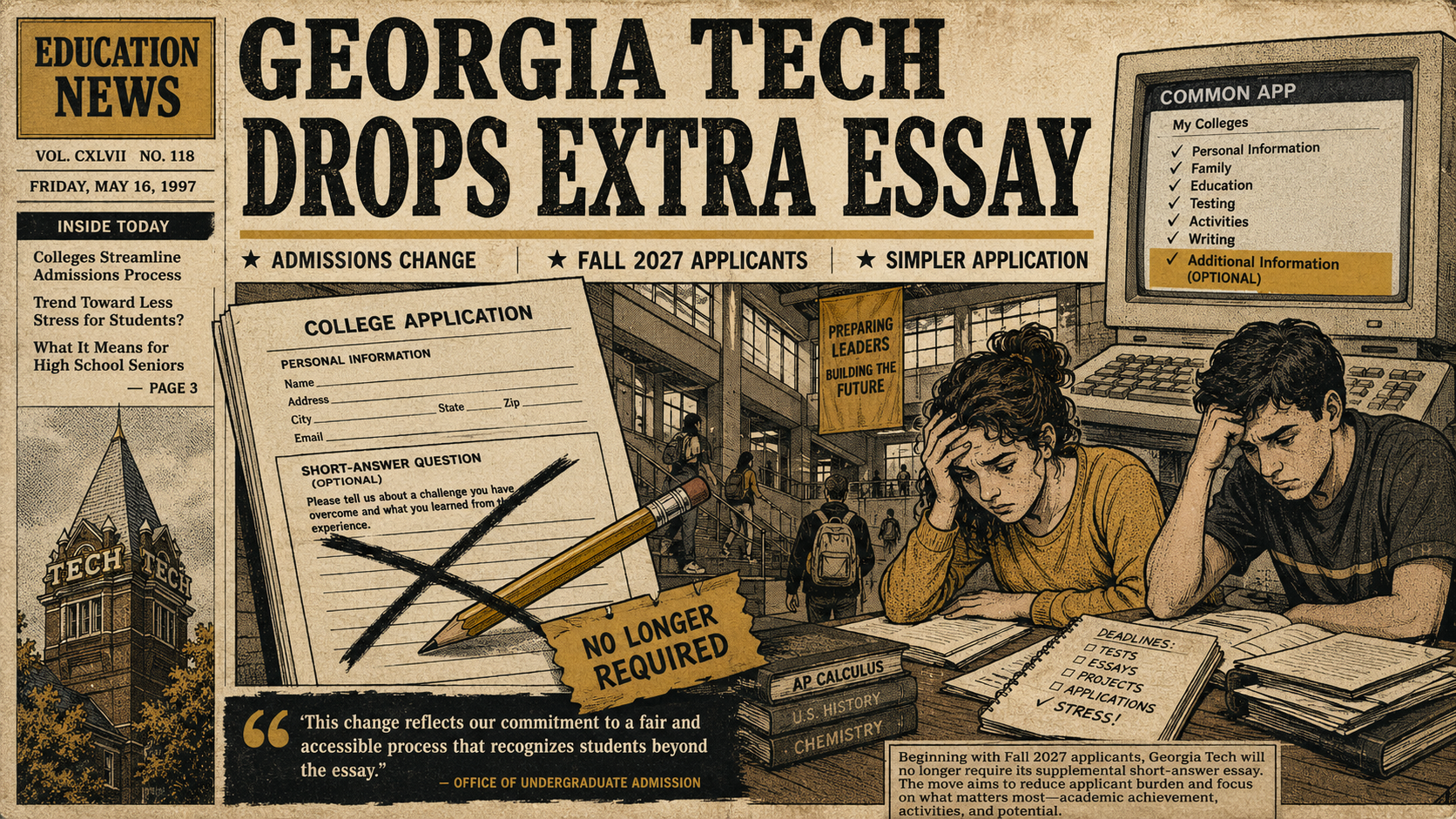
Georgia Tech is removing one piece of its first-year undergraduate application, a change school officials say is meant to make applying less complicated without making admission less selective.
Beginning with the 2026–27 application cycle, first-year applicants will no longer be required to answer Georgia Tech’s school-specific short-answer question. Students will still have to complete the Common App personal essay, along with the rest of the required application materials.
That makes this a simple change on paper, but not necessarily a small one.
For high school seniors building college lists, one fewer supplemental essay can mean one fewer late-night draft, one fewer school-specific explanation, and one fewer reason to skip an application altogether. For Georgia Tech, it also raises the same question facing other selective public universities: if an extra essay no longer adds much to the review process, why keep asking for it?
What Georgia Tech Is Changing?
According to Georgia Tech’s Office of Undergraduate Admission, the school will no longer require the Georgia Tech short-answer question for first-year undergraduate applicants beginning with the 2026–27 cycle.
The change applies to first-year admission. It does not remove the Common App personal essay, which remains part of the Common Application. Common App announced earlier this year that its 2026–27 personal essay prompts would remain the same.
That distinction matters. Georgia Tech is not dropping written reflection altogether. It is dropping its additional school-specific prompt.
For the prior application cycle, Georgia Tech’s admissions site described two required writing pieces: the Common App personal essay and a Georgia Tech short-answer question asking why students wanted to study their chosen major at Georgia Tech.
Now, school officials say that extra response is no longer doing enough work in the review process to justify the added complexity.
Why Officials Say the Essay Is Going Away?
Georgia Tech officials framed the change as an access and clarity move.
Mary Tipton Woolley, executive director of Undergraduate Admission, said in the school’s announcement that applying to college can be demanding and that the admissions office wanted to simplify the process where it could.
She also said the short-answer question was no longer a meaningful differentiator in admission decisions.
That is the key phrase.
In selective admission, almost every added requirement is supposed to help separate one applicant from another. If an essay becomes too repetitive, too generic, or too difficult to evaluate consistently, it can start to look less like a useful signal and more like another hurdle.
Georgia Tech’s position appears to be that removing the prompt makes the process less complex, not less serious.
What Applicants Still Have to Submit?
The application itself is not becoming automatic or light.
Georgia Tech says it uses the Common App for first-year admission. Its current first-year deadline page lists a complete application as including the Common Application, transcripts with required high school coursework and visible grades, self-reported or official SAT/ACT scores, and any additional documents requested through the applicant portal.
The school’s announcement also says students may still submit letters of recommendation from a counselor and teacher.
That means the review will still rest heavily on academic preparation, course selection, grades, test scores, activities, community contribution, and the personal essay.
The removed essay was only one piece.
That may be reassuring for students who worried the short answer was another test of whether they could decode what Georgia Tech wanted to hear. It may be less reassuring for students who liked the extra space to explain why Tech, why their major, or why their background fit the school.
Both reactions can be true at once.
Why This Could Help Some Students?

The strongest case for removing the supplemental essay is straightforward: applying to college has become complicated enough.
Students applying to several selective schools often face a long list of custom prompts. Some ask why a student wants a specific major. Others ask about identity, leadership, community, intellectual curiosity, or values. For students with access to private counseling, editing help, or experienced school advisers, that workload can be managed more easily.
For students without that support, each extra prompt can become a barrier.
That does not mean essays are unfair by definition. Many students use them well. But an additional writing requirement can widen the gap between students who have help navigating the process and students who are trying to figure it out on their own.
Georgia Tech’s announcement places the change in that access frame. Officials say the goal is to make applying for admission, financial aid, and scholarships more straightforward for students from Georgia and beyond.
That is the cleanest argument for the decision: if the prompt is no longer helping the school make better decisions, removing it may help students more than it hurts the review.
Why It May Not Make Admission Easier?
There is another side to this, and it is important not to oversell the change.
A simpler application does not necessarily mean an easier admission decision.
Georgia Tech remains a highly competitive public research university. The school said nearly 68,000 students applied for first-year admission last year, a record total. Its admitted students came from 136 Georgia counties, all 50 states, Washington, D.C., Puerto Rico, and 97 nations, according to the announcement.
If removing a supplemental essay encourages more students to apply, the applicant pool could become larger, not smaller.
That is one reason this trend can be complicated. A college can reduce friction for applicants while also increasing the number of applications it receives. In practice, that can make admission feel even more competitive.
A recent Wall Street Journal report described a broader movement among selective colleges to reduce supplemental essay requirements. Schools told the newspaper they were trying to reduce stress and respond to the growing challenge of AI-assisted writing, while some admissions consultants warned that fewer essays can encourage more applications and potentially make selectivity even sharper.
That is why the Georgia Tech change should be read carefully. It reduces one task. It does not reduce the competition.
The AI Question Is Hard to Ignore
Georgia Tech’s announcement focuses on access, clarity, and usefulness in review.
But the wider admissions world is also wrestling with another problem: whether supplemental essays still reveal what they used to reveal.
Generative AI has made it easier for students to produce polished drafts quickly. That does not mean every essay is artificial, and it does not mean writing should disappear from admissions. But it does make the old logic of school-specific essays more difficult.
If a short answer is supposed to show authentic fit, sincere interest, or a student’s own voice, colleges now have to ask whether that signal is still reliable.
This is not just a Georgia Tech problem. It is a higher education problem.
The Common App personal essay remains, and students will still have writing space. But by removing a shorter school-specific response, Georgia Tech is reducing the number of places where applicants may feel pressure to produce a highly polished, institution-specific answer.
That may make the process cleaner.
It may also make other parts of the application matter more.
Holistic Review Still Carries the Weight

Georgia Tech says it will continue using a holistic review process.
That means admissions staff will still consider more than one number or document. According to the school’s announcement, factors will include academic preparation, student engagement in school communities, and potential fit with Georgia Tech.
The current admissions site also points applicants toward areas such as academic preparation, contribution to community, major selection, recommendations, standardized tests, and personal essays as parts of the first-year process.
The question is not whether Georgia Tech will still read applications closely. The question is what information will now carry more weight when one writing sample disappears.
Academic record is likely to remain central. Test scores remain part of the complete application. Activities and community contribution may become more important for showing who a student is outside the classroom. Recommendation letters may also matter more for applicants whose stories are not fully visible through grades and scores.
That is not necessarily good or bad. It just shifts the burden.
What Students Should Do Now?
The first-year application for Fall 2027 opens Aug. 1 through the Common App, according to Georgia Tech’s deadline page. Early Action 1 applications are due Oct. 15 for Georgia students, Early Action 2 applications are due Nov. 2 for non-Georgia students, and Regular Decision applications are due Jan. 6.
For students, the practical advice is not complicated.
They should not treat the removal of the supplemental essay as a reason to rush the rest of the application.
Instead, the missing prompt makes the remaining pieces more important:
- The Common App personal essay needs to be clear and specific.
- The activities section should explain real involvement, not just list titles.
- Students should make sure transcripts and test scores are submitted by the right deadlines.
- Recommendation letters, if used, should come from people who can add context rather than repeat the resume.
- Applicants should still understand why Georgia Tech fits their academic interests, even if they no longer have to write a short answer about it.
That last point matters. A school can remove a “Why Tech?” prompt, but students still need a reason for applying.
What This Means for Georgia Families?
For Georgia families, the change may be especially relevant because Georgia Tech’s Early Action 1 plan is reserved for Georgia students and residents attending high school in the state or living outside the state.
A shorter application could help students who might otherwise decide that Georgia Tech feels too intimidating, too time-consuming, or too hard to approach.
That is probably part of the point.
Georgia Tech is trying to expand access while still enrolling students who can handle the academic demands of the institution. Removing one essay does not solve every barrier in college admissions. It does not fix uneven counseling access, test preparation gaps, family income differences, or uncertainty around financial aid.
But it does remove one small piece of friction.
In a process where friction adds up quickly, that still matters.
The Bottom Line
Georgia Tech is removing its school-specific supplemental essay for first-year applicants beginning with the 2026–27 application cycle.
The Common App personal essay remains, and students will still need transcripts, test scores, activities, and any required supporting documents.
The simplest version of the story is that Georgia Tech is making its application shorter.
The more complete version is that the school is responding to a broader admissions reality: extra essays can add stress, may not always help decision-making, and may be less useful in an era when AI tools can polish student writing quickly.
That does not mean admission to Georgia Tech is getting easier.
It means the application may become less complicated, while the competition remains very real.
For students and families, the message is practical: one essay is gone, but the rest of the application now has to carry the story.
Follow us for updates on Georgia education, college admissions, and regional higher education news.